
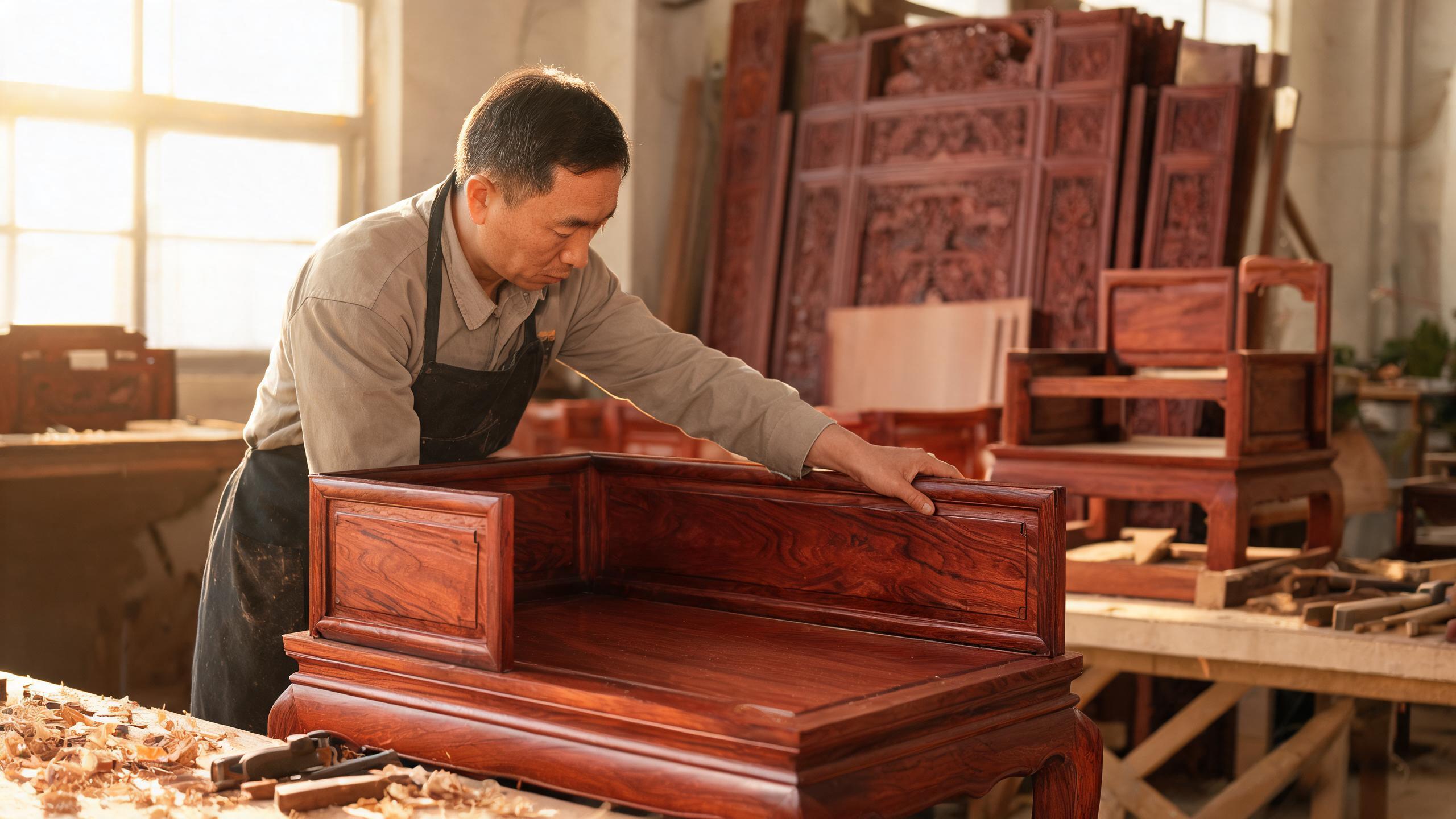
دليل عملي للمشترين في قطاع B2B حول كيفية ضمان مصنع أثاث خشب الورد ثبات لون الخشب وتطابق العروق عبر طلب حاوية كامل — ويغطي توريد الأخشاب، والتجفيف بالفرن، وتدريج الألواح، ومطابقة العروق، والتشطيب، والفحص قبل الشحن.
Why Consistent Wood Color and Grain Matter More Than You Think
When a B2B buyer places a full-container order for classical rosewood furniture, the single most common source of post-delivery disappointment is not a cracked joint or a loose drawer. It is the visible mismatch in wood color and grain between pieces that were supposed to belong to the same set, or between sets that were supposed to match across a whole shipment. A sofa that is a deep, even red-brown and a tea table that arrives noticeably lighter or with a different figure can make an entire room look uncoordinated, and for a hotel, villa, or showroom buyer, that is a costly problem to explain to an end client.
This article explains, from the perspective of a real rosewood furniture factory, exactly how a manufacturer controls wood color and grain matching across a full container order. It is written for importers, wholesalers, hotel and resort project buyers, and interior designers who need to know what questions to ask a supplier and what factory processes separate a reliable partner from one that ships mismatched goods. We will walk through timber sourcing, kiln drying, board grading, color matching during production, finishing, pre-shipment inspection, and the documentation that supports a consistent result.
Yunxiao Rosewood Furniture Co., Ltd, founded in 2008, operates a 12,000-square-metre factory in Xianyou County, Putian City, Fujian Province — the traditional hometown of Chinese hardwood craft. The company manufactures and exports full sets of classical solid redwood furniture for wholesalers, hotels, and designers across Europe, North America, Australia, and Southeast Asia. Everything described in this article reflects the actual manufacturing and quality-control practices of a factory that ships carved sofas, dining sets, and bedroom suites to overseas markets every week.
Why This Matters Differently for Each Type of Buyer
Color and grain consistency is not a single problem with a single answer. It matters in different ways depending on who is buying and how the furniture will be used. Understanding your own stakes helps you ask the right questions.
Wholesalers and Distributors
A wholesaler buys in volume and resells to retailers or smaller dealers. For a wholesaler, color consistency across a container matters because mismatched pieces are hard to sell and may be returned. A distributor who receives a sofa set where the tea table does not match the sofa faces the cost of holding inventory, discounting, or shipping a replacement. Consistent color protects margin and reputation.
Hotel and Resort Project Buyers
Hospitality buyers purchase furniture for lobbies, suites, restaurants, and villas. In a hotel, furniture is part of the brand experience, and guests notice when a room looks coordinated or when it does not. A hotel buyer ordering fifty matching dining sets or a lobby full of carved sofas needs every piece to read as one design. Mismatched color in a public space is a visible quality failure that reflects on the property.
Interior Designers and Architects
Designers specify furniture to a precise aesthetic. They often work from a sample or a colour reference and expect the delivered pieces to match it. For a designer, the ability of a factory to reproduce a finished colour and grain across a whole order is what makes a project repeatable and profitable. A designer who cannot trust a factory's colour consistency will not reorder.
Residential and Villa Buyers
Individual villa owners and their procurement agents buy complete sets for a single home. Because all the furniture sits in one space, the need for matching is absolute. A bedroom suite where the wardrobe is a different tone from the bed is immediately noticeable in a private home.
Across all these buyer types, the underlying need is the same: the furniture must look like a coordinated, intentional whole. The factory process that delivers this is what this article describes.
What "Color and Grain Matching" Actually Means for a Container Order
Before we go into the factory floor, it helps to define the problem precisely. Rosewood is a natural material. No two boards are identical, and even two boards cut from the same log can differ in tone, figure, and the direction of the grain. When a buyer orders a six-piece sofa set or a ten-seat dining set, every visible surface across all the pieces needs to read as one coordinated whole. When a buyer orders several sets in one container, the sets should also be close enough in tone that they can be placed in the same room or project without an obvious jump in color.
There are three distinct dimensions to this requirement:
- Color tone: the overall lightness or darkness of the wood, from a lighter honey-red to a deep, almost black-red. Tone is influenced by the species, the age of the timber, the part of the log, and the finish applied.
- Grain figure: the pattern of the wood fibres — straight, wavy, curly, or with pronounced cathedrals. Some buyers want a uniform, quiet grain; others want a bold, dramatic figure. Either way, the figure should be consistent within a set.
- Surface continuity: how adjacent boards on a tabletop or a cabinet front blend together. A well-matched top uses boards that are similar in tone and grain so the seams are barely visible.
For a factory, achieving this consistency is not a matter of luck. It is a deliberate sequence of decisions made at every stage, starting long before a single board is cut.
Stage One: Timber Sourcing Sets the Ceiling for Consistency
Color and grain matching begin with the raw material. A factory cannot match boards that were never similar to begin with. This is why sourcing discipline is the first and most important control point.
Yunxiao works with legally certified Machilus Nanmu, aged red wood, and Grade-A tropical hardwood, and the company's carved sofa and dining collections are built primarily from Siamese rosewood, the species botanically known as Dalbergia cochinchinensis. Siamese rosewood is prized for its dense, deep-red heartwood, its fine and often beautifully figured grain, and its stability once properly dried. Its Janka hardness is approximately 2,430 pounds-force (10,790 newtons), which makes it a genuinely hard, durable furniture wood — but also a wood that must be handled with care during drying and machining.
For a factory that wants consistent color across a container, the key sourcing decisions are:
- Buying from consistent sources: timber from the same region and similar growing conditions tends to be more uniform in tone than timber bought opportunistically from many different suppliers.
- Buying in volume for a single project: when a factory knows it needs to produce, say, twenty matching dining sets, it can purchase enough boards from the same batch to keep the tone consistent across the whole run.
- Rejecting unsuitable stock early: boards with excessive sapwood, heavy mineral streaks, or wildly divergent color are set aside for other uses rather than mixed into a matched set.
The practical consequence for a buyer is simple: a factory that can show you how it sources and batches its timber is far more likely to deliver a consistent container than one that buys whatever is available on the day. When you audit a supplier, ask to see how they group timber for a large order and whether they reserve boards from a single batch for matched sets.
Stage Two: Kiln Drying and Moisture Control Protect Color Stability
Moisture is the enemy of color stability. Wood that is not dried to the correct moisture content will continue to move after it is made into furniture, and that movement shows up as cracking, warping, and — critically for this discussion — uneven color development as the finish ages.
Yunxiao subjects every product to a 36-day constant-humidity drying cycle before the wood is used in furniture. This is not a quick kiln pass; it is a controlled process that brings the timber to a stable moisture content appropriate for the climates where the furniture will be shipped. The reason this matters for color is that wood that is still releasing moisture when it is finished will change tone unevenly. A properly dried board holds its color consistently, and the finish — whether a raw lacquer or a beeswax treatment — develops evenly across the surface.
For overseas buyers, the drying process also protects against the classic failure mode of rosewood furniture: cracking in a dry, air-conditioned hotel lobby or a heated North American home. A factory that dries to a stable equilibrium moisture content and then lets the wood rest before machining is building color consistency and structural stability at the same time.
When you evaluate a supplier, ask about the drying schedule. A vague answer such as "we dry the wood" tells you little. A specific answer — the number of days, the target moisture content, and how the wood is conditioned after drying — tells you the factory treats moisture control as a real process rather than a checkbox.
Stage Three: Board Grading and Selection Before Machining
Once the timber is dried, the next control point is grading and selection. This is where the factory decides which boards will be used for which parts of a matched set.
In a well-run rosewood factory, the grading step works roughly like this:
- Face-grade boards with the most uniform color and the cleanest grain are reserved for the most visible surfaces — tabletops, sofa fronts, cabinet doors, and bed headboards.
- Secondary boards are used for less visible structural parts such as rails, stretchers, and internal framing, where slight variation does not affect the look of the finished piece.
- Boards are grouped by tone into batches so that all the face boards for one set come from the same tonal group.
This is the heart of color matching. A factory that simply cuts boards in the order they come off the stack will produce a set with obvious tonal jumps. A factory that deliberately groups boards by tone before machining will produce a set that reads as one coordinated piece.
For a buyer, the visible proof of good grading is in the finished product: run your eye across a tabletop and check whether the boards blend together or whether you can see clear seams between lighter and darker sections. On a well-matched top, the seams are subtle and the overall surface looks like one continuous piece of wood.
Stage Four: Grain Matching During Assembly
Grain matching is a craft skill that goes beyond simple color grading. It is the practice of arranging boards so that the grain pattern flows naturally across a surface, and so that matching components — the two sides of a cabinet, the panels of a bed headboard, the leaves of a dining table — mirror or complement each other.
In classical Chinese furniture, this is taken seriously. A master carver and joiner will look at how the figure of the wood runs and will orient boards so that the pattern is pleasing and consistent. For example, on a four-poster bed, the two headboard panels should be cut from boards with similar figure so they read as a pair. On a dining table, the top boards are arranged so the grain runs in a consistent direction and the seams are minimized.
This is also where the mortise-and-tenon joinery that defines classical rosewood furniture comes into play. Because Yunxiao assembles furniture without metal nails — using traditional mortise-and-tenon joints with wooden dowels — the factory can fit boards precisely and control how the grain lines up at every joint. Nailed or stapled construction forces compromises in how boards are joined; joinery-based construction lets the craftsman match grain properly.
The result is furniture that not only matches in color but also looks intentional in its grain. For a hotel or villa project, where every piece is on display, this level of care is what separates a premium supplier from a commodity one.
Stage Five: Finishing and How It Affects Final Color
The finish is the last thing that determines the color a buyer sees, and it is a major control point. Two identical boards can look completely different depending on how they are finished.
Yunxiao uses eco-friendly beeswax and lacquer finishing that meets EU REACH and US CARB standards. The finishing process is applied in multiple coats, hand-rubbed so that each coat cures evenly. The choice of finish — a raw lacquer that lets the natural red of the rosewood show through, versus a heavier opaque finish — dramatically affects the final tone.
For color consistency across a container, the finishing process must be uniform. This means:
- Consistent application: the same number of coats, the same drying time between coats, and the same rubbing technique across every piece in a set.
- Consistent environment: finishing in a controlled humidity and temperature environment so the lacquer cures at the same rate on every piece.
- Final tone check: a visual comparison of finished pieces against a reference sample before they are approved for packing.
For buyers, this is why a physical or photographic sample is so valuable. A factory that can match the finished production to an approved sample is demonstrating that its finishing process is repeatable. When you order, ask for a finished sample and then compare the production pieces against it — not just the wood, but the final color after finishing.
Stage Six: Pre-Shipment Inspection for Color and Grain
Before any container is packed, a responsible factory runs a final inspection that includes a color and grain check across the whole order. This is not the same as a structural quality check, although both happen. The color check is a visual pass where an inspector lays out the pieces of each set and confirms that they match, and then compares sets against each other to confirm the container reads as one coordinated shipment.
At Yunxiao, this inspection is part of the broader quality-control discipline that the company applies to every B2B order. The factory's internal team prepares full export documentation, including FSC certificates and ISPM 15 heat-treated packaging, and the pre-shipment check is the last gate before goods leave the floor.
What a buyer should look for in this stage:
- Set-level matching: every piece in a sofa, dining, or bedroom set matches its companions.
- Container-level consistency: multiple sets in one shipment are close enough in tone to be used together.
- Documented inspection: the factory can provide photos or a report of the finished pieces before packing.
Many experienced importers ask for pre-shipment photos of the actual finished pieces, not just the product catalogue images. This is a reasonable and effective request, and a factory confident in its color matching will be happy to provide it.
Understanding Rosewood Species and Their Natural Color Range
Part of managing buyer expectations is understanding that different rosewood species naturally have different color ranges. A factory cannot make one species look exactly like another, and a buyer who understands this can specify more accurately.
| Timber | Typical Heartwood Color | Grain Character | Best Use in Furniture |
|---|---|---|---|
| Siamese Rosewood (Dalbergia cochinchinensis) | Deep red to dark red-brown, darkening with age | Fine, often figured, can be wavy or curly | Carved sofas, dining sets, bedroom suites, tea tables |
| Machilus Nanmu | Golden to warm brown, sometimes with darker streaks | Straight to mildly figured, soft lustre | Classical cabinets, display pieces, panels |
| Aged Red Wood | Rich red-brown, deepens over time | Straight to moderately figured | Structural frames, dining and bedroom furniture |
| Grade-A Tropical Hardwood | Medium brown to red-brown | Variable, generally straight | Supporting and secondary components |
This table is a general guide, not a guarantee of a single tone. Within any species, individual boards vary. The point is that a buyer should specify the species and the desired tone, and should confirm the expected range with the factory before production. A factory that is transparent about the natural variation of the species it uses is more trustworthy than one that promises an impossible uniformity.
How to Write a Color-Matching Specification Into Your Purchase Order
One of the most effective things a B2B buyer can do is put the color-matching requirement in writing. A verbal expectation is easy to miss; a written specification is a reference point for both sides.
A practical color-matching specification should include:
- An approved reference: a finished sample, a physical colour chip, or a set of approved photographs taken in consistent lighting. This becomes the benchmark for the whole order.
- A stated tolerance: for example, "all pieces in a set must match the approved sample within a clearly visible, acceptable range when viewed together in normal room lighting."
- A set-level requirement: "every piece in each sofa, dining, or bedroom set must be matched to its companions."
- A container-level requirement: "multiple sets in one shipment must be close enough in tone to be used in the same room."
- A pre-shipment check: "the factory will provide photographs of the finished pieces, laid out by set, before packing."
- A remedy clause: "any piece that does not match the approved reference will be corrected or replaced before shipment."
Putting these points in the purchase order does two things. It forces the factory to plan for matching from the start, and it gives you a clear basis for resolution if a problem arises. A factory that is confident in its process will accept such a specification readily; one that is not may resist it.
Common Color-Matching Failures and How to Prevent Them
Knowing what can go wrong helps you prevent it. Here are the most common color-matching failures in rosewood furniture orders and how a disciplined factory avoids them.
Mismatch Between the Sofa and Its Accompanying Tea Table
Because a carved sofa and its tea table are often produced from different board batches, they can drift in tone. Prevention: the factory reserves boards from the same tonal batch for the sofa and its matching tea table, and checks them together before finishing.
Visible Seams on a Tabletop
When the boards of a tabletop are not graded and matched, the seams between them are obvious. Prevention: face-grade boards are selected for the top, arranged so the grain flows, and checked so the seams are subtle.
Color Drift Across Multiple Sets in One Container
When a factory produces several sets over several weeks, later sets can drift from earlier ones. Prevention: the factory keeps a reference sample and re-checks each set against it, rather than matching each set only to the one before it.
Finish-Related Tone Differences
Two pieces finished on different days or in different conditions can cure to slightly different tones. Prevention: finishing is done in a controlled environment with a consistent number of coats and drying times, and finished pieces are compared against the reference.
Age-Related Darkening
Rosewood naturally darkens with exposure to light and air. This is not a defect, but it can surprise a buyer who expects the exact tone of the sample years later. Prevention: the factory explains this natural ageing to the buyer and confirms the expected long-term behaviour.
By understanding these failure modes, a buyer can ask targeted questions and a factory can build the right controls into its process.
The Role of Hand Carving in How Color Is Perceived
Hand carving affects color perception in a way that many buyers do not anticipate. A deeply carved surface catches light differently than a flat surface, and the shadows created by carving can make the wood appear darker or richer in some areas. This means that a heavily carved piece — such as a dragon-carved sofa or a phoenix-carved reception set — can look different from a plainer piece even when the wood is identical.
For a factory, this is a matching consideration. When a carved sofa is paired with a tea table, the factory must account for how the carving changes the perceived tone of each piece. A tea table with a carved apron and a sofa with a deeply carved backrest may need to be matched with this in mind, so that the finished pair reads as one design rather than two pieces that happen to be the same wood.
Yunxiao's master artisans hand-chisel dragon, cloud, and lattice motifs into solid rosewood using traditional tools and generations-old regional methods. This hand carving is part of what makes the furniture distinctive, and it is also part of why color matching requires skill. A factory that understands how carving affects light and tone will produce a more cohesive set than one that treats carving and colour as separate concerns.
Climate, Target Markets, and Color Stability Over Time
Rosewood furniture is shipped to very different climates, and the way the wood and finish behave over time depends on where the furniture ends up. A factory that exports to Europe, North America, Australia, and Southeast Asia must account for this range.
In a dry, heated North American home or an air-conditioned hotel lobby, the air can pull moisture out of the wood. If the wood was not dried to a stable equilibrium moisture content, it can crack and the finish can develop unevenly, which changes the perceived color. In a humid Southeast Asian climate, the wood can absorb moisture and swell, which can also affect the finish and the fit of joints.
This is why the 36-day constant-humidity drying cycle at Yunxiao matters beyond the factory floor. By bringing the timber to a stable moisture content before it is made into furniture, the factory reduces the risk of post-delivery movement that would otherwise show up as cracking, warping, and uneven color. The furniture is built to hold its color and structure in the climates where it will actually be used.
For a buyer, the practical point is to tell the factory where the furniture will be used and to confirm that the drying and finishing are appropriate for that climate. A factory that asks about your destination market is thinking about long-term performance, not just the immediate sale.
OEM and ODM Custom Matching
Many B2B buyers order custom furniture through OEM or ODM arrangements — their own designs, sizes, or branding, manufactured by the factory. Custom orders raise the stakes for color matching, because the buyer may be matching new pieces to existing furniture, or may need a specific tone for a branded collection.
Yunxiao supports flexible OEM and ODM custom sizes and patterns for villas and resorts. For a custom order, the color-matching process starts with a clear reference: a sample, a colour chip, or an existing piece the buyer wants to match. The factory then sources and batches timber to hit that reference, and confirms the finished tone before production.
For a buyer planning a custom order, the advice is to lock the colour reference early and to order a finished sample before committing to volume. Custom work is where the cost of a colour mismatch is highest, because the pieces cannot be resold to another buyer as easily as a standard set. A factory that treats custom colour matching as a core capability is a valuable partner for a branded or project-specific collection.
What This Means for Different Product Lines
Color and grain matching matters differently across the product range, and a good factory adapts its process accordingly.
Carved Sofa Sets
A carved sofa set — such as the Imperial Dragon Carved Redwood Sofa 9-Seat Set or the Auspicious Phoenix Carved Redwood Sofa 6-Piece Reception Set — has many large visible surfaces: the backrest, the armrests, the seat rails, and the tea table that accompanies it. Because the carving draws the eye, any tonal mismatch between the sofa and its tea table is immediately obvious. Matching is critical here.
Dining Sets
Dining sets, from a compact 4-seat square table to a 12-seat banqueting set, put the tabletop front and centre. The top is the largest single visible surface, and it is where board grading and grain matching matter most. A well-matched top is the clearest evidence of a factory's skill.
Bedroom Suites
Bedroom suites, such as the Classical Four-Poster Redwood Bedroom Suite 5-Piece or the Classical Redwood Canopy Bed 3-Piece Bedroom Set, combine a bed, nightstands, a wardrobe, and a dresser. These pieces are often placed in the same room, so they must match each other even though they are separate items. This requires the factory to reserve boards from the same tonal batch across the whole suite.
Tea Tables and Accent Pieces
Tea tables and accent pieces are often bought to accompany a sofa set or to fill a hotel lobby. They need to match the primary furniture they sit beside, which means the factory must keep the tonal reference consistent across product lines.
For a buyer planning a whole-house or whole-project order, this cross-line consistency is a key reason to work with a single factory that controls its own sourcing and finishing, rather than assembling a container from multiple suppliers who each have their own color standard.
How Buyers Can Verify a Factory's Color Matching Before Ordering
You do not have to take a factory's word for its color-matching ability. There are concrete, practical steps you can take before committing to a full-container order.
- Order a finished sample. Yunxiao offers trial single sets and refundable samples. A finished sample lets you see the actual color, grain, and finish quality — not a retouched catalogue image.
- Ask for pre-shipment photos of the actual pieces. Before packing, request photos of the finished furniture laid out by set, so you can see the matching for yourself.
- Request a virtual factory audit. A video walkthrough of the grading, drying, and finishing areas shows you whether the processes described here are actually in place.
- Check the documentation. FSC chain-of-custody and CITES export documentation confirm the timber is legally sourced, which is a prerequisite for consistent, compliant supply.
- Start with a trial order. A single set or a small trial order lets you evaluate the factory's consistency before you commit to a full container.
These steps are not just about color — they are about verifying that the factory has the discipline to deliver a consistent product at all. A factory that matches color well is usually a factory that also controls moisture, joinery, and finishing well.
Documentation and Compliance That Support Consistency
Consistent color and grain are only part of what makes a container order successful. The other part is the documentation that lets the goods clear customs and reach the buyer without delay. Because rosewood is a regulated timber, compliance is inseparable from a reliable supply.
Yunxiao supplies FSC chain-of-custody documentation with each shipment and issues CITES export permits through the Chinese CITES Management Authority for the rosewood species it exports. The factory also uses ISPM 15 heat-treated packaging, which is required for solid wood packaging material entering most countries. For European buyers, the EU Timber Regulation requires due-diligence documentation; for North American buyers, the US Lacey Act requires a declaration that the timber was legally harvested. A factory that prepares these documents internally, rather than leaving the buyer to chase them, is a factory that understands the full scope of a B2B export order.
From a color-matching perspective, the compliance discipline matters because it reflects the same care applied to the product. A factory that documents its timber sourcing properly is a factory that also batches and grades that timber properly. The two go hand in hand.
Lead Times and Planning for a Matched Container
Color and grain matching take time, and a buyer who understands this can plan better. Because matching requires the factory to select and batch boards carefully, and because rosewood furniture is hand-built with joinery and multiple finishing coats, production is not fast.
Yunxiao's container orders typically take 45 to 60 working days after deposit. This reflects the real work involved: sourcing and batching timber, 36-day drying, machining, hand carving, joinery assembly, multiple finishing coats, and pre-shipment inspection. A factory that promises unrealistically fast delivery is often cutting corners on exactly the steps that produce consistent color and grain.
For buyers, the practical advice is to plan lead time into the project schedule. If you need matched furniture for a hotel opening or a villa handover, order early enough that the factory can do the job properly. Partial shipments are available for long-term partners, which can help you manage cash flow and staging while keeping the color standard consistent across deliveries.
Frequently Asked Questions
Can a factory guarantee that all pieces in a container will match exactly?
No honest factory can guarantee an exact match, because rosewood is a natural material and no two boards are identical. What a reliable factory can guarantee is a controlled process — consistent sourcing, drying, grading, finishing, and inspection — that keeps variation within a narrow, acceptable range. Ask the factory what its acceptable tolerance is and how it handles a piece that falls outside it.
Is a lighter or darker tone a defect?
Not necessarily. Rosewood naturally varies in tone, and some buyers prefer a lighter honey-red while others prefer a deep, dark red. The issue is not whether a piece is light or dark, but whether it matches the rest of the set and the approved sample. A factory should confirm the tone against your reference before production.
Does the finish change the color of the wood?
Yes, significantly. A raw lacquer finish lets the natural red of the rosewood show through, while a heavier or tinted finish can darken or alter the tone. Because finishing is the last step, it is the point where the final color is locked in. Confirm the finish type and the expected final color with your sample.
Should I order all my furniture from one factory to ensure matching?
For a whole-house or whole-project order, working with a single factory that controls its own sourcing and finishing is the most reliable way to get consistent color and grain across different product lines. Mixing suppliers means mixing color standards.
What should I do if a shipment arrives with mismatched pieces?
First, document the mismatch with clear photos against your approved sample. Then raise it with the factory under the terms of your agreement. A factory that inspected properly before shipment should be able to resolve the issue, which is why pre-shipment photos and a trial order are so valuable before you commit to a large container.
How long does a finished sample take to produce?
Sample lead times vary by design and complexity, but a finished sample is the most reliable way to lock the colour and grain before volume production. Ask the factory for a sample timeline as part of your inquiry, and use the sample to confirm the tone, finish, and overall quality before you commit to a container.
Can the factory match new pieces to furniture I already own?
Yes, in many cases. If you have an existing piece or a colour reference, the factory can source and finish timber to match it. This is common for villa extensions, hotel refurbishments, and branded collections. Provide a clear reference — a sample, a colour chip, or well-lit photographs — and confirm the match with a finished sample before production.
Conclusion: Consistency Is a Process, Not a Promise
Consistent wood color and grain across a full container order is not something a factory can promise with a slogan. It is the result of a disciplined process that runs from timber sourcing through drying, grading, matching, finishing, and inspection. Every stage either protects or undermines the consistency of the final shipment.
For a B2B buyer, the practical takeaway is to evaluate the process, not just the price. Ask how the factory sources and batches its timber, how it dries the wood, how it grades boards for visible surfaces, how it matches grain during assembly, how it controls the finish, and how it inspects the finished pieces before packing. Order a sample, request pre-shipment photos, and consider a trial order before committing to a full container.
Yunxiao Rosewood Furniture Co., Ltd has built its reputation on exactly this kind of process discipline since 2008. From its 12,000-square-metre factory in Xianyou, Fujian, the company manufactures classical solid redwood furniture — carved sofas, dining sets, bedroom suites, and tea tables — for wholesalers, hotels, and designers across Europe, North America, Australia, and Southeast Asia. Every piece is built with traditional mortise-and-tenon joinery, dried to a stable moisture content, finished with eco-friendly beeswax and lacquer, and inspected before it ships. If you are planning a matched container order and want to see how a factory controls color and grain consistency, the company welcomes your inquiry and can arrange a sample or a virtual factory tour.