
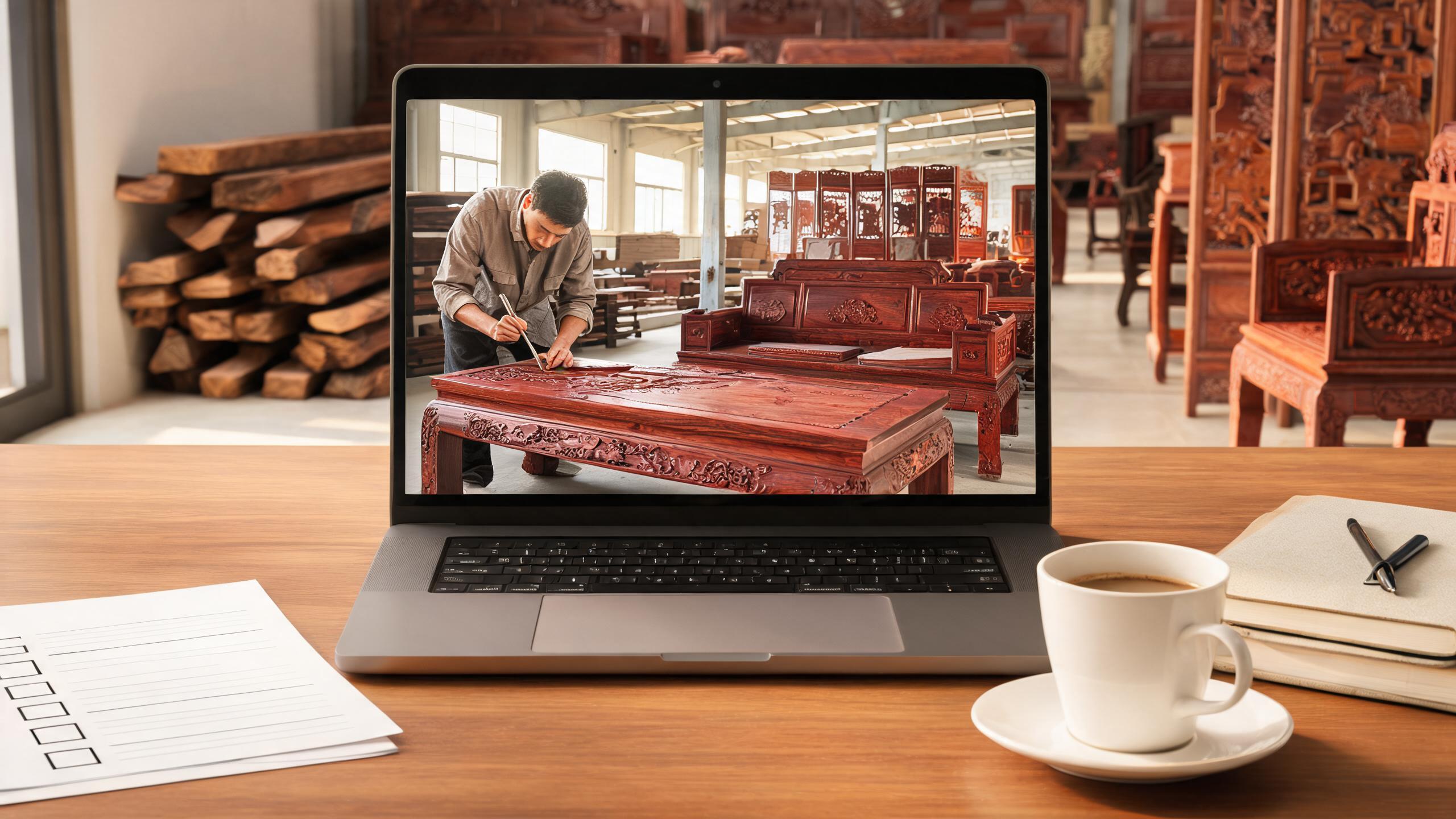
دليل خطوة بخطوة للمشترين الدوليين من B2B حول إجراء تدقيق افتراضي لمصنع أثاث خشب الورد — طلبات المستندات، قائمة فحص فيديو حي من 12 نقطة، شرعية الأخشاب، التجفيف، الوصلات، التشطيب، التعبئة…
Company News · Factory Transparency · September 4, 2026
Ordering a container of classical rosewood furniture from a factory you have never walked through is one of the highest-stakes decisions in the furniture import business. A single misjudged supplier can cost you a season of sales, damage your retail relationships, and lock your capital into stock you cannot sell. The good news is that a well-structured virtual factory audit — a live, evidence-driven remote inspection conducted over video — can eliminate most of that risk before you wire a deposit. In this guide, the team at Yunxiao Rosewood Furniture walks you through exactly how overseas B2B buyers can audit a rosewood furniture factory remotely: what to request, what to look at on camera, which answers separate genuine manufacturers from trading companies, and how to convert an audit into a low-risk first order.
Why Remote Factory Audits Have Become Standard Practice in the Rosewood Furniture Trade
Ten years ago, the default path for a wholesaler sourcing classical Chinese furniture was simple: fly to Guangzhou or Xiamen, take a car to the furniture towns of Fujian, and spend three days walking workshop floors. That model still exists, but it is no longer the only one — and for many buyers it is no longer the first one. Rising travel costs, tighter project timelines, visa friction, and the sheer efficiency of modern video tools have made the remote factory inspection a legitimate first gate in the sourcing funnel.
Three forces in particular have pushed the virtual audit into the mainstream for rosewood and solid hardwood furniture buyers:
- Timber compliance pressure. Importers into the European Union must satisfy EU Timber Regulation due-diligence requirements, and US importers operate under Lacey Act declarations. Both regimes effectively require buyers to know who actually made their furniture and where the timber came from — knowledge that a factory audit, even a remote one, directly supports. (We cover the regulatory side in depth in our article on how EU Timber Regulation and the US Lacey Act affect redwood furniture imports.)
- Long production cycles and large order values. A carved classical sofa set or a 12-seat banqueting dining table represents thousands of dollars of solid hardwood before finishing. With container lead times of 45–60 working days after deposit — the standard we publish for our own orders — buyers cannot afford to discover a capacity or quality problem in week five.
- The rise of project business. Hotels, resorts, villas and designer showrooms increasingly specify classical rosewood pieces. Project buyers are audited by their own clients, so they audit their suppliers — and they increasingly do it remotely, with recorded video sessions that become part of the project file.
A virtual audit is not a replacement for eventually visiting a strategic supplier. It is, however, a highly effective filter: it reliably separates factories from intermediaries, reveals whether claimed equipment and processes actually exist, and gives you a recorded evidence trail you can share with partners, banks and project consultants.
What a Virtual Factory Audit Can — and Cannot — Verify
Before planning the session, be honest about the limits of the medium. A remote audit conducted over a live video call is excellent at some things and structurally weak at others. Knowing the difference lets you design the session around its strengths and compensate for its weaknesses with documents and samples.
What video audits verify well
- Existence and scale of the facility. A continuous, unedited walkthrough of the workshop, timber yard and finishing area is very hard to fake. You can see roof spans, the number of workstations, the volume of work-in-progress, and whether the space matches the claimed capacity (for example, our own 12,000㎡ factory in Xianyou County, Fujian).
- Real manufacturing capability. Watching an artisan actually chisel a carved apron, or a worker fit a mortise-and-tenon joint, demonstrates skill in a way no certificate can. Machine parks, drying kilns, dust extraction and finishing booths are all verifiable on camera.
- Work-in-progress authenticity. If a factory claims to build Ming-style sofa sets and Qing-style carved beds, you should see frames at various stages — rough timber, joined carcases, carved panels, lacquer coats — not just a showroom of finished goods.
- Management maturity. How the tour is organized, whether staff can answer process questions directly, how materials are labeled and staged — these signals reveal a lot about how your order will actually be handled.
What video audits verify poorly
- Touch, weight and smell. The density of genuine Siamese rosewood (Dalbergia cochinchinensis), the feel of a hand-rubbed lacquer surface, the absence of chemical odor from compliant finishes — these require physical samples.
- Precise moisture content. A meter reading shown on camera helps, but a third-party or in-house documented reading attached to your sample matters more.
- Long-term durability. No audit, virtual or in-person, proves how a joint behaves after five years in a heated European living room. That is what joinery design, drying discipline and warranty terms are for.
Practical rule: use the virtual audit to verify who makes the furniture and how; use document requests to verify legality and compliance; use a sample order to verify the physical product itself. A serious supplier will support all three without hesitation.
Step 1: Request the Right Documents Before You Go on Camera
A disciplined remote audit starts before the video call. Asking for documents first serves two purposes: it gives you material to verify against what you see on camera, and it tests how the supplier responds to normal due-diligence requests. Legitimate manufacturers answer document requests within days; evasive answers at this stage are themselves a finding.
Request the following before scheduling the live tour:
- Business license and factory registration. Confirm the legal entity name matches the name on your proforma invoice. Note the registered scope and founding year — our own registration dates to 2008, which any buyer can cross-check against our company profile.
- Timber sourcing and legality documentation. Ask which species the factory actually uses — for classical furniture this is typically Siamese rosewood, aged red wood, and Grade-A tropical hardwoods, sometimes paired with Machilus nanmu for certain components — and what documentation supports legal harvest and import of that timber. FSC certification or equivalent chain-of-custody paperwork should be available for buyers who need it.
- Finishing compliance evidence. Finishes for EU-bound furniture should be documented against REACH expectations, and US-bound furniture against CARB requirements for formaldehyde emissions. Ask what the factory's standard finish system is and what test reports exist.
- Export and packing standards. ISPM 15 heat-treated packaging is the international standard for solid wood packing materials; ask to see the stamp and the crating process during the video tour.
- Two or three reference export shipments. Destination region, product type, and roughly when they shipped. You are not asking for client names — you are confirming the factory regularly ships to markets like yours.
Review the documents, note anything unclear, and bring those questions into the live session. The combination of paper evidence and on-camera verification is far stronger than either alone.
Step 2: Structure the Live Video Tour Around a 12-Point Checklist
An unstructured video call degenerates into a showroom presentation. Insist on a structured walkthrough — ideally 60 to 90 minutes, hosted by someone with production authority (a factory manager or production supervisor, not only a salesperson), with the camera moving continuously through the real facility. Use this checklist:
| # | Checkpoint | What good looks like on camera |
|---|---|---|
| 1 | Continuous walkthrough, no cuts | One unbroken movement from timber storage through processing to packing; the host walks, the camera follows. |
| 2 | Timber yard or storage | Stacked hardwood with visible species labeling or batch separation; timber is air-dried/stickered, not sitting wet on the ground. |
| 3 | Drying kilns | Actual kiln chambers with controls; the host explains the drying schedule. For export-grade classical furniture, expect a controlled process such as our 36-day constant-humidity drying cycle. |
| 4 | Dimensional processing | Planers, saws and CNC or manual milling in use; offcuts and shavings show real throughput. |
| 5 | Carving workshop | Artisans actively carving; ask for a close-up of chisel work on a current order, not a staged piece. |
| 6 | Joinery and assembly | Mortise-and-tenon joints being cut and fitted; ask directly whether frames use metal fasteners. Traditional classical construction assembles without nails precisely to prevent cracking in overseas climates. |
| 7 | Sanding and surface prep | Progressive grit stages visible; surfaces handled with care before finishing. |
| 8 | Finishing area | A controlled finishing space; the host explains the coat system — for example, multiple coats of raw lacquer, each cured and hand-rubbed, finished with beeswax. |
| 9 | Quality control station | Inspectors checking joints, dimensions and finish; ask what gets checked and what happens to a failed piece. |
| 10 | Packing line | Custom crating, moisture barriers, corner protection and bracing for carved components; ask to see the ISPM 15 stamp on actual crates. |
| 11 | Finished-goods and order staging | Orders labeled by client or shipment; this shows how your order will be tracked. |
| 12 | Spontaneous Q&A on the floor | Ask the host to hand the camera to a carving lead or finishing supervisor for one question each. Comfortable, specific answers are a strong authenticity signal. |
Record the session with the supplier's consent. The recording becomes your reference when comparing quotes, and part of your compliance file for regulated markets.
Step 3: Verify Timber Legality and Material Claims Remotely
For rosewood furniture, material claims are the highest-risk area for remote buyers, because the difference between genuine solid Dalbergia construction and a veneered or mixed-hardwood substitute is invisible in photographs. A virtual audit gives you three practical verification levers:
Ask for species-specific evidence on camera
Have the host show you the raw material for your intended product line and state the species on camera. For classical furniture, genuine Siamese rosewood is the premium structural timber; ask what documentation accompanies timber purchases — import documents for the raw logs, supplier declarations, and any chain-of-custody certification such as FSC. Cross-reference what you see with the written documents you requested in Step 1. Consistency between the yard, the paperwork and the sales narrative is the core of timber due diligence.
Watch the cutting, not just the surface
Ask the host to film or show on the live call a board being cut or planed. Solid timber shows consistent figure and color through its thickness; engineered substitutes reveal themselves at the cut. You can also ask for a short video of the cross-section of a sample offcut, with the batch number written on a card beside it. This costs the factory nothing if the claims are true — which is exactly why the request is so diagnostic.
Confirm construction method, not just material
Material and construction interact. Solid rosewood assembled with metal screws into dense hardwood is a design compromise that invites cracking as timber moves with humidity; traditional mortise-and-tenon joinery with wooden dowels accommodates seasonal movement. During the audit, ask to see joints being fitted and ask what percentage of the frame uses metal fasteners. Our own standard — full mortise-and-tenon assembly with zero metal nails in the primary frame — exists specifically because export climates punish careless construction. You can read more about why in our piece on what makes mortise and tenon joinery the soul of classical rosewood furniture.
Step 4: Audit Drying and Moisture Control on Camera
If there is a single technical differentiator between rosewood furniture that survives Chicago winters or Australian summers and furniture that cracks within a year, it is drying discipline. Timber that leaves the factory with internal moisture gradients will move — and movement in dense hardwood means splits, open joints and warped panels.
During the virtual tour, spend real time on this section:
- See the kilns, not a brochure photo. Ask the host to open a kiln chamber door and show the control panel. Note whether multiple chambers are running — a factory serious about export volume dries continuously, not on demand.
- Ask for the schedule. What is the standard drying cycle for the species you are buying? What moisture content does timber reach before assembly? For export-grade classical furniture, a long controlled cycle — our standard is 36 days of constant-humidity drying — followed by equilibration to the destination climate is the professional answer. Vague answers like "we dry it properly" are a finding.
- Ask about destination adjustment. Timber should be conditioned toward the equilibrium moisture content of the destination market. A factory that asks you which climate the furniture is heading to is a factory that understands the problem. We discuss this in detail in why kiln drying matters when buying rosewood furniture from China.
- Request meter readings on camera. Ask the host to take a moisture meter reading of timber staged for your product type and show the display. One reading proves little by itself, but a host who refuses the request tells you more.
Step 5: Evaluate Craftsmanship Through Close-Up Video
Classical rosewood furniture lives or dies on craftsmanship, and craftsmanship is surprisingly verifiable over video if you direct the camera deliberately. Salespeople show finished showpieces; auditors ask for work-in-progress.
Carving: depth, undercut and consistency
Ask for a close-up of a carved panel from the current production floor, ideally lit from the side. Hand carving shows crisp edges, varied depth and clean undercutting in recesses; machine carving shows uniform, shallow relief and rounded-over details. Ask how many hours of carving a typical apron or backrest carries — on our carved tea tables, for example, the cloud-motif apron represents roughly 12 hours of hand carving per table at 2–3 mm relief depth. A specific, checkable number is what you want to hear.
Joinery: fit and finish of unseen surfaces
Ask to see the underside or back of a piece in assembly. Quality factories finish surfaces nobody will see, because the same hands made the whole piece. Check drawer construction — dovetail drawers are a hallmark of serious casegoods — and ask how drawers and doors are fitted after the carcase settles.
Finishing: the coat system
Ask the finishing supervisor to explain the full system: how many coats, what material, curing time between coats, and the final hand-rubbing. Our standard is a six-coat raw lacquer system, each coat cured 24 hours and hand-rubbed with pumice, finished with eco-friendly beeswax — a system documented to meet EU REACH and US CARB expectations. The point for your audit is not the specific numbers but the specificity: a real process has real numbers.
Step 6: Audit the Packing and Export Process
Furniture that leaves the factory perfect can still arrive damaged, and packing is where that battle is won or lost. Carved classical furniture is unusually vulnerable: relief carvings protrude, legs are shaped, and stone inlays (as on some of our tea tables) add fragility. During the remote audit, ask to see the packing line in operation:
- Crating. Export-grade classical furniture ships in custom-built crates, not off-the-shelf cartons. Look for solid frame-and-ply construction sized to the piece.
- Moisture protection. Barrier wrapping around each piece protects against container rain and humidity swings during ocean transit.
- Bracing and corner protection. Carved components should be individually protected and braced so nothing shifts in transit.
- ISPM 15 compliance. Ask to see the heat-treatment stamp on actual packing wood. This is a hard requirement for solid wood packaging in most destination markets, and a factory exporting regularly will show it without hesitation.
For a deeper treatment of this topic, see our guide on how rosewood furniture should be packaged for export shipping.
Step 7: Use a Sample Order as Physical Verification
The virtual audit verifies the factory; the sample verifies the product. Even after an excellent video session, put a physical sample in your hands before committing to a full container. Many established factories — including ours — support exactly this path with trial single sets and refundable sample programs, precisely because serious buyers ask.
When your sample arrives, verify against what you saw on camera:
- Weight and density. Solid Siamese rosewood is heavy. Lift the piece; hollow lightness contradicts solid-timber claims.
- Joint quality. Check every visible and reachable joint. Tight, seamless mortise-and-tenon work with no filler is what the video should have promised.
- Finish. The surface should feel satin, not plasticky; smell should be neutral, consistent with compliant low-emission finishes.
- Documentation. Species declaration, care instructions and any compliance paperwork should ship with the sample.
- Consistency. Photograph the sample and compare against the video session. What you were shown is what you should have received.
A sample order also tests the commercial relationship: invoice accuracy, communication responsiveness, packing quality and shipping documentation all reveal themselves on a small order, at small cost.
Step 8: Read the Communication and Project-Management Signals
Beyond wood and machines, a remote audit tells you how the factory will behave across a 45–60 day production cycle. Watch for these signals during and after the session:
- Who answers technical questions. If every answer routes through one salesperson reading from a script, depth is thin. If a production manager joins the call and answers drying and joinery questions directly, the organization has real bench strength.
- Documentation habits. Factories that send organized quotations, clear specifications and proforma invoices with precise terms will run your order the same way.
- Project support capability. For hotel, resort and villa projects, ask whether the factory provides layout drawings, custom sizing and installation guidance. We provide free layout drawings for projects and remote installation guidance as standard — capabilities that matter enormously when a container arrives at a resort in Queensland or a villa in California.
- Shipment flexibility. Ask whether partial shipments are possible for long-term partners. Flexibility here signals a factory that plans around client cash flow, not just its own production queue.
Step 9: Assess Capacity and Lead-Time Realism
A factory can look impressive on camera and still be unable to deliver your order on time. Capacity assessment is a core part of the virtual audit, and it is more about arithmetic than impressions.
Ask for a production-load snapshot
Ask how many orders are currently in production, how many containers the factory ships per month, and what share of capacity is already committed. A factory that is 90 percent booked before your order arrives will either delay you or rush your work — both are bad outcomes. A realistic answer, such as a clear statement of current load and a production slot for your order, is what you want.
Match the lead time to the product
Classical rosewood furniture cannot be rushed without transferring risk onto you. Drying takes weeks, carving takes days per panel, and finishing requires multiple cured coats. A supplier quoting an implausibly short lead time for a heavily carved set is either not doing the work properly or not doing it in their own factory. For container orders, a professional range is 45–60 working days after deposit; anything dramatically shorter for carved classical pieces deserves a skeptical follow-up.
Ask what happens under load
When production is full, does the factory extend lead times honestly, or does it quietly compress drying and finishing? The answer reveals the factory's integrity under pressure — the exact situation that will determine whether your first container arrives on time and intact.
Step 10: Tailor the Audit to Your Destination Market
Not all export markets demand the same evidence, and a smart buyer audits for the market they actually serve. Adjust your checklist by destination:
European Union
EU importers face the strictest timber-legality regime. Prioritize EUTR due-diligence documentation, species identification, and finish compliance with REACH expectations. Ask the factory how it documents the legal harvest and import of the timber used in your order, and how it would support your due-diligence file.
United States
US importers operate under the Lacey Act, which requires accurate species identification on import declarations. Focus the audit on species documentation and CARB-relevant finish evidence for formaldehyde emissions. Confirm the factory can provide the species declaration you will need.
Southeast Asia and Australia
Buyers in these markets often prioritize climate resilience and project support. Ask about destination-conditioned drying, moisture control for tropical or coastal climates, and whether the factory provides layout drawings and installation guidance for resort and villa projects. Our own export program serves these markets with exactly this kind of support.
For a deeper look at the regulatory side, see our article on how EU Timber Regulation and the US Lacey Act affect redwood furniture imports.
Turn Audit Findings into a Supplier Scorecard
A virtual audit produces a lot of qualitative information, and qualitative information is easy to forget or rationalize. The discipline that separates professional importers from amateurs is converting the audit into a written scorecard before you compare quotes. Build a simple matrix with weighted criteria and score each factory consistently:
| Criterion | Weight | What you are scoring |
|---|---|---|
| Timber legality and species documentation | High | Clear species identification, sourcing documents, chain-of-custody evidence. |
| Drying and moisture control | High | Real kilns, a defined schedule, destination conditioning, meter readings. |
| Joinery and construction method | High | Mortise-and-tenon discipline, no metal fasteners in primary frames. |
| Craftsmanship and carving | Medium | Hand-carving depth and consistency, specific hours per panel. |
| Finishing system | Medium | Defined coat system, compliance references, hand-rubbed quality. |
| Packing and export hygiene | Medium | Custom crating, moisture barriers, ISPM 15 stamps. |
| Capacity and lead-time realism | Medium | Honest load snapshot, realistic schedule for your product. |
| Communication and project support | Medium | Technical depth of answers, documentation habits, project services. |
| Sample and trial flexibility | Low | Willingness to support trial sets and refundable samples. |
Score each criterion on a consistent scale immediately after the audit, while the evidence is fresh. Weight the criteria to match your market and product mix — an EU importer of carved dining sets weights timber legality and joinery higher than a Southeast Asian resort buyer weights project support. The scorecard turns a memorable tour into a defensible decision, and it makes comparing three factories honest rather than impressionistic.
Red Flags: What Should End the Conversation
Some findings during a virtual audit are matters of degree; others are disqualifying. Treat the following as hard red flags:
- Refusal to do a live, unedited walkthrough. Pre-recorded videos and photo albums are marketing, not auditing. A factory with real capacity loses nothing by walking you through it live.
- Showroom-only tours. If every request to see production is deflected back to finished goods, assume the production you care about happens elsewhere — or not at all.
- Species vagueness. "Rosewood" covers many species at many price points. A supplier who cannot or will not state the exact species and its documentation for your order is asking you to underwrite unknown risk.
- No drying process. Air-drying alone, or no answer at all about moisture control, predicts cracking claims in your first season.
- Metal fasteners in primary frames of "classical" furniture. For genuinely classical construction this is a contradiction in terms, and in dense hardwoods it is a cracking mechanism.
- Missing ISPM 15 or evasive answers on packing. This is basic export hygiene; its absence predicts problems across the whole logistics chain.
- Pressure to skip the sample. Any supplier confident in its product welcomes a trial order. Resistance is information.
- Unrealistic lead times. A quote that is dramatically shorter than the product's honest production cycle is a warning that corners will be cut somewhere.
From Audit to Order: Structuring a Low-Risk First Container
A successful virtual audit should flow directly into a deliberately structured first order. The pattern that works for most B2B buyers:
- Trial set or sample first. One sofa set or one dining configuration, shipped as a sample or small lot, verified physically against the audit findings.
- Mixed trial container. Combine one or two sofa configurations, a dining set and a bedroom set in one container to test multiple product lines at once. Factories accustomed to whole-house and project business handle mixed containers routinely.
- Milestone-based production. Agree on photo or video checkpoints — timber selection, carcase assembly, carving completion, finishing, pre-packing inspection — so you audit continuously instead of discovering problems at packing.
- Pre-shipment inspection. Whether you travel, send a third-party inspector, or request a structured live video inspection of your finished order, close the loop before the container seals. Our own pre-shipment process for B2B buyers is described in how Yunxiao ensures rosewood furniture quality control for B2B buyers, and buyers can complement it with their own checklist as covered in our pre-shipment inspection checklist for importers.
- Scale on evidence. Repeat orders should follow successful verification, not optimism. A factory that performed on the trial container has earned the annual program; one that did not has saved you from it.
Plan lead times realistically: for container orders of classical rosewood furniture, 45–60 working days after deposit is a professional, honest range — drying and finishing cannot be compressed without transferring risk onto you.
Common Mistakes Buyers Make in Remote Audits
Even experienced importers make avoidable errors when auditing remotely. Learn from the most common ones:
- Skipping the document stage. Going straight to video without requesting documents first leaves you with no paper trail to verify against what you see on camera.
- Accepting a pre-recorded tour. A polished video proves marketing skill, not manufacturing capability. Insist on live and unedited.
- Letting sales control the camera. If you never get to ask a floor supervisor a question, you have not audited the factory — you have watched a presentation.
- Ignoring work-in-progress. Finished showpieces tell you nothing about how your order will be made. The frames, carvings and lacquer stages are where quality is decided.
- Not recording the session. A recorded audit is your reference for comparing quotes and your evidence file for compliance. Get consent and record.
- Treating the audit as the final step. The audit filters the factory; the sample verifies the product; the pre-shipment inspection closes the loop. Skipping any of these reopens the risk you worked to close.
How Yunxiao Supports Remote Factory Audits
We built our export business on buyers who could not always fly to Fujian, so the remote audit is a process we run weekly, not an exception we tolerate. What overseas buyers can expect from a virtual audit of our facility in Xianyou County, Putian City:
- A structured live walkthrough of our 12,000㎡ factory — timber storage, drying kilns, dimensional processing, carving workshops, assembly, finishing and packing — hosted by production staff who can answer process questions on the floor.
- Document support on request: business registration, timber legality and sourcing documentation, FSC certification where applicable, finish compliance references for EU REACH and US CARB, and ISPM 15 packing evidence.
- Close-up demonstrations: live carving on current orders, mortise-and-tenon fitting, moisture meter readings, and the six-coat lacquer process explained by the finishing team.
- Sample and trial programs: trial single sets and refundable samples so the physical product can confirm what the video showed.
- Project support: free layout drawings, OEM and ODM custom sizes and patterns for villas and resorts, remote installation guidance, and partial shipments for long-term partners.
Our full manufacturing story — from timber selection through carving, joinery and finishing — is documented in Inside the Workshop: How Yunxiao Crafts Classical Rosewood Furniture from Timber to Finished Piece, and buyers evaluating multiple suppliers can also consult our guide on how to choose a reliable rosewood furniture supplier for your business.
Frequently Asked Questions About Virtual Factory Audits
How long should a virtual factory audit take?
Plan 60–90 minutes for the live walkthrough plus a separate follow-up call for commercial terms. Trying to compress the audit into 20 minutes guarantees you will see only the showroom.
Can a virtual audit really detect a trading company posing as a factory?
Yes, in most cases. A continuous live walkthrough of production — with spontaneous questions answered by floor staff — is extremely difficult for an intermediary to fake. Ask to see work-in-progress with your intended product type, and ask the host to hand the camera to a workshop supervisor.
What time zone should I schedule for a China factory audit?
Chinese factories operate roughly 8:00–18:00 China Standard Time. For buyers in Europe, late afternoon CET works well; for North America, early morning Eastern Time catches the end of the Chinese working day. Ask for a slot when production is actually running — a weekend audit of an empty workshop verifies nothing.
Should I still visit in person?
For a strategic long-term supplier, yes — ideally before your second or third container. The virtual audit de-risks the first order; the in-person visit deepens the relationship and lets you negotiate custom programs face to face. Many of our long-term partners audited us remotely first and visited later.
What documents matter most for EU and US imports?
For the EU, timber legality documentation supporting EUTR due diligence; for the US, species identification supporting Lacey Act declarations, plus CARB-relevant finish documentation. ISPM 15 packing compliance applies to both. Request these in writing before the audit and verify consistency with what you see on camera.
How do I verify moisture content without being there?
Three ways: ask for a meter reading on camera during the audit; require a documented moisture reading with your sample shipment; and rely on construction method — proper mortise-and-tenon joinery tolerates residual movement far better than screwed assemblies.
Can custom and OEM/ODM orders be audited the same way?
Yes, with one addition: ask to see a previous custom project's drawings and the corresponding finished piece on camera. Custom capability is best demonstrated by a real custom order, not a promise. Our OEM and ODM program for whole-house custom orders is described in what makes a Chinese rosewood furniture factory reliable for OEM and ODM whole house custom orders.
Is a virtual audit enough for a first order?
For a first container, a well-executed virtual audit combined with a physical sample and a pre-shipment inspection is a strong, defensible position. It is not a substitute for an in-person visit on a long-term strategic relationship, but it reliably filters out the suppliers that would have cost you the most.
What if a factory refuses a virtual audit?
Treat it as a strong negative signal. A factory with real capacity and nothing to hide has no reason to refuse a live walkthrough. If a supplier insists on photos or pre-recorded videos instead, assume the production you care about is not something they want you to see, and move on.
Conclusion: Audit Remotely, Order Confidently
The distance between a profitable rosewood furniture program and an expensive mistake is almost always information — who really makes the furniture, how the timber is dried, how the joints are cut, and how the crate is built. A structured virtual factory audit captures most of that information at a fraction of the cost of a scouting trip, and it leaves you with a recorded evidence file that strengthens your compliance posture in regulated markets.
Start with documents, insist on a live unedited walkthrough, direct the camera at drying, joinery, finishing and packing, confirm with a physical sample, and structure your first container with milestones and pre-shipment inspection. Suppliers with nothing to hide will match you step for step — and that responsiveness is itself the most reassuring finding of all.
Ready to audit our factory from your desk? Contact Yunxiao Rosewood Furniture to schedule a live virtual tour of our Xianyou workshop, request our compliance documentation pack, or arrange a trial sample of any set in our classical sofa, dining and bedroom collections. We ship to wholesalers, hotels and designers across Europe, North America, Australia and Southeast Asia — and we are happy to show you exactly how your furniture will be made, before you commit a single dollar.