
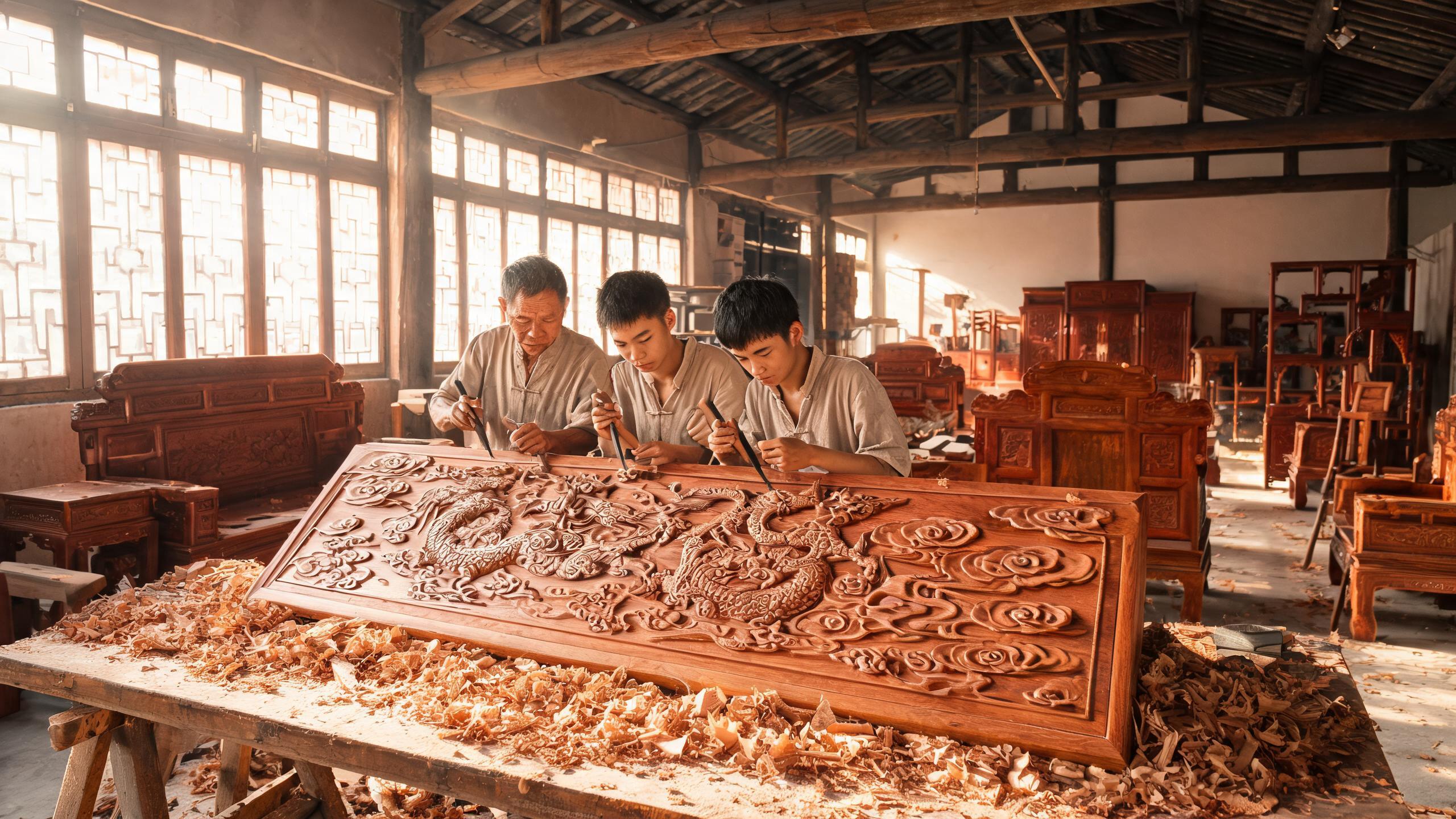
نظرة من الداخل على كيفية تدريب شركة يونشياو لأثاث خشب الورد لنقّاشيها المهرة من خلال نظام تلمذة منظم في شيانيو، فوجيان — يغطي النقش ووصلات النقر واللسان والتحكم في الرطوبة وتشطيب اللك والاعتماد الداخلي والامتثال — وما يعنيه ذلك للمشترين من الشركات (B2B) الذين يوردون أثاث خشب الورد الكلاسيكي من الصين.
Introduction: Why Carver Training Decides the Quality of Your Rosewood Furniture Order
When a wholesaler, hotel group, or interior design firm in Europe, North America, Australia, or Southeast Asia places an order for classical rosewood furniture, the single most important variable is not the price list or the catalog photos. It is the hands that carve, join, and finish every panel. Solid rosewood furniture is one of the few product categories in the furniture trade where the skill of individual artisans directly determines structural integrity, surface quality, and long-term value. A poorly trained carver can leave tear-out in a dragon motif, a weakly fitted tenon, or an uneven lacquer coat — defects that only become visible after the container arrives, when they are most expensive to fix.
This is why Yunxiao Rosewood Furniture Co., Ltd treats carver training as a core manufacturing discipline rather than an HR afterthought. Founded in 2008 and operating a 12,000-square-meter factory in Xianyou County, Putian City, Fujian — widely recognized as the hometown of traditional hardwood craft in China — our company has spent nearly two decades building a structured apprenticeship system that turns regional craft traditions into repeatable, export-grade quality. In this article, we explain in detail how our master carvers are selected, trained, certified internally, and continuously evaluated, and what that means for B2B buyers sourcing classical rosewood sofa sets, dining sets, and bedroom suites from China.
The question every serious importer should ask a Chinese rosewood furniture supplier is simple: how do you train and control the people who make my furniture? This article answers that question for our factory, with the specific processes, standards, and quality gates we use every day.
Why Craftsmanship Training Matters More in Rosewood Furniture Than in Any Other Furniture Category
Mass-market panel furniture can be produced almost entirely by machines. Classical rosewood furniture cannot. The deep relief carving on a Qing Dynasty style sofa backrest, the flowing cloud apron under a tea table, the lattice work on a display cabinet — these are executed by hand, chisel by chisel, because no CNC router can reproduce the varying depth, undercut, and polish that traditional motifs require. Hand carving is not a marketing label; it is a production method with real consequences for buyers.
Three consequences matter most for importers. First, structural reliability: rosewood species such as Siamese rosewood (Dalbergia cochinchinensis) are extremely dense, typically sorted to 0.90–1.00 g/cm³ in our workshop, which makes them unforgiving materials. A carver who does not understand grain direction will split a panel; one who does will let the chisel follow the wood. Second, aesthetic consistency: when a hotel project orders twelve matching reception sofas, every phoenix motif must match in proportion and depth. That consistency is a training outcome, not luck. Third, climate durability: furniture exported to dry North American interiors or humid Southeast Asian coastal cities must be carved, joined, and finished by people who understand how wood moves. Training is where all three of these buyer-critical outcomes are created.
For B2B buyers, this is also a risk-management issue. Furniture that arrives with cracked joints or damaged carvings generates claims, replacement freight, and project delays. A supplier that invests in systematic carver training is, in effect, investing in your defect rate. That is why we open our training system to buyer scrutiny — including virtual factory audits — and why we document it here.
The Foundation: Xianyou's Craft Heritage as a Recruitment Advantage
Yunxiao's factory is located in Xianyou County, Putian City, Fujian Province, a region with generations of accumulated hardwood furniture craft. This location gives us two structural advantages in building a training system. The first is recruitment: the local labor pool includes families where carving, joinery, and lacquer work have been practiced for generations, so entry-level apprentices often arrive with baseline exposure to tools and wood behavior. The second is ecosystem depth: the surrounding region hosts timber traders, tool makers, finishing material suppliers, and specialized subcontractors, which keeps our training aligned with the best current practice in the industry rather than an isolated internal standard.
Heritage alone, however, does not produce export quality. Traditional apprenticeships in the region historically took the form of informal, multi-year shadowing, with quality varying from workshop to workshop. What Yunxiao has done since 2008 is formalize that heritage: we take the region's traditional techniques — passed down through generations of master artisans — and wrap them in written standards, staged assessments, and modern quality control so that every piece leaving our 12,000㎡ factory meets the same export specification. The result is a hybrid system: traditional craft knowledge, industrial quality discipline.
Stage One: Apprentice Selection and the First Ninety Days
Our training pipeline begins with selection. We recruit apprentices primarily from Xianyou and surrounding Fujian counties, prioritizing candidates with family exposure to woodworking, vocational school training in furniture manufacturing, or demonstrated manual skill. Selection includes a practical test: candidates are asked to sharpen a chisel, plane a hardwood offcut, and copy a simple geometric pattern. We are not looking for finished skill — we are looking for patience, tool discipline, and sensitivity to grain, which are the traits that predict whether an apprentice can survive the multi-year pathway.
The first ninety days are deliberately unglamorous. New apprentices do not touch customer furniture. Their curriculum covers tool preparation (grinding, honing, and maintaining the full set of carving chisels and gouges), timber literacy (identifying species, reading grain, understanding density and moisture behavior), and workshop safety. They practice on offcuts and practice blanks, producing hundreds of repetitive exercises — chamfers, beads, flutes, simple relief patterns — that a supervising master inspects daily. An apprentice who cannot produce a clean, consistent bead across a one-meter rail is not ready for motif work. This stage filters for the manual consistency that later stages depend on.
During this period apprentices also learn the material standards that govern everything else in our factory: the difference between legally certified Machilus Nanmu, aged red wood, and Grade-A tropical hardwood; why we condition timber to below 14% moisture content; and how the 36-day constant-humidity drying cycle prepares wood for the carving bench. Understanding the material before shaping it is the first principle we teach, because most carving defects trace back to wood that was not understood or not ready.
Stage Two: Carving Techniques — From Geometric Practice to Traditional Motifs
After the foundation stage, apprentices enter structured carving training under master artisans. Our carving curriculum progresses through four levels of difficulty, mirroring the traditional motif families used in classical Chinese furniture.
Level one covers flat relief: shallow, uniform-depth patterns such as bamboo motifs and simple cloud bands, like those on our tea tables with bamboo carved aprons. The training goal is depth control — holding a consistent 2–3 mm relief across a long rail without wavering. Level two introduces layered relief, where motifs such as the ruyi sceptre patterns on our armrests require two or three depth planes and clean transitions between them. A single ruyi armrest panel on our three-piece Siamese rosewood sofa set takes approximately 18 carving hours, and apprentices must demonstrate they can sustain quality across that duration before advancing.
Level three covers openwork and lattice carving — the pierced lattice doors of display cabinets and the open shoulders of chair backrests — where the carver must plan cuts so the panel retains structural strength after material is removed. Level four is the master tier: the imperial dragon and auspicious phoenix compositions used on our ten-seat Imperial Dragon Carved Redwood Sofa Set and six-piece Auspicious Phoenix Reception Set. These compositions involve freehand scaling of traditional patterns, undercut carving for shadow depth, and surface polish integrated into the carving process. Only carvers with several years of assessed production experience work on these sets, and each master's output is inspected piece by piece.
Throughout all levels, we enforce a simple rule: no carving proceeds against the grain without a planned strategy. Apprentices learn to read each panel's grain map before the first cut, because Siamese rosewood's interlocked grain will tear out unpredictably if a carver works mechanically. This grain-first discipline is one of the clearest differences between trained carvers and machine operators, and it is why hand carving remains irreplaceable for classical furniture.
Stage Three: Mortise-and-Tenon Joinery — The Structural Curriculum
Carving makes rosewood furniture beautiful; joinery makes it survive international shipping and foreign climates. Every piece in our catalog is assembled with traditional mortise-and-tenon joinery reinforced with bamboo dowel pins, with zero metal fasteners in the primary frame. Metal fasteners and dense rosewood expand and contract at different rates, which is a primary cause of cracking in exported furniture; our all-wood joinery avoids that failure mode entirely. But mortise-and-tenon work at this precision level is a trained skill, not a machine setting.
Joinery training runs in parallel with carving training from stage two onward. Apprentices learn to cut and fit the major joint families used in classical furniture: through tenons for frame rails, blind tenons where the joint must not show, mitered shoulder joints for leg-to-apron connections, and the dovetail drawers used in our sideboards. Each joint is cut slightly proud, then fitted by hand — shaving the tenon in thin passes until it seats with firm hand pressure and no gap. The acceptance standard we train to is specific: a fitted joint must hold the assembled sub-frame together without clamps, and disassembly for flat-pack export crating must be possible without damage.
This last requirement connects joinery training directly to export logistics. Many of our sets ship partially disassembled in ISPM-15 heat-treated crates, and a carver-joiner who has not been trained to cut joints that survive repeated assembly cycles will produce furniture that fails at the destination. Our training therefore includes assembly-and-disassembly drills: every joinery student must assemble, crate-simulate, and reassemble their test pieces a minimum number of times before their joints are approved for production furniture.
Stage Four: Moisture, Climate, and the Science Every Carver Must Know
A distinctive feature of our training system is that it treats carvers as material scientists, not just craftsmen. Rosewood furniture cracking in overseas climates is one of the most common failure modes in this trade, and it is almost always a process failure rather than a material failure. Our training makes every artisan understand why.
All apprentices learn the full moisture management chain: incoming timber inspection and density sorting (our Siamese rosewood is sorted to 0.90–1.00 g/cm³ for consistent structural response), the 36-day constant-humidity kiln drying cycle that brings timber below 14% moisture content, post-drying acclimatization in the workshop, and the timing rules that govern when a dried panel may be carved, joined, and finished. Carvers learn that carving a panel too soon after kiln release traps internal stress in the finished piece; joiners learn that a tenon cut at the wrong moisture level will loosen or split after the container crosses the equator.
We also train destination-specific thinking. Furniture bound for dry, heated North American interiors faces different movement patterns than furniture bound for humid Southeast Asia or temperate Australia. While the core drying specification is constant, finishing teams adjust wax and lacquer application strategy by destination climate, and carvers learn how seasonal movement affects wide panels, breadboard ends, and floating panels. This knowledge is why our furniture is engineered to be stable in overseas climates — and why we can offer it as a genuine technical commitment to buyers rather than a slogan.
Stage Five: Lacquer and Beeswax Finishing Training
Surface finishing is the final craft discipline in our pipeline, and it is trained with the same rigor as carving. Our standard finish system combines traditional hand-rubbed raw lacquer — applied in multiple coats, six on pieces like our three-piece sofa set and nine on our Qing Dynasty style five-piece set — with eco-friendly beeswax finishing. The lacquer we use is a breathable, penetrating formula that meets EU REACH and US CARB environmental standards, which is a hard requirement for our European and North American buyers.
Finishing apprentices learn coat-by-coat application: sanding between coats at progressively finer grits, controlling film thickness so the grain and carving detail remain crisp, and hand-rubbing to the satin sheen our catalog specifies. They learn the failure modes — runs, orange peel, dust inclusion, and the dull patches that come from rubbing too early — and how to correct each one. Because raw lacquer cures by oxidation rather than evaporation, timing and workshop humidity control are part of the curriculum; a finisher who does not understand curing behavior will produce a surface that looks acceptable on the day of packing and fails after six weeks at sea.
Finishing training also covers compliance documentation at the workshop level: which finishing materials are approved, how REACH and CARB conformity is maintained through approved supplier lists, and why unapproved substitutes — however cheap — are prohibited. Every finisher understands that the finish is both an aesthetic surface and a regulatory declaration, and that discipline protects our buyers at customs inspection.
Internal Certification and the Master Artisan Tier
Progression through our training system is assessed, not assumed. At the end of each stage, apprentices complete practical examinations evaluated by a panel of master artisans and production supervisors. A carving examination might require the candidate to reproduce a specified motif on a prepared panel within a defined time, judged on depth consistency, edge cleanliness, motif proportion, and grain handling. A joinery examination requires cutting and fitting a set of joints to our no-gap, no-clamp standard. A finishing examination requires completing a full multi-coat finish on a test panel to our satin sheen specification.
Certification levels map directly to production authorization. Certified carvers may work on standard production pieces under supervision. Senior carvers may work unsupervised on complex motifs. Master artisans — the tier that trains the next generation — hold final responsibility for pattern scaling on custom OEM and ODM projects and for the piece-by-piece inspection of master-tier compositions such as dragon and phoenix sets. This tiered structure means that when a buyer orders a twelve-seat banqueting set with carved chairs, the allocation of work to skill levels is a managed decision, not an accident of scheduling.
Importantly, masters are evaluated on their apprentices' outcomes as well as their own output. This creates a self-reinforcing quality culture: the master tier has a direct stake in how well the training pipeline performs, which is how a workshop founded in 2008 has been able to scale from a small team to a factory serving four continents without diluting craft standards.
How Training Connects to Quality Control Gates Buyers Can Verify
Training only matters to a buyer if it is enforced by inspection. Our factory operates a multi-gate quality control system, and each gate corresponds to a skill our training program produces. At the timber gate, incoming wood is checked for species, grade, and moisture before it enters production. At the carving gate, each carved component is inspected for motif fidelity, depth consistency, and surface tear-out before assembly. At the joinery gate, assembled frames are checked for joint fit, squareness, and dowel integrity. At the finishing gate, completed pieces are inspected under raking light for film defects and sheen consistency. At the packing gate, every set is checked against its configuration list and photographed before crating into ISPM-15 heat-treated crates with moisture barriers and carving protection.
Buyers can verify this system in three ways. First, we welcome virtual factory audits conducted by video call, where buyers can see the carving benches, the drying kilns, and the inspection stations in real time. Second, we support third-party inspection before shipment, and our internal QC documentation is prepared to align with external inspectors' checklists. Third, trial orders and refundable samples allow buyers to test our quality on a single set before committing to container volumes. We offer trial single sets precisely because we are confident in what our trained artisans produce — and we encourage first-time buyers to use that option.
Training as the Engine of OEM and ODM Custom Capability
Custom work is the ultimate test of a training system. When a resort developer in Southeast Asia or a villa project in Australia requests custom sizes, custom patterns, or a whole-house furniture package, there is no existing pattern to copy — a master artisan must scale and adapt traditional compositions to new dimensions and design briefs. This is only possible when the senior tier of the workforce has deep, assessed competence.
Our OEM and ODM process begins with free layout drawings for projects: buyers send room dimensions and design intent, and our team produces furniture layout plans and pattern proposals. Approved patterns go to master artisans, who adapt traditional dragon, phoenix, cloud, lattice, and ruyi motifs to the custom piece while preserving classical proportion rules. Because our carvers are trained in the logic of motifs — not just the muscle memory of copying them — custom work retains the authenticity that makes classical rosewood furniture valuable, rather than becoming an approximation. Production for container orders takes 45–60 working days after deposit, with partial shipments available for long-term partners.
For buyers, the practical takeaway is that custom capability and training depth are the same thing. A factory whose carvers can only copy catalog patterns cannot execute a coherent whole-house custom package; a factory with a certified master tier can. When you evaluate a Chinese rosewood furniture supplier for a project, ask specifically how custom patterns are developed and who approves them.
Compliance Training: FSC, CITES, and Export Documentation as Workshop Knowledge
Modern rosewood furniture export is inseparable from timber compliance. Siamese rosewood (Dalbergia cochinchinensis) is listed in CITES Appendix II, and shipments to the EU and US must satisfy EU Timber Regulation and US Lacey Act due diligence. Our response is to make compliance part of workshop literacy, not just a back-office function. Every production team understands which species are approved, why chain-of-custody documentation matters, and how material flows through the factory under controlled identification.
Concretely, our shipments include FSC chain-of-custody certification and CITES Appendix II export permits, prepared by our internal export documentation team alongside full export papers and ISPM-15 heat-treated packaging. Carvers and storekeepers are trained to keep material identity intact from timber yard to carving bench, because a compliance claim is only as strong as the weakest link in material handling. For buyers in regulated markets, this means the beautiful sofa set you import arrives with the paperwork that protects your business — a direct result of training compliance awareness into the production floor.
A Worked Example: How One Qing Dynasty Sofa Set Moves Through Our Trained Workforce
To make the training system concrete, consider how our Qing Dynasty Style Carved Redwood Sofa 5-Piece Set — one three-seat sofa, two armchairs, one coffee table, and one end table in solid Siamese rosewood — moves through the hands of our trained workforce. The process begins in the timber yard, where storekeepers trained in species identification verify the Dalbergia cochinchinensis material and its documentation. The timber then enters the 36-day constant-humidity drying cycle, monitored by technicians who record moisture readings until the wood reaches below 14% moisture content.
Once released from drying, the panels are assigned by the production scheduler according to skill tier. The lattice-and-phoenix backrest carving — a master-tier composition — goes to a senior carver, who first maps the grain on each panel and plans the cutting sequence. The aprons and rails with simpler cloud bands are allocated to certified carvers working under periodic master review. Every carved component passes the carving gate inspection for motif fidelity and depth consistency before it is allowed into assembly.
In the joinery shop, trained joiners cut and fit the mortise-and-tenon joints, reinforcing the primary frame with bamboo dowel pins and zero metal fasteners. The assembled frames rest in the conditioning area so the wood equalizes before finishing. Finishers then apply the nine-coat hand-rubbed raw lacquer finish, sanding and rubbing between coats, followed by the beeswax top layer. Each coat is timed against workshop humidity logs — knowledge that exists only because finishers are trained in curing behavior, not just application technique.
Finally, the packing team — trained in export crating protocols — wraps each piece with moisture barriers, protects the carved reliefs with custom bracing, and crates the set in ISPM-15 heat-treated timber. The documentation team attaches the FSC chain-of-custody certificate and CITES Appendix II export permit. At every one of these steps, the quality of the outcome traces directly to a trained person executing a standard they were assessed on. This is what craftsmanship training looks like when it is a manufacturing system rather than a slogan — and it is why the set that arrives at your warehouse matches the sample you approved.
Continuous Improvement: How Our Carvers Keep Getting Better
A training system is only as strong as its commitment to continuous improvement. At Yunxiao, learning does not stop at certification. We operate a structured feedback loop in which every quality control finding — whether caught at the carving gate, the joinery gate, or by a third-party inspector at destination — is traced back to the individual piece, the producing artisan, and the specific technique involved. Recurring findings become training material: monthly workshop sessions review real cases, showing carvers exactly what a defect looks like, why it happened, and how the correct technique prevents it.
We also invest in cross-training between disciplines. Carvers spend structured time with the joinery and finishing teams so they understand how their surface quality affects glue lines, lacquer adhesion, and final assembly. Finishers learn enough about carving to protect delicate undercuts during sanding. This cross-disciplinary literacy reduces the handoff defects that plague less integrated factories, where each department optimizes only its own step.
Finally, our master artisans study historical pieces and regional museum collections to keep traditional pattern vocabulary alive and accurate. When a buyer requests a Ming-style or Qing-style composition, our masters can distinguish the proportion rules, carving depth conventions, and motif grammar of each period — knowledge that can only come from sustained study and practice. This is the difference between a factory that sells classical style and a factory that practices classical craft.
How to Evaluate a Supplier's Craftsmanship Training Before You Order
Buyers who understand what a real training system looks like can evaluate any Chinese rosewood furniture supplier more confidently. We recommend five practical checks. First, ask how long an apprentice trains before working on export orders; a credible answer involves years, not weeks. Second, ask whether carving, joinery, and finishing are assessed by practical examination, and who conducts the assessment. Third, request a virtual factory audit and look specifically at whether practice pieces, inspection stations, and drying kilns are visible and in use. Fourth, ask how custom patterns are developed and who approves them — the answer should reference senior artisans, not just a design software. Fifth, start with a trial single set or refundable sample and inspect joint fit, carving depth consistency, and finish quality against the standards described in this article.
A supplier that welcomes these questions is telling you something important about its culture. Factories with genuine training systems are proud to show them; factories that cannot answer clearly are asking you to accept quality risk that you cannot see until the container opens. At Yunxiao, we built this article precisely because we believe informed buyers make better long-term partners — and because our training system is one of the strongest reasons to source classical rosewood furniture from our factory.
What This Means for Different Buyer Types
For wholesalers and distributors, our training system translates into catalog consistency: every production run of a Ming style sofa set or a dining series matches the sample you approved, because the same certified skill levels and inspection gates govern every batch. Predictable quality reduces your after-sales cost and protects your brand in your home market.
For hotel, resort, and villa project buyers, training depth is what makes large coordinated orders feasible. A twelve-seat banqueting set, a nine-piece grand living room set, and matching bedroom suites must arrive as one design language. Our master-tier pattern control and piece-by-piece inspection of complex compositions exist precisely for these projects, supported by free layout drawings and remote installation guidance.
For first-time importers of classical Chinese furniture, the training system is your risk shield. You do not need to be a rosewood expert to buy safely; you need a supplier whose internal standards do the expert work for you. Start with a trial single set or a refundable sample, inspect it against the standards described in this article, and scale your orders with confidence. Our team also prepares buyers with practical guidance on EU and US timber compliance and export packing, so even your first container is managed professionally.
Frequently Asked Questions
How long does it take to train a rosewood furniture carver at Yunxiao?
The full pathway from apprentice to certified production carver takes several years of structured, assessed training. Apprentices spend their first ninety days on tool discipline, timber literacy, and repetitive foundational exercises before touching customer furniture. Advancement to complex motif work and master-tier compositions requires years of production experience and passing staged practical examinations. This timeline is deliberate: dense tropical hardwoods do not forgive shortcuts, and our buyers' defect rates depend on carvers being fully ready before they work on export orders.
Can I verify the craftsmanship of my order before shipment?
Yes. We support virtual factory audits by video call, third-party pre-shipment inspection, and photo documentation of every set at the packing gate. First-time buyers can also order a trial single set or refundable sample to evaluate quality before committing to container volumes. We encourage all of these verification steps — a confident factory welcomes scrutiny.
Does hand carving mean longer lead times than machine-made furniture?
Hand carving is more labor-intensive, but our training system and tiered workforce keep lead times competitive: container orders take 45–60 working days after deposit. Because carving skill levels are matched to task complexity, standard catalog sets move efficiently while custom master-tier work is scheduled with realistic timelines. Partial shipments are available for long-term partners with phased project schedules.
How do you ensure carved furniture survives overseas climates?
Stability comes from the full trained process, not one step: timber sorted to 0.90–1.00 g/cm³ density, 36-day constant-humidity drying to below 14% moisture content, mortise-and-tenon joinery with bamboo dowels and zero metal fasteners in the primary frame, and breathable multi-coat raw lacquer with beeswax finishing that meets EU REACH and US CARB standards. Every artisan in the chain is trained to understand how their stage affects climate durability.
What documentation comes with a shipment?
Standard shipments include FSC chain-of-custody certification, CITES Appendix II export permits for Siamese rosewood, full export documents, and ISPM-15 heat-treated export crates. Our internal team prepares all documentation, and compliance awareness is trained into the production floor so material identity is preserved from timber yard to crating.
Can you produce custom patterns for my hotel or villa project?
Yes. Our OEM and ODM service covers custom sizes, patterns, and complete whole-house packages for villas and resorts. Master artisans adapt traditional motifs to your design brief while preserving classical proportions, and we provide free layout drawings for projects. Contact us with your room dimensions and design intent to receive a proposal.
Conclusion: Trained Hands Are Your Supply Chain's Strongest Link
Every question a B2B buyer asks about rosewood furniture — Will it crack in my climate? Will the carving match the sample? Will the paperwork clear customs? Will twelve sets actually match? — traces back to the same root: the training and discipline of the people on the factory floor. Yunxiao Rosewood Furniture has spent nearly two decades building a system where Xianyou's generational craft heritage is formalized into staged training, internal certification, tiered production authorization, and verifiable quality gates. The result is classical rosewood furniture — sofa sets, dining sets, bedroom suites, and whole-house packages — that performs for wholesalers, hotels, and designers across Europe, North America, Australia, and Southeast Asia.
If you are evaluating Chinese rosewood furniture suppliers, we invite you to put our training system to the test: request a virtual factory audit, order a trial single set, or send us your project drawings for a free layout proposal. See the craftsmanship for yourself, then scale with confidence.
Ready to source authentic hand-carved rosewood furniture from a factory that trains its artisans to export standards? Contact Yunxiao Rosewood Furniture today for a quotation, a trial set, or a free project layout drawing.