
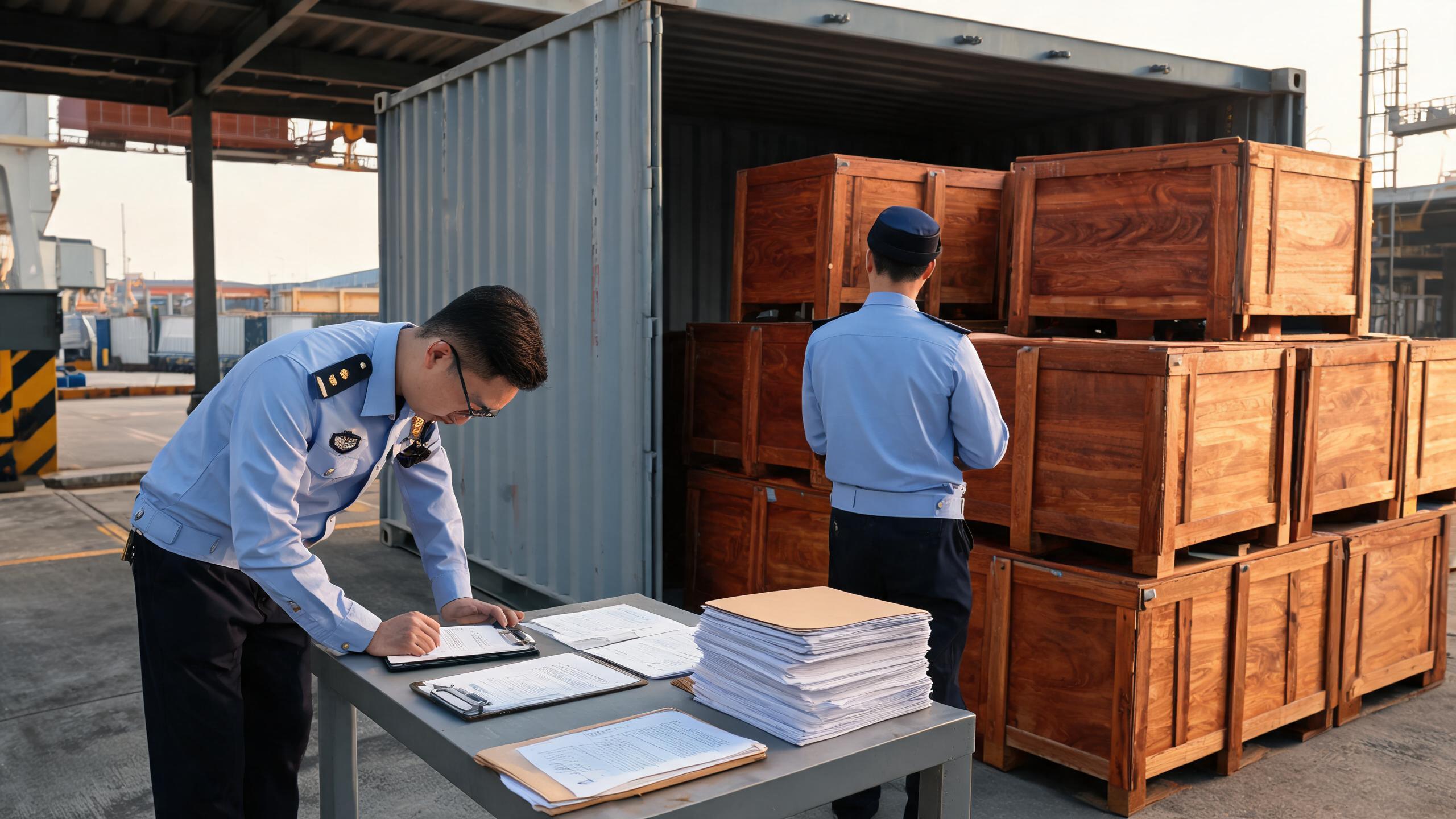
دليل عملي لمشتري B2B حول كيفية تأثير لوائح CITES على واردات أثاث خشب الورد من الصين، ويغطي عمليات التصاريح وتحديد الأنواع ومخاطر الإنفاذ واستراتيجيات الامتثال لعام 2026.
Why CITES Matters for Every Rosewood Furniture Importer in 2026
If you import classical rosewood furniture from China, the letters C-I-T-E-S should already be on your radar. If they are not, the cost of ignorance is rising fast. In July 2026, a restaurant in Brampton, Canada, pleaded guilty to importing rosewood pool tables and furniture without the required CITES permits. The fine was CAD 25,000, the goods were seized, and the business spent months untangling the paperwork. The supplier had labeled the shipment "hardwood." The commercial invoice said "tables." Nobody mentioned Dalbergia-the rosewood genus that CITES has regulated since 2017. By the time Canada Border Services Agency (CBSA) officers pulled the container for examination, the importer had no permit to show.
This is not an isolated incident. Across the European Union, the United Kingdom, the United States, Australia, and Japan, customs authorities are stepping up enforcement of CITES Appendix II listings that cover the entire Dalbergia genus-over 300 species of rosewood and related timber. For B2B buyers sourcing classical redwood furniture from Chinese manufacturers, the implications are direct: every shipment containing regulated species must arrive with valid CITES export permits and import permits, or it will not clear customs. This article walks through what the regulations say, which species are affected, how the permit process works in practice, what documents buyers need, and how to work with a Chinese factory to keep shipments compliant without losing weeks of lead time.
What Is CITES and Why Does It Cover Rosewood?
The Convention on International Trade in Endangered Species of Wild Fauna and Flora (CITES) is an international agreement signed by 184 parties (183 countries plus the European Union). It regulates the cross-border trade in selected species of animals and plants to ensure that international commerce does not threaten their survival in the wild. Species covered by CITES are listed in three appendices, each carrying a different level of trade restriction:
- Appendix I includes species threatened with extinction. Commercial international trade is prohibited. For rosewood, this includes Dalbergia nigra (Brazilian rosewood), which has been listed since 1992.
- Appendix II includes species not necessarily threatened with extinction now, but in which trade must be controlled to avoid utilization incompatible with their survival. This is where most rosewood species sit today.
- Appendix III includes species that individual countries have asked other CITES parties to help regulate. A species can move between appendices as populations recover or decline.
The critical shift for the furniture industry came at the 17th meeting of the Conference of the Parties (CoP17) in Johannesburg in 2016. There, CITES parties voted to list the entire Dalbergia genus-all species worldwide-on Appendix II, with the sole exception of Dalbergia nigra, which was already on Appendix I. The listing took effect on January 2, 2017. Overnight, species that furniture makers had used for decades without restriction-including Dalbergia cochinchinensis (Siamese rosewood), Dalbergia odorifera (fragrant rosewood, known in Chinese as jiangxiang huanghualu), Dalbergia retusa (cocobolo), Dalbergia melanoxylon (African blackwood), and dozens of others-became subject to international trade controls.
At the 19th meeting of the Conference of the Parties (CoP19) in Panama City in November 2022, parties further tightened controls. They adopted annotation #17, which specifies that the Appendix II listing for Dalbergia covers logs, sawn wood, veneers, plywood, and transformed wood-which explicitly includes furniture. Before annotation #17, there was ambiguity about whether finished furniture pieces made from Dalbergia required CITES permits. That ambiguity is gone. As of November 26, 2024, finished rosewood furniture shipped across international borders requires CITES documentation.
Which Rosewood Species Are Common in Classical Chinese Furniture?
Chinese classical redwood furniture (known as hongmu furniture) draws from a defined set of timber species, many of which fall under Dalbergia and therefore under CITES Appendix II. The Chinese national standard GB/T 18107-2017 ("Redwood") classifies 29 species across 8 genera into 5 use categories. Among the most commercially significant for export furniture:
| Species (Scientific Name) | Common Name | CITES Status | Typical Use in Furniture |
|---|---|---|---|
| Dalbergia odorifera | Fragrant rosewood (Huanghuali) | Appendix II | Premium classical reproductions, armchairs, cabinets |
| Dalbergia cochinchinensis | Siamese rosewood | Appendix II | Sofa frames, dining tables, carved panels |
| Dalbergia retusa | Cocobolo | Appendix II | Inlay work, small accent pieces |
| Dalbergia melanoxylon | African blackwood | Appendix II | Fine carving, decorative elements |
| Pterocarpus erinaceus | African padauk / Barwood | Appendix II (since 2016) | Budget-tier "rosewood" furniture, sofa sets |
| Pterocarpus macrocarpus | Burmese padauk | Not CITES-listed (but trade restricted by Myanmar sanctions) | Sofa sets, dining furniture |
Not every timber used in Chinese hongmu furniture is Dalbergia. Pterocarpus species (padauk) are also common, and Pterocarpus erinaceus-a West African species-was listed on CITES Appendix II in 2016, meaning it requires the same permits. Pterocarpus macrocarpus (Burmese padauk) is not CITES-listed, but trade is constrained by international sanctions on Myanmar timber exports, which creates a separate compliance burden. Other non-CITES species used in Chinese furniture include Millettia laurentii (wenge) and Cassia siamea (siamese senna), though these are less common in export-grade classical sets.
The practical implication for buyers: if your furniture is made from any Dalbergia species or Pterocarpus erinaceus, you need CITES permits. If your supplier cannot tell you the exact botanical species of the timber used, you have a compliance problem before the furniture even leaves the factory.
How the CITES Permit Process Works in Practice
The CITES permit system operates on a principle of dual control: the exporting country issues an export permit, and the importing country issues an import permit. Both must be in hand before the shipment crosses the border. Here is how the process works for a rosewood furniture shipment from China to, say, the United States:
- Species identification. The Chinese factory must confirm the exact botanical species of the timber used in the furniture. This sounds straightforward, but in practice many factories use common Chinese trade names-suanzhi (acid branch wood), huanghuali, hei tan-which can map to multiple species. The factory needs to trace the timber back to its scientific name and, ideally, to the original log purchase records.
- Export permit application in China. The factory applies to the CITES Management Authority of China (housed within the National Forestry and Grassland Administration) for an export permit. The application must include the scientific name, the volume or number of specimens, the country of origin of the timber (not necessarily China-many rosewood logs are imported into China from Southeast Asia or Africa before being processed into furniture), and proof that the timber was legally acquired. China's CITES authority then consults with a Scientific Authority to confirm that the export will not be detrimental to the species' survival-a process known as a "non-detriment finding" (NDF).
- Import permit application in the destination country. Simultaneously, the importer applies to their own national CITES Management Authority for an import permit. In the United States, this is the U.S. Fish and Wildlife Service (USFWS) through the ePermits system. In the EU, it is the relevant national CITES authority (for example, the Federal Agency for Nature Conservation in Germany or the Animal and Plant Health Agency in the UK). The import permit application must reference the specific shipment and species.
- Permit issuance and shipment. Once both permits are issued, the shipment can proceed. The export permit travels with the shipment and is presented to customs at the port of export and again at the port of import. The import permit is presented to the destination country's customs authority.
- Clearance and endorsement. At the port of import, the CITES import permit is endorsed by the customs officer, and the shipment is released. The endorsed permit becomes the legal proof that the import complied with CITES.
The entire process typically takes 4 to 8 weeks, assuming no complications. If the timber's origin chain is unclear-if the factory cannot prove where the logs were originally harvested-the export permit application can be rejected outright, and the timeline starts over.
What Happens When Shipments Are Non-Compliant
The Brampton case is instructive, but it is far from the only example. Enforcement actions have increased across major importing regions since 2024, when annotation #17 made it unambiguously clear that finished furniture is covered. The consequences of non-compliance fall into several categories:
Seizure and Forfeiture
In the United States, the Lacey Act makes it a federal offense to import, sell, or transport any plant product that was illegally harvested or traded in violation of any foreign law. Because CITES permits are a legal requirement, importing Dalbergia furniture without a valid CITES permit violates the Lacey Act. The shipment can be seized and forfeited. The importer may also face civil penalties-up to USD 10,000 per violation for negligent violations, and up to USD 20,000 (for individuals) or USD 500,000 (for organizations) for grossly negligent or knowing violations. Criminal prosecution is possible for intentional violations.
In the European Union, CITES is enforced through Council Regulation (EC) No 338/97 and Commission Regulation (EC) No 865/2006. Non-compliant shipments are seized at the border. The importer faces administrative fines that vary by member state-Germany, for example, can impose fines up to EUR 50,000, while France can assess fines up to EUR 750,000 for CITES violations. The goods may be confiscated and destroyed or returned to the country of export at the importer's expense.
In the United Kingdom, post-Brexit CITES enforcement is handled by the Animal and Plant Health Agency (APHA). Seized goods are forfeited, and fines can reach GBP 5,000 per offense under the Control of Trade in Endangered Species (Enforcement) Regulations. Serious cases can be prosecuted under the Customs and Excise Management Act, with penalties including unlimited fines and up to seven years' imprisonment.
Reputational and Commercial Damage
Beyond the immediate legal penalties, a CITES seizure creates a cascade of commercial problems. The container sits at the port, accumulating demurrage charges-typically USD 75 to 200 per day at major U.S. and European ports. The buyer's project timeline slips. If the furniture was destined for a hospitality project (a hotel, restaurant, or showroom), the delay can trigger liquidated damages clauses in construction or fit-out contracts. And a customs seizure becomes part of the importer's compliance history, which can trigger enhanced scrutiny on future shipments-meaning every subsequent container is more likely to be pulled for examination, adding days to every future clearance.
The Country-of-Origin Question: Where Did the Timber Come From?
One of the most underappreciated complexities in CITES compliance for rosewood furniture is the country-of-origin requirement. CITES permits must be issued by the country of origin-the country where the timber was harvested-not necessarily the country of export. China is the world's largest processor of rosewood timber, but it produces almost none of the raw material domestically. The logs arrive in China from a network of source countries:
- Southeast Asia: Laos, Cambodia, Vietnam, and Myanmar have historically been major sources of Dalbergia cochinchinensis and Pterocarpus macrocarpus. Logging and export restrictions in these countries have tightened significantly since 2016.
- West Africa: Nigeria, Senegal, Guinea-Bissau, and Gambia have been sources of Pterocarpus erinaceus. CITES listed this species on Appendix II in 2016, and several West African countries have since imposed their own export bans.
- Central America: Mexico, Nicaragua, Guatemala, and Panama are sources of Dalbergia retusa (cocobolo) and other Central American rosewood species.
- Southern Africa: Mozambique and Tanzania are sources of Dalbergia melanoxylon (African blackwood), increasingly used in fine carving.
When a Chinese factory makes furniture from Dalbergia cochinchinensis logs imported from Laos, the CITES export permit from China must be based on a re-export certificate-not a standard export permit-because China is a re-exporting country for that timber. The re-export certificate references the original CITES export permit issued by Laos when the logs were exported to China. If that original Lao permit does not exist or cannot be located, the Chinese CITES authority cannot issue a valid re-export certificate, and the furniture cannot be legally exported under CITES.
This is where many compliance failures originate. A factory may have purchased logs years ago, before CITES listing, and no longer has the original import documentation. Or the logs may have entered China through informal channels that bypassed CITES permit requirements at the time. In either case, the timber's paper trail is broken, and the furniture made from it cannot be legally exported today-no matter how legitimate the factory's current operations are.
For buyers, this means that due diligence on the timber supply chain is not optional. Before placing an order, ask the factory:
- What is the exact botanical species of the timber?
- From which country was the original log sourced?
- Does the factory have the original CITES export permit from the source country (or proof that the timber was acquired before the relevant CITES listing date)?
- Has the factory previously obtained CITES re-export certificates for shipments of this species?
If the answer to any of these questions is "we are not sure" or "we will check later," treat it as a red flag. The permit application process cannot begin without this information, and a failure at the permit stage can stall a shipment indefinitely.
How to Build CITES Compliance Into Your Sourcing Workflow
The most effective way to manage CITES compliance is to treat it as a parallel workflow that runs alongside production, not as a final hurdle before shipping. Here is a practical framework that B2B buyers can follow:
1. Confirm Species and Timber Origin Before Placing the Order
During the initial quotation stage, ask the factory to specify the exact botanical name of the timber and to provide documentation of the log's origin. A factory that regularly exports Dalbergia furniture will have this information on file, because they need it for their own CITES export permit applications. If the factory cannot provide it, either the species is not CITES-listed (in which case, get that confirmed in writing with the scientific name), or the factory has not been exporting legally-which is a risk you should not take.
2. Start the Permit Process When Production Begins, Not When It Ends
The CITES permit process takes 4 to 8 weeks. Furniture production for a full house order (sofa set, dining set, bedroom set, and ancillary pieces) typically takes 8 to 16 weeks. If you start the permit applications when production starts, the permits should be ready by the time the furniture is finished. If you wait until the furniture is packed and ready to ship, you will add 4 to 8 weeks of storage and delay to your timeline-and the factory may charge warehousing fees for holding the goods.
3. Use a Customs Broker Experienced With CITES
Not all customs brokers are familiar with CITES requirements for timber products. A broker who handles CITES regularly will know how to present the permits, which additional documentation the customs officer may request (such as a declaration of the timber's scientific name on the commercial invoice and packing list), and how to respond to questions about the shipment. Using a broker who has never processed a CITES timber import is a recipe for delays, even when your paperwork is in order.
4. Ensure Commercial Documents Reference the Scientific Name
One of the most common reasons for customs holds is a mismatch between the commercial invoice and the CITES permit. If the commercial invoice says "wooden furniture" or "hardwood sofa" but the CITES permit says Dalbergia cochinchinensis, customs will flag the discrepancy. Every commercial document-the invoice, the packing list, the bill of lading-should reference the timber's scientific name alongside the product description. For example: "Carved rosewood sofa set, 1 set, timber species: Dalbergia cochinchinensis (CITES Appendix II), CITES export permit No. CN-2026-XXXXX, CITES import permit No. US-2026-XXXXX."
5. Keep Copies of All Permits for at Least Five Years
CITES permits are legal documents, and importers are required to retain them. In the United States, the Lacey Act requires importers to maintain a declaration for all plant products, including the scientific name, value, quantity, and country of origin. The declaration must be retained for at least five years. In the EU, CITES documentation must be kept for at least three years (some member states require longer). A post-clearance audit can happen years after the import, and if you cannot produce the permits, you are presumed non-compliant.
How CITES Interacts With Other Timber Regulations
CITES is not the only regulatory framework that governs the international trade in rosewood furniture. Buyers need to understand how it interacts with other timber regulations:
The EU Timber Regulation (EUTR) and the EU Deforestation Regulation (EUDR)
The EU Timber Regulation (Regulation (EU) No 995/2010) prohibits the placing of illegally harvested timber on the EU market and requires operators to exercise due diligence. The EUTR applies regardless of whether the species is CITES-listed-if the timber was harvested illegally in its country of origin, it cannot be sold in the EU. The EUTR was reinforced by the EU Deforestation Regulation (EUDR, Regulation (EU) 2023/1115), which entered into force in June 2023 and applies to timber, cattle, cocoa, coffee, palm oil, rubber, and soy. The EUDR requires operators to prove that products do not come from land deforested after December 31, 2020. For rosewood furniture, this means that in addition to CITES permits, EU importers need to verify the geolocation of the forest where the timber was harvested. The EUDR's full enforcement date has been subject to delay; check the current enforcement timeline with your EU customs authority.
The US Lacey Act
The Lacey Act (as amended in 2008) is broader than CITES. It prohibits trade in any plant or plant product that was taken, harvested, possessed, transported, or sold in violation of any U.S. law, any foreign law, or any Indian tribal law. This means that even if a Dalbergia species were removed from CITES tomorrow, importing furniture made from timber that was illegally logged in, say, Laos would still violate the Lacey Act. The Lacey Act also requires a plant product import declaration (PPQ Form 505), which must include the scientific name, the country of harvest, the quantity, and the value. For CITES-listed species, the Lacey Act declaration and the CITES permits work in tandem-the CITES permit proves legal acquisition, and the Lacey declaration provides the data trail.
WAPPRIITA (Canada)
The Wild Animal and Plant Protection and Regulation of International and Interprovincial Trade Act is Canada's CITES implementing legislation. It applies the same permit requirements as CITES itself, and-as the Brampton case demonstrated-it is actively enforced by CBSA. The fine in that case was directed to the Environmental Damages Fund, and the goods were seized pending resolution. Canadian importers should note that WAPPRIITA also covers interprovincial trade in certain species, which means that moving CITES-listed furniture between Canadian provinces may require additional documentation.
Australia's Illegal Logging Prohibition Act
Australia's Illegal Logging Prohibition Act 2012 and its regulations require importers to assess the risk that the timber in their products has been illegally logged. For CITES-listed species, the risk assessment is straightforward-if the shipment lacks a valid CITES permit, the timber is by definition illegal, and the import violates the Act. The Australian Department of Agriculture, Fisheries and Forestry conducts document checks and can require additional due diligence assessments.
The Cost of Compliance: What Permits and Delays Actually Add to Your Budget
CITES compliance is not free, and buyers should budget for it. Here is a rough breakdown of the direct costs:
| Cost Item | Typical Range (USD) | Who Pays |
|---|---|---|
| CITES export permit application (China) | 50–150 per shipment | Factory (often passed to buyer) |
| CITES import permit application (destination country) | 50–200 per shipment (varies by country; USFWS charges USD 100 for most CITES permit applications) | Importer |
| Customs broker CITES processing fee | 150–400 per shipment | Importer |
| Timber species testing (if required by customs) | 300–800 per sample | Importer |
| Additional storage/demurrage (if permits are delayed) | 75–200 per day | Importer |
For a typical container of rosewood furniture valued at USD 30,000 to 80,000, the direct CITES compliance costs add roughly 1 to 3 percent to the landed cost. This is not negligible, but it is far cheaper than a seizure-which can result in the loss of the entire shipment, fines that exceed the goods' value, and legal fees that dwarf the permit costs.
The indirect cost of compliance is time. A well-managed permit process that runs parallel to production adds zero days to the timeline. A poorly managed process that starts after production is complete can add 4 to 8 weeks. For buyers working with tight project deadlines-hotel openings, showroom launches, or seasonal retail cycles-those weeks can be more costly than the permit fees themselves.
Working With Yunxiao Rosewood Furniture on CITES Compliance
As a manufacturer of classical redwood furniture in China, Yunxiao Rosewood Furniture Co., Ltd. works with several Dalbergia and Pterocarpus species in its sofa, dining, and bedroom sets. The factory's experience with export shipments means that the species identification and timber origin documentation needed for CITES permit applications should be available for products made from regulated timber. Buyers placing orders for furniture that includes CITES-listed species should request the following from the factory at the quotation stage:
- The botanical name of the timber species used in each product line
- The country of origin of the timber (where the logs were harvested)
- The factory's history of CITES export permit applications for that species
- An estimated timeline for the CITES permit process, so it can be synchronized with the production schedule
Yunxiao's product range includes furniture made from Siamese rosewood (Dalbergia cochinchinensis), which is CITES Appendix II listed. Buyers ordering Siamese rosewood furniture should confirm that the factory has the original timber import documentation that allows the Chinese CITES authority to issue a re-export certificate. If the factory is unable to provide this documentation, the buyer may need to consider alternative species-such as Pterocarpus macrocarpus (Burmese padauk), which is not CITES-listed-or adjust the timeline to accommodate the permit process.
The Broader Industry Trend: Why Compliance Is Becoming a Competitive Advantage
The enforcement landscape is moving in one direction: more inspections, more documentation requirements, and higher penalties. Several factors are driving this:
Enhanced Customs Technology
Major customs authorities are deploying advanced timber identification technologies. The U.S. Fish and Wildlife Service operates a forensic laboratory that can identify timber species from wood anatomy and DNA analysis. The EU's CITES enforcement authorities use similar techniques, and the World Customs Organization has developed a rapid timber identification guide for frontline officers. This means that mislabeling a CITES-listed species as "hardwood" or "generic wood furniture" is increasingly likely to be detected. The Brampton case began not with a targeted investigation but with a routine container examination-the CBSA officer simply opened the shipment and saw rosewood.
Supply Chain Transparency Requirements
Beyond CITES, the trend in timber regulation is toward full supply chain transparency. The EU Deforestation Regulation requires geolocation data for the forest where timber was harvested. The U.S. Lacey Act requires a declaration with the scientific name and country of harvest. Major retailers and hospitality brands are imposing their own supply chain transparency requirements on their furniture suppliers, often going beyond what the law requires. For Chinese furniture factories, this means that the ability to trace timber from forest to finished product is becoming a baseline expectation, not a differentiator.
Reputational Risk for Importers
A CITES seizure is a public record. Customs enforcement actions are reported in trade publications, and in some jurisdictions, they appear in public enforcement databases. For an importer's brand-particularly one that markets itself as sustainable or ethically sourced-a CITES violation can be a reputational crisis that extends far beyond the financial penalty. Buyers who sell to environmentally conscious markets (the EU, Scandinavia, parts of North America) should treat CITES compliance as a brand protection issue, not just a legal one.
The Shift Toward Non-CITES Alternatives
Some manufacturers and buyers are responding to CITES compliance costs by shifting toward non-CITES-listed species. Pterocarpus macrocarpus (Burmese padauk), while not CITES-listed, faces its own trade restrictions due to Myanmar sanctions. Millettia laurentii (wenge) and Cassia siamea (siamese senna) are not CITES-listed and can be used for furniture, though they have different aesthetic and physical properties. Plantation-grown timber and certified sustainable sources (FSC-certified) are increasingly attractive for buyers who want to minimize regulatory friction. However, for buyers who specifically want the aesthetic, density, and cultural value of traditional Dalbergia rosewood, there is no true substitute-and CITES compliance is simply the cost of doing business with these species.
Frequently Asked Questions From Rosewood Furniture Buyers
Do I need a CITES permit for every type of rosewood furniture?
You need a CITES permit if the furniture is made from any species listed on CITES Appendix I or II. The entire Dalbergia genus is on Appendix II (with Dalbergia nigra on Appendix I). Pterocarpus erinaceus is also on Appendix II. If your furniture is made from a non-CITES-listed species-such as Pterocarpus macrocarpus or Millettia laurentii-no CITES permit is needed, though other regulations (such as the Lacey Act or EUTR) may still apply. Always confirm the scientific name of the timber with your supplier.
How long does the CITES permit process take?
Typically 4 to 8 weeks, assuming the timber documentation is in order. The export permit in China and the import permit in the destination country are processed in parallel. If the factory cannot provide timber origin documentation, the process can take significantly longer or fail entirely. Start the permit process at the same time as production begins.
Can I use one CITES permit for multiple shipments?
Generally, no. CITES permits are issued for specific shipments-each permit references a specific quantity of specimens, a specific importer and exporter, and a specific time frame (usually valid for 6 months for export permits and 12 months for import permits in most jurisdictions). If you are shipping multiple containers of rosewood furniture over several months, you will need separate permits for each shipment. However, some countries offer "blanket" or "multiple-shipment" permits for frequent traders; check with your national CITES authority.
What happens if my shipment is seized for lack of a CITES permit?
The shipment will be held by customs. You will typically have the option to (a) apply for the necessary permits retroactively (which is difficult and not always possible, especially if the export permit from China cannot be obtained after the fact), (b) re-export the goods back to the country of origin at your expense, or (c) abandon the goods. You may also face fines. In some cases, the goods may be confiscated and destroyed. Legal counsel with experience in CITES enforcement is advisable.
Does Yunxiao Rosewood Furniture provide CITES permits for its furniture?
The factory applies for CITES export permits as part of the export process for furniture made from CITES-listed species. Buyers are responsible for applying for the import permit in their destination country. The factory should provide the species identification, timber origin documentation, and support needed for the buyer's import permit application. Confirm the specific species and CITES status of your order with the factory before placing it, so that the permit process can be planned alongside production.
Practical Checklist: What to Do Before Your Next Rosewood Furniture Order
If you are planning to import rosewood furniture from China in the coming months, use this checklist to ensure CITES compliance:
- Identify the species. Get the exact botanical name of the timber from the factory-not just the Chinese trade name. Cross-check it against the CITES Appendices (available at cites.org/eng/app/appendices.php).
- Verify timber origin. Ask the factory where the timber was harvested and whether they have the original CITES export permit or pre-convention certificate for the logs.
- Confirm the factory's CITES export history. Ask whether the factory has previously obtained CITES re-export certificates for this species. A factory with experience in the permit process will be faster and more reliable.
- Engage your customs broker early. Find a broker who has handled CITES timber imports. Provide them with the species name and shipment details so they can advise on the import permit process in your country.
- Start both permit applications when production begins. The Chinese factory applies for the export permit (or re-export certificate); you apply for the import permit. Run them in parallel with the 8 to 16 week production timeline.
- Ensure all commercial documents reference the scientific name. The commercial invoice, packing list, and bill of lading should all state the timber species by its scientific name and reference the CITES permit numbers.
- Budget for compliance costs. Add 1 to 3 percent to the landed cost for permit fees, broker fees, and potential testing. This is insurance against a seizure that could cost you the entire shipment.
- Keep all permits and declarations for at least five years. Post-clearance audits happen. If you cannot produce the documentation, you are presumed non-compliant.
- Consider alternative species if the timeline is tight. If your project deadline does not allow 4 to 8 weeks for the permit process, or if the factory cannot guarantee timber origin documentation, consider non-CITES-listed species. The aesthetic will differ, but you will avoid the regulatory risk.
- Treat compliance as a relationship issue, not just a paperwork issue. A factory that is transparent about species, timber origin, and permit history is a better long-term partner than one that is vague or evasive. CITES compliance is a test of the factory's overall management quality-and the results tell you something about how they handle every other aspect of production.
Conclusion: Compliance Is the Price of Access to the Rosewood Market
The global trade in rosewood furniture is not going to become less regulated. The CITES Dalbergia listing has been in place since 2017, annotation #17 extended it unambiguously to finished furniture in 2024, and enforcement has intensified in 2025 and 2026. The Brampton seizure is a warning shot, not an anomaly. For every shipment that gets seized, many more are delayed, inspected, and held for additional documentation-adding cost and time that erodes the buyer's margin and timeline.
For B2B buyers sourcing classical redwood furniture from China, the path forward is clear: know your species, know your timber origin, start the permit process early, work with experienced customs brokers, and treat compliance documentation as a core part of your sourcing workflow rather than a last-minute obstacle. The factories that can support this process-by providing species identification, timber origin records, and a history of successful CITES permit applications-are the ones that will thrive in the regulated market. Those that cannot will find their export channels narrowing as enforcement tightens.
At Yunxiao Rosewood Furniture, the commitment to producing classical furniture from genuine rosewood timber remains central to the company's identity. Navigating the CITES landscape is part of delivering that product to international buyers. By understanding the regulations, planning the permit process alongside production, and maintaining transparent timber documentation, buyers and manufacturers can continue to trade in these remarkable materials-legally, responsibly, and without the costly surprises that come from treating compliance as an afterthought.
Planning a rosewood furniture order? Contact Yunxiao Rosewood Furniture to confirm the timber species, CITES status, and export documentation for your specific products, and start the permit process alongside your production schedule.