
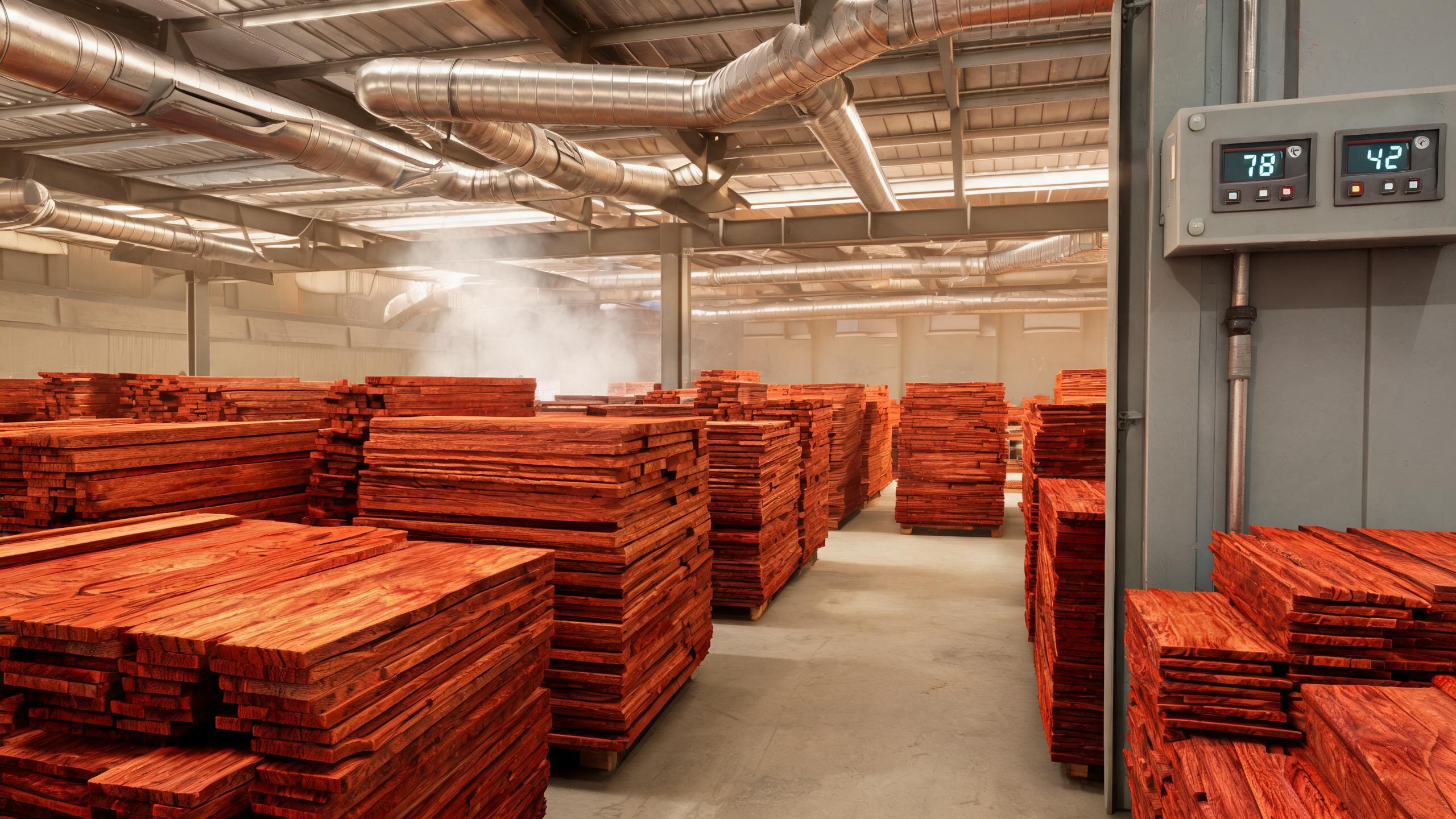
التجفيف بالفرن هو أهم خطوة لمراقبة الجودة في تصنيع أثاث خشب الورد. يشرح هذا الدليل علم محتوى الرطوبة، ومعايير دورة التجفيف، ومحتوى الرطوبة المستهدف لمناخي أوروبا وأمريكا الشمالية، وكيفية التحقق من التجفيف السليم قبل الاستيراد.
What Is Kiln Drying and Why Does It Matter for Rosewood Furniture?
Kiln drying is the controlled process of removing moisture from freshly cut timber using a heated chamber with regulated temperature, humidity, and airflow. For rosewood furniture manufacturers in Fujian, China, this step is non-negotiable. Freshly harvested redwood contains moisture content (MC) of 30% or higher. If this wood is crafted into furniture without proper drying, it will warp, crack, and lose structural integrity as it adjusts to drier indoor environments in Europe and North America.
The goal of kiln drying is to bring the moisture content down to a target range of 8% to 12%, which matches the typical indoor humidity conditions in heated European homes and air-conditioned North American buildings. Wood that arrives at 14% MC or higher from a factory that only air-dries will inevitably develop problems after 3 to 6 months in a dry climate.
How Does the Kiln Drying Process Work in a Redwood Furniture Factory?
A proper moisture content reduction cycle for dense tropical hardwoods like Dalbergia species takes a minimum of 15 to 36 days, depending on the thickness of the planks and the initial MC. The process follows four distinct phases.
Phase 1: Pre-conditioning. Freshly sawn planks are stacked with stickers between each layer to allow airflow. The stack enters the kiln at ambient temperature, and the operator gradually raises the temperature to 40 degrees Celsius over 48 hours while maintaining high humidity. This prevents surface checking, which is the formation of small cracks on the wood surface caused by too-rapid drying.
Phase 2: Main drying. The temperature is raised to 55 to 65 degrees Celsius, and humidity is progressively reduced. This is the longest phase, lasting 10 to 20 days for thick redwood planks. Moisture migrates from the core of the wood to the surface and evaporates. The kiln operator monitors the MC daily using pin-type meters inserted into sample boards.
Phase 3: Equalizing. Once the average MC reaches about 10%, the kiln temperature is held steady while humidity is slightly increased. This allows the drier outer layers to absorb a small amount of moisture while the wetter core continues to release it. The goal is to achieve a moisture gradient of no more than 2% between the surface and the core of the plank.
Phase 4: Conditioning and cooling. The kiln is cooled to ambient temperature over 24 to 48 hours with high humidity to relieve drying stresses. The wood then rests in the factory for 5 to 7 days before machining begins, allowing it to reach equilibrium with the workshop environment.
What Moisture Content Should Rosewood Furniture Have for Export?
The target MC depends on the destination market. For furniture shipped to Northern Europe, where indoor heating drives relative humidity down to 30% in winter, the target MC is 8% to 10%. For North America, where air-conditioned homes maintain 35% to 45% RH year-round, 9% to 11% is ideal. For tropical Southeast Asian markets, 12% to 14% is acceptable because ambient humidity remains high.
If the timber processing is done correctly, each piece of furniture should be tested with a pin-type moisture meter at no fewer than five points: the center of the tabletop, both end-grain surfaces, an interior shelf, and a leg. Any reading above 12% for European-bound furniture is a red flag that demands investigation.
How Can Buyers Verify Proper Kiln Drying?
European and North American buyers cannot stand in the factory during every drying cycle, but they can request quality control documentation that proves the process was followed correctly. Here is what to ask your supplier for.
Request kiln drying records. A reputable factory maintains a drying log for each batch that shows the temperature curve, humidity settings, and MC readings taken at intervals throughout the cycle. This document should span a minimum of 15 days for standard-thickness redwood. If the record shows a cycle shorter than 10 days, the wood was not properly dried.
Test with a moisture meter on delivery. When the furniture arrives at your warehouse, use a calibrated pin-type moisture meter to test multiple surfaces. A reading between 8% and 12% confirms proper drying. A reading of 14% or higher means the wood was either insufficiently dried or re-absorbed moisture during shipping due to poor packaging.
Inspect for signs of improper drying. Look for surface checks, end-grain cracks, warped panels, and loose joints. These are physical evidence that the wood was not dried to the correct MC or was dried too quickly. A single hairline crack on an end-grain surface may be acceptable in a rustic piece, but multiple cracks across a dining tabletop indicate a serious drying failure.
What Happens When Rosewood Furniture Is Not Properly Kiln Dried?
The consequences of skipping or rushing kiln drying are severe and expensive. Within 3 to 6 months of placement in a heated or air-conditioned room, improperly dried redwood furniture will exhibit the following problems.
Cracking and splitting. As moisture escapes from the wood faster than it can redistribute, the surface shrinks faster than the core, causing cracks. These typically appear along the grain on tabletops, chair seats, and cabinet panels. Once a crack opens, it cannot be fully repaired without disassembling the piece.
Warping and twisting. Panels that were flat when they left the factory will cup, bow, or twist as internal stresses are released. A warped tabletop may rock on its base or develop gaps at the joints between the top and the apron.
Joint failure. Mortise-and-tenon joints rely on a precise friction fit. When the wood shrinks, the tenon becomes smaller than the mortise, and the joint loosens. In severe cases, chair legs may wobble or detach entirely. This is particularly common in furniture that uses hide glue, which is reversible but loses strength when the joint opens.
Finish degradation. Lacquer and wax finishes applied to wet wood will blister, peel, or develop a cloudy bloom as moisture pushes outward through the finish. This is not a finish problem but a wood problem that cannot be fixed by re-finishing alone.
How Does Yunxiao Manage Kiln Drying for Export Orders?
At Yunxiao Rosewood Furniture, every batch of redwood timber enters our kiln drying facility before any machining or carving begins. Our standard drying cycle for export orders runs 36 days to ensure the moisture content reaches 8% to 10% for European destinations and 9% to 11% for North American orders. We maintain drying logs for every batch and provide them to buyers upon request as part of our quality control documentation package.
After drying, each plank is tested with a calibrated pin-type meter at multiple points before it is approved for production. Any plank that does not meet our MC standard is returned to the kiln for an additional equalizing cycle. This commitment to proper timber processing is why our furniture has a consistently low rate of post-delivery cracking and warping, even after years in heated European and North American homes.
We also coordinate with our packaging team to ensure that dried furniture is wrapped with moisture-barrier materials and desiccant packs before container loading, preventing re-absorption of moisture during the 30 to 45 day ocean transit. This end-to-end approach to moisture management is one of the key differences between a factory that builds furniture for long-term use and one that simply ships product.