
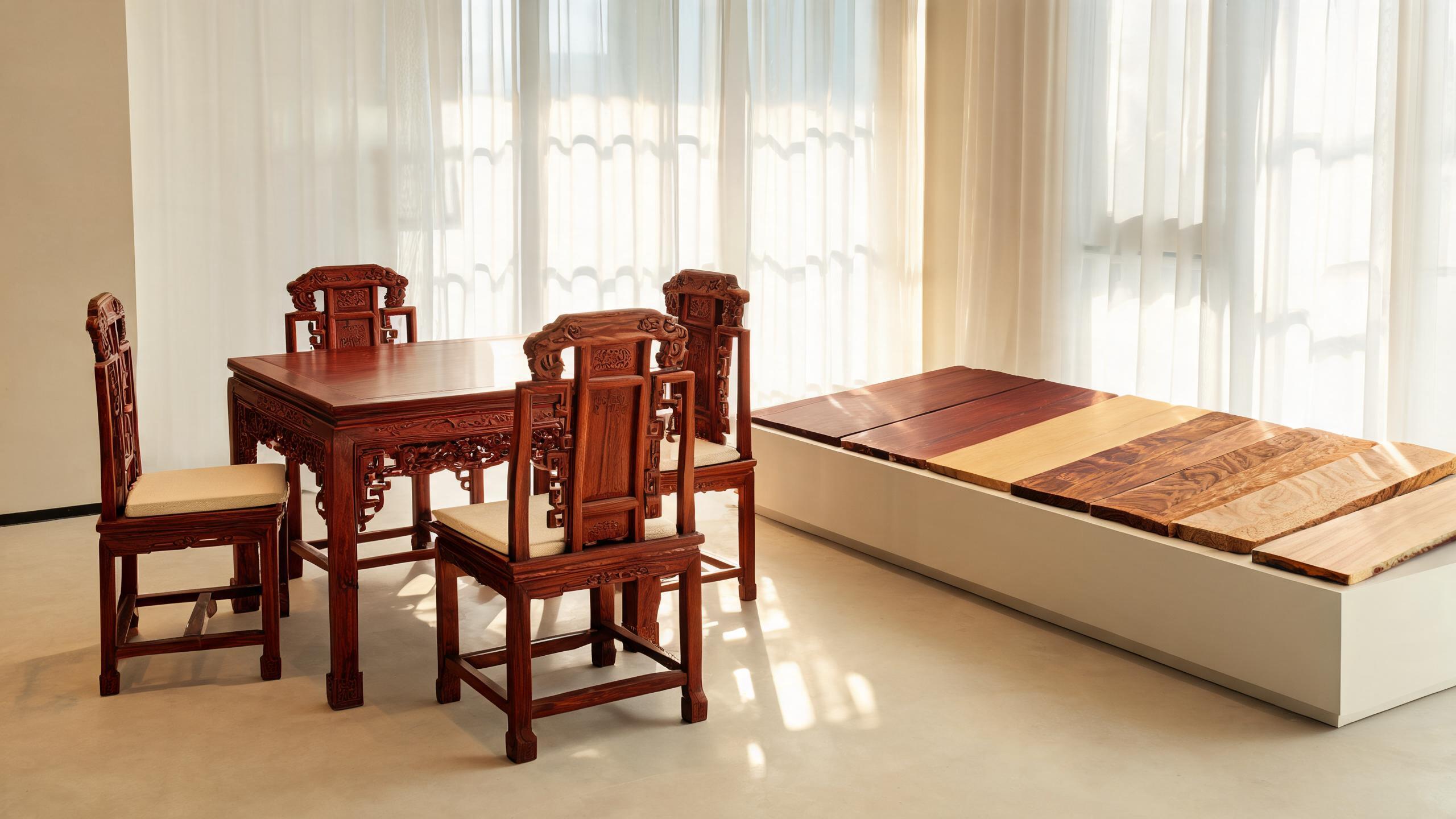
دليل عملي B2B يقارن خشب الورد مع خشب الساج والبلوط والجوز والماهوغاني لتوريد الأثاث، ويغطي الكثافة والمتانة والحبيبات والتكلفة والامتثال والتطبيقات وكيفية اختيار الخشب الصلب المناسب لعملك...
Why the Wood Species Decision Is the Most Important Choice You Will Make
When you import solid wood furniture for resale, for a hotel project, or for a whole-house furnishing program, the single decision that shapes everything else is the species of timber. It determines how the piece looks, how long it lasts, how much it costs, how it behaves in different climates, and how easy it is to keep compliant with timber regulations in your market. Yet many buyers choose a wood the same way they choose a color: by what looks good in a photograph. That is a costly mistake.
This guide is written for B2B importers, interior designers, hotel and hospitality buyers, and furniture retailers who are comparing rosewood with other solid hardwoods such as teak, oak, walnut, and mahogany. We will walk through the properties that actually matter in a commercial sourcing decision, explain where rosewood sits in that landscape, and give you a practical framework for matching a timber to your market, your price point, and your customers. The goal is not to tell you that one wood is universally best. It is to help you ask the right questions and make a decision you can defend to your own customers.
What We Mean by Rosewood and Why It Is Different
The word rosewood is used loosely in the furniture trade, and that looseness causes real confusion. In the strictest sense, true rosewoods belong to the genus Dalbergia, a group of tropical hardwoods prized for their dense grain, rich color, and natural oils. The most famous commercial species include Siamese rosewood (Dalbergia cochinchinensis), which is the timber Yunxiao uses for its classical furniture, along with other Dalbergia species traded under names such as Brazilian rosewood and Indian rosewood.
What separates rosewood from most other hardwoods is a combination of density, color, and workability. Rosewood is heavy and hard, which means it resists dents and wear. It carries a distinctive reddish-brown to deep purple-brown color that deepens with age and exposure to light. It has a fine, often dramatic grain that makes hand-carving and joinery stand out. And it contains natural oils that give it a degree of moisture resistance and a characteristic scent. These are the properties that have made rosewood the timber of choice for classical Chinese furniture for centuries.
Because of these qualities, rosewood is not a commodity wood. It is a premium material, and it is priced and regulated accordingly. That is the first thing a buyer needs to understand: when you choose rosewood, you are choosing a material that carries both a higher cost and a higher compliance responsibility than many alternatives.
Rosewood Species and Grades: Not All Rosewood Is the Same
Just as there is no single wood called hardwood, there is no single wood called rosewood. The term covers a family of Dalbergia species, and the differences between them matter for both appearance and price. Siamese rosewood, also known as Dalbergia cochinchinensis, is one of the most prized species for classical furniture because of its deep color, fine grain, and excellent workability. Other species traded as rosewood can vary in color from lighter reddish tones to very dark browns, and in grain from subtle to highly figured.
Grade also matters. Higher-grade timber is selected for consistent color, minimal defects, and attractive grain, and it commands a premium. Lower-grade timber may contain more knots, color variation, or other imperfections, and it is priced accordingly. When you compare quotes from different suppliers, make sure you are comparing like for like on grade, because a lower price may simply reflect a lower grade of timber rather than a better deal.
For a B2B buyer, this means you should ask your supplier exactly which species and grade of rosewood is used in the furniture you are quoting. A reputable factory will be specific rather than vague, and it will be able to explain how the grade affects the appearance and price of the finished piece. This level of transparency is a good sign of a supplier you can trust.
The Solid Hardwoods You Are Most Likely Comparing
Before we go deeper into rosewood, it helps to place it against the other solid hardwoods that dominate the import market. Each of these woods has a different profile, and each is better suited to some applications than others.
Teak
Teak is the benchmark for outdoor and marine furniture. It is extremely durable, naturally oily, and highly resistant to moisture, rot, and insects. Its color is a warm golden-brown that weathers to a silvery gray if left unfinished. Teak is heavier and more expensive than most domestic hardwoods, and it is a strong competitor to rosewood in markets where weather resistance matters more than decorative carving. If your customers need furniture that will sit on a terrace or in a humid coastal environment, teak is a natural candidate.
Oak
Oak is the workhorse of Western furniture. It is hard, strong, and widely available, which keeps its price relatively moderate. Its grain is bold and open, and it takes stains and finishes well. Oak is an excellent choice for large-volume, mid-priced furniture programs where consistency of supply and cost control matter more than exotic appearance. It does not have the dramatic color or carving character of rosewood, but it is dependable and easy to source in certified, compliant supply chains.
Walnut
Walnut is a premium domestic hardwood with a rich, chocolate-brown color and a straight, elegant grain. It is softer than rosewood or oak, which makes it easier to work but also more prone to dents. Walnut is a favorite for high-end contemporary and mid-century furniture, and it commands a price close to that of many imported tropical hardwoods. If your customers want a refined, modern look with a warm tone, walnut is a strong alternative to rosewood.
Mahogany
Mahogany is a classic furniture hardwood with a reddish-brown color and a straight, fine grain. It is stable, easy to carve, and historically the timber of choice for fine cabinetry and traditional Western furniture. True mahogany is now tightly regulated, and much of what is sold under the name is a related species with similar properties. Mahogany offers a reddish tone that can compete with rosewood on color, though it is generally lighter and less dense.
Rosewood
Rosewood sits at the premium end of this group. It is denser and harder than walnut and mahogany, comparable in durability to teak, and visually the most striking when it comes to color and grain. It is also the most expensive and the most tightly regulated. Rosewood is the right choice when your customers value the material itself as a feature: the deep color, the fine carving, and the sense of permanence that a dense tropical hardwood conveys.
A Side-by-Side Comparison of the Main Furniture Hardwoods
To make the differences concrete, it helps to compare the main furniture hardwoods across the criteria that matter most to a B2B buyer. The table below summarizes how rosewood, teak, oak, walnut, and mahogany typically compare on color, density, durability, cost, and regulatory burden. Use it as a starting point, and confirm the specifics with your supplier, because actual properties vary with the source, the grade, and the seasoning of the timber.
Rosewood offers a deep reddish-brown to purple-brown color, high density, excellent indoor durability, a premium price, and a high regulatory burden because of CITES listing. Teak offers a golden-brown color, high density, excellent outdoor durability, a premium price, and a moderate regulatory burden. Oak offers a light to medium brown color, medium-high density, good indoor durability, a moderate price, and a low regulatory burden. Walnut offers a rich chocolate-brown color, medium density, good indoor durability, a premium price, and a low regulatory burden. Mahogany offers a reddish-brown color, medium density, good indoor durability, a moderate-to-premium price, and a moderate regulatory burden.
What this comparison makes clear is that no single wood wins on every criterion. Rosewood wins on color, grain, and carving character. Teak wins on outdoor durability. Oak wins on cost and availability. Walnut wins on a refined modern aesthetic. Mahogany offers a classic reddish tone at a more moderate price. The right choice depends entirely on what your customers value and where the furniture will be used.
Density, Hardness, and Durability: What the Numbers Mean for Your Customers
When buyers compare woods, they often ask about hardness and durability. The most common reference is the Janka hardness test, which measures the force required to embed a steel ball into the wood. Higher numbers mean harder, more dent-resistant wood. Rosewood scores high on this scale, which is why it holds up well in high-traffic settings such as hotel lobbies, dining rooms, and living areas where furniture is used daily.
Durability, however, is about more than hardness. It is also about dimensional stability, which is how much a wood expands and contracts with changes in humidity. All solid wood moves; the question is how much and how predictably. Dense, well-seasoned hardwoods such as rosewood move less than softer, more porous woods, which is one reason classical rosewood furniture can survive for generations without cracking or warping, provided it is properly dried and constructed.
For a B2B buyer, the practical implication is this: if your customers expect furniture to last for decades and to be handed down or reused across many years of commercial use, a dense hardwood such as rosewood is a defensible premium. If your market is more price-sensitive and the furniture will be replaced more frequently, a more affordable hardwood may be the better commercial choice.
Color, Grain, and the Role of Hand Carving
One of the clearest differences between rosewood and other hardwoods is visual. Rosewood's deep reddish-brown color and fine, often dramatic grain make it the natural canvas for hand carving. The contrast between the carved relief and the surrounding surface is sharper on a dense, fine-grained wood than on a more open-grained wood such as oak. This is why classical Chinese furniture, with its elaborate carved aprons, cloud motifs, and ruyi backrests, is almost always made from rosewood or a similarly dense tropical hardwood.
If your product range includes carved furniture, the species choice directly affects how the carving reads. On oak, a carved detail can look busy because the open grain competes with the relief. On rosewood, the fine grain recedes and lets the carving speak. This is a subtle but important point for buyers who are sourcing statement pieces for hotels, restaurants, or luxury homes where the furniture is a focal point.
Color is equally important. Rosewood deepens with age and light exposure, which many customers find desirable because the furniture develops character over time. Teak, by contrast, lightens or grays if left unfinished. Walnut stays relatively stable in tone. If your customers expect a piece to look richer in five years than it does today, rosewood delivers that in a way few other woods do.
Joinery and Construction: Why the Wood Is Only Half the Story
No matter how good the timber is, a piece of furniture is only as good as its construction. This is especially true for solid wood furniture, where the way pieces are joined determines whether the piece stays square, whether joints loosen, and whether the furniture survives changes in humidity.
The traditional joinery used in classical Chinese furniture is the mortise-and-tenon joint, in which a projecting tenon on one piece fits into a matching mortise cut into another, often locked with a peg or wedge. This joint is strong, and because it allows the wood to move slightly with changes in humidity, it is well suited to solid wood furniture that must travel across climates. When you source rosewood furniture, you should expect mortise-and-tenon construction as a mark of quality, and you should verify it rather than assume it.
This matters for your comparison because not all woods are equally suited to fine joinery. A dense, stable hardwood such as rosewood holds precise joints well. Softer woods are easier to work but may not hold a tight joint as long under heavy use. When you compare rosewood with other hardwoods, you are not just comparing the material; you are comparing what the material makes possible in terms of construction quality.
Finishing: Raw Lacquer and the Difference It Makes
The finish is the layer between the wood and the world, and it has a major effect on both appearance and durability. Classical rosewood furniture is often finished with raw lacquer, a traditional finish that is applied in multiple thin coats. Raw lacquer is prized because it is durable, water-resistant, and lets the natural color and grain of the wood show through rather than covering it with an opaque film.
For export markets, the finish must also meet food-safety and regulatory requirements where the furniture will be used. A dining table, for example, needs a finish that is safe for contact with food. This is a compliance point you should confirm with your supplier rather than assume. A reputable factory will be able to tell you exactly what finish is used and whether it meets the relevant standards for your market.
When you compare rosewood with other hardwoods, consider the finish as part of the equation. A premium wood deserves a premium finish, and the two together determine how the piece looks and how long it lasts. A cheap finish on an expensive wood is a waste of the material; a good finish on a modest wood can elevate it.
Cost and Value: What You Are Really Paying For
Rosewood is one of the more expensive furniture timbers, and the price reflects several factors: the scarcity of the resource, the cost of legal and compliant sourcing, the density of the material, and the craftsmanship required to work it. For a B2B buyer, the question is not simply whether rosewood is expensive, but whether the premium is justified by what your customers will pay.
In practice, rosewood furniture commands a higher retail price because the material itself is a selling point. Customers who buy rosewood are often buying permanence, craftsmanship, and a distinctive aesthetic rather than the lowest possible price. If your market values those things, rosewood can support a healthy margin. If your market is driven primarily by price, a more affordable hardwood may be the safer commercial choice.
It is also worth considering the total cost of ownership. Dense, well-made rosewood furniture lasts longer and requires less maintenance than cheaper alternatives. Over the life of the piece, the higher initial cost can be offset by lower replacement and repair costs. This is a compelling argument for hospitality buyers who furnish properties that must look good for years.
Compliance: The Non-Negotiable Difference
This is where rosewood differs most sharply from domestic hardwoods such as oak and walnut. Many rosewood species are listed under the Convention on International Trade in Endangered Species of Wild Fauna and Flora, commonly known as CITES. This means that international trade in these species is regulated, and shipments must be accompanied by the correct permits and documentation.
For an importer, this has practical consequences. You need a supplier who can provide the documentation that proves the timber was legally and sustainably sourced. You need to understand the requirements of your own market, which may include regulations such as the European Union Timber Regulation or the United States Lacey Act, both of which require importers to exercise due diligence to ensure the wood they buy was legally harvested. Failure to do so can result in seized shipments, fines, and reputational damage.
This is not a reason to avoid rosewood. It is a reason to choose your supplier carefully. A responsible factory will be able to document its timber sourcing, provide the necessary permits, and guide you through the compliance process. When you compare rosewood with other hardwoods, compliance is not a minor footnote; it is a core part of the decision, and it should be a central question you ask every supplier.
Supply and Lead Times: Planning for a Premium Material
Premium and regulated timbers such as rosewood are not always available on demand. Supply can be affected by harvest cycles, regulatory changes, and the availability of documented timber. This means lead times for rosewood furniture can be longer than for furniture made from more readily available hardwoods, and you should plan your purchasing accordingly.
For a B2B buyer, this argues for building a relationship with a supplier who can give you realistic lead times and who will be transparent about supply constraints. It also argues for ordering in advance of your peak season rather than expecting rush delivery on a premium material. If your project has a hard deadline, such as a hotel opening, you need a supplier who understands the importance of on-time delivery and who will communicate early if there is any risk.
Customization and OEM/ODM: Matching the Wood to Your Program
Many B2B buyers do not buy off-the-shelf furniture; they commission custom pieces to fit a specific space, style, or brand. This is where OEM and ODM manufacturing comes in. OEM means the factory makes a product to your specifications and branding. ODM means the factory designs and manufactures a product that you then sell under your own brand.
When you commission custom rosewood furniture, the species choice interacts with the design. Rosewood's density and fine grain make it ideal for intricate carving and precise joinery, which means it can realize designs that would be difficult or less attractive in other woods. But custom work also requires a factory with the skill to work the material well. Not every factory can hand-carve rosewood to a high standard, so the factory's craftsmanship is as important as the wood itself.
If you are building a whole-house furniture program, you will likely want consistency across sofa, dining, and bedroom sets. Rosewood can deliver that consistency because it is a single, coherent material with a distinctive look. The challenge is managing cost, lead time, and compliance across a larger program, which is exactly where an experienced OEM/ODM partner adds value.
Matching the Wood to Your Application
Beyond the market, the specific application of the furniture should guide your species choice. Different settings place different demands on the material, and matching the wood to the use is part of a professional sourcing strategy.
For hospitality projects such as hotels, resorts, and restaurants, furniture must withstand heavy daily use while maintaining a polished appearance. Dense hardwoods such as rosewood are well suited to these settings because they resist wear and develop a rich patina over time. Statement pieces such as lobby sofas, dining tables, and carved accent furniture benefit from rosewood's distinctive look.
For residential projects, the choice depends on the style of the home and the preferences of the owner. A buyer furnishing a traditional or classical home may prefer rosewood for its heritage and permanence. A buyer furnishing a modern or minimalist home may prefer walnut or oak for a cleaner, more contemporary look.
For office and commercial settings, durability and maintenance are often the priorities. A dense hardwood such as rosewood can deliver a professional, high-end appearance while standing up to daily use. If the budget is tighter, oak offers a dependable, cost-effective alternative.
For outdoor and semi-outdoor settings, teak is generally the strongest choice because of its exceptional weather resistance. Rosewood is better suited to indoor applications where its color and carving can be appreciated without exposure to the elements.
Common Mistakes Buyers Make When Choosing a Wood
Over years of working with importers, we have seen the same mistakes repeated. Avoiding them will save you time, money, and frustration.
The first mistake is choosing a wood by photographs alone. A photograph cannot convey density, grain, or how the wood will age. Always ask to see physical samples or detailed, unedited images of the actual material before you commit to a large order.
The second mistake is ignoring compliance until it is too late. For a regulated species such as rosewood, compliance is not an afterthought. Confirm the documentation before you order, not after the shipment is already on the water.
The third mistake is comparing quotes without comparing specifications. A lower price may reflect a lower grade of timber, a thinner finish, or simpler construction. Make sure you are comparing like for like, and ask each supplier to spell out exactly what is included.
The fourth mistake is underestimating lead times. Premium materials take longer to source and produce. If you plan for a realistic lead time from the start, you will avoid the stress of a rushed order.
The fifth mistake is choosing a wood that does not match the market. A beautiful wood that your customers do not want is not a good choice, no matter how good it looks. Understand your market before you commit to a material.
How to Verify Quality and Sourcing When You Compare Suppliers
Once you have narrowed down your species, the next step is to verify that the supplier can deliver the quality and compliance you need. This is especially important for a premium, regulated material such as rosewood, where the difference between a good and a poor supplier is significant.
Ask your supplier to show you the timber documentation, including proof of legal and sustainable sourcing and any permits required for international trade. A responsible factory will be transparent about where its timber comes from and how it is documented. If a supplier cannot or will not provide this information, treat that as a warning sign.
Ask about the drying and seasoning process. Properly dried timber is essential for dimensional stability, and a factory that kiln-dries its timber to the correct moisture content is more likely to deliver furniture that does not crack or warp in your market's climate.
Ask about construction methods. Verify that the furniture uses solid joinery such as mortise-and-tenon, and ask to see examples of the workmanship. If possible, request photographs or a video of the production process, and ask about the finishing system used.
Ask about lead times and production capacity. A supplier who can give you realistic lead times and who communicates clearly about capacity is easier to plan around than one who overpromises and underdelivers.
Finally, ask for references or examples of similar projects. While you should not rely on unverifiable claims, a supplier who has completed comparable work will be able to point to it.
Working with a Factory: From Sample to Container
Once you have chosen your wood and your supplier, the process of bringing furniture to your market follows a familiar path, and understanding it helps you plan and communicate effectively.
The first step is usually a sample or a detailed specification. For custom work, you will agree on the design, dimensions, wood species and grade, finish, and construction details. A good factory will confirm these in writing and will flag anything that is not feasible or that will affect cost or lead time.
The next step is production. For a premium material such as rosewood, production involves selecting and drying the timber, cutting and shaping the pieces, hand-carving where required, assembling with joinery, and applying the finish. Each of these steps takes time, and a factory that rushes through them is unlikely to deliver the quality you expect.
Before shipping, there is usually a quality inspection. This is your opportunity to verify that the furniture matches the specification, that the joinery is sound, and that the finish is even. If you cannot inspect in person, ask for detailed photographs or a video of the finished pieces.
Finally, the furniture is packed for export and shipped. Proper packing is essential for solid wood furniture, which can be damaged by moisture, impact, or temperature changes in transit. A factory that packs carefully is protecting your investment.
Throughout this process, communication is key. A good factory will keep you informed of progress, flag any issues early, and give you realistic timelines. This is the relationship that turns a one-time order into a long-term partnership.
Care and Maintenance: How the Wood Affects the Long-Term Experience
The species you choose also affects how your customers care for the furniture over time, and that affects their satisfaction and your reputation.
Rosewood is relatively low-maintenance because it is dense and naturally oily. It should be kept out of direct, prolonged sunlight to avoid uneven fading, and it should be dusted regularly and cleaned with a soft, dry cloth. Occasional conditioning with a suitable furniture oil can help maintain the finish, but you should follow the manufacturer's guidance rather than improvise.
Teak, if left unfinished, will weather to a silvery gray and requires periodic cleaning to maintain its appearance. Oak is durable but can be marked by water if not properly finished, so it needs a good protective finish and prompt attention to spills. Walnut is softer and more prone to dents, so it needs careful handling. Mahogany is stable but should be protected from excessive humidity changes.
For a B2B buyer, communicating the right care guidance to your customers is part of delivering a good product. A piece of furniture that is cared for correctly will last longer and reflect better on your brand, regardless of the species.
A Practical Framework for Choosing Your Timber
To bring all of this together, here is a practical framework you can use the next time you compare rosewood with other solid hardwoods.
First, define your customer. Who is buying the furniture, and what do they value? If they value permanence, craftsmanship, and a distinctive aesthetic, rosewood is a candidate. If they value price and volume, a more affordable hardwood may serve you better.
Second, define your application. Is the furniture for indoor or outdoor use? Will it see heavy daily use or occasional use? Will it be a focal point or a supporting piece? Outdoor and high-moisture applications favor teak; high-traffic indoor applications favor dense hardwoods such as rosewood; large-volume mid-priced programs favor oak.
Third, define your price point. What can your customers pay, and what margin do you need? Rosewood supports a premium price but carries a higher cost and longer lead time. Make sure the premium is recoverable in your market.
Fourth, define your compliance obligations. What regulations apply in your market, and can your supplier document the timber's legal and sustainable sourcing? This is non-negotiable for regulated species such as rosewood.
Fifth, define your supply requirements. What lead times can you accept, and how much flexibility do you need? Premium materials require more planning.
Finally, define your construction standards. Whatever wood you choose, verify the joinery, the finish, and the overall build quality. The wood is the raw material; the construction is what makes it furniture.
Frequently Asked Questions
Is rosewood worth the higher price compared with other hardwoods?
Rosewood is worth the premium when your customers value permanence, craftsmanship, and a distinctive aesthetic, and when you can recover the higher cost in your pricing. If your market is primarily price-driven, a more affordable hardwood may be a better fit.
Is rosewood more difficult to import than other hardwoods?
Rosewood is more tightly regulated than domestic hardwoods such as oak and walnut because many species are listed under CITES. Importing it requires documented, legally sourced timber and compliance with your market's timber regulations. This is manageable with a responsible supplier, but it is a real consideration.
Which is better for outdoor furniture, rosewood or teak?
Teak is generally the better choice for outdoor and marine furniture because of its exceptional moisture and rot resistance. Rosewood is better suited to indoor furniture where its color, grain, and carving character can be appreciated.
Can rosewood furniture be customized for OEM and ODM programs?
Yes. Rosewood's density and fine grain make it ideal for intricate carving and precise joinery, which suits custom and whole-house programs. You should work with a factory that has the craftsmanship to realize your designs to a high standard.
How do I verify that rosewood furniture is legally sourced?
Ask your supplier for documentation that proves the timber was legally and sustainably harvested, including any CITES permits required for international trade. A responsible factory will provide this and will help you meet your market's due-diligence requirements.
Is rosewood suitable for hotel and hospitality projects?
Yes. Rosewood's density and durability make it well suited to high-traffic hospitality settings, and its distinctive appearance makes it an excellent choice for statement pieces such as lobby sofas, dining tables, and carved accent furniture.
How does rosewood compare with walnut for a modern interior?
Walnut offers a refined, contemporary look with a warm chocolate-brown tone and is often preferred for modern and mid-century interiors. Rosewood offers a deeper, more dramatic color and finer grain, and is better suited to classical and traditional designs.
What should I ask a supplier before ordering rosewood furniture?
Ask about timber documentation and compliance, drying and seasoning, construction methods, finishing, lead times, and production capacity. A responsible supplier will be transparent about all of these.
Conclusion: Choose the Wood That Serves Your Business
There is no single best wood for every furniture import business. Rosewood offers a combination of density, color, grain, and craftsmanship potential that few other hardwoods can match, and it is the right choice for buyers who serve customers that value permanence and a distinctive aesthetic. But it carries a higher cost, a longer lead time, and a real compliance responsibility.
The most successful importers do not choose a wood by looks alone. They match the material to their customer, their application, their price point, their compliance obligations, and their supply requirements. They also choose a factory that can work the material to a high standard, because the wood is only half the story.
If you are sourcing rosewood furniture, or if you are weighing rosewood against other solid hardwoods, the right next step is to talk to a factory that can show you the material, explain its sourcing and compliance, and demonstrate its craftsmanship. That conversation will tell you more than any comparison table can.
At Yunxiao Rosewood Furniture, we specialize in classical Siamese rosewood furniture, including sofa, dining, and bedroom sets, built with mortise-and-tenon joinery, hand carving, and raw lacquer finishes, with documented FSC and CITES sourcing and OEM/ODM support. If you are comparing rosewood with other hardwoods for your import business, we are happy to help you understand the material and how it fits your market.