
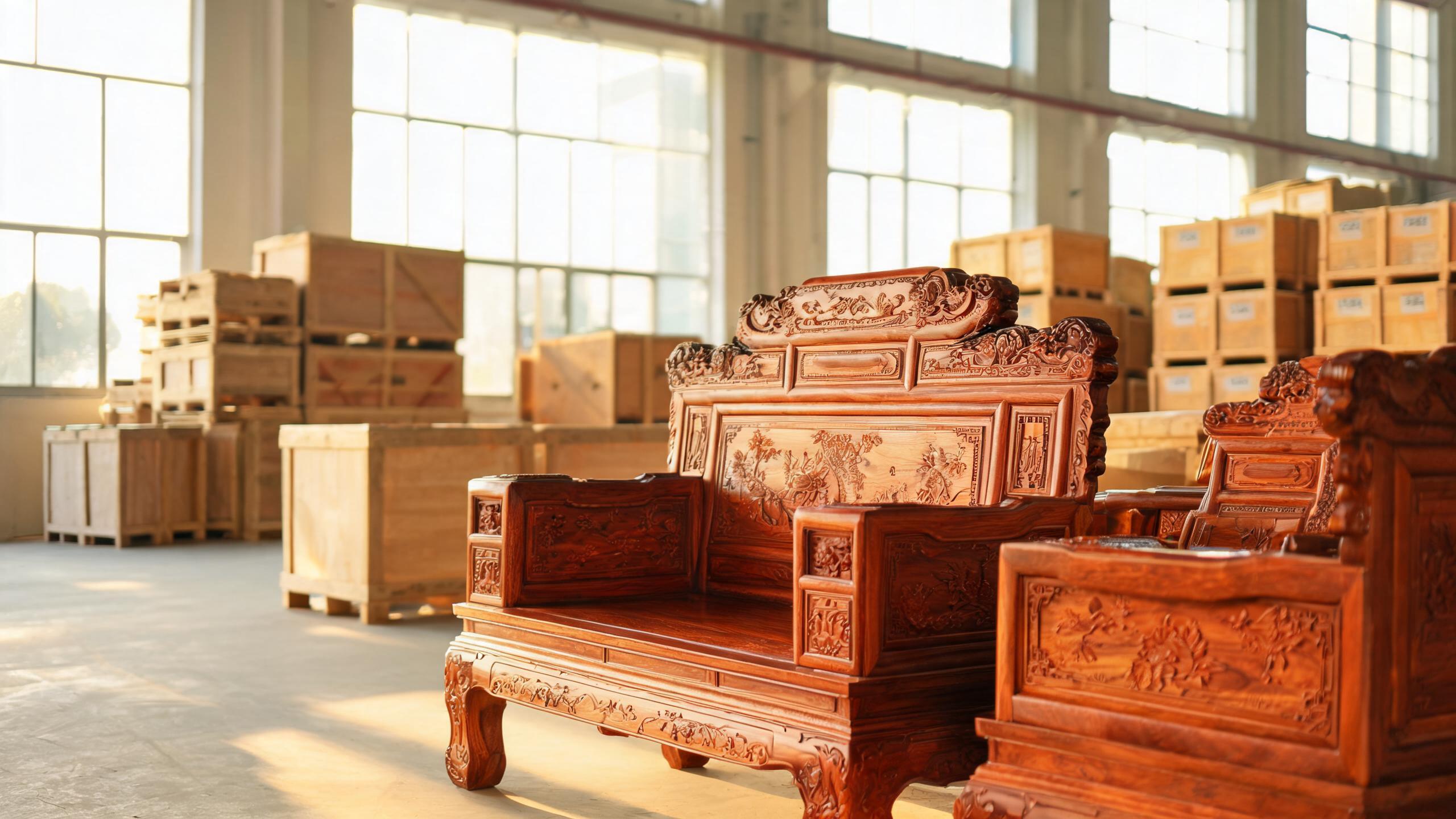
دليل B2B لعام 2026 حول الرسوم الجمركية والضرائب على أثاث خشب الورد المستورد من الصين: تصنيف HS، القسم 301 الأمريكي، ضريبة القيمة المضافة في الاتحاد الأوروبي، تصاريح CITES وتخطيط التكلفة الإجمالية للوصول.
Introduction: Why Duties and Tariffs Decide Your Rosewood Furniture Margins
Every importer of classical rosewood furniture eventually asks the same question: what import duties and tariffs will I actually pay when my container of carved rosewood furniture arrives from China? It is a fair question, and in 2026 it has become one of the most important questions in the entire sourcing decision. A beautifully carved Siamese rosewood sofa set or a Ming-style dining table can look like a bargain on a proforma invoice, yet the true cost of that furniture is only known after customs valuation, tariff classification, anti-dumping checks, VAT or sales tax, and port charges are all applied in the destination country. Buyers who skip this homework routinely discover that their landed cost is 15 to 40 percent higher than they expected, and that difference is rarely recoverable from their retail customers.
This guide is written for wholesalers, hotel project buyers, interior designers, and furniture import businesses in Europe, North America, Australia, and Southeast Asia who are evaluating rosewood furniture from China in 2026. It explains how customs authorities classify solid wood furniture, what the major tariff programs charge, how trade-remedy measures and timber regulations interact with ordinary duties, and how a well-prepared supplier can keep your duty exposure predictable. Throughout the article we use the practical perspective of a working export factory, because the supplier you choose has a direct influence on how smoothly your furniture clears customs.
Nothing in this article is legal or tax advice, and tariff schedules change. Always confirm the current rate with a licensed customs broker in your market before you sign a purchase contract. What this guide does give you is a realistic framework: the questions to ask, the documents to demand, and the cost items that separate a profitable rosewood furniture shipment from an expensive lesson.
How Customs Authorities Classify Solid Wood Furniture
Before any tariff rate can be applied, customs officers must decide what your goods actually are in the language of the Harmonized System. Almost all finished furniture from China travels under Chapter 94 of the HS code. The distinctions inside that chapter matter enormously for your duty bill, so it is worth understanding them before you compare supplier quotations.
The HS Headings That Matter for Rosewood Furniture
Seat furniture, including carved rosewood sofas, armchairs, and stools, is generally classified under HS 9401. Tables, including dining tables, tea tables, and coffee tables, fall under HS 9403, which is the broad residual heading for other furniture. Bedroom furniture such as wardrobes, dressers, and bed frames also sits under 9403, while lamp bases and lighting furniture belong to 9405. Wooden furniture parts, for example a carved panel or a table top shipped separately for local assembly, may be classified differently from complete sets, and some customs authorities treat knock-down furniture that is unassembled but complete as finished furniture while treating genuinely incomplete sets as parts.
The material of the furniture also matters. Many tariff schedules distinguish furniture of tropical wood, furniture of other wood, and furniture of bamboo or rattan. Genuine rosewood, known botanically as Dalbergia and commercially as hongmu, is a tropical hardwood, so your classification may differ from a buyer importing oak or pine furniture. Because the differences between these subheadings can be several percentage points of duty, a careless declaration is not a small paperwork error; it can change your landed cost calculation by thousands of dollars per container.
Why Classification Disputes Happen with Carved Furniture
Heavily carved classical furniture occasionally attracts scrutiny because customs officers must decide whether an item is furniture, a work of art, or an antique reproduction. Reproduction furniture made in a factory is furniture, and it is taxed as furniture. Genuine antiques more than one hundred years old can be treated as collectibles under a different heading, but factory-made classical reproductions in Ming or Qing style do not qualify. The safest approach is a clear commercial invoice that describes the goods plainly: solid rosewood furniture, newly manufactured, with the construction method and wood species stated. Suppliers experienced in export, such as those shipping classical redwood furniture sets to Europe and North America every month, prepare invoices and packing lists that match what is actually in the cartons, which is the single best protection against classification disputes.
United States Tariffs on Chinese Furniture in 2026
The United States is the most complex major market for Chinese furniture because several tariff layers stack on top of each other. A buyer importing rosewood furniture into the United States in 2026 needs to understand all of them, because the headline rate on the invoice is only the beginning.
Column 1 General Rates and Section 301
The base MFN duty rate for wooden furniture under HS 9401 and 9403 is typically zero to a few percent, which historically made furniture one of the lighter categories in the tariff schedule. Since 2018, however, Section 301 measures have added substantial additional duties on a long list of Chinese-origin goods, and furniture lists have been adjusted several times since. The additional percentage depends on the specific list and on any exclusions or adjustments in force at the time of import. Because these measures change through executive action rather than through the annual tariff schedule, the practical advice is simple: ask your customs broker for the current combined rate for your exact HS code in the week you place the order, and build a buffer into your pricing in case the rate changes between order and arrival.
Reciprocal Tariffs and Cumulative Stacking
In recent years the United States has also applied additional country-based tariff measures that stack with Section 301 duties. For a Chinese-origin furniture shipment, the cumulative effect can be significant, and the exact total depends on measures in force on the date of entry. This is precisely why experienced importers no longer quote a single duty percentage from memory. They request a written landed-cost estimate from their broker, listing each tariff program separately, so that when one layer changes they can see which layer moved.
Merchandise Processing Fee and Harbor Maintenance Fee
Beyond ad valorem duties, US imports carry the Merchandise Processing Fee, calculated on the declared value with a minimum and maximum per entry, and the Harbor Maintenance Fee on ocean shipments, calculated as a small percentage of value. These fees are modest for a single container but they are real money, and they belong in every landed-cost model. A buyer comparing a Chinese factory quotation with a Vietnamese or Malaysian quotation should apply the same fee structure to both, because fees are often forgotten while headline tariffs are remembered.
State Sales Tax and the Importer of Record
Federal customs duty is not the end of US tax exposure. Depending on your business structure and state, sales or use tax may apply when the imported furniture is sold or used. Importers of record should also be aware that customs can require a bond, and that continuous bonds are standard for regular importers. None of this is unique to rosewood furniture, but classical furniture shipments are high-value, which raises the stakes of any valuation error.
European Union Duties, VAT, and Timber Rules
The European Union applies a more uniform system than the United States, which many buyers find easier to plan around, but the EU adds its own layer of timber legality requirements that interact with duty compliance.
Conventional Duty Rates on Wooden Furniture
Most wooden furniture enters the EU under a conventional duty rate in the low single digits, commonly around zero to 5.6 percent depending on the exact subheading and the seat or table category. Seats under 9401 and furniture under 9403 have specific lines, and the EU tariff database, known as TARIC, gives the precise current rate for your code. Unlike the United States, the EU has not imposed country-specific additional tariffs on Chinese furniture of the kind that dominates US calculations, so the EU duty calculation is comparatively stable year to year.
Import VAT: The Largest Single Cost Item
The largest cost item at EU customs is usually not duty but import VAT. VAT is charged on the customs value plus duty plus transport costs to the border, at the standard rate of the member state of entry, which ranges from around 17 percent to 27 percent. Registered businesses can generally reclaim import VAT as input tax, so it is a cash-flow cost rather than a permanent cost, but the cash-flow effect on a full container of high-value rosewood furniture is substantial. Buyers using deferment or postponement schemes, available in several member states, can significantly smooth this cash flow, and it is worth asking your freight forwarder about postponement of VAT accounting before your first shipment.
EUDR and the End of Simple Due Diligence
The EU Deforestation Regulation has changed the compliance landscape for wood products. In its implemented form it requires operators placing wood and derived products on the EU market to demonstrate that the products are deforestation-free, supported by geolocation information and due diligence statements. Furniture falls within its scope, and although implementation timelines have shifted, the direction of travel is unmistakable: European buyers increasingly demand documented, legal, traceable timber. For rosewood furniture this intersects directly with CITES, because the Dalbergia species used in classical Chinese furniture are listed in CITES Appendix II. A factory that already operates CITES export permitting and FSC chain-of-custody documentation is, in practical terms, the only kind of supplier a serious EU buyer can afford. We return to this in the section on documentation.
Australia and Southeast Asia: Duty Structures for Regional Buyers
Australia applies a general tariff on furniture that is typically zero to 5 percent, with most wooden furniture entering duty free or at a low rate, plus 10 percent GST calculated on the customs value plus duty plus transport and insurance. Australian buyers of Chinese rosewood furniture therefore face a comparatively simple cost structure, and the main compliance considerations are biosecurity: the Department of Agriculture treats wooden furniture and timber packaging as potential pest pathways, requiring clean, treated packaging. ISPM 15 heat-treated crates and careful container hygiene are not optional extras for Australian shipments; they are the difference between a smooth release and an expensive re-export or treatment order.
Southeast Asian markets vary widely. ASEAN members importing from China under the ASEAN-China Free Trade Agreement can often claim preferential or zero duty with a Form E certificate of origin, which makes intra-Asian rosewood furniture trade unusually duty-friendly when the paperwork is correct. Markets such as Singapore apply no general tariff on furniture, while others combine MFN rates with FTA preferences. Buyers in the region should ask their supplier whether the factory can issue the correct certificate of origin for the specific FTA claim, because a missing or incorrect certificate converts a zero-duty shipment into a full-rate one. Hotel and resort project buyers in Southeast Asia should also check local luxury or excise taxes, which in some jurisdictions apply to high-value furnishings regardless of origin.
CITES, Timber Legality, and the Hidden Cost of Bad Paperwork
Duties are only one part of the regulatory cost of importing rosewood furniture. The other part is species and legality compliance, and in 2026 it is the area where unprepared buyers lose the most money.
Why Rosewood Is a Controlled Species
The Dalbergia genus, which includes the Siamese rosewood used in premium classical Chinese furniture, has been listed in CITES Appendix II since 2017. An Appendix II listing does not prohibit trade, but it requires export permits issued by the country of export and, in many cases, import permits or presentations at the border. For a furniture importer this means every commercial shipment of genuine rosewood furniture from China should travel with CITES export documentation, and buyers into markets with stricter import controls should confirm permit requirements before shipment rather than at the port. Shipments without correct CITES paperwork can be seized, and seizure of a container of hand-carved furniture is a total loss, not a fine.
Lacey Act and EUDR Declarations
US buyers must additionally satisfy Lacey Act declaration requirements for certain wood products, which call for species and harvest-country information. EU buyers face the due diligence obligations described above under the EUDR. Both regimes reward the same supplier behavior: legal timber sourcing, species identified to the botanical level, chain-of-custody documentation, and consistent declarations across the invoice, packing list, and permit paperwork. When evaluating a rosewood furniture factory, the presence of FSC chain-of-custody certification and a working relationship with CITES permitting authorities is one of the strongest signals that your shipments will clear customs without drama.
The Real Cost of Compliance Failures
Consider the arithmetic. A container of classical rosewood furniture might be worth sixty to one hundred thousand US dollars at invoice value. A customs seizure for missing CITES permits, a biosecurity re-treatment order in Australia, or a valuation penalty in the United States can each cost a five-figure sum plus weeks of delay, and hotel projects do not wait. Compliance is not a bureaucratic tax; it is insurance priced in paperwork, and the premium is far lower than the loss it prevents.
Anti-Dumping and Trade Remedy Risks: What to Watch
Beyond ordinary tariffs, furniture importers should understand trade-remedy instruments, because they can change the economics of a product line with little warning. Anti-dumping duties are imposed when an industry in the importing country proves that imports are sold below fair value and cause injury. Countervailing duties address subsidized imports. Safeguard measures respond to sudden import surges. Wooden furniture from China has been the subject of trade-remedy investigations in various jurisdictions over the years, and bedroom furniture in particular has a history of anti-dumping measures in the United States dating back two decades.
The practical lesson for a rosewood furniture buyer is not to avoid Chinese sourcing but to avoid concentration risk. Buyers who source a single category from a single country at aggressive volumes are the most exposed when a new investigation lands. Diversifying across product categories, maintaining a second qualified supplier, and keeping margin buffers large enough to absorb a mid-year tariff change are the standard defenses. It is also worth monitoring the trade press or asking your broker for alerts on furniture-related investigations, because the public comment periods of investigations often telegraph what is coming months in advance.
How Incoterms Change Who Pays What
The duty conversation is inseparable from the Incoterms rule on your purchase contract, because the rule determines who is the importer of record and therefore who files the entry and pays the duties.
FOB, CIF, and DDP in Practice
Under FOB, the buyer arranges and pays ocean freight, insurance, destination duties, and taxes, and controls the customs entry. This is the most common rule for experienced furniture importers because it keeps control and cost visibility with the buyer. Under CIF, the seller pays freight and insurance to the destination port, but the buyer still handles import clearance and duties. Under DDP, the seller delivers goods cleared for import with duties paid, which sounds convenient but carries real risks: the seller must either be the importer of record in your country or act through an agent, tax treatment can become complicated, and the buyer loses visibility into what was actually declared. Many professional buyers avoid DDP for high-value furniture precisely because an opaque declaration today can become an audit problem tomorrow.
For a first container from a new supplier, FOB with your own broker is usually the cleanest structure. Once trust is established, some buyers let the factory consolidate freight through a preferred forwarder while still acting as importer of record themselves, preserving both convenience and control.
Calculating Landed Cost: A Worked Example
Let us walk through a realistic landed-cost calculation for a 40-foot container of classical rosewood furniture shipped from a Fujian factory to Los Angeles, using illustrative numbers that you should replace with current quotes and broker advice.
Assume an invoice value of 80,000 US dollars under FOB Xiamen. Ocean freight and insurance add 4,500 dollars. US customs value is therefore 84,500 dollars. Suppose the combined duty rate for the relevant furniture subheadings, including base rate and all additional measures in force, totals 30 percent for illustration: that is 25,350 dollars in duties. The Merchandise Processing Fee adds a few hundred dollars, and the Harbor Maintenance Fee adds roughly 0.125 percent of the ocean portion. Customs brokerage and drayage might add 800 dollars, and inland delivery to a California warehouse another 1,200 dollars. The total landed cost lands near 112,000 dollars, meaning duties and fees added roughly 33 percent to the invoice value in this scenario.
Now run the same container to Rotterdam. With a 3 percent conventional duty, import VAT at 21 percent on the duty-paid value, freight of 3,800 dollars, and clearance fees, the cash outlay at import is dominated by VAT, but most of that VAT is recoverable by a registered business. The permanent cost difference between the two markets is therefore driven almost entirely by the duty layers, which is why the same rosewood dining set can support very different retail prices in Dallas and in Amsterdam.
The discipline to take from this example is to build your landed-cost model line by line, update the duty layers every quarter, and never price your retail or project bid from the invoice value alone. Factories that provide detailed packing lists with per-carton values, species declarations, and HS code suggestions make this modeling dramatically easier, and it is a fair question to ask any prospective supplier how they support it.
Documentation That Protects Your Duty Rate
Customs outcomes are decided by documents. The difference between a smooth release and an examination is usually the quality of the paper trail, and for rosewood furniture the essential set is well established.
The Core Document Set
- Commercial invoice: itemized by product, quantity, unit value, total value, currency, Incoterms, and consignee details, with wood species and construction described accurately.
- Packing list: carton-level detail with weights and dimensions, matching the container loading plan, so officers can verify contents without unloading everything.
- Bill of lading: consistent with the invoice in shipper, consignee, and goods description.
- CITES export permit: for shipments of Dalbergia rosewood furniture, issued by the Chinese management authority, plus any import permits your market requires.
- Certificate of origin: for FTA preference claims such as Form E in ASEAN, or standard origin certificates where required.
- FSC chain-of-custody documents: increasingly requested by EU and North American buyers as evidence of legal, traceable timber.
- Fumigation or heat-treatment certificates: ISPM 15 compliant packaging documentation, essential for Australia and useful everywhere.
Valuation Integrity
Customs valuation is the other half of duty accuracy. Declared value must reflect the actual price paid, including any royalties or assists, and undervaluation to save duty is both illegal and, in the era of automated risk screening, increasingly likely to be caught. High-value carved furniture attracts attention precisely because its value is hard to verify from the outside, so a factory whose invoices match its packing lists and whose transaction records are consistent is your best protection. Buyers should also keep records of the purchase contract, payment evidence, and proforma invoice, because customs authorities may request the full transaction chain during a valuation review.
Common Mistakes Importers Make with Rosewood Furniture Duties
After years of watching containers move through major ports, a pattern of avoidable mistakes is clear, and every one of them is preventable with a little process.
The first mistake is classifying by guesswork. Buyers copy an HS code from an old shipment or a forum post without checking whether the subheading matches their exact product, then discover at entry that the rate is higher. The fix is a binding ruling or a written broker confirmation for your specific products before the first order.
The second mistake is ignoring the date-of-entry rule. Tariff measures apply on the date of entry, not the date of order or the date of shipment. A container that sails under one tariff regime and arrives under another is a genuine risk in the current environment, and buyers with long production lead times should ask their broker to model both scenarios before committing to a large order.
The third mistake is treating CITES as the supplier's problem. Export permits are the factory's responsibility, but import permits, advance presentations, and record-keeping are the importer's. Buyers who assume the factory handles everything sometimes discover at the port that their market required an import permit applied for weeks earlier.
The fourth mistake is forgetting non-duty charges. Merchandise processing fees, harbor fees, brokerage, terminal handling, demurrage, and customs examinations all add cost, and a landed-cost model that only includes the duty percentage will understate reality by several percentage points.
The fifth mistake is poor communication between supplier, forwarder, and broker. When the invoice says one thing, the packing list another, and the booking a third, examinations follow. A short pre-shipment alignment call between the three parties prevents most of these mismatches, and factories accustomed to export will happily join one.
How a Prepared Factory Reduces Your Duty and Compliance Risk
It is worth being direct about what a buyer should expect from a rosewood furniture factory in 2026, because supplier capability is a duty-risk variable, not just a quality variable.
A prepared factory maintains legal, documented timber sourcing with species identified to the botanical level, and holds FSC chain-of-custody certification so buyers can evidence legality to EU and North American authorities. It processes CITES export permits routinely and can tell you realistic permit lead times rather than optimistic ones. It produces export-grade documentation: invoices that match packing lists, carton-level detail, accurate weights, and ISPM 15 heat-treated crating with certificates. It understands that furniture destined for different markets needs different paperwork and prepares Form E certificates for ASEAN buyers, Lacey-supporting species data for US buyers, and EUDR-ready due diligence data for European buyers.
It also packs for the journey. Classical carved furniture with mortise-and-tenon joinery survives ocean freight well when it is crated with moisture barriers, bracing, and corner protection, and it arrives in a condition that passes inspection without claims. Every claim avoided is margin preserved, and every examination passed quickly is demurrage avoided. When you audit a factory, ask to see a recent full document set from a shipment to your market. The answer tells you more than any catalog.
Frequently Asked Questions
Do I pay duties on furniture samples?
Yes, in most markets samples of commercial value are dutiable, though many countries apply simplified clearance or de minimis treatment for low-value sample shipments. Some exporters mark samples as "sample, value for customs purposes only," but customs authorities generally require a realistic value for anything of commercial quality. Budget for duties on samples just as you would for production, or ask your broker whether your market offers a sample-specific procedure.
Is antique reproduction furniture taxed differently from modern furniture?
No. Factory-made reproductions in classical Ming or Qing style are new furniture and are classified and taxed as furniture. Genuine antiques over one hundred years old can fall under a different heading with different rates, but the burden of proving age rests with the importer, and factory reproductions do not qualify.
Can I reduce duties by shipping through a third country?
Transshipment does not change the origin of goods. Furniture manufactured in China remains Chinese-origin regardless of where it is transshipped, and declaring otherwise is origin fraud with severe penalties. Only substantial transformation in a third country changes origin, and furniture assembly rarely meets that threshold. The legitimate ways to manage duty exposure are correct classification, FTA preference where it genuinely applies, and staying informed about tariff changes.
Who is the importer of record under FOB?
The buyer. Under FOB the buyer arranges import clearance, pays duties and taxes, and bears responsibility for the accuracy of the declaration. This is why buyers under FOB should engage a licensed customs broker rather than relying on the factory's forwarder to "handle customs" at destination.
How far ahead should I plan CITES permits?
Plan for several weeks, and longer for first-time shipments or peak periods. Export permit processing involves the management authority in China, and some destination markets require the import permit to be secured before export. Build permit lead time into your project schedule the same way you build production lead time, and ask your factory for the current realistic timeline rather than a best case.
Does the duty rate differ between carved and plain furniture?
Generally no. Duty rates are set by HS subheading, which distinguishes furniture types and materials rather than decoration levels. Carving affects value, and therefore the duty amount, but not usually the rate. The exception is where a product might be argued into a different heading altogether, which is why clear descriptions matter.
What happens if my container is selected for examination?
An examination is a normal part of customs risk management, not an accusation. Costs include examination fees, drayage, and possible demurrage while the container waits. Complete, consistent documentation is the fastest way through an examination, which is why the document set described earlier matters. Most examinations of well-documented furniture shipments conclude without penalty.
Should I buy on DDP to avoid customs hassle?
DDP transfers paperwork but also transfers visibility and can create tax complications, since the seller or its agent becomes responsible for import declarations in your market. For high-value furniture, most professional buyers prefer FOB with their own broker, accepting the administrative work in exchange for control over valuation, classification, and compliance history in their own name.
Conclusion: Turn Tariff Uncertainty into a Planning Advantage
Import duties and tariffs on rosewood furniture from China in 2026 are neither simple nor static, but they are entirely manageable for buyers who treat them as a planning input rather than an afterthought. Classify your products correctly and confirm rates with a licensed broker in each market. Model your landed cost line by line, including the fees that hide behind the headline duty. Demand complete, consistent documentation from your supplier, including CITES export permits, FSC chain-of-custody evidence, and ISPM 15 compliant packaging. Understand your Incoterms and keep the importer-of-record role where you can see it. And choose a factory whose export discipline reduces your risk instead of adding to it.
Buyers who build this discipline into their sourcing process gain a durable advantage. While competitors absorb surprise costs and delayed containers, they quote projects with confidence, protect their margins, and deliver hotel and residential installations on schedule. In a market where a hand-carved rosewood sofa set represents a significant investment for any end customer, that operational reliability is part of what the premium is paying for.
If you are planning a rosewood furniture order for the European, North American, Australian, or Southeast Asian markets and want a supplier who prepares export documentation, CITES permits, and FSC-certified sourcing as a matter of routine, the team at Yunxiao Rosewood Furniture welcomes your inquiry. Share your destination market, product list, and project timeline, and we will support your landed-cost planning with accurate specifications and complete paperwork from the first proforma invoice to the final delivery.
Market-by-Market Quick Reference for 2026 Planning
To make the preceding sections easier to act on, the following planning notes summarize how each major destination market treats Chinese rosewood furniture imports. Treat every figure as a starting point for broker confirmation, not as a final rate, because tariff measures in 2026 continue to move through administrative updates.
United States
Expect the duty conversation to be dominated by stacked measures: the low MFN base rate for furniture, Section 301 additional duties, and any country-based reciprocal measures in force on your date of entry, plus the Merchandise Processing Fee and Harbor Maintenance Fee. Confirm the combined rate for your exact subheadings with your broker at order time, model the risk of rate changes during your 45 to 60 day production window, and keep Lacey Act species declarations consistent with your CITES paperwork. High-value carved furniture is a natural examination candidate, so documentation consistency is your fastest route through the port.
European Union
Duty rates are low and stable, but import VAT is the dominant cash item and is generally recoverable for registered businesses, with postponement schemes available in several member states to ease cash flow. The strategic compliance item is the EUDR: geolocation-backed due diligence and deforestation-free evidence are becoming standard requests in European tenders for wood furniture. Pair your CITES export permits with FSC chain-of-custody documentation and you will be ahead of most competing quotations, because European project buyers increasingly treat traceability as a qualification requirement rather than a bonus.
United Kingdom
Post-Brexit, the UK maintains its own tariff schedule with rates broadly similar to the EU for furniture, plus 20 percent VAT at import. UK buyers should also note the UK's own timber legality regulation, which requires evidence that imported timber was legally harvested. In practice the document set that satisfies EU buyers satisfies UK buyers, so a single compliance package serves both markets with minor adjustments.
Australia and New Zealand
Duty on most wooden furniture is zero to 5 percent with 10 percent GST in Australia and 15 percent GST in New Zealand, both generally claimable by registered businesses. The distinctive risk is biosecurity: untreated or contaminated timber packaging is the most common cause of intervention, so insist on ISPM 15 heat-treated crating with certificates and clean containers. A treatment order at the border costs far more than the small premium for compliant packaging at the factory.
Southeast Asia
Under the ASEAN-China Free Trade Agreement, correctly documented shipments can claim preferential or zero duty with a Form E certificate of origin, making the region one of the most duty-friendly destinations for Chinese rosewood furniture. Confirm that your factory can issue Form E for each shipment, check local GST or VAT treatment, and for hotel and resort projects verify any local luxury taxes on high-value furnishings. Regional buyers should also confirm species documentation, because CITES requirements apply at re-export from Asia just as they do at first export from China.
Building a Tariff-Aware Sourcing Process
The buyers who handle 2026 tariff conditions best are not the ones who memorize rates; they are the ones who built a repeatable process. The process has five steps, and none of them requires specialist knowledge beyond what a good broker and a good factory already provide.
Step one is classification confirmation. Before your first order of any new product line, send the factory's product specifications to your broker and obtain a written classification opinion for each item. Keep these opinions on file; they are your defense if a later officer disagrees.
Step two is landed-cost modeling. Maintain a spreadsheet with one column per cost layer: invoice value, freight, insurance, each duty program separately, fees, brokerage, inland transport, and recoverable taxes shown separately from permanent costs. Update the duty columns quarterly and whenever a trade-remedy headline appears in the news.
Step three is documentation review at order confirmation. When the factory issues the proforma invoice, check that species names, values, and Incoterms match what your broker expects. When the final documents are issued, compare the invoice, packing list, and bill of lading line by line before the container sails, because corrections at origin cost hours while corrections at destination cost days.
Step four is permit scheduling. Put CITES export permit applications, and any import permits your market requires, on the project calendar at the same time as production. Permits run in parallel with manufacturing, not after it, and the factories that treat permitting as a routine step are the ones whose containers never wait.
Step five is post-entry review. After each shipment clears, reconcile the actual duty paid against your model and record any variance. Over a year, this review turns your landed-cost model from an estimate into a forecasting tool, and it surfaces classification or valuation issues while they are still cheap to fix.
Run this process across two or three shipments and it becomes nearly automatic. The payoff is confidence: when a hotel group asks whether you can deliver forty carved rosewood guest-room sets to a resort in Queensland by a fixed date, you can answer with numbers instead of hedges, and in B2B furniture, the supplier who answers with numbers wins the order.