
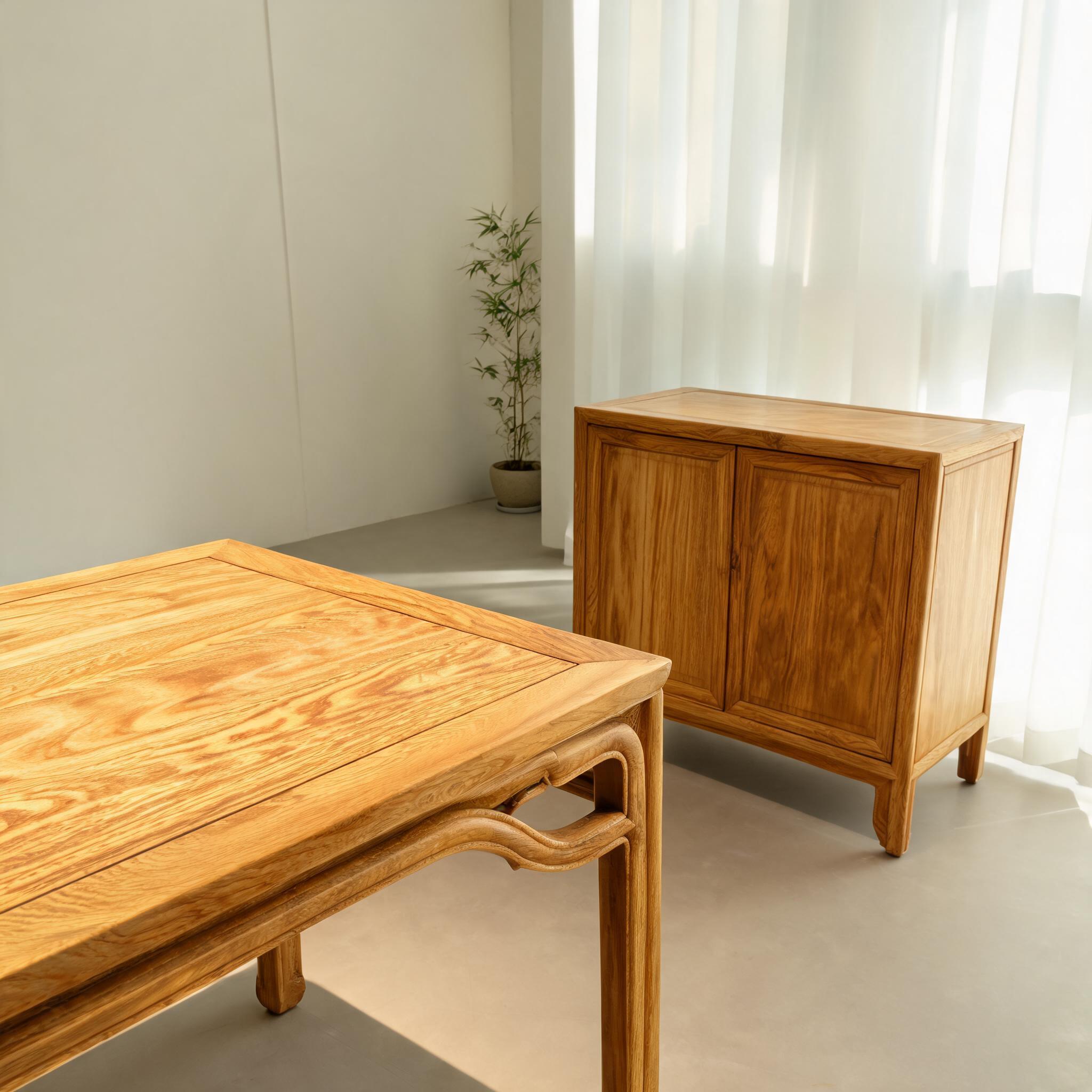
دليل B2B شامل لأثاث خشب النانمو: ما هو النانمو، وكيف يقارن بخشب الورد السيامي، ومصادره القانونية وشهاداته، وحرفية الورش، والتطبيقات المثالية للفنادق والفلل وغرف الشاي، وأسئلة الشراء الرئيسية التي يجب على المستوردين طرحها قبل الطلب.
Introduction: Why Nanmu Is Suddenly on Every Buyer's Shortlist
If you source classical Chinese furniture for hotels, villas, tea rooms or premium residential projects, you have almost certainly spent the last few years comparing rosewood species, checking CITES paperwork and negotiating over Siamese rosewood prices. But there is a quieter story unfolding in the same workshops: a growing number of global buyers are asking about Nanmu wood furniture — and for good reason. Nanmu (楠木, Machilus spp., often called golden-thread Nanmu or 金丝楠 when the timber shows shimmering golden figure) offers the classical Chinese aesthetic, excellent dimensional stability and a legal, traceable supply chain, often at a more accessible price point than CITES-listed rosewoods.
At Yunxiao Rosewood Furniture Co., Ltd — a classical furniture manufacturer founded in 2008 in Xianyou, Fujian, operating a 12,000-square-meter factory — we work with legally certified Machilus Nanmu alongside Siamese rosewood. This guide answers the questions B2B buyers actually ask us: What exactly is Nanmu? How does it compare with rosewood? Is it legal to import? How is it crafted, finished, packed and shipped? And what should you confirm before placing a wholesale or OEM/ODM order?
This article is written for importers, distributors, hospitality procurement teams and brand owners. It is deliberately practical: every section ends with information you can act on, whether that action is a question to put to a supplier, a specification to write into a purchase contract, or a product decision for your next catalog season.
What Is Nanmu Wood? Botanical Identity and Timber Characteristics
Nanmu refers to several species of evergreen trees in the genus Phoebe and Machilus (laurel family, Lauraceae), native to southern China. Historically, Phoebe zhennan — the legendary imperial Nanmu of Ming and Qing palace construction — was reserved for imperial tombs, temples and the grandest halls. Today, commercially available Nanmu furniture is typically made from Machilus Nanmu and related species harvested from managed plantations, which is precisely what makes it a practical and compliant choice for international buyers.
The timber itself is prized for several measurable characteristics:
- Color and figure: A warm golden to honey-brown heartwood. In selected logs, the grain produces the famous "golden thread" shimmer (金丝楠) — an optical effect where reflective wood rays catch light and appear to glow as the viewing angle changes.
- Grain: Predominantly straight and fine, with a smooth, almost silky texture after finishing. This makes Nanmu exceptionally well suited to the clean, restrained lines of Ming-style design.
- Dimensional stability: Nanmu has moderate density (roughly 0.55–0.65 g/cm³ air-dry) and a reputation — earned over centuries of use in doors, beams and cabinetry — for resisting warping and splitting better than many denser hardwoods.
- Fragrance: Freshly machined Nanmu carries a subtle, elegant scent often described as faintly sweet or camphor-like, which fades to a gentle warmth in finished pieces.
- Workability: It cuts cleanly, holds crisp arrises on carved edges, and takes wax and natural lacquer finishes beautifully.
These are general timber characteristics of the species; the exact properties of any given batch depend on the log source, age and drying process — which is why serious buyers always ask a supplier about material sourcing and kiln-drying records, a point we return to below.
A Brief History: Why Nanmu Carries a Thousand-Year Pedigree
Understanding Nanmu's history is not just cultural color — it is a sales asset your team can use when presenting the material to hotel developers, designers and retail customers. Nanmu has been documented in Chinese construction and furniture since at least the Tang dynasty, and by the Ming dynasty it had become the timber of imperial preference for palace halls, imperial tombs and the grandest religious buildings. The Forbidden City's great halls and the Ming tombs at Shisanling contain Nanmu columns that have stood for more than five centuries — a durability record few furniture timbers can match.
What made Nanmu the imperial choice? Three properties. First, its resistance to decay and insect attack, which made it ideal for structural timber intended to last centuries. Second, its dimensional stability: large Nanmu beams and panels stayed flat and true through centuries of seasonal humidity swings. Third, its beauty — the quiet golden figure that became associated with wealth, scholarship and refinement. Scholars' studios in the Ming period favored Nanmu for desks, bookcases and brush holders precisely because its understated elegance matched literati taste better than flashier materials.
For B2B storytelling, this history translates directly: when your sales team presents a Nanmu tea table to a hotel procurement committee, they are not selling "a cheaper alternative to rosewood." They are selling a timber that Chinese emperors reserved for their most important buildings, now available through certified plantation supply. That is a materially different conversation — and it closes deals.
Understanding Nanmu Species, Grades and Figure Types
Not all Nanmu is the same, and buyers who understand the grading vocabulary negotiate better and specify more accurately. In the Chinese trade, Nanmu is commonly discussed in terms of figure types rather than formal botanical grades:
- Golden-thread Nanmu (金丝楠): Timber whose rays produce the shimmering golden figure under light. This is the most sought-after and visually distinctive category, used for prominent panels and statement pieces. Figure intensity varies log by log, which is why panel-matching for large sets is a quotation-level discussion.
- Plain or straight-grain Nanmu: Consistent, fine, straight grain without pronounced shimmer. This is the workhorse of the category — ideal for frames, legs, internal structures and designs where clean lines matter more than figure.
- Water-wave and cloud figure variants: Less common figure patterns that appear in a small percentage of logs; typically reserved for special pieces or custom projects where the client wants a distinctive surface.
On species: commercial supply today centers on Machilus Nanmu and closely related Machilus and Phoebe species from managed plantations in southern China. The legendary Phoebe zhennan of imperial times is extremely rare and protected; any supplier offering "imperial Nanmu" at commodity prices should be treated with skepticism. Reputable manufacturers state the botanical species on commercial documents and can explain exactly which plantation source their current stock comes from.
Practical specification advice: for a mixed product program, specify golden-figure stock for visible panels on hero pieces and straight-grain stock for structural components. This controls cost while concentrating the visual impact where customers actually see it — a technique we use on our own Nanmu lines and recommend to OEM clients.
Nanmu vs Rosewood: How Should a B2B Buyer Actually Choose?
The most common question we receive from importers is not "is Nanmu good?" but "Nanmu vs rosewood — which should I put in my catalog?" The honest answer is that they serve different positions in a product portfolio, and the strongest catalogs often carry both.
Where Siamese Rosewood Wins
Siamese rosewood (Dalbergia cochinchinensis, 交趾黄檀) is the benchmark timber for high-end classical Chinese furniture. It is dense (around 1.0 g/cm³), takes a deep red-brown polish, and carries enormous brand recognition among collectors and hospitality buyers who specifically want "the real rosewood look." Its challenges are equally well known: it is CITES Appendix I listed, which means strict export/import permitting, longer documentation cycles, and steadily rising raw material prices. For buyers whose customers explicitly demand rosewood and accept the price and lead time, it remains irreplaceable.
Where Nanmu Wins
Nanmu occupies a different strategic position:
- Regulatory simplicity: The Machilus Nanmu we use is sourced from legally certified, plantation-managed supply and is not CITES-listed, so import documentation is dramatically simpler than for rosewood. For buyers in the EU (EUTR/EUDR due diligence) and the US (Lacey Act), this reduces compliance risk and cost.
- Price accessibility: Without CITES-driven scarcity pricing, Nanmu furniture typically lands at a more accessible wholesale price point, opening classical Chinese design to mid-premium hotel projects, restaurant groups and residential developers who cannot justify rosewood budgets.
- Aesthetic differentiation: The pale golden tone and straight grain read as lighter, calmer and more contemporary than deep red rosewood — a look increasingly requested for boutique hotels, tea houses and modern-classical interiors.
- Stability in varied climates: For buyers shipping to humid Southeast Asia and drier Australian or North American interiors, Nanmu's dimensional stability is a genuine selling point, provided the timber is properly kiln-dried (more on our 36-day constant-humidity drying process below).
Side-by-Side Comparison for Catalog Planning
- Botanical identity: Nanmu = Machilus/Phoebe spp. (Lauraceae); Siamese rosewood = Dalbergia cochinchinensis (Fabaceae).
- CITES status: Nanmu — not listed; rosewood — Appendix I, full permit cycle required.
- Air-dry density: Nanmu roughly 0.55–0.65 g/cm³; rosewood roughly 1.0 g/cm³.
- Color presentation: Nanmu — golden to honey tones, light and calm; rosewood — deep red-brown, formal and dramatic.
- Documentation burden: Nanmu — standard commercial plus legal-harvest documentation; rosewood — full CITES export/import permit chain.
- Best catalog position: Nanmu — volume classical lines, tea-room and restaurant programs, design-led projects; rosewood — flagship, collector-grade and "must be rosewood" hospitality lines.
A Practical Positioning Framework
When we advise distributor partners, we suggest this simple framework: use rosewood for your flagship, collector-grade and "must be rosewood" hospitality lines; use Nanmu for volume classical lines, tea-room and restaurant programs, and design-led projects where a lighter golden aesthetic is an advantage. This lets you serve both price tiers without diluting either story — and it is exactly how many of our OEM/ODM clients structure their catalogs.
Legality and Certification: What Paperwork Should Nanmu Furniture Come With?
For B2B importers, timber legality is no longer optional. The EU Timber Regulation and its successor the EU Deforestation Regulation, the US Lacey Act, and Australia's illegal logging provisions all require documented due diligence on wood products. Here is what matters for Nanmu specifically:
- Species identification: Your supplier should state the botanical name (e.g., Machilus spp.) on commercial documents, not just the trade name. This is what customs and due-diligence auditors look for.
- Legal harvest documentation: Because our Nanmu comes from legally certified, plantation-managed sources, we can supply harvest and chain-of-custody documentation supporting your due-diligence file. Always request this before ordering — a supplier who cannot document legal origin is a risk regardless of species.
- ISPM-15 compliant export packaging: Solid wood crating and dunnage must be heat-treated and stamped to ISPM-15. We treat this as standard for all shipments.
- Fumigation certificates: Most destination markets require fumigation certificates for wooden furniture consignments; we arrange these per shipment.
One important clarification for buyers comparing materials: Nanmu's simpler regulatory profile does not make it a "lesser" wood — it makes it a differently positioned wood. Rosewood's CITES listing is a conservation measure for over-harvested Dalbergia species; Nanmu from certified plantations simply does not carry that burden. Both can be fully legal; the paperwork burden differs.
Inside the Workshop: How Nanmu Furniture Is Actually Made
Understanding the manufacturing process helps buyers evaluate quotes and quality claims. Classical Nanmu furniture at our Xianyou factory passes through the same disciplined sequence as our rosewood lines — because the joinery tradition is identical, even when the timber differs.
Step 1: Timber Selection and Grading
Logs are graded for color consistency, grain figure and defect-free yield. For golden-thread Nanmu pieces, boards with visible shimmer figure are reserved for prominent panels — table tops, cabinet doors, bed headboards — while straighter-grain stock is used for legs, frames and internal structures. Buyers who care about figure consistency across a set (a hotel lobby with six matching cabinets, for example) should discuss panel-matching expectations at the quotation stage, because figure matching affects both material yield and price.
Step 2: Controlled Drying — the Step That Determines Export Success
This is where many low-cost suppliers fail, and where we invest most heavily. Every board enters our constant-humidity kilns for a 36-day drying cycle, with moisture content brought down to a level matched to the destination climate. Why does this matter so much? Because the single most common failure mode for exported solid wood furniture is post-arrival cracking or warping: timber dried for humid southern China will misbehave in a heated North American interior or an air-conditioned Australian office. When you compare supplier quotes, ask exactly this: what is the drying cycle, and what moisture content do you target for my destination market? A supplier who cannot answer precisely is a risk.
Step 3: Mortise-and-Tenon Joinery
All structural connections in genuine classical furniture are cut as mortise-and-tenon joints — dozens of joint types in complex pieces, from simple through-tenons to interlocking mitred joints on cabinet corners. No screws, no glue as the primary structure. This is not nostalgia; it is engineering. Solid wood moves with seasonal humidity, and metal fasteners in moving wood eventually loosen, split the surrounding timber, and create squeaks and failures. Mortise-and-tenon construction allows controlled micro-movement while keeping the structure tight for decades. For B2B buyers, this is also a quality checkpoint: ask your supplier whether joints are machine-cut-then-hand-fitted (the professional standard) or simply glued butt joints (a red flag).
Step 4: Carving and Surface Work
Depending on the design line, carving ranges from clean Ming-style lines with minimal ornament to Qing-style deep relief — dragons, phoenixes, peonies, landscape scenes. Our carving teams combine CNC roughing for efficiency with hand finishing for every visible edge, because machine-only carving leaves telltale rounded internal corners that collectors and knowledgeable buyers notice immediately. For OEM/ODM projects, we can develop custom carving programs from your drawings or adapt motifs from our existing library.
Step 5: Finishing — Raw Wood, Wax, or Natural Lacquer
Classical Chinese furniture uses three traditional finishing approaches, each with different maintenance and market positioning:
- Raw wood (素面): Sanded fine and left bare or lightly sealed — favored by purists who want to watch the patina develop.
- Beeswax finish (烫蜡): Hot beeswax worked into the open grain, then buffed. This is our default for Nanmu lines: it protects while keeping the wood breathable, enhances the golden figure, and is repairable — a practical advantage for hotel housekeeping teams.
- Natural lacquer (生漆): Traditional raw lacquer, applied in multiple hand-rubbed coats. Deepest protection and a distinctive luster, with longer curing time affecting lead time.
Specify the finish explicitly in your order — it changes both the look and the care instructions you will pass to your end customers.
Step 6: Assembly, Inspection and Export Preparation
Finished components are dry-fitted, checked for joint tightness and alignment, then finally assembled. Every piece passes a pre-shipment inspection covering structure, finish, hardware and dimensions against the approved specification. Only then do pieces move to export packing: foam corner protection, bubble wrap, and ISPM-15 stamped solid wood crating designed for container stacking loads.
Climate Adaptation: Matching Nanmu Furniture to Destination Markets
One of the most under-discussed topics in furniture exporting is climate matching. Solid wood is a hygroscopic material: it exchanges moisture with the surrounding air, expanding in humid conditions and contracting in dry ones. The furniture that performs perfectly in Xianyou can fail in Phoenix or Singapore if the drying protocol ignored the destination. Here is how we think about the major markets:
- Southeast Asia (Singapore, Malaysia, Thailand, Indonesia): Consistently high humidity, moderate temperature swings. The risks are swelling and, in air-conditioned interiors, sharp humidity gradients. Target moisture content sits in the higher end of the export range, and ventilation-friendly designs perform well.
- Australia: Highly variable — tropical north, temperate south, and interiors with heating and cooling that create dry conditions. Southern-market shipments need lower target moisture content, and buyers should advise end customers on humidity management in heated interiors.
- North America: The driest interior environments of the three regions, especially in winter with forced-air heating. This is the market where under-dried timber fails most visibly — surface checking, joint gaps, panel splits. Our lowest target moisture content applies here, and we recommend buyers include care guidance about humidifiers in extreme climates.
- Middle East: Arid conditions with strong air-conditioning; similar drying targets to North American interiors, with additional attention to UV exposure near windows.
The takeaway for buyers: any supplier who dries all timber to one universal moisture content is not engineering for your market. Ask for the destination-specific target in writing, and include it in your purchase contract as an acceptance criterion.
Where Nanmu Furniture Performs Best: Applications and Project Types
Hotels and Boutique Hospitality
For hotel projects, Nanmu's lighter tone photographs beautifully in marketing materials and pairs well with the neutral palettes dominant in contemporary hospitality design. Tea tables, console cabinets, bed frames and lobby seating in Nanmu deliver the "Chinese classical" story at a unit cost that scales across 40–200 key properties. Housekeeping teams also appreciate wax-finished surfaces: scratches can be spot-repaired with wax rather than requiring full refinishing.
Villas and Premium Residential
In residential projects, Nanmu suits whole-house programs — dining sets, bedroom suites, study rooms and tea rooms in one consistent timber. Developers marketing to buyers who want classical Chinese character without rosewood pricing find Nanmu lines give them a defensible story: genuine solid wood, genuine joinery, genuine craftsmanship, at a position their market can absorb.
Tea Rooms, Restaurants and Cultural Spaces
Tea culture venues are perhaps Nanmu's natural home. The timber's subtle fragrance, calm golden tone and historical association with scholars' studios make it the default choice for tea tables, side cabinets and display pieces in tea houses across Asia — and increasingly in Western tea rooms and wellness spaces seeking authentic East Asian atmosphere.
Offices and Executive Spaces
A growing niche: executive offices and meeting rooms furnished with classical Chinese pieces as a statement of cultural confidence. Nanmu desks, bookcases and conference tables serve this market well, particularly in Southeast Asian markets where Chinese classical aesthetics carry strong business-cultural resonance.
Three Buyer Profiles: How Different Businesses Use Nanmu Lines
To make the positioning concrete, here are three anonymized buyer archetypes drawn from the kinds of programs we support — useful templates for thinking about your own catalog.
Profile 1: The Regional Distributor Building a Two-Tier Catalog
A Southeast Asian distributor carries rosewood dining and bedroom sets as their premium tier but was losing quotations in the mid-market, where competitors offered lighter, cheaper "Chinese-style" furniture of uncertain quality. Adding a Nanmu line — tea tables, console cabinets, a bedroom suite in straight-grain stock with wax finish — gave them a defensible mid-premium tier: genuine solid wood and mortise-and-tenon construction at a price point their competitors' veneer products could not match on quality. The Nanmu line now accounts for a substantial share of their container volume and feeds their project business.
Profile 2: The Boutique Hotel Group
A boutique hotel operator furnishing a 60-key property in a classical Chinese theme needed the aesthetic story without a rosewood budget across hundreds of pieces. The solution: rosewood anchor pieces in the lobby and flagship restaurant, and a full Nanmu program for guest rooms, corridors and the tea house — consistent design language, dramatically different unit economics, and a material story (certified plantation timber, imperial heritage) their marketing team could tell with confidence.
Profile 3: The Western Brand Owner
A North American brand building a "modern classical" collection wanted a lighter aesthetic than deep red rosewood and simpler compliance documentation for their retail channel. Golden-figure Nanmu with a natural lacquer finish, scaled to North American room dimensions through our ODM sizing program, gave them a differentiated line with a compliance file their customs broker described as the simplest they had handled in the category.
The B2B Purchasing Playbook: Questions to Ask Before You Order
Having supplied distributors and project buyers for over fifteen years, we have compiled the questions that separate smooth orders from painful ones. Bring these to any Nanmu furniture supplier — including us.
1. Material Questions
- What is the exact botanical species, and can you document legal origin?
- Is the timber kiln-dried, for how long, and to what moisture content for my destination climate?
- Are panels solid wood throughout, and how is figure matched across sets?
2. Construction Questions
- Are all structural joints mortise-and-tenon? Can you send joint detail photos?
- Is carving hand-finished, and what carving depth/design options exist for custom orders?
- What finish is applied, and what maintenance documentation do you provide?
3. Commercial Questions
- What is the MOQ, and how does it differ for stock designs versus custom OEM/ODM development?
- What is the realistic production lead time — typically 45–60 days for custom orders — and what affects it?
- What are the payment terms, and what quality remedies are contractually defined?
- Can you support mixed-container loading across product lines?
4. Logistics and Compliance Questions
- Is export packing ISPM-15 compliant, and are fumigation certificates provided?
- What documentation package accompanies the shipment for my customs broker?
- Have you shipped to my market before, and what destination-specific issues should I plan for?
A supplier who answers these readily and in writing is demonstrating exactly the operational maturity you need in a long-term manufacturing partner.
Quality Control: How Buyers Should Verify Before Shipment
Distance is the B2B furniture buyer's core challenge. Professional suppliers mitigate it with transparent QC processes. Our standard program includes in-process inspection at each production stage, a final pre-shipment inspection with photo and video documentation, and — for project buyers — third-party inspection welcome at agreed stages. Buyers should also define acceptance criteria in the purchase contract: moisture content targets, joint tolerances, finish standards and dimensional tolerances. Vague contracts produce disputes; specific ones produce repeat orders.
A practical QC sequence for a first order: approve a pre-production sample or detailed photo set; request in-process photos at the drying-complete and joinery-complete stages; commission or conduct a final inspection against a written checklist before container loading; and require the inspection report as a payment milestone document. This sequence costs little and eliminates the majority of quality disputes in cross-border furniture trade.
Container Planning and Logistics: Getting Nanmu Furniture There Intact
Furniture logistics deserve more attention than most first-time importers give them. A few practical points from thousands of shipped containers:
- Container selection: Full sets and cabinets typically ship in 40-foot high-cube containers; mixed programs with sofas and beds benefit from the extra volume. Discuss loading plans with your supplier before confirming the order — good suppliers provide container loading plans showing how every carton and crate is positioned.
- Disassembly strategy: Classical furniture is engineered to be assembled and disassembled via its mortise-and-tenon joints — this is a genuine shipping advantage. Beds, tables and large cabinets ship knocked-down where the design allows, dramatically reducing damage risk and container waste. Confirm which pieces ship assembled versus knocked-down.
- Packing specification: Foam corner protection, bubble wrap, and ISPM-15 stamped solid wood crating for vulnerable pieces. Cartons should be marked with piece counts and room-destination labels for project orders — a small detail that saves hours at installation.
- Transit protection: Container desiccants and moisture barriers matter for long ocean transits, particularly into humid Southeast Asian ports after a temperate-origin loading. Ask what container preparation the supplier performs.
- Insurance and terms: Clarify Incoterms (FOB, CIF, DAP) and marine insurance at quotation. For first orders, many buyers use CIF to simplify their logistics learning curve, then move to FOB with their own forwarder as volumes grow.
Care and Maintenance: What Your End Customers Need to Know
The care instructions you pass downstream shape customer satisfaction and warranty exposure. For Nanmu furniture, the essentials are simple:
- Dust with soft, dry cloth along the grain; avoid abrasive cleaners and silicone-based polishes, which interfere with wax finishes.
- Re-wax periodically (typically once or twice a year in normal interiors) with a quality beeswax furniture wax; hotel housekeeping can spot-repair light scratches with wax sticks.
- Manage the environment: avoid prolonged direct sunlight on surfaces, use humidifiers in extremely dry heated interiors, and use coasters and pads under hot or wet items — the same common-sense rules as any fine solid wood.
- Seasonal movement is normal: solid wood panels may expand and contract slightly with seasons; classical construction accommodates this by design. Educating end customers on this point prevents unnecessary warranty claims.
We supply care instruction documentation with every order, and OEM clients can request co-branded care cards for their own retail channels.
OEM and ODM: Building Your Own Nanmu Line
For distributors and brand owners, Nanmu's accessible price point makes it an excellent vehicle for private-label classical furniture. Our OEM/ODM support covers design adaptation from your sketches or references, custom sizing to fit target markets (apartment-scale for Singapore and Hong Kong, generous scale for North American villas), custom carving programs, branded packaging, and exclusive design arrangements for qualifying volume commitments. Typical custom development runs 45–60 days from approved drawings to shipment-ready goods, depending on complexity and season. If you are building a differentiated catalog rather than reselling stock designs, discuss exclusivity terms early — capacity for custom programs is allocated by order queue.
The ODM process in practice: you provide sketches, references or a brief; we return design proposals with material and finish specifications; you approve a pre-production sample (photos or physical, depending on distance and urgency); production proceeds against the approved sample with in-process checkpoints; and the shipment leaves with a documentation package matched to your market's requirements. Buyers who invest in a thorough pre-production sample stage consistently report smoother first orders.
How to Evaluate a Nanmu Furniture Supplier: A Due-Diligence Checklist
Whether you choose us or another manufacturer, run this checklist before committing:
- Factory verification: Can the supplier host a visit or a live video factory tour? A 12,000-square-meter dedicated facility with in-house kilns, carving workshops and finishing lines looks very different from a trading office.
- Material transparency: Will they state botanical species on documents and explain their timber sourcing?
- Process evidence: Can they show kiln-drying records, joint detail photos and finishing samples on request?
- Export track record: How long have they exported, to which markets, and can they discuss destination-specific issues knowledgeably?
- Communication quality: Do quotations arrive complete (specification, materials, finish, packing, terms) or do details emerge only after payment?
- References: Can they connect you with existing buyers in a comparable market?
Suppliers who pass this checklist comfortably are rare enough that when you find one, the relationship is worth investing in — order samples, start with a trial container, and build volume as trust accumulates.
Sustainability and the Future of Plantation Nanmu
Buyers increasingly ask not only whether timber is legal, but whether it is sustainable — and this is where Nanmu's plantation supply model becomes a genuine commercial advantage. Because commercial Nanmu is grown in managed plantations rather than harvested from old-growth forests, each planting cycle renews the resource, and responsible suppliers can document the chain from plantation to workshop. For retail brands and hotel groups with published ESG commitments, this traceability story is increasingly part of the procurement decision itself: a material that combines imperial heritage with modern plantation renewability is far easier to present to sustainability committees than scarce, slow-growing CITES-listed hardwoods.
Our advice to buyers is to make sustainability documentation a standard part of supplier evaluation, alongside the material and construction questions above. Ask where the timber was grown, whether harvest documentation is available, and how the supplier manages waste and finishing materials in the workshop. Suppliers with real answers — and real documents — are the ones worth building long-term programs with.
Frequently Asked Questions from B2B Buyers
Is Nanmu furniture suitable for humid climates like Southeast Asia?
Yes — with proper kiln-drying matched to destination humidity. Nanmu's dimensional stability is one of its historic strengths; the key variable is the drying protocol. We adjust target moisture content by destination market and confirm it in writing on order documents.
How does Nanmu furniture pricing compare with rosewood?
Nanmu lines are typically positioned below comparable rosewood pieces, reflecting raw material costs rather than reduced craftsmanship — the same joinery, carving and finishing labor goes into both. For exact wholesale pricing, request a quotation for your specific product mix and volumes.
Can Nanmu furniture be mixed with rosewood pieces in one interior?
Yes, and it is a popular design approach: rosewood anchor pieces (a dining table, an altar cabinet) with Nanmu supporting pieces (tea tables, consoles, bedroom furniture) create tonal layering that designers increasingly request.
What is the typical lead time for a mixed container of Nanmu furniture?
Stock designs typically ship faster than custom work; mixed containers with custom elements generally run 45–60 days from order confirmation, plus ocean transit. Confirm current lead times at quotation, as seasonal capacity varies.
Do you provide documentation for EU and US import compliance?
Yes — species identification on commercial documents, legal harvest documentation for our certified Machilus Nanmu, ISPM-15 compliant crating, and fumigation certificates per shipment form the standard export package.
What maintenance should end customers be told about?
Wax-finished Nanmu furniture needs only dry dusting and periodic re-waxing (we supply care instructions with every order); avoid prolonged direct sunlight and standing water, as with any solid wood. Natural lacquer finishes require even less intervention.
Is golden-thread figure available on all pieces?
No — golden figure appears in a minority of logs and is allocated to prominent panels on hero pieces. For sets requiring consistent figure across many pieces, discuss panel-matching at quotation, as it affects material yield and price.
Can we order samples before a full container?
Yes — sample orders and trial containers are the recommended path for new buyers. Sample lead times are shorter than production orders, and sample costs are typically discussed as part of establishing a trading relationship.
What warranty or quality remedies apply?
Quality remedies are defined in the purchase contract — this is exactly why we recommend buyers specify acceptance criteria (moisture content, tolerances, finish standards) in writing. Discuss warranty terms directly with our sales team for your specific program.
Does Nanmu furniture hold value for end customers?
Classical solid-wood furniture in genuine mortise-and-tenon construction is durable across generations — Nanmu's own imperial-era structures are the proof. Resale value depends on market and design, but the material's longevity story is a genuine selling point at retail.
A Short Glossary for Buyer Teams
- Nanmu (楠木): Commercial name for Machilus/Phoebe spp. timber from southern China.
- Golden-thread Nanmu (金丝楠): Nanmu showing shimmering golden figure in the grain.
- Mortise-and-tenon (榫卯): Interlocking wooden joinery used as the primary structure in classical Chinese furniture.
- Beeswax finish (烫蜡): Hot beeswax worked into the grain and buffed; the traditional protective finish.
- Raw lacquer (生漆): Natural lacquer applied in multiple hand-rubbed coats for deep protection.
- ISPM-15: International standard requiring heat treatment and stamping of solid wood packaging for export.
- MOQ: Minimum order quantity; differs between stock designs and custom development.
- OEM/ODM: Manufacturing to your design (OEM) or co-developed design (ODM) under your brand.
Conclusion: A Material Whose Time Has Come
Nanmu wood furniture is not a compromise or a trend — it is a classical material with a 1,000-year Chinese pedigree, now available through legal, certified, plantation-managed supply chains that modern B2B buyers can actually document. For importers building catalogs that span price tiers, for hotel project buyers who need classical character at scale, and for brands seeking a differentiated golden-toned aesthetic, Nanmu deserves a place on the shortlist alongside — not instead of — rosewood.
The next step is practical: define your target market position, request quotations with the purchasing questions above, and where possible, order samples or a trial container before committing to a full program. We welcome those conversations — and the factory floor in Xianyou is open to visiting partners who want to see the timber, the kilns and the carving benches for themselves.