
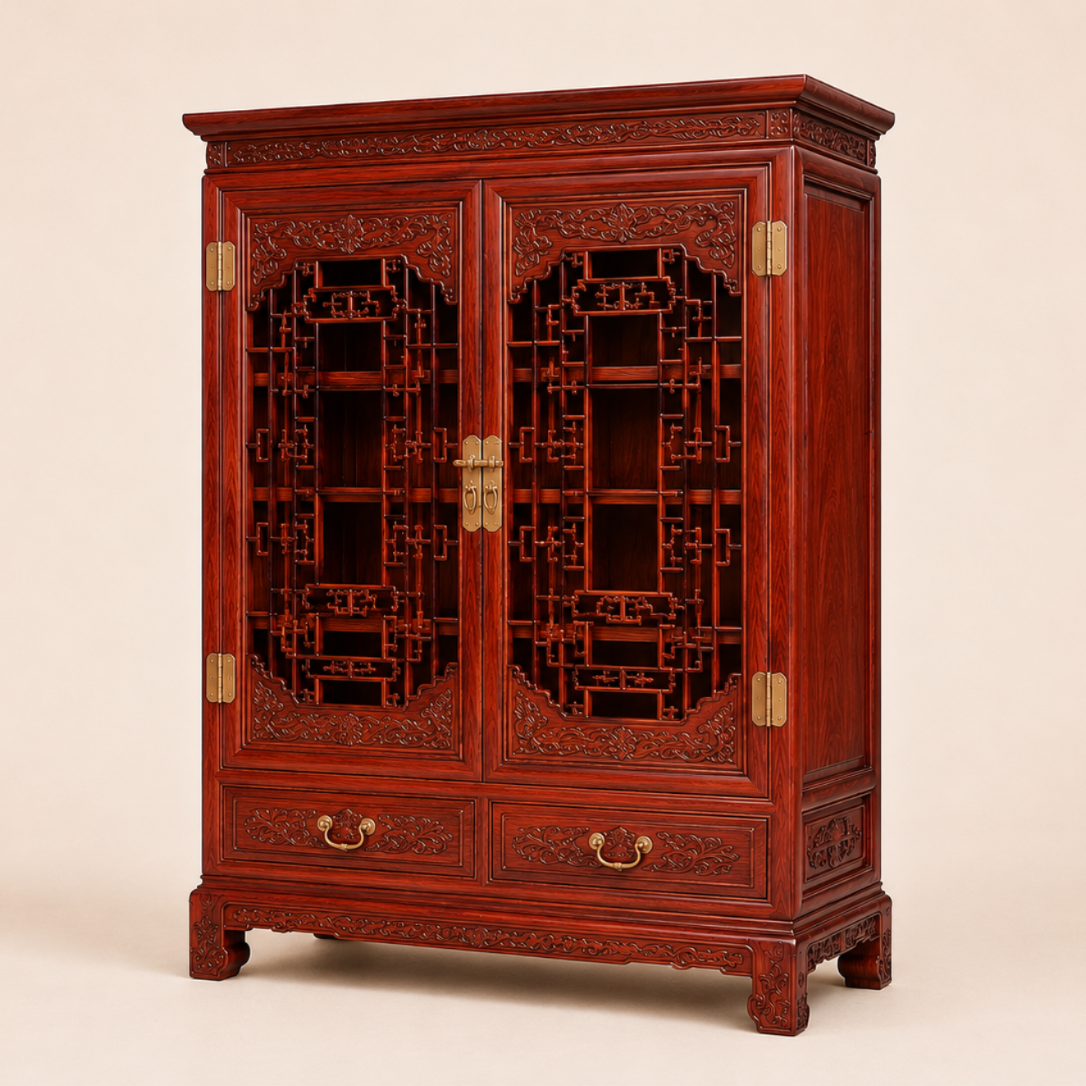
A practical B2B sourcing guide for importing classical Chinese rosewood display cabinets and curio cabinets. Covers wood types, joinery quality checks, carving assessment, finish evaluation, MOQ and shipping considerations, and a supplier evaluation checklist for overseas buyers.
BUYER GUIDE · CLASSICAL CHINESE FURNITURE
# Rosewood Display Cabinet & Curio Cabinet Sourcing Guide A carved rosewood display cabinet is not a commodity purchase. It is a long-life piece that sits in a living room, a study, or a retail showroom for decades. For importers, the margin between a good source and a bad one shows up not at the port, but eighteen months later — when a drawer sticks, a panel cracks, or a carving detail chips off. This guide covers what to check before you place an order for a Chinese rosewood cabinet: wood species, joinery, carving quality, finish, packaging, and how to evaluate a supplier without visiting the factory.
Key takeaways for buyers:
## Why Buyers Choose Classical Chinese Rosewood Cabinets
A rosewood display cabinet serves two functions at once. It stores and protects collectibles — porcelain, jade, tea sets, bronze — and it acts as a visual anchor in a room. The carved panels, the dark wood grain, and the brass hardware give it a presence that mass-produced veneer cabinets do not have.
For importers, the category is attractive for three reasons:
- **High perceived value.** A solid-wood carved cabinet can retail at a significant markup over its landed cost.
- **Low return rate.** Buyers of classical furniture are typically collectors or interior designers who know what they want. They are less likely to return a piece for minor aesthetic reasons.
- **Repeat orders.** A customer who buys one cabinet for a study often comes back for a matching bookcase or tea table.
The risk is on the sourcing side. The category is fragmented, quality varies widely between workshops, and the difference between a $400 cabinet and a $1,200 cabinet is often invisible in a low-resolution product photo.
## Wood Species: What "Rosewood" Actually Means
The term "rosewood" covers a range of species with very different price points, grain patterns, and working properties. In the Chinese furniture trade, the most common terms you will encounter are:
- Specify the exact wood species in your PO — "rosewood" alone is not a material specification.
- Check joinery, not just looks: mortise-and-tenon construction determines whether the cabinet survives shipping and climate change.
- Carving quality is judged by depth, undercutting, and tool marks — ask for close-up photos of the back and underside of carvings.
- Confirm the finish type (lacquer vs. oil vs. PU) and its VOC compliance for your target market.
- Ask for a pre-shipment inspection report and moisture-content readings before loading.
| Common Trade Name | Botanical / Chinese Term | Typical Use in Cabinets | Relative Cost |
|---|---|---|---|
| Huanghuali (Yellow Rosewood) | Dalbergia odorifera | High-end antique reproductions | Very high |
| Hongmu (Red Rosewood) | Dalbergia cochinchinensis / Dalbergia spp. | Premium carved cabinets | High |
| Pterocarpus (Burma / Lao rosewood) | Pterocarpus macrocarpus | Mid-to-high-end furniture | Medium-high |
| African rosewood / Padauk | Pterocarpus soyauxii | Budget "rosewood-style" cabinets | Low-medium |
| Finish Type | Appearance | Durability | Notes for Importers |
|---|---|---|---|
| Traditional Chinese lacquer (raw lacquer / daqi) | Deep, glossy, slightly translucent | Excellent — very hard, water-resistant | Higher cost; longer production time; requires skilled application |
| Natural oil / wax finish | Matte, shows wood grain clearly | Good — but needs periodic re-oiling | Preferred by buyers who want the natural wood feel; lower sheen |
| PU (polyurethane) lacquer | High gloss, uniform | Very durable, scratch-resistant | Most common for export; check VOC compliance for EU/US markets |
| Parameter | Typical Range | Notes |
|---|---|---|
| MOQ (per design) | 5–20 pieces | Lower for standard designs; higher for custom carving |
| Lead time (production) | 30–60 days | Longer for hand-carved pieces; confirm before PO |
| Lead time (shipping) | 25–45 days sea freight | Depends on port pair; add 5–10 days for customs |
| Packaging | Foam + carton + wooden crate (for large pieces) | Confirm whether crating is included in the price |
Pre-order checklist:
## Common Sourcing Mistakes
**1. Ordering from photos alone.** A photo can hide poor joinery, thin panels, and shallow carving. Always request a pre-production sample, even if you have to pay for it and the shipping. The sample cost is negligible compared to a container of defective goods.
**2. Assuming "rosewood" means one thing.** As discussed above, the term covers species ranging from premium Dalbergia to budget padauk. Specify the species in your PO and get it in writing.
**3. Skipping the moisture-content check.** A cabinet that cracks in a dry climate is a warranty claim. One 10-second reading with a moisture meter can prevent it.
**4. Underestimating the cost of packaging.** Cheap packaging saves $5–10 per piece at the factory and costs $50–100 per piece in damaged claims. Do the math.
**5. Not planning for lead time.** Hand-carved furniture cannot be rushed. If you need stock for a holiday season, place your order 4–5 months ahead, not 2.
## FAQ
**Q: What is the difference between a display cabinet and a curio cabinet?**
A: In practice, the terms overlap. A display cabinet typically has open shelves or glass doors for general display. A curio cabinet is usually smaller, with glass on multiple sides, designed for a specific collection of small objects. Chinese manufacturers often use the terms interchangeably.
**Q: Can I get a custom size or custom carving design?**
A: Yes, most workshops accept custom orders. Expect a higher MOQ (often 10+ pieces) and a longer lead time for new carving designs, since the carver needs to create a new pattern. Custom sizes within the same design are usually easier than custom carving.
**Q: What is the best finish for a tea set display cabinet?**
A: For a cabinet that will hold tea sets, choose a sealed finish (PU lacquer or traditional lacquer) on the interior. This prevents the wood from absorbing tea odors and makes cleaning easier. A raw or oiled interior is more traditional but less practical.
**Q: How do I verify the wood is genuine rosewood and not a substitute?**
A: Ask for the botanical name in writing, request a small wood sample, and if the order is large, use a third-party inspection service that can test the wood density and grain. A simple visual check by an experienced inspector is usually sufficient for common species.
**Q: What is a reasonable MOQ for a first order?**
A: For a standard design, 5–10 pieces is typical. For a custom design with new carving, expect 10–20 pieces. If a supplier quotes a very low MOQ (e.g., 1–2 pieces), check whether the per-piece price is inflated to compensate.
## Final Recommendation
Importing classical Chinese rosewood display cabinets is a viable, profitable category — but it rewards buyers who do their homework. The key is not to find the cheapest supplier; it is to find a workshop that will show you the joinery, the carving depth, and the moisture content without hesitation. Those three details tell you more about the piece than any marketing photo.
When you are ready to shortlist suppliers, ask each one for a pre-production sample of your target design. Compare the samples side by side — the differences in wood quality, carving, and finish will be immediately obvious. Then place your first order with the workshop that earns your confidence, not just the one with the lowest quote.
*For specific product availability, MOQ, and lead times, contact the supplier directly. Specifications vary by workshop and design.*- Species confirmation: Supplier states the botanical name of the wood in writing.
- Construction photos: Interior joinery, back panel, drawer construction.
- Carving close-ups: Side-lit video showing depth and undercutting.
- Finish specification: Type, sheen level, VOC compliance documentation.
- Glass spec: Thickness, tempered or not, gasket material.
- Hardware spec: Solid brass or plated; hinge and lock quality.
- Moisture content: Reading at production and before shipment.
- Packaging spec: Material, weight limits, crating cost.
- Inspection: Pre-shipment inspection by a third party (e.g., SGS, Bureau Veritas) or your own agent.
- Sample policy: One pre-production sample before mass production — always.