
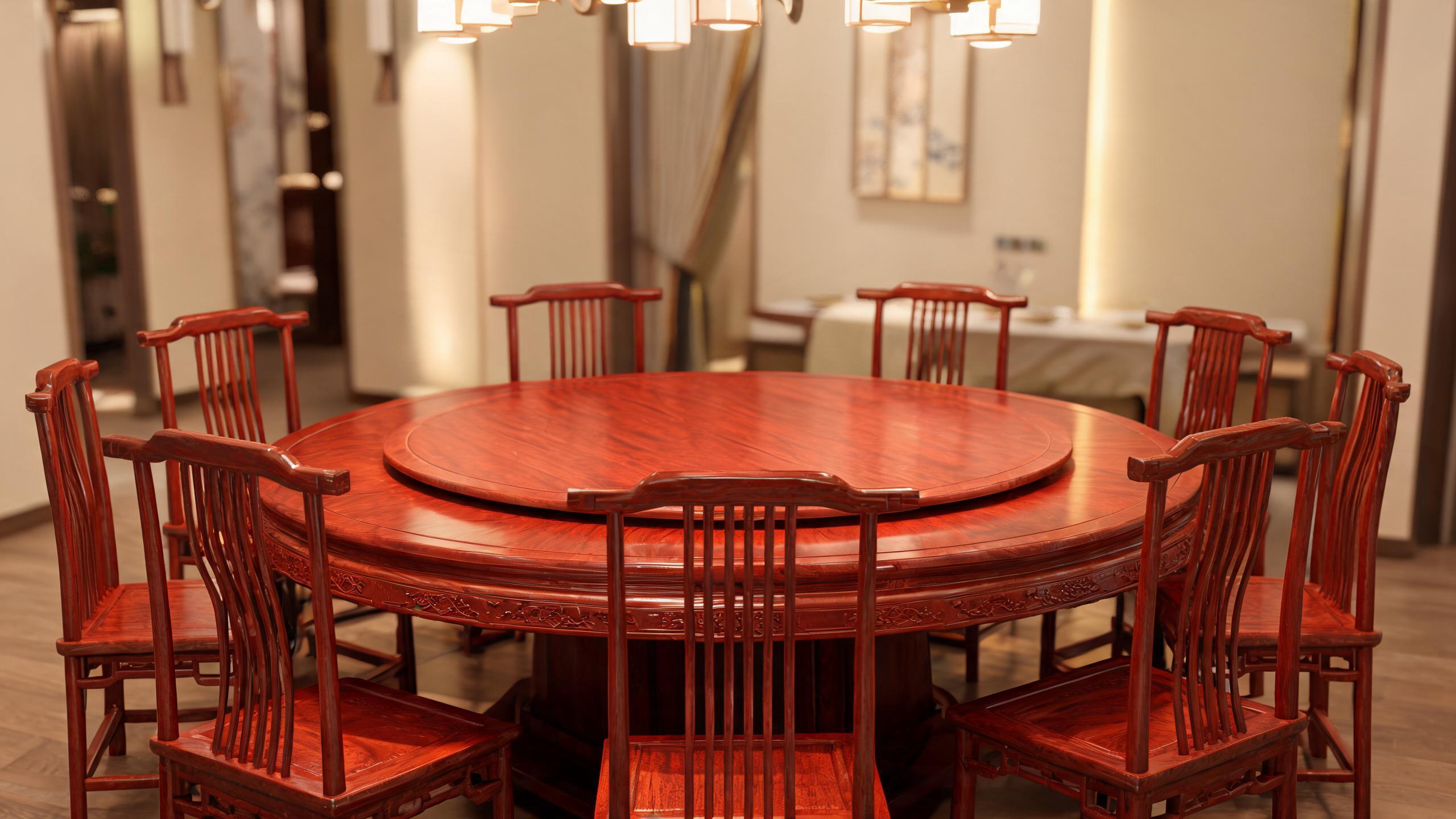
Choosing between round and rectangular rosewood dining tables is a decision that affects your floor plan, guest comfort, service efficiency, and long-term durability. This guide compares the two shapes across seating capacity, space utilization, traffic flow, and maintenance—so you can spec the right rosewood dining table for your restaurant, hotel, or banquet hall.
BUYER GUIDE · COMMERCIAL FURNITURE
# Round vs Rectangular Rosewood Dining Tables: Choosing the Right Shape for Restaurants, Hotels and Banquet Halls When a hotel or restaurant procurement manager asks us about rosewood dining tables, the first question is rarely about wood grade or finish. It is almost always about shape: **round or rectangular?** That question matters because the shape of your dining tables determines three things at once: how many guests you can seat per square meter, how your staff moves through the room, and how the space feels to the customer. Get it wrong, and you lose revenue per square foot. Get it right, and the room works efficiently for years. This guide compares round and rectangular rosewood dining tables across the criteria that matter to commercial buyers—seating capacity, space efficiency, traffic flow, durability, and maintenance. We will also cover when to mix both shapes in one venue.
Key takeaways for procurement:
## Why shape is a commercial decision, not just a design one
A dining table is a revenue asset. It occupies floor space that costs rent, and it must turn over enough times per day to justify that cost. Shape directly affects that math.
A standard rectangular rosewood dining table for four measures roughly 1400 × 800 mm. It seats four guests with a clear service aisle on each side. A round table for four, typically 1200 mm in diameter, seats the same number but requires more surrounding clearance because guests sit at all four points of the circle. In a linear dining room with a 3-meter column grid, you can often fit one more rectangle per bay than you can rounds.
But the opposite is true in a square or wide-open space. A 1600 mm round table seats 6–8 guests comfortably; achieving the same capacity with rectangles would require a 2000 × 900 mm table that eats far more floor area. This is why banquet halls and private dining rooms default to rounds, while casual dining and canteens default to rectangles.
## Rectangular rosewood dining tables: strengths and limits
### Space efficiency in linear layouts
Rectangular tables align cleanly along walls, windows, and partition lines. They create neat rows with predictable aisle widths. For a restaurant with a long, narrow floor plan, rectangles are almost always the better choice—they let you place more covers without creating awkward dead zones.
A typical calculation: a 6-seat rectangular rosewood dining table at 1800 × 800 mm takes about 1.44 m² of table surface. With 900 mm aisles, the total footprint per table is roughly 3.2 m². A 6-seat round at 1500 mm diameter takes about 1.77 m² of surface and roughly 3.8 m² with clearance. In a 200 m² dining area, that difference can mean 4–6 extra tables.
### Service and plated dining
Rectangular tables work best for plated service—where each guest receives a pre-set plate or a set menu. Waitstaff can approach from either long side, and guests do not need to reach across the table for shared dishes. This makes rectangles the default for Western fine dining, hotel breakfast buffets (in row formation), and staff canteens.
### Group dynamics
The limitation is social. On a long rectangle, guests at the ends are cut off from conversation at the center. For groups of six or more, the table becomes two separate conversations. If your venue hosts business meals, family gatherings, or celebratory dinners, this is a real drawback.
## Round rosewood dining tables: strengths and limits
### Social dining and shared dishes
Round tables are the standard for Chinese, Cantonese, and family-style dining because every guest has equal reach to the center. A 1500 mm round rosewood dining table seats 6–8 people, and with a lazy Susan or manual rotation, every dish is accessible to everyone. This is why hotpot restaurants, dim sum houses, and banquet halls in Asia overwhelmingly use rounds.
### Seating flexibility
A round table is more forgiving with group sizes. A 1200 mm round can seat 4 comfortably, 5 at a squeeze. A 1400 mm round seats 6. If your walk-in party sizes vary, rounds absorb that variation better than fixed rectangles.
### The space cost
Rounds are less efficient in linear layouts. They do not align flush with walls, and the curved edge creates triangular dead space in corners. In a narrow room, rounds waste more floor area than rectangles of equal guest capacity. They also make it harder to create straight service aisles.
### Traffic and service
Serving a round table is slower. Staff must reach across a larger diameter, and if the table is against a wall, guests on the inner side cannot be served from that direction. For fast-turnover venues, this is a measurable inefficiency.
## Comparison table: round vs rectangular rosewood dining tables
- Rectangular tables maximize seating density in linear dining rooms and banquet halls—typically 10–15% more covers per square meter than rounds of similar guest capacity.
- Round tables are the standard for social dining (Chinese, Cantonese, family-style) because they allow shared dishes and equal reach for every guest.
- Rosewood (dalbergia) is a dense, heavy hardwood—table weight and mobility should be planned into your floor layout and staff handling procedures.
- Your choice affects service style: rounds suit large-plate sharing; rectangles suit plated service and set menus.
- Many operators mix both: rectangular for perimeter and banquet rows, round for center social seating.
| Criterion | Round Rosewood Dining Table | Rectangular Rosewood Dining Table |
|---|---|---|
| Typical 4-seat size | 1200 mm diameter | 1400 × 800 mm |
| Typical 6–8 seat size | 1500–1800 mm diameter | 1800–2200 × 900 mm |
| Space efficiency (linear rooms) | Lower—creates corner dead space | Higher—aligns with walls and rows |
| Space efficiency (square/open rooms) | Higher—fits more covers per area | Lower—needs more footprint per guest |
| Social dining / shared dishes | Excellent—equal reach for all guests | Poor for groups above 4 |
| Plated service | Slower—staff must reach across | Faster—approach from long sides |
| Group size flexibility | High—absorbs odd party sizes | Low—fixed seating per table |
| Traffic flow | Irregular—harder to plan aisles | Predictable—straight aisles |
| Best venue types | Banquet halls, private rooms, Chinese/Family dining | Casual dining, canteens, Western fine dining, hotel breakfast |
Ask your supplier three questions before ordering: What is the exact dalbergia species? What finish is applied and what is the recommended maintenance interval? What CITES documentation is included with the shipment?## When to mix both shapes in one venue Most successful venues do not choose one shape—they mix them. A common pattern in hotels and mid-to-large restaurants: - **Rectangular rosewood dining tables** along perimeter walls and in rows for plated service and breakfast buffets. - **Round rosewood dining tables** in the center of the room for social dining, larger parties, and a more intimate atmosphere. This hybrid approach maximizes seating density while retaining social flexibility. It also creates visual rhythm—the straight lines of rectangles against the curves of rounds make a dining room feel designed rather than merely filled. For banquet halls, the standard configuration is rounds for the main floor (typically 1500–1800 mm, seating 8–10) and rectangles for buffet lines, registration tables, and perimeter seating. If the hall hosts weddings and corporate events interchangeably, rounds are the safer default because they accommodate both seated banquets and mixed group sizes. ## Practical checklist for procurement Before you send an inquiry to a supplier, run through this list: 1. **Measure your floor plan.** Draw the room to scale and place tables with realistic aisle widths (900 mm minimum for staff, 1200 mm for wheelchair access). Do not estimate—draw it. 2. **Define your service style.** Plated set menus favor rectangles. Shared dishes favor rounds. If you do both, plan for both. 3. **Confirm group size patterns.** If your average party is 2–4, rectangles are more efficient. If it is 6–10, rounds win. 4. **Check table weight and mobility.** Rosewood is heavy. Decide whether tables will be fixed in place or reconfigured daily. 5. **Ask for finish and maintenance specs.** Get the finish type, recommended cleaning products, and reapplication interval in writing. 6. **Verify wood species and CITES documentation.** Do this before you commit to an order, not after. ## Frequently asked questions **Q: Can a round rosewood dining table seat more people than a rectangle of the same floor area?** A: In a square or open room, yes. A 1500 mm round seats 6–8 in roughly 3.8 m² including clearance. A rectangle seating 6–8 needs about 4.2 m². In a linear room, the rectangle is more efficient because it fits flush against walls. **Q: Is rosewood suitable for outdoor or semi-outdoor dining?** A: Rosewood is moisture-resistant, but it is not a weatherproof material. For covered terraces, it can work with a marine-grade finish. For fully exposed outdoor areas, consider other hardwoods or aluminum tables with a rosewood-look finish. Confirm with your supplier before specifying. **Q: What is the typical lead time for a custom batch of rosewood dining tables?** A: Lead times vary by factory capacity and order size. For a standard batch of 50–100 tables, expect 30–60 days plus shipping. Custom sizes and finishes add time. Ask your supplier for a written production schedule before confirming the order. **Q: How do I maintain the rosewood surface in a high-traffic restaurant?** A: Wipe spills immediately, use coasters and trivets for hot items, and reapply the recommended oil or polish every 3–6 months depending on usage. Avoid harsh chemical cleaners—they strip the protective finish. **Q: Can I request a mixed batch—some round, some rectangular—in one order?** A: Yes. Most suppliers accept mixed configurations in a single order. This is common for hotels that need both shapes for different zones. Specify the exact quantities and dimensions for each shape in your inquiry. ## Final recommendation There is no universal "best" shape—only the right shape for your floor plan, service style, and guest profile. - Choose **rectangular rosewood dining tables** for linear dining rooms, plated service, breakfast buffets, and any venue where seating density per square meter is the top priority. - Choose **round rosewood dining tables** for banquet halls, private dining rooms, and venues where guests share dishes and social interaction drives the experience. - Choose **a mix of both** for mid-to-large venues that serve different meal periods and party sizes. When you are ready to spec your order, send your supplier a clear inquiry with your floor plan dimensions, required table sizes and quantities, finish preference, and target delivery date. A reliable factory will respond with a detailed quotation, production timeline, and the documentation you need for customs clearance. If you are comparing suppliers, ask each one the three questions listed above—the answers will tell you more than any brochure. --- *Need help selecting the right rosewood dining table for your project? Contact our sales team with your floor plan and seating requirements—we will recommend a configuration that fits your space and your budget.*