
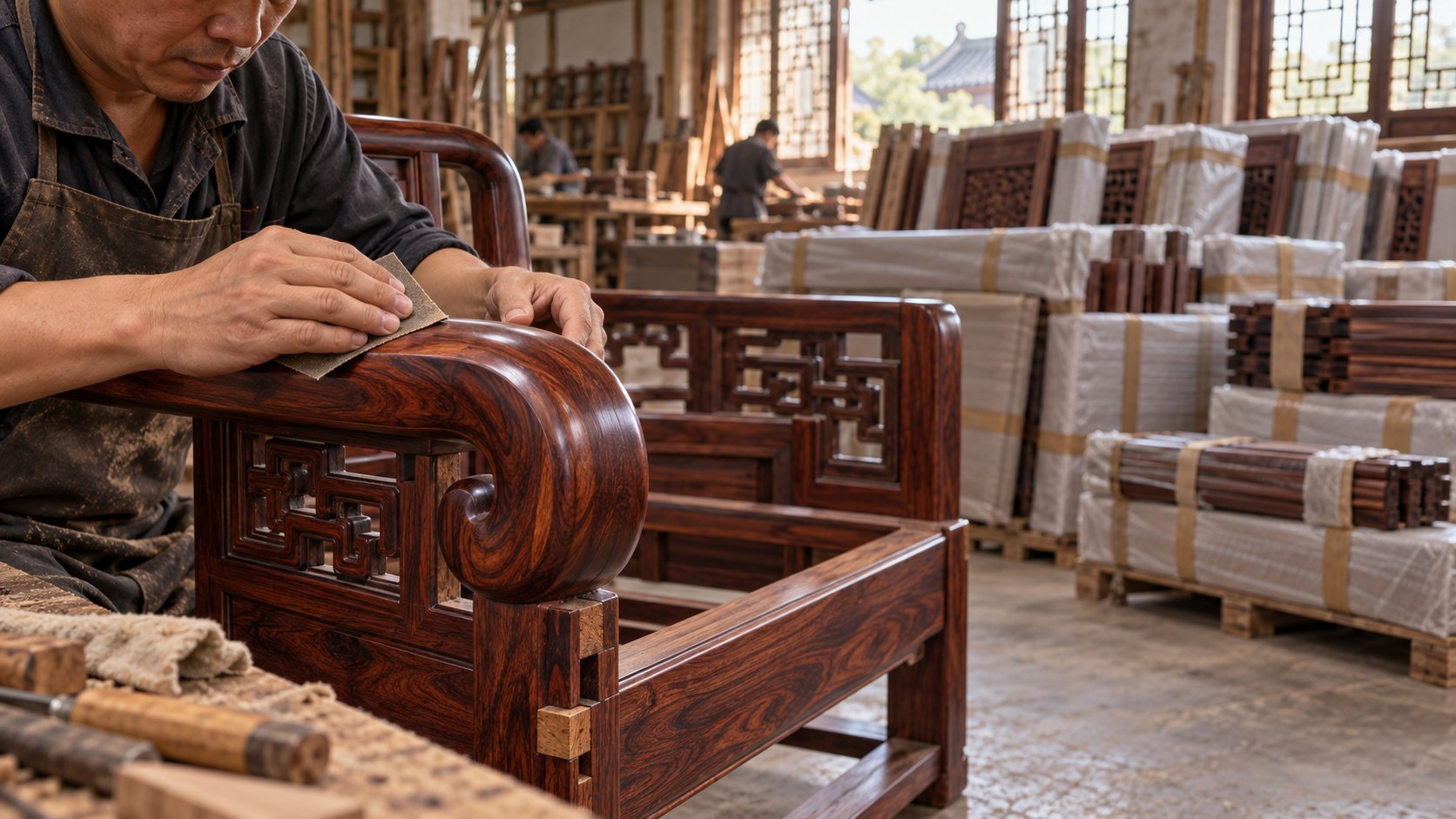
Ein vollständiger B2B-Leitfaden dazu, was die Fertigung von Private-Label-Rosenholmöbeln umfasst: Holzdokumentation, OEM/ODM-Designservices, Verbindungs- und Oberflächenstandards, Compliance-Unterlagen, gebrandete Verpackung, stufenweise Qualitätskontrolle und kommerzielle Bedingungen für wiederkehrende Containerbestellungen.
Private label rosewood furniture manufacturing has become one of the most searched topics among furniture importers, wholesalers, hospitality procurement teams, and design-build contractors across Southeast Asia, Australia, Europe, and North America. The reason is simple: classical rosewood furniture carries a craftsmanship story that mass-produced panel furniture cannot match, yet most buyers do not own a factory, a carving workshop, or a seasoning yard. They need a manufacturing partner who can produce complete sofa sets, dining sets, bedroom suites, tea tables, wardrobes, and display cabinets under the buyer's own brand, at export-grade quality, with documents that survive customs and retail scrutiny.
This guide answers the question in the title in practical, verifiable detail. It walks through every component of a professional private label program for rosewood furniture: material selection and species identity, design and engineering services, sample development, joinery and finishing standards, compliance documentation, branding and packaging, quality control, lead times, and the commercial terms that decide whether a private label project is profitable. Every section is written from the perspective of a working rosewood furniture factory serving B2B buyers, so you can use it as a checklist when you compare suppliers.
1. What Private Label Rosewood Furniture Manufacturing Actually Means
Private label manufacturing, sometimes called white label or OEM production, means the factory manufactures furniture to its own established designs or to the buyer's designs, and the finished goods carry the buyer's brand instead of the factory's. In the rosewood furniture segment, private label goes further than simply gluing a logo onto a carton. Because classical Chinese furniture is sold on craftsmanship, material identity, and cultural value, a serious private label program must cover the entire product story: the timber specification, the joinery method, the carving style, the finish, the compliance paperwork, and the retail presentation.
For a B2B buyer, the practical definition is this: you choose or co-develop the product range, the factory produces it under your brand at an agreed specification and price, and you receive a complete documentation package that lets you sell the products confidently in your home market. The factory remains invisible to your customers; your brand owns the shelf, the showroom, or the project reference.
Private Label vs. OEM vs. ODM in Rosewood Furniture
Buyers often use these three terms interchangeably, but they describe different levels of involvement:
- Private label / OEM: The factory's existing classical designs are produced and badged under your brand. You select models from the catalog, adjust dimensions, finishes, or carving details, and the factory executes. This is the fastest route to market because the tooling, carving patterns, and production jigs already exist.
- ODM (Original Design Manufacturing): The factory's design team develops new models for you, based on your market brief, price positioning, or a reference you provide. The factory owns the engineering work: drawing conversion, proportional adjustment of classical motifs, structural review, and sample iteration.
- Full customization: For villa projects, hotels, or collectors, dimensions and motifs are engineered per project from architectural drawings. This is common for whole-house rosewood interiors where sofas, dining sets, beds, wardrobes, and display cabinets must share one design language.
A capable rosewood furniture manufacturer offers all three tiers under one roof, which matters because most importers start with catalog OEM and grow into ODM as their brand matures.
2. Timber Selection and Material Identity: The Foundation of the Program
No part of private label rosewood furniture manufacturing carries more commercial risk than material identity. Buyers and their customers pay a premium for genuine rosewood, so the program must start with a documented timber specification.
Species Documentation
The factory should state, in writing, the species used for each product line. For the products discussed here, that means Siamese rosewood (Pterocarpus macrocarpus and related Pterocarpus species traded as padauk-family timber), documented by botanical name rather than trade nickname alone. A professional private label program includes:
- Botanical species identification for every timber lot, not just the first shipment.
- Documentation supporting legal harvest and trade, including the permits required under CITES Appendix II for rosewood species in international trade.
- Chain-of-custody documentation, ideally under FSC (Forest Stewardship Council) chain-of-custody certification, so the buyer can make responsible-sourcing claims.
- Consistent grading: heartwood-only construction, no sapwood in visible surfaces, and documented moisture content targets.
Seasoning and Drying
Classical rosewood furniture is built from dense hardwood that moves with humidity if it is not properly seasoned. A private label program should specify the drying protocol. In a disciplined factory this means air drying in covered seasoning yards followed by controlled kiln drying, with moisture content brought to a stable band appropriate for the destination climate before joinery begins. A documented kiln schedule of roughly thirty-six days of humidity-controlled drying, with moisture readings recorded by batch, is the kind of verifiable detail that separates export-oriented manufacturers from domestic-market workshops. Buyers shipping to air-conditioned offices in Singapore, heated homes in Canada, or dry Australian interiors should ask for the moisture content target for their destination climate and confirm it in the purchase contract.
Color and Grain Matching Across a Container
Because rosewood varies in color from batch to batch, a private label program must include timber selection for color and grain continuity. When a buyer orders a full container of sofa sets, dining sets, and bedroom suites under one brand, the factory should select and match timber so that pieces photographed together in the buyer's catalog and displayed together in showrooms look consistent. This is a manufacturing service that pure trading companies cannot control, and it is one of the strongest arguments for buying from the factory directly.
3. Design and Engineering Services Included in Private Label Manufacturing
The second pillar of the program is design conversion. Classical Chinese furniture carries proportional rules — the relationship between seat height, armrest sweep, back splat curvature, and leg taper — that were refined over centuries. Private label manufacturing must translate those rules into production documents.
From Catalog Selection to Production Drawings
When a buyer selects a Ming-style sofa set or a Qing-style dining suite from the factory catalog, the private label process normally includes:
- Dimensional adaptation: Adjusting seat depth, table height, or bed length to the destination market's ergonomic expectations. European and North American buyers, for example, frequently request larger seat dimensions and king-size bed platforms.
- Motif selection: Choosing carving motifs — dragon, phoenix, peony, auspicious clouds, lattice patterns — and deciding where they appear. A catalog model can be produced with denser carving for a luxury hotel lobby or plainer surfaces for a minimalist retail line.
- Hardware and functional details: Specifying drawer runners, hinge types, felt-lined jewelry compartments, cable management in display cabinets, and removable back panels for narrow stairways.
- Engineering review: Checking that every adaptation preserves structural integrity. Classical joinery is geometry-specific; lengthening a table or widening a bed changes stress distribution, so the factory's carpenters must review the modified drawing before carving begins.
Sample and Prototype Development
For ODM and custom work, the factory produces a prototype or a sample of critical components before mass production. A disciplined sample process includes a dimensioned drawing confirmation, a material and finish approval sample, and a signed golden sample that becomes the quality benchmark for the production run. Buyers should expect to approve: timber color under their market's lighting, carving depth and detail, finish sheen, upholstery fabric or leather on cushions, and hardware finish. The golden sample is then referenced during pre-shipment inspection, which closes the loop between what was approved and what ships.
4. Craftsmanship Standards: What Goes Into Each Piece
Private label buyers are ultimately reselling craftsmanship, so the manufacturing program must specify, in measurable terms, the construction standards behind every piece.
Mortise and Tenon Joinery
Authentic classical rosewood furniture is assembled with mortise and tenon joinery — interlocking wooden joints cut directly into the frame members — rather than metal fasteners. This is not nostalgia; it is engineering. Wood expands and contracts across seasons, and metal fasteners locked into dense hardwood create split points over time, while well-cut wooden joints flex with the material. A professional program specifies:
- Joint types per position (through tenons, blind tenons, dovetail-shaped shoulder joints, mitred joints with internal splines for table frames).
- Tolerances for joint fit, typically requiring hand-fitting so each joint closes without gaps yet disassembles for container transport.
- A no-visible-metal-fastener policy on structural frames, with concealed hardware permitted only for functional fittings such as drawer runners.
Hand Carving
Carving depth, line quality, and motif symmetry are what customers photograph and judge. The program should state which elements are hand-carved, which are machine-roughed and hand-finished, and the acceptable tolerance for symmetry across a matched pair of chairs. Master carvers train for years to cut classical motifs correctly; a factory that documents its carving team and quality checkpoints can defend the hand-carved claim in the buyer's marketing, which is exactly what a private label buyer is paying for.
Surface Finishing
Traditional rosewood finishing is a layered process: surface preparation, grain raising, repeated coats of natural lacquer or wax with hand-polishing between coats. An eight-coat natural lacquer and beeswax finishing schedule, with polishing between coats, produces the deep, tactile sheen that distinguishes genuine rosewood furniture from stained imitations. The private label program should specify the number of coats, the finishing materials, and the sheen level, and the golden sample should lock the approved finish for the production run. Buyers serving the EU and US should also confirm finish material compliance with their market's chemical regulations, which leads to the next section.
5. Compliance and Documentation: The Part Buyers Forget Until It Hurts
Nothing ends a private label relationship faster than a shipment stuck at customs or a retail claim the brand cannot answer. Rosewood furniture carries a specific compliance profile, and the manufacturing program must include it.
Timber Legality and Species Documentation
Most rosewood species traded internationally are listed under CITES Appendix II, which means shipments require export permits documenting legal, traceable sourcing. The factory's role is to provide accurate species declarations and support the buyer's import permit process. Buyers importing into the European Union must also consider the EU Deforestation Regulation and timber due-diligence obligations, while US imports fall under the Lacey Act declaration framework. A private label program should deliver, per shipment: species and botanical names, quantities and volumes, harvest documentation references, and export permit copies.
FSC Chain of Custody
FSC chain-of-custody certification allows a documented claim that the timber in a product comes from responsibly managed forests. For buyers selling to institutional purchasers — hotels, government projects, LEED-targeted developments — FSC documentation is increasingly a tender requirement. The program should confirm whether the factory's chain-of-custody covers the specific product lines and how the claim is passed to the buyer's invoices.
Chemical and Finish Compliance
Finishes, adhesives, and cushioning materials must meet destination-market rules: REACH in the European Union, CARB (California Air Resources Board) formaldehyde standards for composite components in the United States, and analogous requirements in Australia and Southeast Asia. Because classical rosewood furniture is primarily solid wood with natural lacquer and beeswax finishes, its compliance profile is favorable — but the program should state it in writing, including test reports or declarations for any upholstered or composite components.
Export Packaging and ISPM 15
Solid wood packaging materials crossing borders must comply with ISPM 15, the international standard for wood packaging treatment. Export crating for rosewood furniture should use heat-treated, stamped packaging wood, plus corner protection, foam interleaving, and moisture barriers. Container loading plans should account for the weight of dense hardwood — a container of classical rosewood furniture loads differently from a panel-furniture container — and fragile carved elements should be crated individually. The private label program should include the packing specification, carton markings, and the buyer's brand presentation on export cartons.
6. Branding, Packaging, and Retail Presentation Services
This is where private label manufacturing visibly differs from generic OEM. The buyer's brand must appear consistently from the container to the customer's living room.
- Brand marking on the product: Options include a discreet branded metal plate, laser or hand engraving on an unseen frame surface, or a stamped brand seal inside drawers and cabinets — the classical equivalent of a maker's mark, which many brands use as an authenticity feature.
- Packaging design: Custom-printed cartons, branded protective blankets for showroom deliveries, care booklets, and authenticity cards describing the timber species, joinery method, and finishing process in the buyer's market language.
- Product content support: Specification sheets, high-resolution photography of the actual production run, and material descriptions the buyer can reuse in e-commerce listings and catalogs. Factories that provide accurate content reduce the buyer's time to market.
- Kit-of-parts retail logistics: Classical furniture often ships partially disassembled (legs removed, backs off) to increase container utilization. The program should confirm reassembly instructions, included tools, and whether delivery partners in the destination market are supported with assembly guidance.
A well-run program treats the buyer's unboxing and assembly experience as part of the brand, not an afterthought.
7. Quality Control Built Into the Production Run
Private label quality control has three stages, and buyers should confirm all three are included.
In-Process Control
Checkpoint inspections after timber selection, joinery assembly, carving, and finishing catch problems while they are still cheap to fix: a warped frame member, an inconsistent carving pair, a finish with dust inclusions. Ask the factory which checkpoints exist and who signs them off.
Pre-Shipment Inspection
Before container loading, every piece — or a statistically meaningful sample for repeat programs — is inspected against the golden sample: dimensions within tolerance, joinery tight, finish consistent with the approved sheen, hardware functional, upholstery correctly fitted, and no transit-critical defects. Buyers may attend in person, send a third-party inspector, or rely on the factory's inspection report with photos. For first orders, an independent pre-shipment inspection is a reasonable cost for the confidence it buys.
Container Loading Supervision
How furniture is packed determines how it arrives. Loading supervision confirms crate orientation, weight distribution, moisture barriers, and photo documentation of the loaded container. Combined with the packing specification, this stage protects the brand's first impression in the market.
8. Commercial Terms: MOQ, Lead Time, and Cost Structure
A private label program is also a commercial arrangement, and buyers should understand the standard structure before comparing quotes.
Minimum Order Quantities
Because rosewood furniture is produced in sets and requires timber selection for color continuity, factories typically work with container-based or set-based minimums. Common structures include mixed-container loading, where a buyer combines sofa sets, dining sets, and bedroom suites from the catalog to fill one container, and per-model minimums for fully customized designs. Buyers should confirm: minimum order per model, whether samples are available at production cost, and the policy for repeat orders of customized models.
Lead Times
Realistic production lead times for classical rosewood furniture run roughly forty-five to sixty working days, driven by the sequence that cannot be compressed: timber selection and moisture stabilization, joinery and assembly, carving, finishing coats with polishing time between them, and quality control with proper curing before packing. Custom designs add engineering and sample time. Buyers should plan retail or project calendars backward from these lead times rather than expecting panel-furniture schedules.
What Drives Price
Price in private label rosewood furniture follows transparent drivers: timber species and grade, carving density (hand-carving hours), finishing coat count, set configuration and upholstery specification, compliance documentation scope, and order volume. A trustworthy factory quotes against a written specification rather than a photo, which is another reason the golden sample and specification sheet matter — they turn the quote into an auditable document.
9. How to Evaluate a Private Label Rosewood Furniture Partner
Before committing a brand to a manufacturing partner, run this checklist:
- Factory verification: Confirm you are dealing with the manufacturer, not a middleman: workshop visit (in person or virtual), production photos and videos of your actual models, and named contact persons in production and export documentation.
- Material documentation: Botanical species declarations, CITES export permit support, FSC chain-of-custody status, and written moisture content targets for your destination climate.
- Craftsmanship evidence: Mortise and tenon construction on structural frames, documented carving team, and a finishing schedule you can verify against the golden sample.
- Compliance readiness: Familiarity with your market's import requirements — EU timber due diligence, US Lacey Act declarations, ISPM 15 packaging — and willingness to provide the documentation per shipment.
- Sample discipline: A written golden sample process, dimensioned drawings before production, and inspection reports with photos.
- Communication: Production progress updates at agreed milestones — typically timber selection, frame assembly, carving completion, finishing, and pre-shipment — so you never learn about a problem after the container sails.
- References and track record: Export experience to your region, repeat-container customers, and after-sales support terms for transit damage or warranty claims.
Suppliers who resist written specifications, golden samples, or shipment documentation are asking the buyer to absorb risks the buyer cannot see — the defining failure mode of private label sourcing.
10. Frequently Asked Questions
Can I put my own brand on classical designs the factory already produces?
Yes — that is the standard private label / OEM model. The factory produces its catalog designs under your brand, with your approved dimension, finish, carving, and packaging adjustments. Discuss exclusivity for specific models if your market strategy requires it; exclusivity terms are a commercial negotiation, not a manufacturing limitation.
How many pieces fit in a container?
It depends on set configuration and disassembly. Classical sets ship partially disassembled, so a mixed container typically combines several sofa sets, one or two dining suites, and bedroom pieces. The factory's loading plan will show exact utilization for your selected models.
Do you support small trial orders?
Most factories accommodate a first-order trial — often a single set at production cost or a reduced mixed container — because the goal of private label programs is repeat business. Confirm the sample policy and whether sample cost is credited against the first container.
What documentation do I receive with each shipment?
Commercial invoice and packing list, species declaration and CITES export permit support, FSC documentation where applicable, ISPM 15-compliant packaging, inspection report with photos, and loading documentation. Buyers in the EU and US should also request the declarations their customs brokers need for timber due-diligence and Lacey Act entry.
How is color consistency guaranteed across repeat orders?
Through timber selection for color and grain at the start of every production run, referenced against archived production records and, where provided, your retained golden samples. This is a genuine factory capability — ask how the supplier matches color across a container, because trading companies cannot control it.
What happens if a piece arrives damaged?
The packing specification, loading supervision photos, and insurance terms define the answer. Reputable manufacturers support claims with photographic evidence from loading, replacement parts or pieces for transit damage, and clear warranty terms for structural joinery.
11. Private Label Across the Full Rosewood Product Range
A practical private label program should be evaluated by how much of the classical rosewood range it can carry under one brand. Retailers and project buyers rarely launch with a single product; they build a catalog. The categories below are the core of most private label rosewood programs, and each carries its own specification decisions.
Sofa Sets: The Anchor of the Catalog
Classical rosewood sofa sets are usually the anchor purchase because they define the brand's visual identity. Specification decisions include the style family (Ming-style lines with cleaner geometry, or Qing-style with denser carving), the seat count (three-seat plus single-seat combinations are the export standard), cushion construction (high-density foam wrapped in silk-blend or linen fabric, or leather for hospitality use), and carving density on the aprons, arms, and backrests. Buyers should also decide whether armrests are carved or plain, because carving hours materially affect cost and the resulting retail price point.
Dining Sets: Function Meets Ceremony
Rosewood dining sets range from six-seat rectangular tables with matching chairs to round banquet tables with rotating center trays for Chinese restaurants and hotel banquet rooms. Private label decisions include table extension mechanisms, chair seat height for Western ergonomic expectations, and finish durability for commercial dining use. Restaurants and banquet halls subject dining surfaces to heat, moisture, and daily cleaning chemicals, so buyers in hospitality should request the finishing specification and maintenance guidance in writing.
Bedroom Suites: Beds, Wardrobes, and Nightstands
Four-poster beds and carved wardrobes anchor the bedroom category. Key specifications: platform dimensions matched to destination-market mattress standards, slat or panel bed bases, wardrobe internal layout (hanging rails, drawers, felt-lined compartments), and disassembly strategy for stairway access. Because bedroom pieces are bulky, container utilization depends heavily on knock-down engineering, so buyers should confirm which models ship with removable legs and back panels and whether assembly instructions are branded.
Tea Tables, Display Cabinets, and Accent Pieces
Tea tables (low tables with optional rotating trays), display cabinets with glass doors and interior lighting provisions, console tables, and altar cabinets round out the range. These accent pieces carry high margin and photograph well, making them efficient catalog fillers for private label collections. Glass specification, shelf adjustability, and cable routing for illuminated cabinets should appear in the written specification.
12. The Private Label Process Timeline, Step by Step
Buyers comparing factories should ask each candidate to describe its process in stages. A well-run private label program follows a predictable sequence:
- Stage 1 — Brief and catalog selection (week 1): The buyer shares target market, price positioning, and category priorities. The factory proposes catalog models or ODM concepts with indicative specifications.
- Stage 2 — Specification lock (weeks 1–2): Dimensions, timber species, finish schedule, carving density, upholstery, hardware, packaging, and branding elements are written into a specification sheet. This document, not a photo, becomes the commercial reference.
- Stage 3 — Golden sample (weeks 2–5): The factory produces a sample or critical-component samples. The buyer approves dimensions, color under target lighting, finish sheen, and carving detail, then both parties retain a signed golden sample.
- Stage 4 — Production (roughly 45–60 working days): Timber selection and moisture stabilization, joinery and assembly, carving, finishing coats with polishing intervals, and in-process checkpoints. Progress photos at agreed milestones keep the buyer informed without site visits.
- Stage 5 — Pre-shipment inspection: Inspection against the golden sample, dimension and finish checks, hardware function tests, and a photographic inspection report.
- Stage 6 — Packing and loading: ISPM 15-compliant crating, moisture barriers, corner protection, container loading supervision with photo documentation, and handover of the shipment documentation package.
Buyers should map this timeline against their retail or project calendar and confirm each stage in the proforma invoice or contract, so expectations are contractual rather than verbal.
13. Risk Management: What the Contract Should Cover
Private label sourcing concentrates brand risk on the buyer, so the commercial agreement deserves the same rigor as the specification sheet. Mature programs address the following points explicitly:
- Specification as the quality standard: The contract should reference the specification sheet and golden sample as the acceptance criteria for every shipment, removing ambiguity from dispute resolution.
- Model exclusivity: If the buyer's market strategy depends on unique designs, exclusivity for defined models in defined territories should be written, including duration and volume conditions.
- Intellectual property boundaries: Classical motifs are heritage, but the buyer's logo, packaging artwork, catalog photography, and any new ODM designs belong to defined parties. The contract should state who owns ODM output and whether the factory may resell the design elsewhere.
- Transit damage and warranty: Inspection rights at destination, claim windows, evidence requirements (loading photos, third-party survey reports), and remedies such as replacement parts or pieces.
- Payment and production milestones: Deposit and balance terms tied to verifiable stages — golden sample approval, production completion, inspection passed — align incentives across the timeline.
- Repeat-order consistency: Retained golden samples and archived production records support color and finish consistency across future containers, which protects the brand as it scales.
14. Frequently Asked Questions About Private Label Rosewood Furniture
Is rosewood furniture suitable for air-conditioned or heated environments?
Yes, when the timber is properly seasoned and the destination moisture target is respected during manufacturing. The relevant variable is the moisture content of the wood at the time of joinery relative to the destination climate's equilibrium. This is why written moisture targets — and batch moisture records — matter more for buyers in heated North American interiors or dry Australian conditions than for buyers in equatorial Southeast Asia.
How do I verify the timber species claim after the goods arrive?
Ask for the species declaration with botanical names on the shipping documents, retain golden samples, and, for critical programs, commission an independent wood identification test on received goods. Documented supply chains with CITES export permit support and FSC chain-of-custody records give buyers a defensible paper trail from forest to showroom.
What carving options can I choose without redesigning a model?
Catalog models usually accept carving-density variants — plain, light, medium, dense — and motif substitutions within the same carving zones, because the frame geometry stays unchanged. This lets a buyer create two retail tiers from one model family without paying full ODM engineering cost.
Can the factory ship directly to my warehouse, or drop-ship to my customers?
Container shipping to the buyer's warehouse or port of choice is standard. Direct-to-customer fulfillment is unusual for full container programs but may be arranged for showroom and project deliveries in some markets. Confirm Incoterms, destination services, and who books freight before quoting.
How does the factory protect my brand during production?
Through controlled branding application (branded plates or seals applied at the final production stage), packaging produced against the buyer's approved artwork, and restricted photography of branded items. Buyers with confidentiality concerns should state them early and agree on handling rules for branded samples and photography.
What is the difference in cost between hand-carved and machine-assisted carving?
Hand-carving hours are the main cost driver in the carving stage. Machine roughing with hand finishing sits between fully hand-carved and plain production. The specification sheet should state which method applies to each carving zone, because the method determines both cost and the authenticity story the buyer can market.
For importers building a durable brand in classical furniture, these operational details are not bureaucracy — they are the difference between a private label line that compounds in value and one that generates claims, returns, and reputational risk. The factories that welcome written specifications, staged inspections, and complete documentation are the ones built for export partnership, and they are the suppliers worth auditing first.
15. Regional Market Notes for Private Label Buyers
Although the private label mechanics are universal, destination markets shape specification choices in predictable ways, and buyers should raise these points during the specification stage rather than after the first container arrives.
Southeast Asia
Proximity to timber origins and a shared appreciation for classical Chinese design make Southeast Asia a natural first market for private label rosewood programs. Humidity, however, is the defining technical variable: equatorial moisture levels mean the timber's equilibrium moisture content differs from temperate markets, and factories should confirm the drying target for tropical destinations. Chinese restaurant chains, hotel groups, and tea houses across the region are steady institutional buyers, and banquet-format round dining tables with rotating trays remain a strong catalog category.
Australia
Australian buyers combine strict biosecurity expectations with a design-literate retail market. Packaging must be immaculately clean and ISPM 15 compliant, and timber legality documentation should be ready before the container books. Dry interior climates in southern cities call for explicit moisture targets, and the market responds well to lighter carving densities and Ming-style lines that sit comfortably in contemporary interiors.
Europe
European imports of rosewood furniture operate under the region's timber due-diligence framework, so species declarations, harvest documentation, and FSC chain-of-custody status are commercially decisive, not optional extras. Scandinavian and Germanic buyers favor restrained carving and clean silhouettes; Southern European villa and hospitality projects absorb denser, more ornamental Qing-style work. Finish compliance declarations for the EU market should be requested in writing with the specification sheet.
North America
The United States and Canada bring the Lacey Act declaration regime, CARB chemical standards for any composite components, and a consumer market that expects king-size bed platforms, deeper seats, and robust after-sales support. Private label buyers serving North American retail should also plan for higher packaging standards and branded assembly instructions, because unboxing experience directly shapes review scores on major e-commerce platforms.
16. Working With the Factory: Communication That Protects the Brand
The final ingredient of a successful private label program is communication discipline, and it costs nothing to demand. Buyers should expect named contacts for engineering, production, and export documentation; milestone photo updates at timber selection, frame assembly, carving completion, and finishing; and proactive notice of any material substitution or schedule slip while alternatives still exist. Factories that volunteer this information are demonstrating the operational maturity that private label partnerships require, because once the buyer's brand is on the crates, every production surprise becomes the buyer's customer-service problem. Set the communication standard in the first order, and repeat containers become routine rather than renegotiation.