
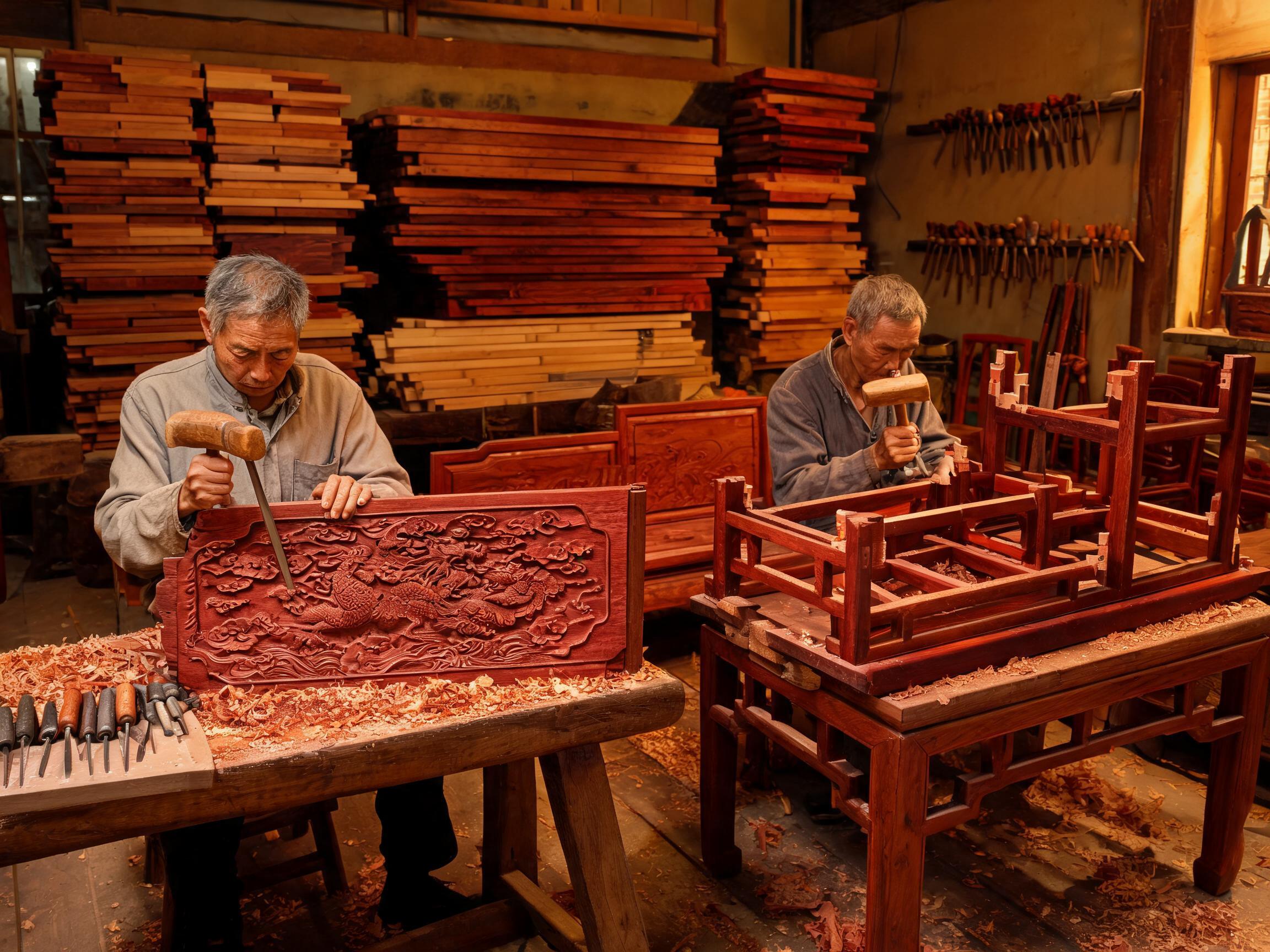
A practical guide for B2B buyers on developing custom rosewood furniture collections through ODM programs. Learn what ODM covers versus OEM in classical furniture, the step-by-step path from drawings to container production, available customization options, and the key commercial terms to confirm before committing.
BUYER GUIDE — CLASSICAL FURNITURE SOURCING
# ODM Furniture Manufacturing: How B2B Buyers Develop Custom Rosewood Furniture Collections For importers, wholesalers, and interior contractors, rosewood furniture is a high-ticket category. A single dining set or bookcase can retail for several thousand dollars, and the margin depends as much on design and finish consistency as on wood cost. That is why more B2B buyers are moving beyond picking from a catalog and into **ODM furniture** programs — commissioning a manufacturer to develop a collection that is exclusive to their brand. This guide walks through what ODM actually covers versus OEM in classical furniture programs, the development path from drawings to container production, the customization options available, and the commercial terms you must confirm before committing.
Key takeaways for buyers:
## ODM vs. OEM: What Each Covers in Classical Furniture Programs
The distinction between ODM and OEM is often blurred in supplier communications, but it materially changes your cost structure and your control over the product.
**OEM (Original Equipment Manufacturing)** means you provide the design. You send drawings, CAD files, or reference photos, and the factory produces to your specification. The manufacturer is responsible for material sourcing, joinery, finishing, and quality control — but not for the design itself. You own the design; they own the production process.
**ODM (Original Design Manufacturing)** means the factory contributes the design work. In a rosewood furniture ODM program, you typically provide a brief: target market, price point, style direction (Ming, Qing, Art Deco, contemporary-classical fusion), and functional requirements. The manufacturer's in-house design team then develops the collection — producing layout plans, technical drawings, and prototypes for your approval.
- ODM means the factory handles design and engineering based on your brief; OEM means you supply the drawings and they manufacture to spec.
- The typical development path is: brief → layout plan → technical drawings → sample → revisions → bulk production → container loading.
- Customization in rosewood programs covers sizes, patterns, finishes, hardware, and configurations — but each change affects cost and lead time.
- Confirm MOQ, sample policy, lead time, and drawing ownership in writing before paying any development fee.
Key difference
— In ODM, the factory absorbs the design risk and usually the design cost into the unit price. In OEM, you pay for the design work (or bring it in-house) but keep full ownership. For most B2B buyers, ODM is the faster route to an exclusive collection. You do not need a furniture designer on staff, and you benefit from the factory's knowledge of what actually sells in export markets — including which proportions survive container shipping and which finishes photograph well. ## The Development Path: From Drawings to Container Production A typical rosewood furniture ODM program follows a structured sequence. Understanding it helps you plan timelines and budget. ### 1. Design Brief and Layout Plan You send the factory your requirements: product categories (dining tables, sideboards, lounge chairs, bedroom sets), target dimensions, style references, and retail price targets. The factory's design team responds with a **layout plan** — a preliminary arrangement of pieces within a collection, showing how the set works as a coordinated group. This stage is where you align on scope. A full dining collection might include a table, six chairs, a sideboard, and a display cabinet. A bedroom program includes a bed frame, nightstands, a dresser, and a wardrobe. The layout plan establishes which pieces are in scope and how they relate proportionally. ### 2. Technical Drawings Once the layout is approved, the factory produces detailed technical drawings. These specify: - **Dimensions** for each piece, including height, width, depth, and seat height for chairs - **Wood grade** and cut plan (which parts use solid rosewood versus veneer) - **Joinery method** (mortise-and-tenon, dowel, or hardware assembly) - **Finish specification** (open-pore, closed-pore, gloss level, color tone) - **Hardware details** (hinges, drawer slides, handles) Review these drawings carefully. This is the cheapest stage to make changes. Once the factory cuts wood, revisions become expensive. ### 3. Sample Production The factory produces a physical sample — usually one hero piece first (the dining table or the bed frame), then the rest of the collection once the first sample is approved. Sample lead time for rosewood furniture is typically **25–45 days**, depending on the complexity of the piece and the factory's current production load. ### 4. Sample Approval and Revisions Inspect the sample against the drawings. Check: - **Joinery tightness** — no visible gaps at corners - **Finish uniformity** — color consistency across panels, no blotching - **Hardware operation** — drawers slide smoothly, doors align - **Stability** — the piece does not wobble on a level floor - **Weight** — matches your freight cost assumptions Most programs require one to two rounds of revisions. Budget for this in your timeline. ### 5. Bulk Production Once the sample is approved, the factory issues a production order. Bulk production for a container-sized order (typically 40–80 pieces depending on size) runs **30–60 days**. The factory should provide a production schedule and progress photos at key milestones — usually after cutting, after finishing, and before packing. ### 6. Container Loading and Inspection Before loading, arrange a pre-shipment inspection. A third-party inspector (or your own agent) checks quantity, packaging, and a random sample of pieces against the approved sample. Rosewood furniture is heavy and fragile; proper packaging — usually a combination of foam corner protectors, stretch wrap, and a sturdy outer carton or wooden crate — is non-negotiable. ## Customization Options: Sizes, Patterns, Finishes, and Configurations A rosewood furniture ODM program offers more than just picking a catalog design and changing the dimensions. Here is what you can realistically customize: ### Sizes Virtually every dimension is adjustable. Table lengths, chair seat heights, cabinet depths, and bed frame sizes can all be modified to suit your market. Standard US and EU mattress sizes differ, so a bed frame designed for the Chinese domestic market will not automatically fit a US king mattress. Confirm the target market's standard dimensions early. ### Patterns and Carving Rosewood's dense grain makes it ideal for carving. You can specify: - **Carving density** — from clean, minimal lines to heavy relief carving - **Motif style** — traditional Chinese patterns (cloud scrolls, dragon motifs, geometric lattice) or Western classical elements (acanthus leaves, fluting, reeding) - **Inlay work** — mother-of-pearl, marble, or metal inlays Each carving pattern affects production time. Heavy carving can add 30–50% to the labor cost of a piece. ### Finishes Finish options for rosewood include:| Finish Type | Appearance | Durability | Typical Use |
|---|---|---|---|
| Open-pore (natural) | Matte, wood grain visible and tactile | Good; requires care | High-end residential, traditional styles |
| Closed-pore (filled) | Smooth, semi-gloss to high-gloss | Excellent; resists moisture | Commercial, hospitality, heavy-use pieces |
| Wax finish | Soft sheen, very natural feel | Low; needs periodic re-waxing | Display pieces, low-traffic residential |
| Lacquer (PU or NC) | Glossy, film-forming | Very high; scratch-resistant | Hotels, restaurants, rental properties |
Before you send an inquiry, prepare: your target market and price points, the product categories you need, approximate quantities, your timeline, and any style references. A factory that receives a clear brief can give you a much more accurate quote and development plan than one that has to guess.
## FAQ: Rosewood Furniture ODM Programs
**Q: What is the typical MOQ for an ODM rosewood furniture program?**
A: It varies by factory and product size. Single-SKU MOQs often start around 20–50 pieces; full collection programs may require 100–300 pieces total. Always ask for the MOQ per SKU and whether mixed containers are allowed.
**Q: How long does the full development process take?**
A: From brief to delivered container, plan for 90–150 days. This includes design (2–3 weeks), sample production (4–6 weeks), revisions (1–2 weeks), bulk production (4–8 weeks), and shipping (2–5 weeks depending on destination).
**Q: Do I own the design in an ODM program?**
A: Usually not outright. The factory typically retains ownership of the technical drawings, and you receive an exclusive license for your market. Confirm the exclusivity terms and duration in writing.
**Q: What is the sample fee, and is it refundable?**
A: Sample fees for rosewood furniture typically range from a few hundred to over a thousand dollars per piece, depending on complexity. Many factories refund the sample fee against the first bulk order. Confirm the policy before paying.
**Q: Can I mix different pieces in one container to reach the MOQ?**
A: Many factories allow mixed containers — for example, a 40-foot container with dining tables, chairs, and a sideboard. This is often the most practical way to launch a collection. Confirm the factory's mixed-container policy and any additional packing costs.
**Q: Is rosewood export regulated?**
A: Yes. Rosewood species are listed under CITES, and export requires permits. Confirm that the factory holds valid export documentation and that your destination country accepts the species you are importing. Work with a freight forwarder experienced in wood furniture imports.
---
**Ready to discuss your rosewood furniture collection?** Send us your product categories, target market, and approximate volumes, and we will provide a development plan and timeline. [Request a consultation](#inquiry) or ask for our ODM program overview and sample policy.