
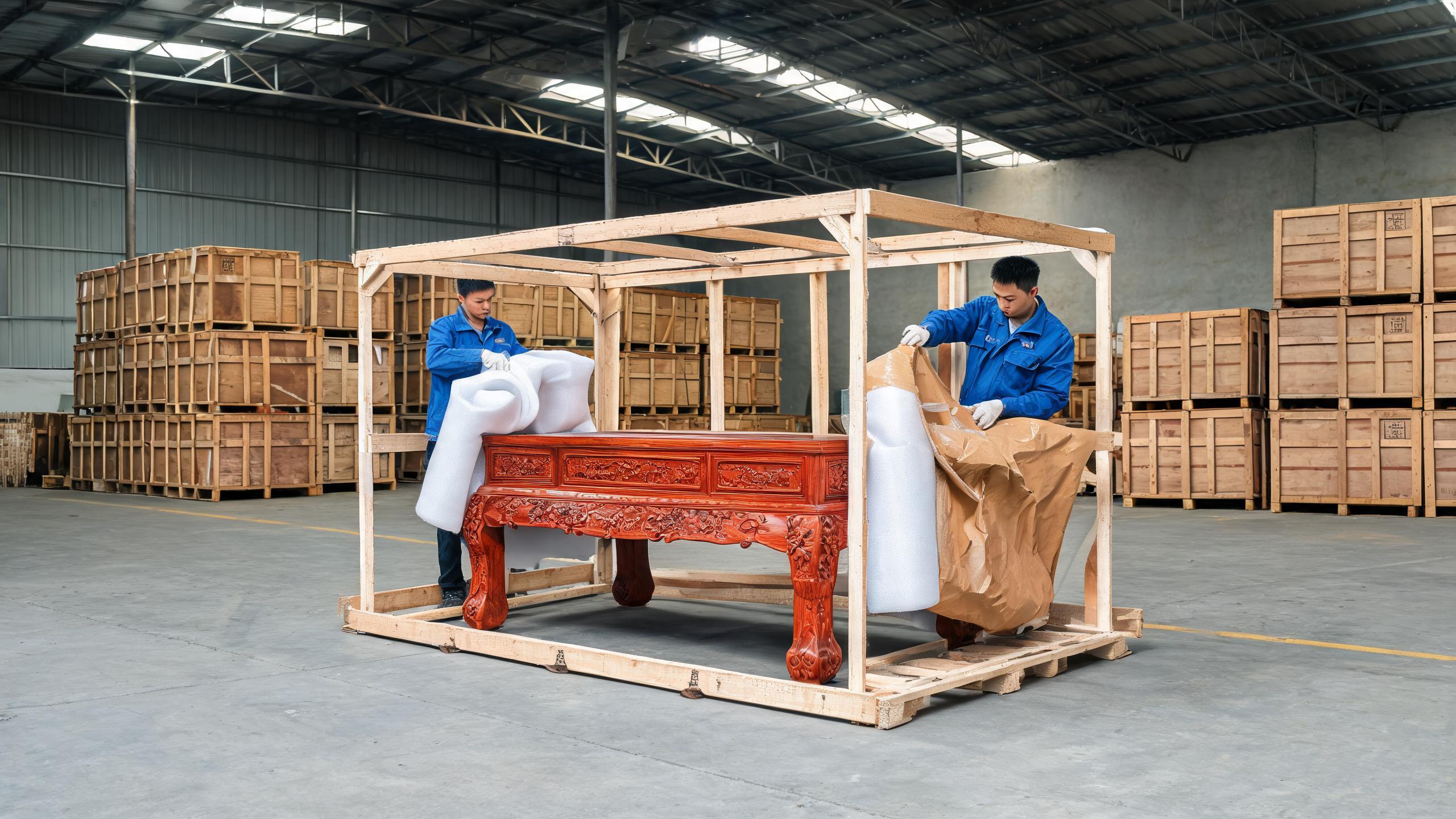
El embalaje de exportación para muebles de madera de palisandro requiere un sistema de protección de cuatro capas, cumplimiento de ISPM 15, carga adecuada del contenedor y seguro marítimo. Esta guía cubre todo lo que los compradores necesitan saber sobre el envío de muebles desde China.
Why Is Export Packaging Critical for Rosewood Furniture?
Classical rosewood furniture traveling from Fujian, China to Europe or North America faces a 30 to 45 day journey through extreme humidity swings, temperature changes, and physical handling at multiple ports. Without proper export packaging, a 20,000 USD container of hand-carved furniture can arrive with warped panels, cracked finishes, and dented corners. Packaging is not an afterthought; it is a critical part of the manufacturing process that protects the value of the goods from factory floor to buyer warehouse.
The challenge with redwood furniture is that it is both heavy and fragile. A 7-piece dining set can weigh over 400 kilograms, yet the carved surfaces and lacquer finishes are easily damaged by abrasion and impact. The packaging system must absorb shocks, block moisture, and prevent pieces from shifting inside the crate during ocean transit.
What Is the Four-Layer Protection System for Redwood Furniture?
Professional ISPM 15 compliant packaging for rosewood furniture uses a four-layer protection system. Each layer addresses a specific risk.
Layer 1: Surface protection. A thin foam wrap is applied directly to the furniture surface. This prevents scratches and abrasion from the subsequent packaging layers. For carved surfaces, a soft non-woven fabric is used instead of foam to conform to the contours without compressing the details.
Layer 2: Moisture barrier. VCI (volatile corrosion inhibitor) anti-corrosion paper is wrapped over the foam. This paper inhibits mold growth on the wood surface and prevents moisture from penetrating to the finish. For high-value carved pieces, a vacuum-sealed PE bag with a single large desiccant pack is used instead, creating an airtight environment that maintains a stable humidity level inside the package.
Layer 3: Structural protection. A corrugated carton or wooden crate is built around the wrapped furniture. Corner protectors made of hardboard or molded pulp are placed at every vertical edge. The crate must be sized so the furniture does not touch any inner surface, with a minimum 50mm gap filled with foam blocks or air pillows.
Layer 4: Container securing. Inside the shipping container, crates are blocked and braced with timber dunnage to prevent movement. Cargo straps anchored to the container lashing points hold the crates in position. Silica gel desiccant bags are placed at 1 gram per liter of crate volume to absorb any residual moisture.
What Is ISPM 15 and Why Does It Matter?
The International Standards for Phytosanitary Measures No. 15 (ISPM 15) is a regulation that requires all solid wood packaging material used in international trade to be treated to prevent the spread of pests and diseases. This applies to the wooden crate, pallets, dunnage, and any other solid wood packaging component.
Treatment is done by heat treatment (HT), where the wood is heated to a core temperature of 56 degrees Celsius for at least 30 minutes, or by methyl bromide fumigation (MB), which is being phased out globally. Treated wood is stamped with the IPPC mark, which includes the ISO country code, a unique facility number, and the treatment code (HT or MB).
European and North American customs authorities inspect incoming container loading for ISPM 15 compliance. Non-compliant packaging can result in the shipment being refused entry, re-exported at the buyer expense, or fumigated at the destination port at significant cost. Some countries, including the United States, have additional requirements for wood packaging from China and require the HT stamp specifically.
How Should Redwood Furniture Be Loaded into a Shipping Container?
Container loading is where many preventable damage incidents occur. A standard 40-foot high-cube container holds 55 to 68 cubic meters of cargo, but redwood furniture is dense and often weight-limited rather than volume-limited. The following practices are essential.
Distribute weight evenly. Heavy pieces like dining tables and carved screens should be distributed across the container floor rather than concentrated at one end. The total container weight should stay under 19,000 kilograms, which is the practical road weight limit in many European countries. An unevenly loaded container can tip during inland transit.
Stack strategically. Lighter items like chairs and side tables can be stacked on top of heavier crates, but never stack more than two layers high. Each layer must be separated by timber dunnage or plywood sheets to distribute the load and prevent point loading on the lower crates.
Secure with cargo straps. Use woven polyester cargo straps rated for at least 2,000 kilograms breaking strength, anchored to the container lashing points. Do not rely on cardboard edge protectors alone. The goal is to prevent any movement of the crates during the ship roll and pitch cycles that occur during the ocean freight transit.
Document the loading. Photograph the container interior at three stages: one-third loaded, two-thirds loaded, and fully loaded before closing the doors. These photos are essential evidence if an insurance claim is filed for transit damage.
What About LCL Shipments and Damage Prevention?
Less-than-container-load (LCL) shipments face higher freight damage risk because the furniture is transloaded at a consolidation warehouse in China and again at the destination deconsolidation warehouse. Each transloading event is an opportunity for forklift damage, dropping, and exposure to weather.
For LCL shipments, insist on the following. First, a tally report from the consolidation warehouse in China showing the condition of each crate when received. Second, shrink-wrap the exterior of each crate to provide a tamper-evident seal. Third, place fragile labels on all four sides of each crate. Fourth, use a freight forwarder who specializes in furniture, not a general cargo consolidator.
Marine cargo insurance for furniture shipments typically costs 0.3% to 0.5% of the declared cargo value. This is a small expense relative to the cargo value and is essential. The buyer has 7 days from container devanning to file a claim with the insurer. Missing this window voids most policies, so inspect every piece immediately upon delivery.
How Does Yunxiao Handle Export Packaging?
At Yunxiao Rosewood Furniture, we apply the four-layer protection system to every piece we ship. Our wooden crate material is ISPM 15 heat-treated and stamped with the IPPC mark. We photograph each piece before packaging, during crate construction, and after container loading, and we provide these photos to the buyer as part of the shipping documentation.
For container orders, our team supervises the loading process from start to finish, ensuring weight distribution, dunnage placement, and cargo strap securing meet international standards. We coordinate with freight forwarders who understand rosewood furniture handling requirements and can provide door-to-door service to major European and North American ports. This attention to export packaging detail is why our shipments consistently arrive in the condition our buyers expect.