
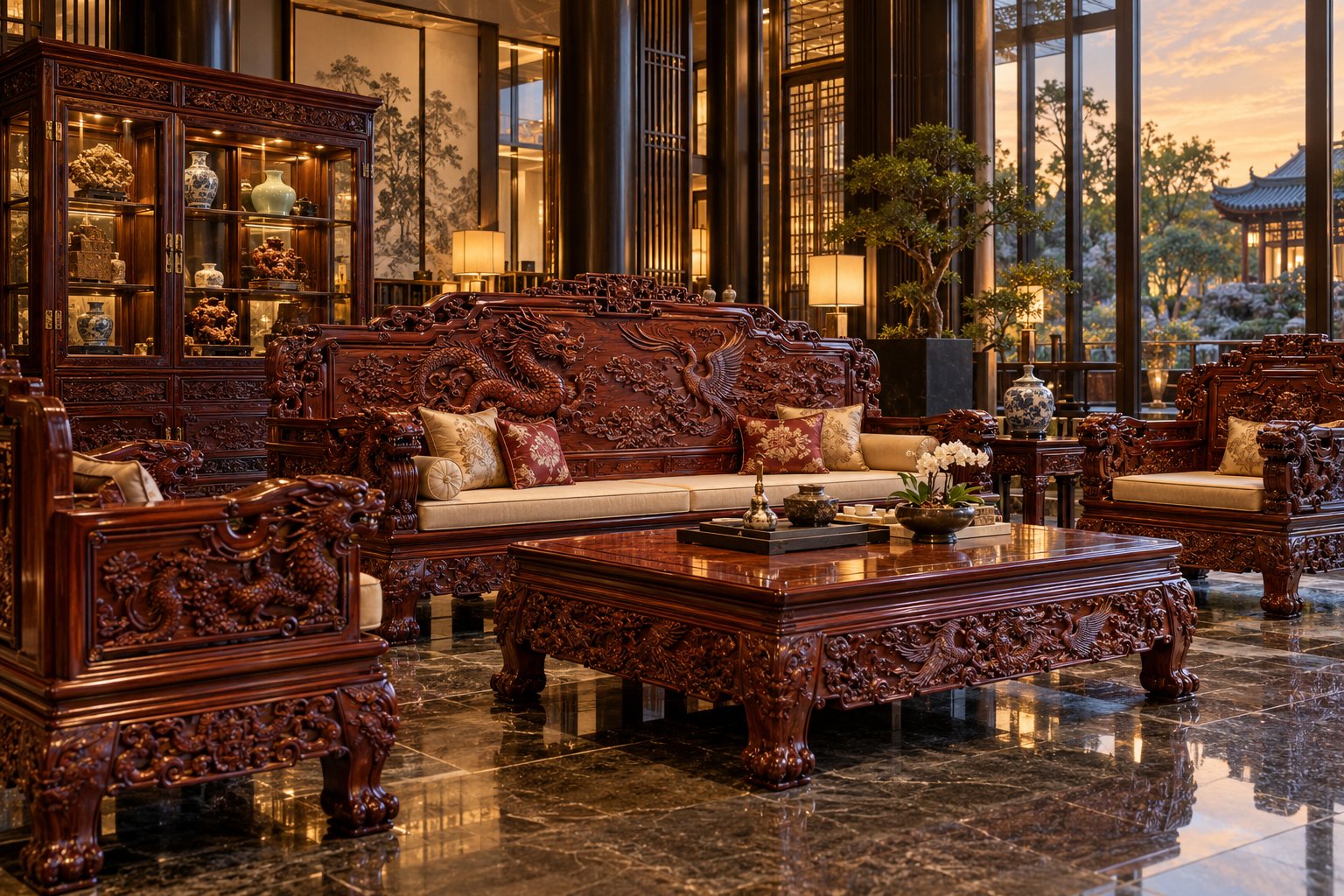
Una guía B2B que responde dónde comprar mobiliario hotelero al por mayor para hoteles, villas y resorts: cinco canales de abastecimiento, particularidades del palosanto clásico, planificación por zonas, cotización, cumplimiento y plazos, con capacidades reales de producto y exportación de Yunxiao.
A procurement manager planning a 40-key boutique hotel, a villa developer fitting out six show residences, or a resort operator refreshing a lobby does not search "where to buy hotel furniture wholesale" out of curiosity. That search happens at the moment a real project has a budget, a floor plan and a deadline, and the buyer needs to know which channel can actually deliver hospitality-grade furniture at wholesale terms. It is one of the highest-intent commercial questions in the furniture trade, and the answer is more layered than a single supplier directory.
The short, honest answer is this: there are five real channels for buying hotel furniture at wholesale — specialized manufacturers selling direct, trading companies and sourcing agents, B2B marketplaces and trade fairs, and project-side intermediaries such as interior design studios and FF&E procurement consultants. For standardized commercial casegoods made from veneer, laminate or engineered wood, most of these channels can work. For classical rosewood furniture — solid wood, hand-carved, built with traditional joinery and configured to a specific property — the channel list narrows dramatically, because the number of manufacturers with genuine hotel-scale hand-carving capacity is limited. In that category, buying direct from a specialized manufacturer is not just the cheapest route; it is also the route best positioned to deliver a coherent, matching, documented collection, because consistency across a full order is a factory-level discipline.
This guide walks through each channel from a B2B buyer's perspective, explains what changes when the material is classical rosewood rather than standard contract furniture, shows how to map furniture to the functional zones of a hotel or resort, and outlines how a professional wholesale order is scoped, quoted, documented and scheduled. It is written for importers, dealers, developers and procurement teams — not for retail shoppers.
Who Actually Buys Hotel Furniture Wholesale — and What They Need
Before comparing channels, it helps to be precise about who is on the other side of the search. "Hotel furniture wholesale" buyers generally fall into five groups, and their needs differ enough to change which channel fits.
- Hotel owners and developers furnishing an independent property or a small portfolio. They usually control the budget directly, want factory-level pricing, and care about a supplier who can guarantee consistency across every room type.
- Procurement teams working for hotel management groups. They often follow an FF&E (furniture, fixtures and equipment) process with formal specification documents, sample approvals and staged payments. Documentation and repeatability matter as much as price.
- Villa and resort developers. Their projects demand statement pieces — grand reception seating, banquet dining sets, signature suite furniture — where design individuality is part of the commercial value of the property.
- Furniture dealers and distributors who supply hospitality projects in their own markets. They buy at wholesale to resell, so they need stable factory relationships, OEM/ODM flexibility and reliable export documentation.
- Interior designers and architects specifying furniture for a client's property. They may not buy directly, but they decide what gets bought — and they increasingly specify classical Chinese furniture for projects where a sense of place is the design concept.
Across all five groups, the non-negotiables are similar: real wholesale pricing, the capacity to produce in project quantities, consistent quality across a full order, customization to drawings, and export experience with correct documentation. Keep those five requirements in mind, because they are exactly the tests each channel must pass — and where most channels fail for classical rosewood.
Channel 1: Buying Direct from a Specialized Manufacturer
The first and most important channel is the specialized manufacturer — a factory whose core business is the category you are buying. For commercial hotel furniture in the classical Chinese style, that means a rosewood furniture factory with its own timber supply, carving workshops, joinery lines and export experience, not a general furniture trader with a catalog.
Direct sourcing concentrates several advantages that matter most on hotel-scale projects:
- True wholesale economics. There is no intermediary margin layered between the factory and your project budget. On a multi-container order, the difference between factory-direct pricing and distributor pricing is frequently the difference between fitting the FF&E budget and exceeding it.
- Customization to drawings. Hotels rarely fit standard SKUs. Reception counters need specific lengths, banquet halls need specific seat counts, suites need beds sized to the market you operate in. A specialized factory works from your drawings and adjusts dimensions, carving density and configuration — this is the essence of OEM/ODM service, and it is only genuinely available from the party that holds the tools and the craftsmen.
- Single-point accountability. When one factory produces the lobby seating, the banquet dining sets and the suite furniture, one party owns color matching, grain selection, carving style consistency and delivery coordination. Splitting the order across intermediaries multiplies the risk that pieces arriving from different sources will not read as one collection.
- Craft capability you can verify. Hand carving, mortise-and-tenon joinery and traditional finishing are workshop-level skills. Buying direct means you can review real production evidence — workshop photographs, process documentation, sample pieces — rather than trusting catalog renderings.
- Export competence. An experienced manufacturer handles export packaging coordination, container planning, commercial documentation and timber compliance paperwork as routine. For a buyer in Southeast Asia, Australia, Europe or North America, this competence is not optional.
The trade-off is that direct sourcing puts more responsibility on the buyer to communicate specifications clearly and to verify capability before committing. A professional manufacturer will support this with samples, drawings, video calls and reference documentation — and will be comfortable doing so, because it has nothing to hide. If a supposed "factory" resists every verification request, that is itself the answer to your sourcing question.
At Yunxiao Rosewood Furniture, for example, hotel and villa project buyers work direct with the production side: the company manufactures classical redwood furniture sets — sofa, dining and bedroom collections — in solid rosewood with hand carving and mortise-and-tenon construction, accepts OEM/ODM orders built from buyer drawings, quotes standard production lead times of 45–60 working days from order confirmation depending on carving complexity, order volume and the production calendar, and supplies FSC and CITES documentation support for cross-border timber compliance. Those four capabilities — customization, capacity, lead-time transparency and documentation — are precisely the checklist a wholesale hospitality buyer should apply to any direct manufacturer they evaluate.
Channel 2: Trading Companies and Sourcing Agents
The second channel is intermediaries: export trading companies and independent sourcing agents, both concentrated in China's furniture manufacturing regions. They exist for legitimate reasons and can add value in specific situations.
A trading company typically aggregates products from multiple factories under one export umbrella. For a buyer assembling a mixed order — say, standard bedroom casegoods from one supplier, lighting from another, and a small number of accent pieces from a third — a trading company consolidates shipping, simplifies payment and provides one point of contact. For buyers without in-house China expertise, that convenience has real value.
A sourcing agent goes further, representing the buyer's interests: shortlisting factories, attending inspections, negotiating on the buyer's behalf. Independent agents paid by the buyer, rather than by factory commission, can be a genuine safeguard for first-time importers.
But both intermediaries carry structural limitations for classical rosewood hotel projects:
- Margin compression. Every intermediary takes a margin, which either raises your cost or squeezes the factory's scope — and on carved solid-wood production, a squeezed scope almost always shows up in the carving.
- Technical distance. Carving depth, grain matching across a sofa set, joinery tolerance and finishing sequence are workshop conversations. An intermediary who cannot read a carving drawing cannot supervise the detail that defines classical furniture.
- Diluted accountability. If a carved panel arrives inconsistent with the approved sample, a direct factory fixes it; a trader relays messages between you and a factory it may barely know.
- Limited category depth. Most traders stock broad, fast-moving categories. Classical rosewood is slow, specialized production; it rarely sits in a trader's standard catalog, which means the trader is itself buying from the specialized factory — and adding its margin on top.
The practical guidance: use intermediaries when your order is genuinely mixed-category and your volumes are modest. When classical rosewood furniture is the centerpiece of the order — as it usually is for hotel lobby and banquet programs — go direct to the source and keep the full budget working on the furniture itself.
Channel 3: B2B Marketplaces and Online Catalogs
When buyers type "where to buy hotel furniture wholesale" into a search engine, most of the results point to B2B marketplaces — and that is not wrong, it is simply the beginning of the process rather than the end. Platforms that list Chinese furniture manufacturers are efficient discovery tools: you can compare dozens of hospitality furniture suppliers in an afternoon, scan product ranges, review minimum order terms and message several candidates in parallel.
Use marketplaces well with three disciplines:
- Treat listings as lead generation, not procurement. Catalog photographs — especially of hand-carved furniture — rarely survive contact with production. Marketplace listings tell you who exists and roughly what they make; they do not tell you what will arrive in your container.
- Verify the seller is the manufacturer. Many marketplace "suppliers" of hotel furniture are resellers. Ask directly: which production steps happen in your own workshop? Request a live video walkthrough of carving and joinery areas. A real specialized factory does this routinely.
- Move the conversation to a real technical dialogue. Share drawings, ask how the factory would adapt a set to your suite count and room sizes, request a sample or a production reference for the same carving style. The quality of the technical response separates manufacturers from middlemen faster than any certificate badge.
For classical rosewood specifically, expect the marketplace stage to be short. The population of factories that genuinely hand-carve solid rosewood at hospitality scale is small; within an hour of focused searching you can identify the realistic candidates, and the rest of the evaluation should happen through direct technical engagement — the same engagement you would conduct with a factory found through any other channel.
Channel 4: International Furniture Fairs
Trade fairs remain a serious wholesale channel, particularly for hospitality buyers. The major Chinese fairs — the China International Furniture Fair (CIFF) in Guangzhou and the China International Furniture Expo in Shanghai among them — concentrate hundreds of exhibitors across contract, hospitality and classical furniture categories, and buyers from hotel groups, dealerships and design studios walk them precisely to solve the "where to buy" question face to face.
Fairs offer three things no screen can replicate:
- Physical evaluation. You can sit in the chair, run a hand over the carving, open a drawer and see the joinery. For hand-carved solid wood, tactile inspection in person is worth hours of video calls.
- Concentrated comparison. In two days you can compare ten carving workshops' output side by side, which would otherwise take months of correspondence.
- Relationship building. Meeting the export team face to face establishes the working rhythm that a multi-month production and shipping schedule will require.
The limitation is timing and coverage. Fairs run on fixed calendars, and no fair displays a factory's full custom capability — OEM/ODM work built from buyer drawings rarely appears on a booth. Treat the fair as a shortlisting and trust-building channel: collect contacts, examine build quality, then continue evaluation through the factory's own technical channels. And note the fair's usual rhythm: orders discussed at the fair are quoted, sampled and produced afterward through the factory — meaning the fair again funnels you back to direct manufacturing engagement.
Channel 5: Design Studios, Contractors and FF&E Consultants
The fifth channel operates on the buyer's side of the table. Interior design studios, main contractors and specialized FF&E procurement consultants regularly specify and purchase hotel furniture wholesale on behalf of property owners. For branded hotels with formal standards, an FF&E consultant who manages specification, tendering, sample approval and site delivery can be indispensable.
For classical rosewood programs, the consultant's decisive task is manufacturer selection — because the consultant's library of "contract furniture vendors" rarely includes genuine rosewood carving workshops. A consultant who can connect a project to a specialized manufacturer, and who manages the specification interface (drawings, finish references, quantity schedules) between the design team and the factory, adds real value. A consultant who simply resells from a trader's catalog adds a layer of margin with none of the craft supervision.
If you work through this channel, keep two principles: first, insist on knowing the actual manufacturing source — the factory identity is not a secret to be managed; second, keep a direct technical line to the factory for carving samples, material selection and production milestones, because these conversations do not survive two levels of relay.
The Five Channels Compared
| Channel | Best for | Wholesale pricing | Customization depth | Main limitation for classical rosewood |
|---|---|---|---|---|
| Specialized manufacturer, direct | Hotel, villa and resort programs centered on classical furniture | Highest (no intermediary margin) | Full OEM/ODM from drawings | Requires buyer diligence in verification — which a transparent factory welcomes |
| Trading company / sourcing agent | Mixed-category consolidated orders; local representation for first-time buyers | Middle (intermediary margin included) | Limited; relays to factories | Margin plus technical distance from the carving workshop |
| B2B marketplace | Discovery and shortlisting | Varies; verify who quotes | Discovered, not delivered | Listings do not represent production quality |
| Trade fair | Physical evaluation and relationship building | Factory-direct usually | Custom work discussed, produced after | Fixed calendar; partial catalog visibility |
| Design studio / FF&E consultant | Branded and formal-procurement projects | Includes professional fees | Specified via the factory | Value depends entirely on whether they source the real manufacturer |
Read as a whole, the table tells a simple story: every channel either is the specialized manufacturer or, at best, leads you to one. For a category as specialized as hand-carved classical rosewood, the efficient strategy is to reach the manufacturer directly and use the other channels for what they are good at — discovery, verification and professional specification.
Why Classical Rosewood Changes the Wholesale Equation
Much of the world's hotel furniture wholesale trade runs on standardized contract furniture: engineered-wood casegoods, commercial upholstery, repeatable SKUs produced by the container. That supply chain rewards scale and punishes individuality. Classical rosewood furniture inverts the logic, and buyers who apply contract-furniture assumptions to it consistently make expensive mistakes.
Four structural differences matter most:
- Material is the product. Solid rosewood — dense, grain-rich, often Siamese rosewood for premium classical work — is not a surface treatment over a substrate; it is the substance of every component. This makes material selection, grain direction and color matching across a set a production-level discipline, not a purchasing afterthought. It also means timber documentation (FSC chain-of-custody support, CITES-related paperwork where species rules apply) is part of the purchase, not an optional extra.
- Hand carving is capacity-constrained. Machine carving can be scaled; master hand carving cannot be expanded by adding machines. A workshop's realistic monthly output of deeply carved sets is finite, which is why serious manufacturers quote production windows measured in weeks — 45 to 60 working days is a standard professional range for carved classical orders — and why buyers with fixed opening dates must reserve production capacity early.
- Joinery determines longevity. Mortise-and-tenon construction, the structural grammar of Chinese classical furniture, delivers the durability that commercial hospitality use demands — but it must be cut by experienced hands. A loose tenon hidden under a rail is invisible in photographs and obvious within two years of hotel service. This is why verification of actual workshop practice matters more in this category than in any other furniture procurement.
- The supplier population is small. There are thousands of factories that can produce a standard hotel headboard. There are dozens, not thousands, that can produce a nine-seat carved reception sofa set with consistent grain and coherent relief work across every piece. "Where to buy" is therefore a narrower question than it appears: the answer is a short list of specialized manufacturers, and the buyer's skill lies in identifying and verifying them.
These differences also explain why classical rosewood commands its position in hospitality design. A lobby furnished with genuinely carved solid rosewood is not decorated — it is authored. For boutique hotels, heritage-themed resorts and luxury villas in Southeast Asia, and for premium residential projects worldwide, that authored quality is precisely the commercial differentiation the property is buying.
Mapping Furniture to the Functional Zones of a Hotel or Resort
A professional wholesale order begins not with products but with zones. Walk any property through a buyer's eyes and the furniture requirement organizes itself into four zones, each with its own performance and aesthetic logic. Below is how classical rosewood furniture maps onto them, using real production examples.
Lobby and Arrival Zone
The lobby is the property's signature statement, and hotel lobby furniture carries the heaviest representational load: it is photographed, remembered and judged. Classical carved rosewood performs this role exceptionally because the material itself communicates permanence and cultural depth.
A large carved sofa set anchors the arrival experience. The Imperial Dragon Carved Redwood Sofa 9-Seat Set — with its deep dragon relief carving across backrests, arms and aprons — is built for exactly this scale of statement: a nine-seat composition that furnishes a grand lobby lounge as a single coherent ensemble. For properties where the carving motif should carry auspicious symbolism appropriate to a reception setting, the Auspicious Phoenix Carved Redwood Sofa 6-Piece Reception Set offers a slightly smaller, phoenix-carved alternative suited to boutique lobbies, VIP reception rooms and villa living halls. Both sets demonstrate the defining discipline of this category: grain and color matched across every component so the ensemble reads as one piece of craft, not an assembly of furniture.
Around the seating, carved tea tables and display cabinets complete the zone — display cabinets in particular give the lobby a cultural layer for porcelain, artwork or brand artifacts, and are a frequent request from resort buyers in Southeast Asia.
Banquet and Dining Zone
Private dining rooms, banquet halls and restaurant VIP rooms need dining furniture that seats large parties with dignity. The Square Redwood Dining Table 12-Seat Banqueting Set addresses this directly: a twelve-seat square banqueting table in solid rosewood, proportioned for formal service and built with the joinery discipline that keeps a heavily used commercial table stable for years. For buyers planning dining programs in detail — seat counts, clearance, room dimensions — the technical considerations are the same whether the material is rosewood or oak, and we cover the selection logic for rosewood dining sets in a separate guide.
Guest Suites and Signature Rooms
Standard guestroom casegoods across most of a property are typically specified in durable commercial materials. The exception is the signature tier: presidential suites, honeymoon villas, heritage-themed suites — the rooms that anchor a property's premium rate. Here the Classical Four-Poster Redwood Bedroom Suite gives the room its identity: a four-poster bed with carved posts and matching casegoods, producing an interior that no laminate catalog can imitate. Developers of villa projects routinely extend this logic to the entire residence, furnishing master bedrooms in carved rosewood as a core selling feature.
Back-of-House and Executive Areas
Executive offices, boardrooms and reception counters complete the program. Classical rosewood desks, conference tables and reception counters extend the property's design language into the spaces where VIP guests and owners actually conduct business — a detail increasingly requested by boutique hotel owners who want the property's character consistent from arrival to back office.
Zoning the requirement this way produces the document every supplier needs: a furniture schedule by area, with quantities, dimensions and reference images per line. Whether you buy through a consultant or direct from a factory, this schedule — not a shopping list — is the unit of professional wholesale procurement.
How a Professional Wholesale Order Is Scoped and Quoted
Buyers who understand how manufacturers price and plan hotel furniture orders negotiate better and receive faster, more accurate quotations. The process from a buyer's side has six steps.
1. Build the Furniture Schedule
List every zone, every item, quantities per room type and total. A 40-key boutique property might read: lobby — one 9-seat carved sofa set, two display cabinets, four tea tables; restaurant — four 12-seat banqueting sets; signature suites — six four-poster bedroom suites; executive floor — one reception counter, two desks. Precision here is worth more than any negotiation later, because carving labor and timber consumption are priced per configuration.
2. Share Drawings and References
Provide floor plans, ceiling heights, door and elevator dimensions for delivery paths, and any design references. Where the property has a design concept — a dynasty aesthetic, a regional motif, a brand color story — share it. Specialized manufacturers work OEM/ODM from drawings: dimensions adjusted, carving density tuned, configurations recomposed. This is the moment to state non-negotiables (a specific seat count, a specific wood tone) and to ask what the factory recommends adapting.
3. Confirm Material and Craft Specifications
Agree the timber species and grade, carving depth (relief carving is priced by depth and density), joinery standard, and surface treatment. Reputable factories will offer a material confirmation — and for cross-border orders, state the documentation requirement early: FSC-related chain-of-custody support and CITES-related export paperwork where applicable are routine for an experienced exporter but must be scheduled, not improvised at the port.
4. Obtain Sample or Production Reference
Before a container order, professional buyers approve either a physical sample or verified production references of the same carving style and material. Video calls into the workshop, process photographs and — for critical programs — a pre-production sample piece are normal requests that a confident manufacturer accommodates.
5. Agree Commercial Terms and Production Window
Confirm unit pricing, payment structure, and the production schedule. For carved classical orders, standard production runs 45–60 working days from order confirmation, varying with carving complexity, order volume and the factory's production calendar — and peak-season scheduling or deeply carved full-program orders can extend beyond this window, so build a buffer into the plan. Buyers with fixed opening dates should work backward: production window, plus sea freight time to the destination port, plus customs clearance and installation, plus a contingency buffer. A property opening in high season reserves its production slot months ahead — established buyers do exactly this.
6. Plan Delivery and Installation Interfaces
Agree packing specifications, container loading plan and delivery terms, and confirm who handles installation at the property. Experienced exporters coordinate loading plans that protect carved components; on the destination side, local teams assemble classical furniture with remote guidance from the factory's installation documentation. Clarify these interfaces in the quotation stage, not after the container sails.
Run through these six steps with two or three candidate manufacturers and the differences between them — responsiveness, technical depth, documentation confidence — become obvious within days. That comparative evidence is the real answer to "where to buy": not a platform, but a verified working relationship with the manufacturer who performs best on the six steps.
How Wholesale Pricing for Carved Rosewood Is Actually Built
Wholesale quotations for classical carved furniture are built differently from contract-furniture quotes, and understanding the structure helps buyers compare offers fairly. A credible quote starts from the timber consumed by each configuration — a nine-seat carved sofa set consumes dramatically more solid rosewood than a compact suite piece — and then adds carving labor, which scales with the depth and density of the relief work rather than with surface area alone. Joinery and assembly, surface preparation and finishing, and export-grade packing complete the cost base. Because carving labor is priced by configuration, two quotations for "the same" sofa set can legitimately differ if one specifies deeper relief carving; that is why the furniture schedule and the carving specification must be fixed before prices are compared.
Buyers should also expect quotations to be structured around container economics: a manufacturer will indicate how many sets of each configuration fit a container and where mixed loading saves freight. The size of the gap between direct and intermediary pricing varies with order scale and configuration, so treat any rule-of-thumb figure with caution and compare itemized quotations built on the same furniture schedule. If a quote arrives without configuration detail, packing assumptions or documentation terms, treat it as preliminary and ask for the itemized version — the discipline of the quotation is a preview of the discipline of the production.
Documentation and Compliance for Cross-Border Hotel Orders
Hospitality procurement is formal by nature, and cross-border furniture orders add a documentation layer that buyers should demand from the first conversation, not the last. The professional baseline includes:
- Timber compliance documentation. FSC-related chain-of-custody support and CITES-related export documentation where the species and destination require it. Rosewood species sit inside international timber regulation frameworks, and destination rules — from the EU to North America to Australia — continue to tighten. An exporter who produces this documentation routinely is a materially safer partner than one who treats it as an exception; the regulatory direction of the global rosewood trade is one topic we track in a dedicated industry analysis.
- Commercial documentation. Correct commercial invoices, detailed packing lists, certificates of origin and material declarations — the paperwork your customs broker and project accountants both need.
- Quality records. Production photographs, material confirmations and pre-shipment inspection reports tied to your specific order, giving the property's file a verifiable quality trail.
Buyers sometimes underestimate how much documentation capability signals. A factory that quotes FSC and CITES support confidently, itemizes paperwork in its quotation and provides inspection records without prompting is a factory that ships hotel-scale orders regularly. Evasion or vagueness on documentation is one of the most reliable early warning signals in this trade.
Working Backward from Opening Day: The Timeline Discipline
The most common failure mode in hotel furniture procurement is not quality — it is timing. Furniture that arrives after the soft opening is a crisis no discount repairs. Professional buyers manage the calendar backward from opening day:
- Production: 45–60 working days from order confirmation for carved classical orders, longer for deeply carved full-program orders or peak production seasons. Reserve the slot early.
- Freight: sea transit from Chinese ports typically runs two to six weeks depending on destination — Southeast Asian ports sit at the short end, Europe and North America at the longer end, with schedule variability worth buffering.
- Clearance and delivery: customs clearance, inland transport and site delivery add days to weeks depending on the destination's procedures.
- Installation and acclimatization: on-site assembly and — for solid wood furniture — a settling period in the property's climate before heavy use. Solid rosewood is kiln-dried and climate-prepared for export markets, but scheduling a modest acclimatization window before opening day remains good practice for any solid wood program.
Added together, a realistic total timeline for a classical rosewood hotel program runs three to five months from order confirmation to installed furniture. Buyers who start "where to buy" research the moment the project is concept-approved, shortlist manufacturers within weeks and reserve production capacity early, convert that timeline into a competitive advantage: their furniture arrives finished, inspected and calm, while neighboring projects are still sourcing.
One Supplier or Several? Structuring the Award
Large properties sometimes split furniture awards across multiple suppliers to diversify risk. For standard contract furniture that logic is defensible. For classical rosewood, it usually backfires, for a simple reason: consistency. A lobby set, banquet sets and signature suites produced by different workshops will differ in timber tone, grain character and carving style, and the property's public areas will read as assembled rather than composed. Color and grain matching across a full order is a factory-level discipline — one workshop controlling timber selection across every piece.
The professional structure is the opposite: one specialized manufacturer holds the whole classical program, with the buyer managing risk through staging — sample approval before production, inspection before shipment, documentation verified before payment milestones. That structure concentrates accountability where it belongs and keeps the collection coherent. Mixed-category needs outside the classical program — lighting, bedding, standard casegoods — can still go through other channels without touching the coherence of the rosewood collection.
Frequently Asked Questions from Wholesale Buyers
Where is the best place to buy hotel furniture wholesale?
The best channel is the one that combines factory-direct pricing with proven production capability in your specific category. For classical and carved solid-wood hotel furniture, that means buying direct from a specialized rosewood furniture manufacturer; for standardized contract casegoods, marketplaces and trading companies can work. Verify manufacturing capability with workshop evidence and technical dialogue before committing any order.
What is the typical minimum order for hotel furniture wholesale?
MOQ structures vary by category. Specialized manufacturers typically frame hotel project orders around container economics rather than rigid piece counts, and mixed configurations — lobby, dining and suite furniture combined — are normal for project buyers. State your program in the furniture schedule and let the manufacturer propose the most economical order structure, including mixed-container loading where appropriate. If your program is a single suite or a small set of public-area pieces, present it to the manufacturer as a trial or sample order and ask directly what terms apply, rather than assuming the project is too small to quote.
Can hotel furniture be customized to our drawings and brand concept?
Yes — customization is the core service of a specialized manufacturer. Dimensions, seat counts, carving motifs and density, configurations and surface treatment are all adjustable under OEM/ODM service. Provide drawings, dimensions and design references; the factory returns proposals, sample approvals and production scheduling from that technical base.
How long does production and delivery take for a hotel project?
Production for carved classical orders typically runs 45–60 working days from order confirmation, depending on carving complexity and volume, with peak-season scheduling and deeply carved full-program orders able to extend beyond the window. Add sea freight, customs clearance, delivery and installation on the destination side — a realistic end-to-end window of three to five months for a full program. Buyers with fixed opening dates should reserve production capacity as early as possible.
What documentation should we require for imported rosewood hotel furniture?
Require timber compliance support — FSC-related chain-of-custody documentation and CITES-related export paperwork where applicable — plus commercial invoices, detailed packing lists, certificates of origin and pre-shipment inspection records. Confirm documentation capability at the quotation stage; it is a reliable indicator of the exporter's overall professionalism.
Do you work with furniture dealers and distributors supplying hotel projects?
Yes. Dealers and distributors serving hospitality projects are a standard partner type for specialized manufacturers, with wholesale terms, OEM/ODM support and export documentation. Dealers typically bring the local installation and service relationship; the factory brings production capability and documentation.
Conclusion: The Answer Is a Verified Manufacturer, Not a Platform
"Where to buy hotel furniture wholesale" has a different answer for every furniture category. For standardized contract furniture, the market offers many interchangeable channels. For classical rosewood furniture for hotels, villas and resorts, the answer converges: the buyers who succeed identify a small number of specialized manufacturers, verify production capability with evidence, scope the order professionally through a zone-based furniture schedule, and secure production capacity and documentation early.
That is precisely the engagement model we operate at Yunxiao Rosewood Furniture: direct wholesale supply of hand-carved classical redwood furniture sets — sofa, dining, bedroom and whole-house programs — with OEM/ODM customization from buyer drawings, 45–60 working day production windows for carved orders, FSC and CITES documentation support, and export experience serving hotel, villa and resort projects across Southeast Asia, Australia, Europe and North America.
If you are planning a hotel, villa or resort program and evaluating hospitality furniture suppliers, send us your furniture schedule, drawings or simply your project concept and key dates. Our export team will respond with configuration recommendations, a quotation structure and a production timeline mapped to your opening day — the concrete starting point every professional wholesale relationship should begin with.