
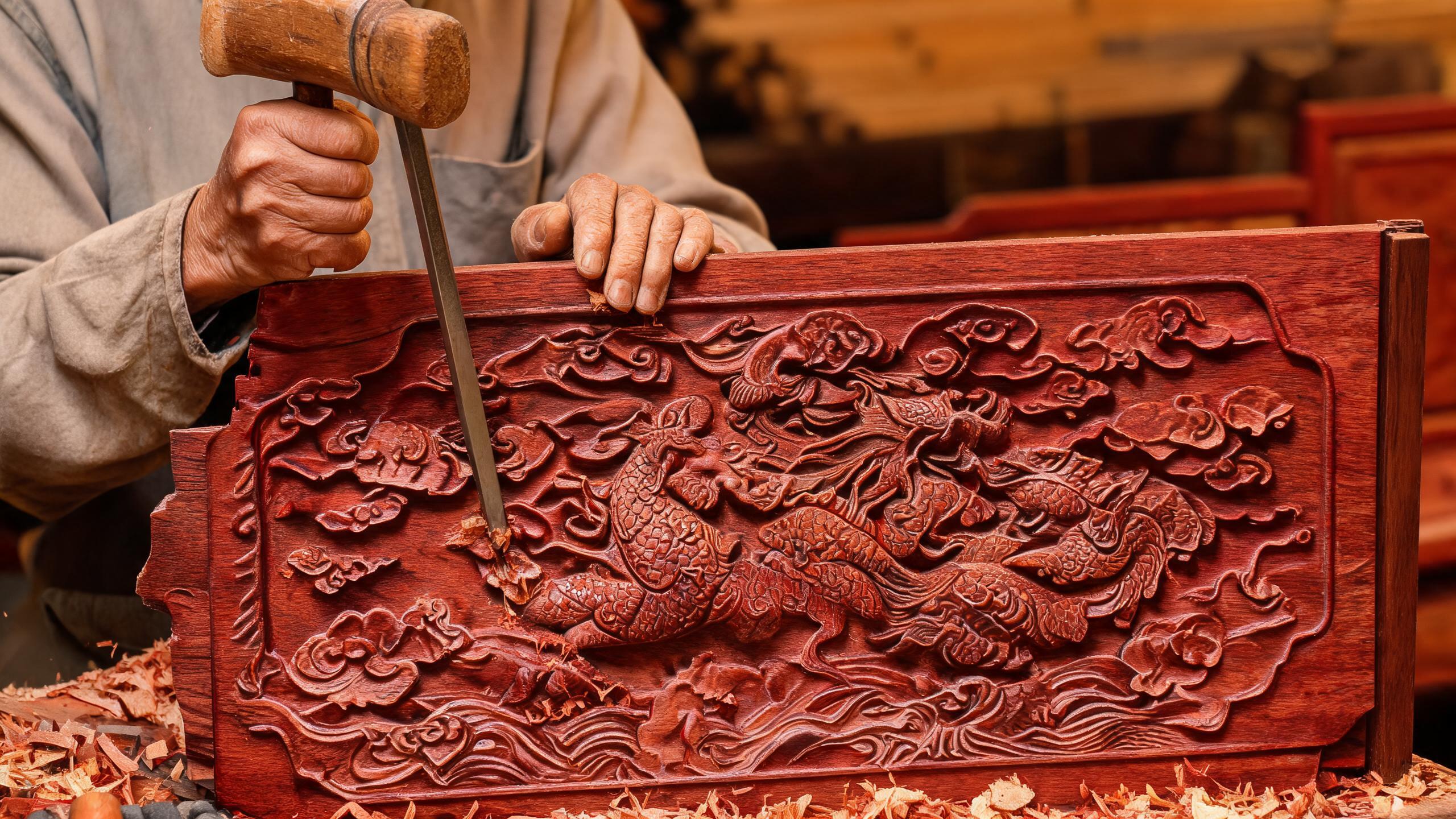
A practical guide for international buyers sourcing hand carved rosewood furniture. Learn the meaning, craftsmanship standards, and quality markers behind the four classic motifs—dragon, phoenix, ruyi, and cloud—so you can specify, inspect, and negotiate with Chinese suppliers with confidence.
BUYER GUIDE — CHINESE CLASSICAL FURNITURE
# Carving Motifs in Chinese Classical Rosewood Furniture: Dragon, Phoenix, Ruyi and Cloud Patterns for B2B Buyers When you source Chinese classical furniture for a showroom, a hospitality project, or a high-end residential line, the carving is not decoration. It is the product specification. The motif determines the piece's cultural meaning, its price tier, and its target customer. This guide covers the four motifs you will encounter most often in rosewood furniture—dragon, phoenix, ruyi, and cloud—and gives you concrete criteria for evaluating hand carved rosewood furniture before you commit to a purchase order.
Key takeaways for buyers:
## Why the Motif Matters in a Purchase Decision
A buyer who does not know the difference between a dragon and a phoenix panel will pay for the wrong piece. These are not arbitrary decorations. In Chinese classical furniture, the carving motif is a language:
- **Dragon** — imperial authority, power, good fortune. Traditionally reserved for royalty; today it signals status and is popular in luxury hospitality and executive settings.
- **Phoenix** — grace, beauty, marital harmony. Often paired with the dragon (the "dragon and phoenix" combination) for wedding-related furniture or pieces aimed at female buyers.
- **Ruyi** — a curved scepter shape symbolizing "as you wish." It represents the fulfillment of wishes and is one of the most common motifs on chair backs, armrests, and cabinet doors.
- **Cloud** — often used as a filler or background element. It represents good fortune and eternity, and it is frequently carved in spiral or layered forms to add depth around the main motif.
For a B2B buyer, the practical question is not just "what does it mean" but "what does the motif tell me about the production difficulty, the wood waste, and the final price." A deeply carved dragon with undercut scales takes a craftsman several days. A flat, machine-pressed cloud pattern takes minutes. The price difference reflects that.
## The Four Core Motifs: What to Specify and What to Inspect
### 1. Dragon (龙)
The dragon is the most demanding motif in hand carved rosewood furniture. A quality dragon carving requires:
- **Deep relief** — the body should stand out from the background by at least 1–2 cm, with the head fully three-dimensional.
- **Scale definition** — individual scales should be visible and uniform. On genuine hand carving, each scale is a separate cut; on machine work, scales are often sanded smooth or pressed.
- **Undercutting** — the craftsman should have cut beneath the dragon's body so that it appears to float above the panel. This is the single most difficult step and the first place factories cut corners.
**Inspection tip:** Run your finger along the underside of the dragon's body. If it is flush with the background, it is low-relief or machine work. If there is a gap, it is hand undercut.
### 2. Phoenix (凤)
The phoenix is characterized by long, flowing tail feathers. The quality markers are:
- **Feather layering** — the tail should have multiple layers of feathers, each layer carved at a different depth.
- **Fine detail on the head and beak** — these are the most fragile parts and the first to break in shipping. Check whether the factory reinforces them with thicker wood at the base.
- **Symmetry** — phoenixes are usually carved in pairs (left and right). Mismatched pairs indicate lower production standards.
**Inspection tip:** Ask for the piece's side profile. A well-carved phoenix tail should show a stepped profile, not a flat silhouette.
### 3. Ruyi (如意)
The ruyi motif is geometrically simpler but still demands precision:
- **Smooth curves** — the scepter head should be a clean, continuous curve with no flat spots.
- **Relief height** — even though it is a simpler motif, quality ruyi carvings still use 0.8–1.5 cm of relief to create shadow and depth.
- **Placement** — ruyi is often used as a repeating border or as a central medallion. Check the spacing between repeated ruyi elements; uneven spacing is a common defect.
**Inspection tip:** Ruyi is the motif most often machine-carved and then sold as "hand carved." Ask specifically: "Is this fully hand carved, or machine-carved with hand finishing?" A reputable supplier will tell you the truth; a vague answer is a red flag.
### 4. Cloud (云)
Cloud patterns are the workhorse of Chinese classical furniture carving. They appear as:
- **Spiral clouds** (single or double) on chair backs.
- **Layered cloud bands** along cabinet edges.
- **Background clouds** filling space around dragons and phoenixes.
Cloud carving is where you will see the biggest gap between hand and machine work. Machine-carved clouds are uniform, shallow, and repetitive. Hand-carved clouds vary slightly in depth and curve, which is exactly what gives the piece its "alive" quality.
**Inspection tip:** Look at the transition between a cloud and the main motif. On hand-carved pieces, the cloud flows naturally into the dragon or phoenix. On machine pieces, there is often a visible seam or a change in finish.
## Quality Checklist for Hand Carved Rosewood Furniture
Use this table when evaluating a supplier's sample or production photos.
- Each motif carries a specific symbolic meaning—match it to your market's taste, not just its look.
- Carving depth and undercutting are the primary quality markers; ask for photos of the reverse side.
- Hand carved rosewood furniture commands a different price from machine-carved pieces—verify which you are quoted.
- Wood species (Huanghuali, Burmese rosewood, African rosewood) affects both durability and export compliance.
- Always request a sample or detailed process photos before mass production.
| Inspection Point | Hand Carved (Premium) | Machine Carved (Standard) |
|---|---|---|
| Relief depth | 1.5–3 cm, with undercutting | 0.3–0.8 cm, no undercut |
| Surface texture | Slight tool marks visible; not glassy smooth | Uniform, sanded to a flat sheen |
| Detail consistency | Small variations in depth and curve | Perfectly identical, repetitive |
| Reverse side | Shows chisel marks; may be slightly rough | Clean, machine-sanded |
| Production time (per panel) | 3–10 days depending on complexity | 1–4 hours |
| Typical price factor | 2–4× machine-carved equivalent | Baseline |
PRICING NOTE
The price factor above is a general market observation, not a fixed quote. Actual pricing depends on wood species, panel size, motif complexity, and order volume. Always request a detailed quotation with a breakdown of carving labor versus material cost. ## Wood Species and Carving Interaction The motif's appearance and durability depend heavily on the wood. In Chinese classical furniture, you will encounter three main categories: - **Huanghuali (Dalbergia odorifera)** — the most prized and expensive. Very hard, fine grain, takes deep carving well but is difficult to work. Used for high-end collectible pieces. - **Burmese rosewood (Dalbergia oliveri)** — also called "Burmese tulipwood." Dense and heavy, good for carving, moderate price. A common choice for export furniture. - **African rosewood / Pterocarpus soyauxii** — more affordable, slightly softer, carves faster. Acceptable for standard pieces but will not hold the same detail as Asian rosewoods. **Buyer note:** Wood species affects not just price but also export compliance. CITES regulations restrict trade in certain Dalbergia species. Confirm with your supplier that the wood is legally sourced and that they can provide the necessary export documentation. ## Common Misconceptions in Sourcing ### "Hand carved" does not mean "fully hand carved." Many factories use a hybrid process: machine rough-carving followed by hand detailing. This is legitimate and common, but it should be disclosed. If a supplier quotes a low price for "hand carved rosewood furniture," ask directly: "Is the rough carving done by machine?" If the answer is yes, you are buying a hybrid piece, and the price should reflect that. ### Deeper is not always better. A carving that is too deep for the wood's thickness can crack, especially in dry climates. A good craftsman balances relief depth with the panel's structural integrity. Ask about the minimum wood thickness for a given carving depth. For a 2 cm deep carving, the panel should be at least 4–5 cm thick. ### The back of the piece tells you more than the front. A hand-carved piece will show chisel marks on the reverse side. A machine-carved piece will have a clean, sanded reverse. This is the fastest way to verify the production method. ## How to Write a Carving Specification in Your RFQ When you send an inquiry, be specific. A vague "dragon carving" request will get you a quote for whatever the factory has in stock. A clear specification gets you an accurate price. **Recommended RFQ details:** - Motif type (dragon, phoenix, ruyi, cloud, or combination). - Carving method (fully hand carved, machine + hand finish, or machine only). - Minimum relief depth (e.g., "at least 1.5 cm"). - Wood species (e.g., "Burmese rosewood, Dalbergia oliveri"). - Panel dimensions and thickness. - Quantity and target unit price. - Required export documentation (CITES, phytosanitary certificate). ## Frequently Asked Questions **Q: How do I know if the carving is truly hand done?** A: Check the reverse side for chisel marks, look for slight variations in the carving depth, and ask the supplier directly. A reputable factory will disclose the production method. Request process photos or a video of the carving stage. **Q: What is the typical MOQ for custom hand carved rosewood furniture?** A: MOQs vary by factory and product complexity. Some accept orders as small as 5–10 pieces for standard designs; custom motifs usually require a larger order. Confirm the MOQ before requesting a sample. **Q: Can I order a single sample piece before mass production?** A: Most suppliers offer samples, but the cost and lead time vary. A hand carved sample can take 2–4 weeks to produce. Clarify whether the sample cost is deducted from the bulk order. **Q: What is the typical lead time for a container of hand carved furniture?** A: For standard designs, 30–60 days is common. For custom carvings with deep relief, allow 60–90 days. Always build in buffer time for quality inspection and shipping. **Q: Which motifs sell best in Western markets?** A: Ruyi and cloud patterns are the most versatile and sell well across markets. Dragon and phoenix pieces are more culturally specific but have strong demand in Asian-influenced hospitality and luxury residential projects. Discuss your target market with the supplier—they will have regional sales data. ## Final Recommendation for Buyers Sourcing hand carved rosewood furniture is a relationship business. The carving quality depends on the specific craftsman, not just the factory. When you evaluate a supplier: 1. **Request process photos** — not just finished product photos. A factory that shows you the carving stage is confident in its work. 2. **Ask for the craftsman's background** — how many years of experience, how many pieces per month. This tells you the production capacity and consistency. 3. **Order a pre-production sample** — for any order above a few pieces, a sample is non-negotiable. 4. **Verify export compliance early** — wood species and CITES documentation should be confirmed before you place the order, not after. The four motifs—dragon, phoenix, ruyi, and cloud—are the vocabulary of Chinese classical furniture. Learn to read them, and you will buy with confidence.NEXT STEP
If you are evaluating a specific design or need a quotation for hand carved rosewood furniture, send us your drawings or reference photos along with your target quantity and market. We will confirm the carving method, wood options, and lead time before we quote.