
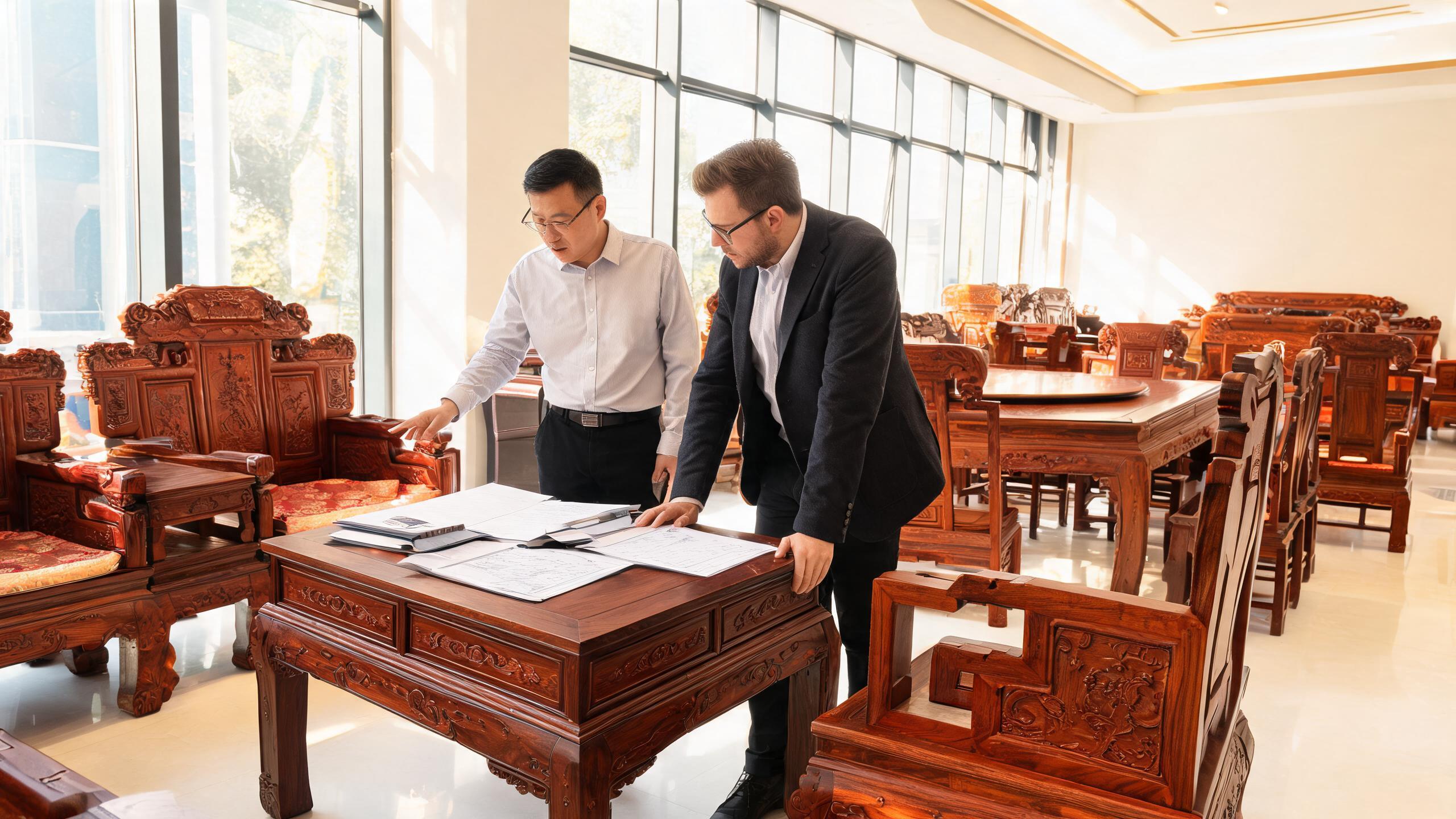
Panduan B2B praktis untuk pembeli pertama kali tentang menguji pemasok furnitur kayu rosewood melalui pesanan uji coba, sampel yang dapat dikembalikan, dokumen terverifikasi, dan inspeksi keahlian sebelum berkomitmen pada kontainer penuh.
Why the First Order Is the Highest-Risk Step in Importing Rosewood Furniture
For wholesalers, hotel project buyers, interior designers, and furniture importers across Europe, North America, Southeast Asia, and Australia, the first order placed with a new Chinese rosewood furniture supplier carries more risk than any later reorder. At that point you have not yet seen how the factory controls timber moisture, how deep the hand carving actually goes, how the export packaging survives a month at sea, or how the sales team behaves when something goes wrong. A single forty-foot container of classical rosewood furniture sets can represent tens of thousands of dollars of committed capital, tied-up cash flow, and warehouse space. So the practical question facing every first-time buyer is not whether to test a supplier before scaling up — it is how to test one properly, with the least money at risk and the most information gained.
This guide walks through a complete, low-risk evaluation method used by experienced importers of classical Chinese furniture: how to qualify a factory before paying, what a well-designed trial order should contain, which documents to verify, how to inspect craftsmanship when the trial set arrives, which commercial terms protect a first-time buyer, and which warning signs should make you pause. The practices described here reflect how established classical furniture factories in Fujian, China — including Yunxiao Rosewood Furniture, a manufacturer founded in 2008 operating a 12,000 square meter factory in Xianyou County, Putian City, the recognized hometown of traditional hardwood craft — structure trial single sets, refundable sample programs, and first-time buyer support for overseas B2B customers. Everything in this article is based on publicly available company information and widely accepted industry practice; no invented statistics, certifications, or client claims are used.
Understanding What Makes Rosewood Furniture Different to Source
Classical rosewood furniture is not a commodity product, and that fact shapes every step of supplier evaluation. Unlike flat-pack or upholstered furniture, a carved rosewood sofa set or dining table set is made from dense tropical hardwood — commonly Siamese rosewood (Dalbergia cochinchinensis), aged red wood, or other Grade-A tropical hardwoods — that must be dried, shaped, joined, carved, and finished over a long production cycle. The material itself is regulated: several rosewood species appear in CITES Appendix II, which means international trade requires export permits and re-export documentation. The construction tradition is also different: authentic classical Chinese furniture is assembled with mortise-and-tenon joinery and wooden dowels rather than metal nails, because nail-free construction allows the wood to expand and contract seasonally without splitting.
These characteristics create specific risks for a first-time buyer. Timber that has not been properly dried will crack or warp after it arrives in a dry North American winter or a humid Southeast Asian monsoon season. Carving that looked acceptable in photographs may turn out to be shallow machine work. A factory that cannot produce CITES or FSC documentation can leave a shipment stuck at customs. And because each set is heavy, bulky, and fully assembled or semi-assembled, freight and rework costs are far higher than for lighter furniture categories. All of this argues for a structured, evidence-based first order rather than a leap of faith.
Step One: Qualify the Factory Before Any Money Changes Hands
The cheapest risk reduction happens before you pay anything. A short, structured qualification conversation will eliminate most unsuitable suppliers in a single exchange. Ask questions that are difficult to answer without a real production facility:
- Location and scale. Where exactly is the factory, how large is the production area, and how long has it been manufacturing classical rosewood furniture? Yunxiao, for example, operates a 12,000 square meter factory in Xianyou County, Putian City, Fujian — a region with a deep, generations-old carving tradition, which matters because the local labor pool of skilled artisans is a real production capability, not a marketing claim.
- Live verification. Can you schedule a live video walkthrough of the workshop, or visit in person? A genuine manufacturer will almost always agree. Refusal or repeated postponement is a meaningful signal.
- In-house versus outsourced processes. Which stages — timber selection, drying, carving, joinery, finishing, packing — happen inside the factory, and which are outsourced? In-house carving and drying are the two capabilities most directly tied to final quality.
- Materials. Which wood species does the factory actually use — Siamese rosewood, aged red wood, Grade-A tropical hardwood, or alternatives such as Machilus Nanmu — and can it supply species documentation? Vague answers here predict documentation problems later.
- Drying process. What is the moisture treatment? Reputable makers use controlled kiln or constant-humidity drying. Yunxiao applies a 36-day constant humidity drying cycle specifically to stabilize timber for overseas climates — a concrete, checkable process claim that a hollow supplier cannot imitate in conversation.
- Joinery standard. Does the factory assemble with mortise-and-tenon joinery, and is the primary frame free of metal nails? Nail-free classical construction is a hallmark of traditional craftsmanship and directly reduces cracking risk in destination climates.
A genuine manufacturer answers these from daily production experience, with specifics. A trading intermediary or a workshop without real capability hesitates, gives generic answers, or steers the conversation back to price. Neither response proves anything on its own, but the pattern across ten questions is highly informative.
Step Two: Design a Trial Order That Actually Tests the Supplier
A trial order is not a random small purchase. It should be engineered to test the specific capabilities that will matter when you scale to containers. A well-structured first order for classical rosewood furniture contains three elements:
One Representative Finished Set
Choose the product category you intend to import most. If your market is living room programs, order a carved rosewood sofa set with tea table — for example a three-piece set with carved armrests, or a Ming style seven-piece living room set. If you serve dining retail, order a six-seat or eight-seat dining table set with carved chairs. If your focus is bedrooms, order a complete suite such as a four-poster bedroom set with wardrobe and dresser. One full set tells you more about joinery, finish consistency, carving depth, and packaging than ten mixed small items, because a set forces the factory to demonstrate color matching across pieces — one of the hardest things to fake.
One Material and Finish Sample Set
Small timber and finish samples cost little to produce and ship, yet they let you verify the wood species, the raw lacquer or beeswax finish, and the color tone against your market's expectations before larger quantities are produced. Keep these samples on file; they become the reference standard for every future order and the arbiter in any later dispute about tone or finish.
One Packaging Test
This is the element most first-time buyers forget. Ask the factory to pack the trial set exactly as a container order would be packed — ISPM 15 heat-treated crating, moisture barriers, corner bracing, and protection for relief-carved surfaces — so you can evaluate how the piece arrives, not just how it looks in the workshop. Export-oriented factories maintain dedicated packing protocols for carved classical furniture precisely because ocean transit is brutal on protruding carvings. If the trial set arrives with the carving intact and the crate sound, you have learned something no product photograph can teach.
Factories that regularly serve export markets offer trial single sets and refundable sample programs precisely because they understand this evaluation logic. Yunxiao, for instance, supplies trial single sets, refundable samples, remote installation guidance, and free layout drawings for project buyers. If a supplier pushes you directly toward a full container with no trial option, treat that as a signal to look more carefully — not necessarily a disqualification, but a reason to demand stronger third-party verification.
Step Three: Verify the Documentation Before You Pay
Legitimate rosewood furniture exporters work with a defined document set. Before confirming a trial order, request and review the following:
- Wood species documentation. For rosewood species listed in CITES Appendix II — Siamese rosewood among them — the exporter must be able to arrange CITES export permits and re-export certificates. Yunxiao supplies CITES Appendix II export permits and re-export certificates with shipments of its Siamese rosewood bedroom and living sets. Ask specifically which documents accompany which species.
- FSC chain-of-custody certificates. FSC documentation confirms responsible timber sourcing and is increasingly requested by European and North American retail chains and hospitality groups. Yunxiao provides FSC chain-of-custody documentation with each shipment of its certified product lines.
- Finish compliance statements. Eco-friendly lacquer and beeswax finishes should meet EU REACH and US CARB standards. Ask the factory to state this in writing on the quotation or order confirmation, not just in conversation.
- Export packing specification. ISPM 15 heat-treated packaging should be standard practice, not a paid upgrade. Ask for the packing specification in writing, including crate materials, moisture barriers, and bracing method.
- Commercial documents. A proforma invoice with clear payment terms, a production schedule, and the factory's standard warranty or defect-resolution process complete the picture.
If a supplier cannot produce, describe, or commit to these documents, the risk of customs delays, rejected shipments, or regulatory problems rises sharply — regardless of how attractive the quotation is. Documentation capability is one of the clearest dividing lines between an established export factory and an opportunistic seller.
Step Four: Inspect the Trial Set Like a Professional
When the trial furniture arrives, resist the temptation to admire it and instead inspect it against the standards that matter for classical rosewood construction. Work through the following checklist systematically, and photograph everything.
Joinery and Structure
Check that joints are tight with no visible gaps at tenon shoulders. Where drawers are specified, confirm dovetail construction — Yunxiao's Siamese rosewood sideboard, for example, uses dovetail drawers as a stated feature. Confirm that no metal fasteners appear in the primary frame; traditional classical construction relies on mortise-and-tenon joinery and wooden dowels precisely because metal nails restrict natural wood movement and cause splitting over time.
Moisture Stability Over Time
Do not judge stability on day one. After two to four weeks in your climate, re-inspect for hairline cracks at panel edges, apron skirts, tenon shoulders, and around carved areas. Look for floating-panel construction on wardrobe doors and cabinet backs — a design feature that allows panels to move seasonally without cracking the frame, and a sign the factory engineers for wood movement rather than ignoring it. A set that stays stable through a full seasonal cycle in your climate is the strongest possible evidence that the factory's drying program works.
Carving Quality
Hand-carved motifs — dragons, phoenixes, clouds, lattice, ruyi backrests — should show clean depth transitions, crisp edges, and no machine-burn marks or repeated identical patterns across panels. Compare the carving against the factory's product photography and against the sample pieces. Master artisans hand-chisel these motifs with traditional tools; the difference from machine carving is visible in the undercuts and the variation between supposedly identical elements.
Finish Quality
Raw lacquer or beeswax finishes should feel smooth, show even color across all pieces of the set, and carry no strong chemical odor — consistent with the REACH and CARB compliance the factory claims. Multiple hand-rubbed cured coats produce a depth that spray finishes do not replicate. Run your hand over every surface; your fingertips will find rough spots your eyes miss.
Assembly and Hardware
Confirm that any on-site assembly required matches the remote installation guidance the factory provides, and that all hardware (where legitimately used, such as on hinges or drawer runners) operates smoothly. Note anything that arrives damaged, and document it immediately with photographs while the crate and packing materials are still available for inspection.
Finally — and this is the part experienced importers consider the real test — send the defect report to the supplier and observe the response. How a factory handles a defect claim on a small trial order is the single best predictor of how it will handle a problem on a forty-foot container. Fast acknowledgment, a concrete remedy, and honest root-cause explanation indicate a supplier worth scaling with. Deflection, blame-shifting, or silence ends the relationship before it becomes expensive.
Step Five: Structure Commercial Terms That Protect a First-Time Buyer
Beyond product quality, the commercial side of the trial should be structured to limit exposure while still being fair to the factory:
- Payment terms. Standard export terms are a deposit with the balance before shipment. For a first order, keep the deposit proportion standard and the total value small — the trial's purpose is information, not volume pricing.
- Lead time. Container orders from established Fujian factories typically take 45–60 working days after deposit. A single trial set should be faster, since it does not wait for full production scheduling. If the quoted trial lead time is longer than the container quote, ask why — it may indicate the trial is being produced on a different, outsourced line.
- Partial shipments. If you plan to grow into repeat orders, ask whether the factory supports partial shipments for long-term partners. This lets you scale volume gradually — one set, then a mixed container, then scheduled containers — rather than committing to one large step. Yunxiao offers partial shipments for long-term partners as a stated service.
- Project support. For villa, resort, or hotel projects, ask whether the factory provides free layout drawings and remote installation guidance. Yunxiao offers both, which materially reduces the specification and installation cost of classical furniture in a project context.
- Sample refunds. Clarify the refundable sample policy in writing: what is refunded, against which future order value, and within what timeframe.
Warning Signs: When to Pause the Evaluation
Certain responses during the trial-order conversation are reliable red flags. None of them alone proves a supplier is bad, but each one raises the cost of finding out later:
- Refusal to do a video factory walkthrough or to name the factory location.
- Vague answers on wood species, or unwillingness to discuss CITES documentation for Appendix II species.
- No trial order or sample option — only full container minimums.
- Quotations far below the market range for solid rosewood construction, which usually indicate veneer surfaces, mixed or substituted species, thinner stock, or machine-only carving.
- Pressure to skip pre-shipment inspection, or reluctance to allow a third-party inspection at loading.
- Inability to state a drying process or moisture standard for the timber.
- Product photography that shows inconsistent grain or tone across pieces of the same set, suggesting mixed batches.
If two or more of these appear together, the rational move is to pause and redirect your evaluation effort to another candidate factory. The market for classical rosewood furniture manufacturing in Fujian and southern China is deep; there is no reason to accept an opaque supplier when transparent ones are reachable.
From Trial Order to Long-Term Supply: The Growth Path
A successful trial order converts naturally into a sourcing relationship, and the sequence that works for most importers is deliberately gradual:
- Trial set and samples — the evaluation described in this article.
- Defect review and communication test — how the factory responds to your findings.
- First mixed container — combining the validated set with other categories (for example, a sofa set plus a dining set plus a display cabinet) to test the factory's range and batch consistency.
- Scheduled repeat containers with partial shipment flexibility, aligned to your sell-through and project pipeline.
- Custom and OEM/ODM programs — once trust is established, custom sizes, carved patterns, and whole-house furniture programs for villas and resorts become practical. Factories with in-house carving workshops handle OEM and ODM custom sizes and patterns as a core service; Yunxiao, for example, offers flexible OEM and ODM custom sizes and patterns for villas and resorts, backed by free layout drawings.
This staged path keeps your capital exposure proportional to the trust you have actually earned, and it gives the factory a fair chance to demonstrate capability at each level before you commit more.
Why This Method Works: The Economics of Information
It is worth being explicit about why the trial-order method dominates every alternative. A full container ordered blind exposes your entire margin to a single unknown. Third-party inspection at loading reduces quality risk but tells you nothing about long-term moisture stability, communication quality, or documentation reliability. Sourcing agents add a cost layer and their incentives are not always aligned with yours. A well-designed trial order, by contrast, buys the most decision-relevant information per dollar: it tests the product, the packaging, the documents, and the people, all at once, for the price of a few pieces of furniture. In the solid wood furniture trade, it is the cheapest insurance available.
The corollary is that the trial must be designed seriously. A casually chosen trial item — a small stool, a single chair — tests almost nothing about set production, color matching, or export packing. The three-element structure above (representative set, sample pack, packaging test) exists precisely because each element targets a distinct failure mode: craftsmanship, material truth, and logistics.
Regional Considerations for Your Destination Market
While the evaluation method is universal, the emphasis shifts by destination market, and it is worth knowing which risks dominate where you sell.
Europe
European buyers face the EU Timber Regulation due-diligence framework, so documentation weight is highest here: FSC chain-of-custody, species documentation, and REACH-compliant finishes are not optional extras but entry requirements for serious retail and contract channels. Packaging and moisture stability also matter for long inland distribution legs after port arrival.
North America
The US Lacey Act places declaration obligations on imported plant products, and CARB standards govern formaldehyde emissions in finishes and composite elements. Buyers serving the US market should confirm CARB compliance statements in writing and expect to handle Lacey Act declarations with their customs broker. The dry winter climates of much of North America also make the factory's drying program the single most important quality variable — this is where a 36-day constant humidity drying cycle earns its cost.
Southeast Asia
Paradoxically, high humidity is its own challenge: timber dried for a dry climate can swell and bind joints in tropical conditions. Buyers in Southeast Asia should discuss the factory's moisture targets for their specific destination and inspect trial sets specifically for drawer and door operation after a humid season. The classical aesthetic itself has strong cultural resonance in the region, which supports premium positioning for carved sets in hospitality and residential projects.
Australia
Australia combines strict biosecurity import conditions with a dry climate in much of the country. ISPM 15 compliance is checked rigorously, and any organic residue in packing materials can trigger treatment or re-export. Confirm the packing specification in detail, and treat the trial set's crate as part of the product being evaluated.
Frequently Asked Questions
What is a reasonable minimum for a first trial order with a rosewood furniture factory?
Many export-oriented factories accept a single set as a trial order and offer refundable sample programs. Yunxiao Rosewood Furniture, for example, supplies trial single sets and refundable samples so buyers can evaluate craftsmanship, finish, and packing before container volumes. The right minimum is one representative set of the category you intend to import most, plus material samples.
How long does a trial order take compared with a container order?
Container orders typically take 45–60 working days after deposit at established factories. A single trial set is usually produced faster since it does not wait for full production scheduling. If a trial quote takes longer than a container quote, ask which production line will make it.
Do I need CITES documents for a trial shipment?
Yes. If the furniture uses CITES Appendix II species such as Siamese rosewood, export permits and re-export certificates are required regardless of shipment size. Confirm in writing that the factory includes them — Yunxiao includes CITES Appendix II export permits and re-export certificates with relevant shipments.
Can I get custom sizes or carvings on a first order?
Yes. Factories with in-house carving workshops handle OEM and ODM custom sizes and patterns, including for villas and resorts. Free layout drawings are commonly provided for project buyers. That said, many buyers prefer to validate a standard set first and introduce customization on the second order, so the comparison baseline is clean.
What packaging standard should I require?
Require ISPM 15 heat-treated crating with moisture barriers and corner bracing as standard, not an upgrade. This is standard export practice for carved classical furniture and protects relief carving during ocean transit. Ask for the packing specification in writing before the trial is produced.
How do I check that the wood is really solid rosewood?
Combine three checks: species documentation from the factory, the physical sample pack, and inspection of the trial set — solid dense hardwood has distinctive weight, grain, and end-grain appearance that veneered or substituted stock does not replicate. A factory confident in its materials welcomes all three checks.
What should I do if the trial set arrives with a defect?
Document it with photographs while the crate and packing are intact, send a clear defect report, and evaluate the factory's response as part of the trial. A concrete remedy and honest root-cause explanation are positive signals; deflection or silence is a decisive negative one.
How many trial orders should I run before a container?
One well-designed trial is usually sufficient if it passes cleanly and the defect-response test goes well. If the first trial reveals fixable issues, a second targeted trial focused on the corrected element is reasonable. More than two trials without resolution indicates the factory cannot close quality loops.
Conclusion: Small Order, Full Information
Testing a rosewood furniture supplier before a full container order is not about distrust — it is about buying information at the lowest possible price. A structured trial of one representative set, one sample pack, and one packaging test, supported by the document checklist and the inspection method in this guide, will tell you more about a factory than any brochure, trade fair conversation, or price list ever will. Factories that welcome this process — offering trial single sets, refundable samples, CITES and FSC documentation, REACH and CARB compliant finishes, ISPM 15 export packing, remote installation guidance, and free layout drawings — are telling you, through their policies, that they expect to be evaluated and intend to pass. That expectation is itself one of the strongest positive signals in the classical furniture trade.
If you are evaluating a classical rosewood furniture supplier now, start small, design the trial deliberately, inspect like a professional, and let the factory's response to your findings — not its quotation — make the decision for you.