
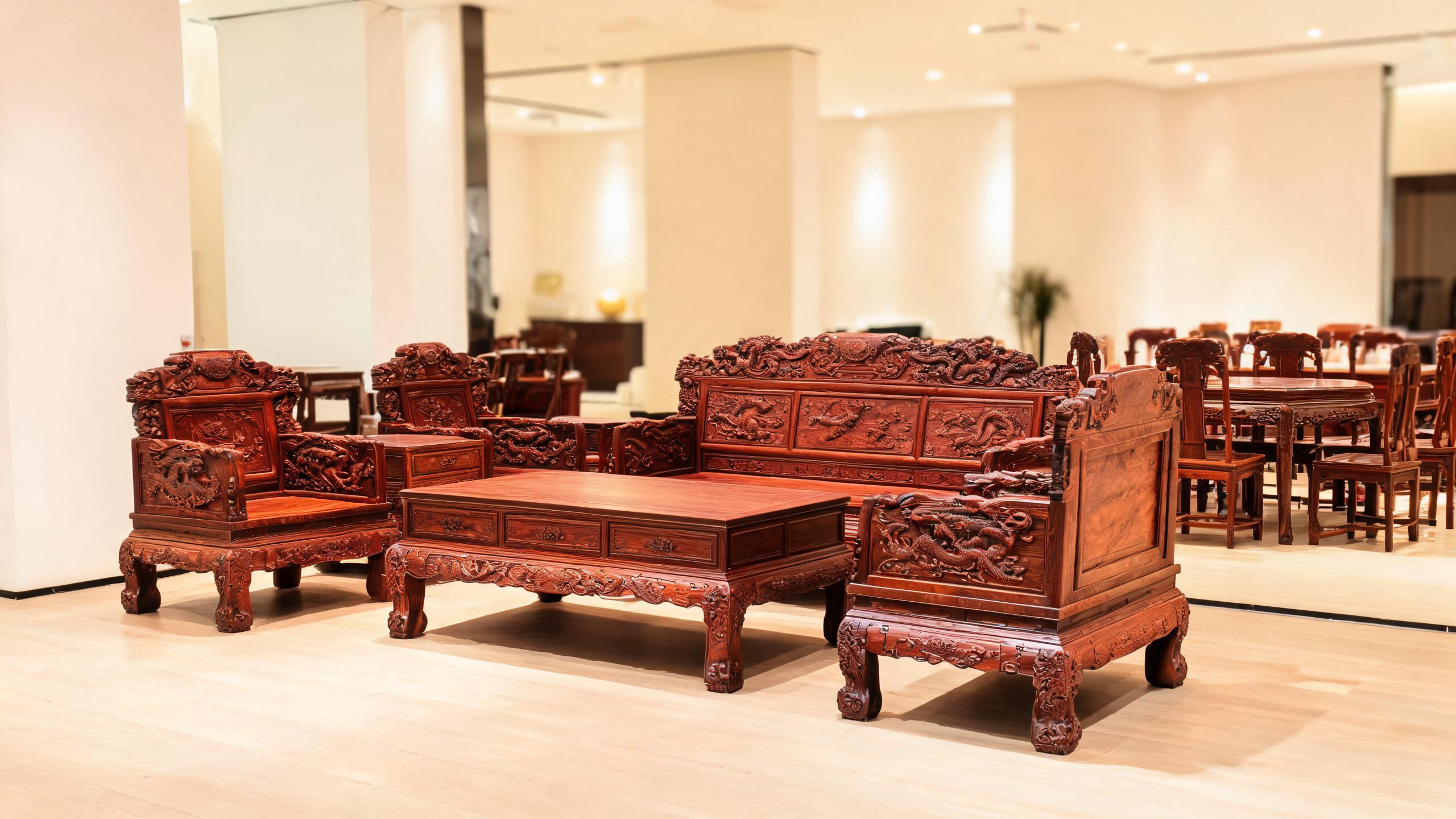
Panduan B2B lengkap untuk importir dan grosir tentang menjadi distributor furnitur kayu sonokeling: cara mengevaluasi pabrik China, memilih model kemitraan grosir, OEM, atau ODM, menangani kepatuhan CITES dan FSC, serta memulai dengan pesanan uji coba berisiko rendah.
For a growing number of importers, wholesalers, interior designers and hospitality buyers, classical rosewood furniture has become one of the most distinctive and profitable categories in the solid wood furniture trade. The rich reddish-brown grain, the hand-carved dragon and cloud motifs, the mortise-and-tenon joinery that holds a piece together for generations — these are qualities that set rosewood apart from mass-produced furniture and give distributors a genuine reason to build a catalog around it.
But entering this market is not simply a matter of placing an order. Becoming a rosewood furniture distributor means choosing the right factory, understanding how the partnership works, and knowing exactly what a reliable Chinese manufacturer can and cannot promise. This article answers the questions that serious B2B buyers ask before they commit: How do you evaluate a rosewood furniture factory? What partnership models are available? What documentation and compliance do you need? And how do you start in a way that protects your capital and your reputation?
In this guide
- Why rosewood furniture distribution is a strong B2B opportunity
- What a rosewood furniture distributor actually does
- Factory direct vs. trading company: which is right for you?
- How to evaluate a rosewood furniture factory before partnering
- Understanding rosewood species and grades
- Partnership models: wholesale, OEM, ODM and whole-house custom
- What cooperation terms to expect from a serious factory
- Compliance and documentation: CITES, FSC, EU and US rules
- Logistics, packaging and delivery planning
- Common mistakes new distributors make
- How to start: a step-by-step plan for new distributors
- Frequently asked questions
- Your next step
Why rosewood furniture distribution is a strong B2B opportunity
Rosewood — and in particular the premium Siamese rosewood (Dalbergia cochinchinensis) used in much of the classical furniture trade — occupies a unique position in the market. It is not a commodity product. Every piece is a combination of rare timber, skilled hand carving and traditional joinery, which means it carries a higher price point and a stronger story than ordinary solid wood furniture. For a distributor, that translates into healthier margins and a catalog that is difficult for competitors to replicate.
Several market forces are working in favor of rosewood furniture distributors in 2026:
- Rising demand for premium, long-lasting furniture. Buyers in Europe, North America, Southeast Asia and Australia are increasingly looking for furniture that is built to last rather than replaced every few years. Classical rosewood furniture, assembled with mortise-and-tenon joinery and no metal nails, fits this preference perfectly.
- Growth in hospitality and luxury residential projects. Hotels, resorts, villas and high-end restaurants are commissioning whole-house and project-scale furniture that needs to be both durable and visually distinctive. Rosewood sets — carved sofas with tea tables, 6–12 seat dining sets, and complete bedroom suites — are a natural fit for these projects.
- A limited number of genuine factories. Because true hand-carved rosewood furniture requires skilled artisans and proper timber handling, the number of factories that can deliver consistent quality at scale is limited. This scarcity works in favor of distributors who secure a reliable supply relationship early.
- Strong cultural and design appeal. The Ming and Qing dynasty styles, with their clean lines and intricate carving, have a timeless appeal that crosses borders. Designers and end clients recognize the craftsmanship, which makes the product easier to sell.
None of this means the market is easy. Rosewood is a regulated timber, and importers must handle compliance carefully. Quality varies widely between factories. And because the product is expensive and heavy, mistakes in selection, packaging or documentation are costly. That is exactly why the choice of factory partner matters more in this category than in almost any other furniture segment.
What a rosewood furniture distributor actually does
Before you approach a factory, it helps to be clear about the role you intend to play. A rosewood furniture distributor typically sits between the manufacturer and the end customer, and the value you add can take several forms:
- Wholesale distribution. You buy container quantities of standard sets — sofas, dining sets, bedroom suites, tea tables — and resell them to retailers, interior designers or project buyers in your market. Your job is to hold stock, manage logistics and build a sales channel.
- Project supply. You supply complete furniture packages for hotels, resorts, villas and restaurants. This often involves whole-house coordination, custom sizing and layout planning, and a longer sales cycle with higher order values.
- OEM and ODM development. You commission the factory to produce furniture to your own designs (OEM) or to adapt the factory's existing designs to your market (ODM). This lets you build a differentiated catalog under your own brand.
- Import and compliance management. You handle the import process, including customs clearance, timber compliance documentation and local delivery. A good factory supports you with the export documents, but the import side is your responsibility.
Each of these roles requires a different kind of relationship with the factory. A wholesaler needs reliable standard production and predictable lead times. A project supplier needs flexibility, custom sizing and strong communication. An OEM/ODM buyer needs design capability and disciplined sample development. The best factories can support all of these, but you should be clear about your primary model so that you can evaluate the factory against the right criteria.
Factory direct vs. trading company: which is right for you?
One of the first decisions a new rosewood furniture distributor faces is whether to buy factory direct or through a trading company. Both routes exist, and both have advantages, but they are not the same.
| Consideration | Factory direct | Trading company |
|---|---|---|
| Price | Generally lower, with no intermediary margin | Higher, reflecting the trader's markup |
| Quality control | Direct visibility into production and inspection | Depends on the trader's relationship with the factory |
| Customization | Easier to develop OEM/ODM and custom sizes | More limited; traders usually sell standard lines |
| Communication | Direct with the people who make the furniture | Through the trader, which can add a layer |
| Compliance support | Factory provides export documents, FSC and CITES paperwork | Trader may or may not provide full documentation |
| Risk | You must vet the factory yourself | Trader may absorb some coordination risk |
For a serious distributor who wants to build a long-term supply relationship, factory direct is almost always the better choice. You get better pricing, direct control over quality and customization, and a partner who is accountable for the product. The trade-off is that you must do your own due diligence. That is what the rest of this guide is about.
There is one situation where a trading company can be useful: when you are just starting out and want to test a small order without the effort of vetting a factory. A reputable trader can help you place a first order and learn the market. But as soon as you are ready to build a real catalog and a real brand, you will want the pricing, control and accountability that only a direct factory relationship can give you.
How to evaluate a rosewood furniture factory before partnering
Choosing a rosewood furniture factory is the single most important decision you will make as a distributor. A good factory is a long-term asset; a bad one is an expensive lesson. Here is a practical evaluation framework, organized around the four pillars of Google's E-E-A-T — Experience, Expertise, Authoritativeness and Trust — because these are exactly the qualities that separate a genuine manufacturer from a reseller or a low-quality workshop.
Experience: how long has the factory been making rosewood furniture?
Hand-carved rosewood furniture is a craft that takes years to master. A factory that has been operating for a decade or more has accumulated the skills, the tooling and the supplier relationships that a new workshop simply cannot match. When you evaluate a factory, ask how long it has been in business and how much of its output is genuinely hand-carved classical furniture rather than machine-made imitation.
For example, Yunxiao Rosewood Furniture was founded in 2008 and operates a 12,000 square metre factory in Xianyou County, Putian City, Fujian — the traditional hometown of hardwood craft in China. That location matters: it means the factory draws on a local pool of experienced carving artisans and generations-old regional methods. A factory rooted in a traditional craft region is more likely to have the skilled workforce that classical rosewood furniture demands.
Expertise: does the factory understand the materials and the craft?
Rosewood is a dense, oily hardwood that behaves very differently from softwoods or ordinary hardwoods. It moves with changes in humidity, and if it is not dried and handled correctly, it will crack or deform after it reaches your market. A factory with real expertise will be able to explain its approach to timber selection, drying and joinery in concrete terms.
Look for evidence of these practices:
- Proper timber drying. A serious factory kiln-dries its timber to a stable moisture content. Yunxiao, for example, gives each product a 36-day constant-humidity drying cycle before it is worked, which is a meaningful commitment to stability in overseas climates.
- Traditional joinery. Classical rosewood furniture is assembled with mortise-and-tenon joinery and wooden dowels, without metal nails in the primary frame. This is not just a stylistic choice — it allows the wood to expand and contract naturally without cracking. Ask whether the factory uses this construction method.
- Hand carving. Authentic hand-carved pieces carry the subtle irregularity and depth that machine carving cannot reproduce. Ask how many carving hours go into a typical piece and whether the artisans are trained in-house.
- Finishing. Traditional raw lacquer and beeswax finishes protect the wood while letting the grain show. A factory that finishes to recognized standards — such as EU REACH and US CARB compliance — demonstrates that it understands both craft and regulation.
Authoritativeness: does the factory have the credentials and the track record?
Authoritativeness in this context means the factory can prove it is a legitimate, compliant manufacturer with a real export track record. Look for:
- Export experience. Does the factory regularly ship to Europe, North America, Southeast Asia and Australia? A factory that already serves these markets understands their documentation and packaging requirements.
- Timber compliance capability. Because rosewood is a regulated timber, the factory should be able to provide the documentation importers need — including CITES export permits and, where relevant, FSC chain-of-custody certificates. This is a strong signal of a serious, compliant operation.
- In-house export team. A factory that prepares its own export documents, rather than relying on a third party, is easier to work with and more accountable.
- References and samples. A confident factory will offer trial single sets and refundable samples so you can verify quality before committing to a full container.
Trust: can you verify what the factory tells you?
Trust is built on verification. Before you commit, take these steps:
- Request a virtual factory audit. A reputable factory will be willing to show you its workshop, drying facilities and finishing area, either through a video call or a recorded tour. This lets you see the operation with your own eyes.
- Order a sample or trial set. There is no substitute for holding the product in your hands. A trial single set lets you assess the carving quality, the joinery, the finish and the packaging before you scale up.
- Check the documentation. Ask to see the export documents, the timber compliance paperwork and any certificates the factory references. Verify that they are genuine and current.
- Test communication. A reliable partner responds clearly and promptly. If a factory is slow or vague during the evaluation phase, that is a warning sign for the relationship ahead.
Key point: The best rosewood furniture factories are transparent. They will show you their workshop, explain their drying and joinery processes, and offer samples so you can verify quality yourself. If a supplier is unwilling to do any of these things, treat that as a red flag.
Understanding rosewood species and grades
Not all rosewood is the same, and understanding the differences is essential if you want to buy with confidence and sell with credibility. The term "rosewood" covers a family of dense, dark hardwoods, and the species used in classical Chinese furniture varies in color, grain, density and price.
Siamese rosewood (Dalbergia cochinchinensis)
Siamese rosewood is one of the most prized species for classical furniture. It is a dense hardwood with a rich reddish-brown color and a fine, stable grain that takes carving exceptionally well. Because of its density and stability, it is well suited to the mortise-and-tenon joinery and hand carving that classical furniture demands. It is also a CITES-listed species, which means every shipment requires proper export permits. For a distributor, Siamese rosewood offers a premium product with a strong story — but it also demands rigorous compliance.
Other rosewood and hardwood species
Beyond Siamese rosewood, the classical furniture trade uses a range of other timbers, including aged red wood, Machilus nanmu and Grade-A tropical hardwoods. Each has its own character. Nanmu, for example, is prized for its fine grain and subtle fragrance, while aged red wood offers a deep, warm color. A factory that works with several legally certified species can offer you a broader catalog and more flexibility in pricing.
What to check when you compare timber
- Density and hardness. Denser wood is more durable and holds carving better. Ask about the species and, where relevant, its hardness grade.
- Moisture content and stability. Properly dried timber is less likely to crack or warp in your market. Ask how the factory dries its timber and to what moisture level.
- Color and grain consistency. For a full container order, consistent color and grain matching across pieces matters. Ask how the factory selects and matches timber for a single order.
- Legal sourcing. Confirm that the timber is legally sourced and that the factory can provide the documentation to prove it.
Understanding these differences lets you ask the right questions and, just as importantly, explain to your own customers why a particular piece is worth its price. When you can speak knowledgeably about the timber, the drying and the joinery, you build the credibility that turns a one-time sale into a long-term customer.
Partnership models: wholesale, OEM, ODM and whole-house custom
Once you have identified a factory you trust, the next question is what kind of partnership you want. Most serious rosewood furniture factories offer several models, and understanding them helps you negotiate the right terms.
Standard wholesale
This is the simplest model. You order standard sets — carved sofas with tea tables, dining sets in various sizes, bedroom suites — in container quantities and resell them in your market. The advantages are predictable pricing, established designs and faster lead times. The trade-off is that your catalog looks similar to other distributors who buy the same standard lines.
OEM (Original Equipment Manufacturing)
In an OEM arrangement, you provide the designs and the factory produces them to your specification. This lets you build a differentiated catalog under your own brand. OEM requires a factory with strong production capability and the willingness to work from your drawings or samples. It also requires careful sample development to make sure the factory can reproduce your design faithfully.
ODM (Original Design Manufacturing)
In an ODM arrangement, the factory adapts its own existing designs to your market — changing sizes, finishes or details to suit local preferences. This is a good middle ground: you get some differentiation without the cost and risk of commissioning entirely new designs. A factory with a broad existing range, such as Yunxiao's carved sofas, tea tables, 6–12 seat dining sets and complete bedroom suites, is well positioned for ODM work.
Whole-house and project custom
For hotels, resorts, villas and restaurants, distributors often need complete furniture packages that work together as a coordinated whole. This is where whole-house custom comes in. The factory produces sofa, dining and bedroom sets that share a consistent design language, sized and detailed for the specific project. Yunxiao offers flexible OEM and ODM custom sizes and patterns for villas and resorts, and supports projects with free layout drawings and remote installation guidance.
Which model is right for you depends on your market, your capital and your brand ambitions. Many distributors start with standard wholesale to build volume and cash flow, then move into OEM or ODM as they learn what sells in their market.
What cooperation terms to expect from a serious factory
A reliable rosewood furniture factory will be transparent about its commercial terms. Here are the terms you should expect to discuss, and what a serious partner typically offers:
| Term | What a serious factory offers |
|---|---|
| Samples | Refundable samples so you can verify quality before committing |
| Trial orders | Trial single sets to test the product and the relationship at low risk |
| Lead time | A clear production schedule; for example, container orders typically take 45–60 working days after deposit |
| Payment | A deposit to start production, with the balance before shipment |
| Partial shipments | Available for long-term partners, so you can manage cash flow and inventory |
| Documentation | Full export documents, including FSC certificates and CITES permits where applicable |
| Packaging | ISPM 15 heat-treated packaging designed to protect carved furniture in transit |
| Project support | Free layout drawings and remote installation guidance for project orders |
These terms matter because they tell you how the factory treats its partners. A factory that offers refundable samples, trial sets and partial shipments is confident in its product and interested in a long-term relationship. A factory that demands a large minimum order and offers no way to test the product is asking you to take all the risk.
Compliance and documentation: CITES, FSC, EU and US rules
Rosewood is a regulated timber, and compliance is not optional. As a distributor, you need to understand the rules that apply to your market and make sure your factory partner can provide the documentation you need. This is one of the areas where a serious factory earns its keep.
CITES
Many rosewood species, including Siamese rosewood (Dalbergia cochinchinensis), are listed under the Convention on International Trade in Endangered Species (CITES). This means international trade in the timber requires permits. A compliant factory will arrange the CITES export permit through the Chinese CITES Management Authority and include it with each shipment. Without this documentation, your goods can be held or seized at the border.
FSC chain-of-custody
For buyers who need to demonstrate that their timber comes from responsibly managed sources, FSC chain-of-custody certification provides a verifiable trail from forest to finished product. A factory that can supply FSC chain-of-custody documentation with each shipment gives you a strong selling point and reduces your compliance risk.
EU Timber Regulation (EUTR)
If you import into the European Union, the EU Timber Regulation requires you to exercise due diligence to ensure the timber in your products was legally harvested. This means you need documentation that traces the timber back to a legal source. A factory that provides clear timber compliance documentation makes this process straightforward.
US Lacey Act
In the United States, the Lacey Act prohibits trade in illegally sourced plants and plant products, including timber. Importers must be able to demonstrate the legality of their wood. Again, the factory's documentation is the foundation of your compliance.
Finish and material compliance
Beyond the timber itself, the finishes and materials used in the furniture must meet the chemical safety standards of your market. Look for factories that finish to recognized standards such as EU REACH and US CARB, which regulate the chemicals used in furniture finishes and composite materials.
Key point: Compliance is a shared responsibility. A good factory provides the export documents, CITES permits, FSC certificates and finish compliance you need. But you are responsible for understanding the import rules in your own market and for keeping that documentation on file. Work with a factory that treats compliance as a core capability, not an afterthought.
Logistics, packaging and delivery planning
Rosewood furniture is heavy, valuable and often intricately carved. Getting it to your market in perfect condition requires careful attention to packaging and logistics. Here is what you need to plan for.
Packaging that protects the carving
Carved surfaces are vulnerable to impact and abrasion in transit. A serious factory uses custom crating, moisture barriers and bracing designed specifically for delicate relief-carved furniture. ISPM 15 heat-treated packaging is standard for international shipments, because it prevents the spread of pests and is required by many countries.
Container loading
How furniture is loaded into the container affects both safety and cost. Well-planned loading maximizes the use of container space while protecting the pieces. Ask your factory how it plans container loading for carved sets, and whether it has experience with the specific mix of products you intend to order. A factory that has shipped carved furniture to Europe, North America and Southeast Asia will have refined its loading and bracing methods over many containers.
Lead times and scheduling
Because rosewood furniture is made to order and involves hand carving, production takes time. A realistic expectation for a container order is 45–60 working days after deposit. Plan your inventory and your sales commitments around this lead time, and build in a buffer for shipping and customs clearance. If you are supplying a hotel or villa project with a fixed opening date, communicate that deadline clearly and confirm the factory can meet it.
Partial shipments for long-term partners
If you are building an ongoing relationship, partial shipments can help you manage cash flow and keep your inventory fresh. A factory that offers partial shipments to long-term partners gives you flexibility that a one-off supplier cannot. This is especially useful if you are testing several product lines at once and want to adjust your mix based on early sales.
Remote installation guidance
For project orders — hotels, villas, restaurants — installation matters. A factory that offers remote installation guidance helps your team or your client's team assemble and place the furniture correctly, reducing the risk of damage and dissatisfaction. Ask whether this support is included and how it is delivered.
Common mistakes new distributors make
Every experienced distributor has learned a few lessons the hard way. Here are the most common mistakes to avoid as you enter the rosewood furniture market.
Choosing a factory on price alone
The cheapest quote is rarely the best value. Rosewood furniture is made from expensive, regulated timber, and genuine hand carving takes time. A price that is dramatically lower than the market usually means lower-grade timber, machine-carved imitation, or shortcuts in drying and finishing — all of which will cost you more in returns and reputation later.
Skipping the sample and trial order
It is tempting to move straight to a container order to save time, but a sample or trial set is the cheapest insurance you can buy. It lets you verify the carving quality, the joinery, the finish and the packaging before you commit significant capital. If a factory is not willing to offer a sample or trial set, treat that as a warning.
Ignoring compliance until it is too late
Rosewood is a regulated timber, and the documentation is not optional. Confirm the CITES permits, FSC certificates and finish compliance before you order, not after your goods are held at the border. A factory that treats compliance as a core capability will make this easy; one that is vague about it is a risk.
Underestimating lead times
Hand-carved furniture takes time. If you promise your customers delivery in a month when production alone takes 45–60 working days, you will disappoint them. Build realistic lead times into your sales commitments and keep a buffer for shipping and customs.
Ordering a mix you cannot sell
It is easy to over-order across many product lines and end up with slow-moving stock. Start with a focused mix of your best-selling categories, learn what your market actually wants, and expand from there. Partial shipments and trial orders let you test the market without overcommitting.
Not planning for the import side
The factory handles the export; you handle the import. Customs clearance, local delivery, and the timber compliance paperwork in your own market are your responsibility. Plan for these costs and steps before your first container arrives.
Neglecting after-sales and care guidance
Rosewood furniture is an investment for your customers, and how it is cared for affects how long it lasts and how it looks. A distributor who can give end customers clear care and maintenance guidance — how to manage humidity, how to clean and condition the wood, how to protect the finish — builds trust and reduces returns. Ask your factory for the care information you can pass on, and make it part of your own customer service.
How to start: a step-by-step plan for new distributors
If you are ready to become a rosewood furniture distributor, here is a practical, low-risk path to get started.
- Define your market and your model. Decide which market you serve, which product categories you want to lead with, and whether you are starting with wholesale, project supply, or OEM/ODM. This shapes everything that follows.
- Shortlist factories. Identify two or three rosewood furniture factories that serve your target market and appear to have genuine manufacturing capability. Look for factories in traditional craft regions with export experience.
- Conduct due diligence. Request a virtual factory audit, ask about drying, joinery, carving and finishing, and verify the compliance documentation. Shortlist the factories that pass your evaluation.
- Order samples or a trial set. Before any large commitment, order a refundable sample or a trial single set. Assess the carving quality, the joinery, the finish and the packaging with your own hands.
- Negotiate terms. Discuss pricing, lead times, payment, minimum orders and whether partial shipments are available. Confirm what documentation the factory will provide with each shipment.
- Place a first container order. Start with a manageable first order that lets you test the market without overcommitting capital. Use the 45–60 working day lead time to plan your sales launch.
- Build the relationship. As you learn what sells, move into OEM or ODM to differentiate your catalog, and negotiate partial shipments and other long-term benefits.
This approach keeps your risk low while you build the knowledge and the relationships that a successful rosewood furniture distribution business requires.
Frequently asked questions
How much capital do I need to start as a rosewood furniture distributor?
The capital requirement depends on your model and your market. A trial single set or a small first order is a relatively modest commitment and is the best way to start. As you move to container orders, your capital requirement grows with the order value. Many distributors start small, verify the product and the relationship, and scale up as they build sales. It is always wise to reserve part of your working capital for samples, trial orders and the import costs that arrive with your first container, so that you are never caught short when the goods land.
Can I order a single set or a small trial order before committing to a container?
Yes. A serious factory will offer trial single sets and refundable samples so you can verify quality before committing to a full container. This is standard practice among confident, reliable manufacturers and is a good way to test both the product and the relationship. A trial order also gives you the chance to photograph the furniture, prepare your own marketing materials and confirm the selling price before you commit to larger volumes.
How long does production take?
Because rosewood furniture is made to order and involves hand carving, production takes time. A realistic expectation for a container order is 45–60 working days after deposit, before shipping and customs clearance. Plan your inventory and sales commitments around this lead time.
What documentation do I need to import rosewood furniture?
You need the export documents from the factory, including CITES export permits for regulated rosewood species and, where relevant, FSC chain-of-custody certificates. You also need to comply with the timber regulations in your own market, such as the EU Timber Regulation or the US Lacey Act. A compliant factory provides the documentation; you are responsible for understanding your local import rules.
Is rosewood furniture compliant with EU and US regulations?
It can be, provided the timber is legally sourced and the factory provides the required documentation. Look for factories that supply CITES permits, FSC chain-of-custody certificates and finishes that meet EU REACH and US CARB standards. Compliance is a shared responsibility between the factory and the importer.
Can I get custom sizes and designs for my market?
Yes. Many rosewood furniture factories offer flexible OEM and ODM custom sizes and patterns. You can commission your own designs (OEM) or adapt the factory's existing designs to your market (ODM). Custom work requires careful sample development to ensure the factory can reproduce your design faithfully.
How is rosewood furniture packaged for export?
Serious factories use custom crating, moisture barriers and bracing designed to protect carved furniture in transit, with ISPM 15 heat-treated packaging for international shipments. Good packaging is essential because carved surfaces are vulnerable to impact and abrasion.
Do you support hotel and villa projects?
Yes. Rosewood furniture is well suited to hospitality and luxury residential projects. A factory that offers whole-house coordination, custom sizing, free layout drawings and remote installation guidance can support project-scale orders for hotels, resorts, villas and restaurants.
Your next step
Becoming a rosewood furniture distributor is a real opportunity, but it rewards careful preparation. The distributors who succeed are the ones who choose their factory partner wisely, verify quality with samples and trial orders, understand the compliance requirements, and build a long-term relationship based on trust and transparency.
If you are ready to explore a partnership, the first step is to talk to a factory that can show you its workshop, explain its craft and offer you a sample to judge for yourself. Ask the right questions, verify what you are told, and start with a trial order that protects your capital while you build your catalog. The right factory will make the process transparent, support you with documentation and samples, and help you grow a catalog that your customers will value for years.
Start your rosewood furniture distribution partnership
Yunxiao Rosewood Furniture has been manufacturing and exporting classical solid redwood furniture since 2008. We offer trial single sets, refundable samples, flexible OEM and ODM custom work, full export documentation, and support for hotel and villa projects. Tell us about your market and the product range you want to build, and we will help you plan your first order.
Request distributor information