
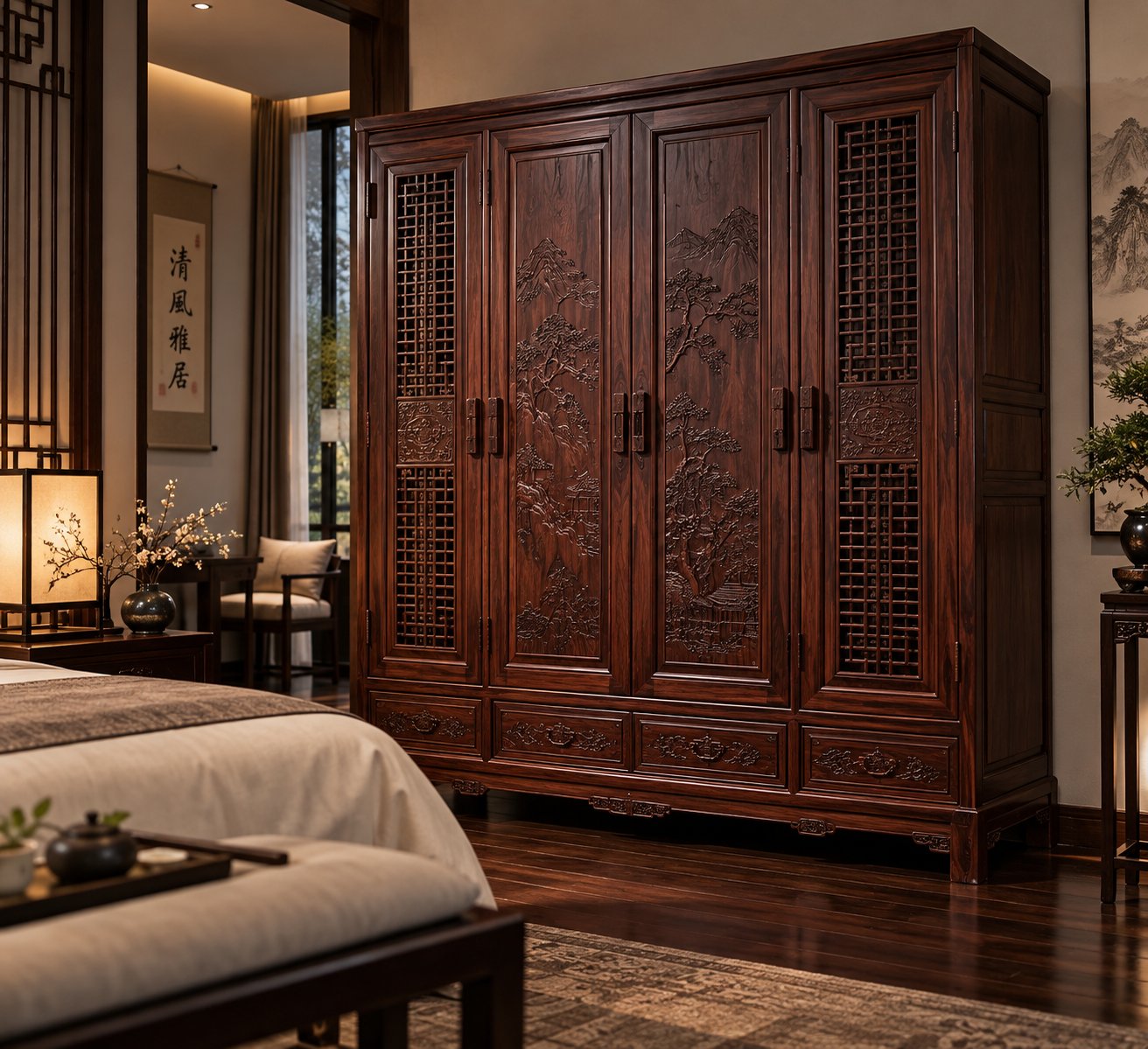
Panduan pembeli B2B untuk mencari lemari kayu rosewood dari China: material dan kayu teras, pengeringan kiln, sambungan mortise-and-tenon, ukiran tangan, ukuran, penyelesaian, kepatuhan CITES/FSC, kustomisasi OEM/ODM, inspeksi, pengemasan, dan evaluasi pemasok.
Why a Rosewood Wardrobe Is a High-Value Category for B2B Importers
For importers, wholesalers, hotel buyers and interior designers who work with classical solid wood furniture, the rosewood wardrobe is one of the most under-appreciated product categories in the catalog. Sofas, dining tables and bedroom suites get most of the attention in showrooms and marketing materials, yet the wardrobe is the piece that anchors a bedroom, carries the largest amount of solid timber per unit, and often commands the highest per-piece value in a whole-house order. When a buyer is planning a full container of classical redwood furniture, the wardrobe is frequently the item that determines whether the shipment is profitable.
This article is written for B2B buyers who are sourcing rosewood wardrobes from Chinese factories for resale, for hospitality projects, or for whole-house residential programs. It walks through the material, construction, craftsmanship, sizing, finishing, compliance, customization, inspection and logistics decisions that separate a wardrobe that sells well and lasts for decades from one that arrives cracked, warped, or impossible to move through a standard doorway. The goal is to give you a practical, evidence-based framework you can use when you evaluate a supplier, compare quotations, and place your first order.
Throughout this guide we refer to the real product lines manufactured by Yunxiao Rosewood Furniture, a classical redwood furniture factory in Xianyou County, Putian City, Fujian, China, which has been exporting full sets of solid rosewood furniture since 2008. The company's wardrobe range includes the Classical Siamese Rosewood Wardrobe with Carved Panel Doors and the Classical Redwood Bedroom Wardrobe Suite 6-Piece Set, both of which are useful reference points for the quality standards and customization options available in this category.
Understanding the Wood: Why Rosewood Is Not One Single Material
The first thing any serious importer must understand is that the word rosewood covers a family of dense, dark tropical hardwoods, and the specific species, the origin of the timber, and the ratio of heartwood to sapwood all affect the price, the appearance, the stability and the legal status of the finished wardrobe. When you compare quotations from different factories, you are rarely comparing the same material, even when both suppliers use the word rosewood in their product names.
Siamese Rosewood and the Heartwood Question
One of the most common premium materials used in classical Chinese furniture is Siamese rosewood, botanically Dalbergia cochinchinensis. It is a dense, fine-grained hardwood with a rich reddish-brown color that deepens with age and exposure to light. Because the timber is heavy and stable, it is well suited to large case pieces such as wardrobes, where a single door panel or side panel can be more than a meter tall and must hold its shape across changing humidity.
When you evaluate a rosewood wardrobe, the single most important material specification is the heartwood ratio. Heartwood is the dense, colored inner core of the log; sapwood is the paler, softer outer layer. A wardrobe made from timber with a high heartwood ratio will have consistent color, better carving clarity, and greater dimensional stability. A wardrobe made with a high proportion of sapwood will look patchy, carve poorly, and is far more likely to move, check or crack after it reaches a different climate. Serious factories select heartwood-dense timber specifically for carving clarity and for the deep, even color that buyers expect from a premium rosewood piece.
Why Large Case Pieces Need the Right Timber Grade
A wardrobe is structurally different from a sofa or a dining chair. It is a tall, box-like case piece with large flat panels, doors that must open and close without binding, and drawers that must slide smoothly. Every one of these functions depends on the timber being properly selected, dried and stabilized before it is cut. If a factory starts with green or poorly dried timber, the panels will twist, the doors will warp, and the drawers will jam within the first season in a new climate. This is why the drying process matters more for wardrobes than for almost any other furniture category.
Kiln Drying and Moisture Control: The Foundation of a Stable Wardrobe
Classical rosewood furniture is assembled without metal nails, using traditional mortise-and-tenon joinery. That construction method only works if the timber is stable, because the joints rely on the wood holding its shape rather than on fasteners holding it together. The foundation of that stability is controlled drying.
At a serious factory, freshly sawn timber goes through a constant-humidity drying process that can take more than a month. For example, Yunxiao's production line uses a 36-day constant-humidity drying cycle before any timber is cut into furniture components. This is not a cosmetic step. It removes internal moisture gradually so that the wood does not develop the internal stresses that cause cracking, checking and warping later. When you visit a factory or review its process documentation, ask specifically how long the drying cycle is, whether the kilns hold a constant humidity, and whether the timber is allowed to rest and equalize after drying before it is machined.
For an importer, the practical consequence is simple: a wardrobe built from properly dried timber will survive the journey to a different climate and continue to perform for decades, while a wardrobe built from rushed timber will develop problems that are expensive to repair and impossible to hide from an end customer. The drying process is invisible in a showroom photo, but it is the difference between a product that protects your reputation and one that generates returns and complaints.
Mortise-and-Tenon Joinery: Why It Matters for a Tall Case Piece
Classical Chinese furniture is famous for its mortise-and-tenon joinery, a system in which components are shaped to fit together without nails or screws. In a wardrobe, this joinery is not a stylistic choice; it is an engineering decision. A tall wardrobe carries heavy loads, is opened and closed thousands of times, and must resist the forces of wood movement across seasons. Mortise-and-tenon joints allow the panels to expand and contract naturally while keeping the frame rigid, which is exactly what a large case piece needs.
When you evaluate a rosewood wardrobe, look for evidence that the joinery is genuine and well executed. The tenons should be tight-fitting, the joints should be clean and gap-free, and the assembly should be rigid when you push on the corners. Many factories reinforce their mortise-and-tenon joints with bamboo dowel pins rather than metal fasteners. Bamboo dowels are traditional, and they also avoid the corrosion and stress concentration that metal fasteners can introduce. A wardrobe assembled entirely without metal nails is a strong signal of traditional, high-quality construction.
This matters commercially because it affects how the wardrobe behaves in your market. A wardrobe with weak joinery will loosen, wobble and eventually fail under normal use. A wardrobe with proper mortise-and-tenon construction will remain rigid and quiet for decades. When you compare quotations, the joinery quality is one of the most reliable indicators of whether you are buying a premium product or a cheap imitation.
Hand Carving: The Detail That Defines a Classical Rosewood Wardrobe
The carving on a classical rosewood wardrobe is what gives it its identity and its value. Traditional motifs such as dragons, clouds, lattice patterns, peonies, phoenixes and auspicious symbols are hand-chiseled into the solid wood by master artisans. The depth, clarity and consistency of the carving are the most visible signs of craftsmanship, and they are also the hardest thing for a machine to replicate convincingly.
When you inspect a carved wardrobe, look at the relief work closely. Genuine hand carving has a natural variation and depth that machine carving cannot match. The undercuts are clean, the transitions are smooth, and the details remain sharp even in areas that are difficult to reach. Machine-carved imitations tend to have a uniform, shallow, repetitive quality, and they often lose detail in tight corners. For a premium product that you plan to sell at a high margin, hand carving is a decisive differentiator.
Carving also affects the production time and therefore the price. A heavily carved wardrobe panel can represent many hours of an artisan's work. When you compare quotations, understand that a lower price usually means less carving, shallower carving, or machine carving. Decide in advance what level of carving your target market expects, and make sure the supplier's product matches that expectation rather than just matching the price.
Sizing and Configuration: Matching the Wardrobe to Your Market
Rosewood wardrobes are not one-size-fits-all. The dimensions, the number of doors, the internal configuration, and the overall style must match the expectations of the market you serve. A wardrobe that is perfect for a Southeast Asian villa may be too large or too small for a North American bedroom, and a wardrobe designed for a hotel suite may have different storage requirements than one designed for a private residence.
Standard Dimensions and Door Configurations
Classical rosewood wardrobes are typically available in two-door, three-door and four-door configurations. A two-door wardrobe is compact and suits smaller bedrooms and hotel rooms. A three-door or four-door wardrobe provides more storage and suits master bedrooms and larger suites. The height is also important: many classical wardrobes are tall, and you must confirm that the finished piece will fit through standard doorways and into elevators in your market. This is a practical detail that is easy to overlook and expensive to discover after the container arrives.
When you specify a wardrobe, provide the supplier with the ceiling height, the doorway width, and the corridor constraints of your typical installation site. A good factory will help you choose a configuration that maximizes storage while remaining practical to install. This is exactly the kind of customization that a factory with OEM and ODM capability can handle, and it is one of the reasons buyers work directly with manufacturers rather than with trading companies.
Internal Storage Configuration
The inside of the wardrobe is as important as the outside. Buyers in different markets expect different internal layouts: hanging rails for long garments, shelves for folded items, drawers for accessories, and sometimes a safe or a tie rack. A factory that offers ODM customization can adjust the internal configuration to match the storage habits of your market. When you brief a supplier, be specific about the mix of hanging space, shelving and drawers you need, and ask to see the internal layout before you commit to a full container.
Finishing: Lacquer, Beeswax and Compliance
The finish on a rosewood wardrobe protects the wood, deepens the color, and determines how the piece looks in a showroom and in a customer's home. Classical Chinese furniture is traditionally finished with raw lacquer or beeswax, applied in multiple thin coats and hand-rubbed to a deep, satin sheen. The choice of finish affects both the appearance and the compliance of the product in your market.
Raw Lacquer and Beeswax Finishes
A high-quality rosewood wardrobe is finished with multiple coats of raw lacquer, often six to eight coats, each hand-rubbed. This builds up a durable, moisture-resistant surface that protects the wood while allowing the natural grain to show through. Beeswax finishes are also used, particularly on pieces where a more natural, matte appearance is desired. Both finishes are traditional, and both are appropriate for premium classical furniture.
When you evaluate a finish, look at the evenness of the sheen, the depth of the color, and the absence of brush marks, runs or cloudy patches. A well-finished wardrobe should have a smooth, consistent surface that feels pleasant to the touch. The finish should also be appropriate for the intended use: a wardrobe in a bedroom does not need the same food-contact certification as a dining table, but it should still meet the general safety and emissions standards of your market.
Compliance: EU REACH, US CARB and Food-Safe Finishes
For export to Europe and North America, the finish must comply with relevant regulations. European buyers typically require finishes that meet EU REACH standards, and North American buyers often require finishes that meet US CARB standards for formaldehyde emissions. For dining furniture that comes into contact with food, a food-safe finish that meets FDA 21 CFR 175.300 is required. While a wardrobe is not a food-contact surface, the same factory discipline that produces compliant dining finishes is a good sign that the wardrobe finish is also safe and compliant.
Ask the supplier for the compliance documentation for the finish they use, and confirm that the documentation covers the specific product you are importing. Do not assume that a factory that is compliant for one product line is automatically compliant for another. Verify the documentation for the wardrobe specifically.
Timber Compliance: CITES, FSC and Legal Sourcing
Rosewood is a regulated timber, and compliance is not optional. The international trade in many rosewood species is controlled under the Convention on International Trade in Endangered Species of Wild Fauna and Flora (CITES). Importers must be able to document that the timber in their furniture was legally harvested and legally exported, and that the necessary permits accompany the shipment.
For European buyers, the EU Timber Regulation (EUTR) requires due diligence to ensure that timber placed on the EU market is legally harvested. For North American buyers, the US Lacey Act prohibits trade in illegally sourced timber. Both regulations place a compliance burden on the importer, and both are easier to satisfy when you work with a factory that maintains proper documentation.
A reliable factory will provide CITES export permits, FSC chain-of-custody documentation where applicable, and the full export documents needed for your shipment. When you evaluate a supplier, ask specifically about their timber compliance process, and request to see sample documentation before you place an order. A factory that cannot document the legal origin of its rosewood is a serious risk, regardless of how good the product looks.
Customization and OEM/ODM Capability
One of the strongest reasons to source rosewood wardrobes from a factory rather than a trading company is the ability to customize. A factory with OEM and ODM capability can adjust the dimensions, the carving motifs, the internal configuration, the finish, and even the overall design to match your brand and your market. This is especially valuable for buyers who serve hospitality projects, where every room may need a slightly different configuration, or who want to build a distinctive product line under their own brand.
When you brief a factory for a custom wardrobe, be specific about the target market, the installation constraints, the storage requirements, and the design language you want. Provide reference images, dimensions, and any brand requirements. A good factory will respond with a clear proposal, a sample or a drawing, and a realistic lead time. Customization adds value, but it also adds lead time, so plan your orders accordingly.
For buyers who are new to a factory, it is often wise to start with a trial order of a single set or a small quantity before committing to a full container. Many factories offer trial single sets and refundable samples, which let you verify the quality, the finish, the dimensions and the documentation before you scale up. This is a low-risk way to test a supplier and to confirm that the product meets your expectations.
A Practical Inspection Checklist for Rosewood Wardrobes
Before you accept a shipment, or before you place a large order, use a structured inspection checklist to verify the quality of the wardrobes. The following points cover the most important things to check:
- Timber and color: Confirm the heartwood ratio and the consistency of the color across the panels. Look for patchy sapwood, which indicates lower-grade timber.
- Joinery: Check that the mortise-and-tenon joints are tight, clean and gap-free, and that the frame is rigid when you push on the corners.
- Carving: Inspect the depth, clarity and consistency of the carving. Look for natural variation that indicates hand work rather than machine carving.
- Doors and drawers: Open and close every door and drawer. They should move smoothly, align properly, and not bind or stick.
- Finish: Check the evenness of the sheen, the depth of the color, and the absence of brush marks, runs or cloudy patches.
- Moisture and stability: Look for any signs of cracking, checking or warping, which indicate problems with drying or timber selection.
- Documentation: Verify that the CITES permits, FSC documentation (where applicable), and export documents are complete and correct.
If you are not able to inspect the goods in person, consider using a third-party inspection service or requesting detailed photos and video from the factory before shipment. A factory that is confident in its quality will usually be happy to provide this evidence.
Packaging and Shipping: Protecting Carved Wardrobes in Transit
A rosewood wardrobe is heavy, tall and often elaborately carved, which makes it one of the more challenging items to ship safely. Proper packaging is essential to prevent damage during the long journey from the factory to your warehouse or project site.
A reliable factory uses custom crating, moisture barriers and bracing protocols designed for delicate carved furniture. The wardrobe should be protected against impact, vibration and moisture. ISPM 15 heat-treated packaging is required for international shipments, and a factory that prepares its own export packaging will ensure that the crating meets the requirements of your destination country.
When you plan a container load, consider the dimensions and weight of the wardrobes, and work with the factory to optimize the loading so that the pieces are stable and protected. A well-planned container load reduces the risk of damage and maximizes the value of your shipping spend. For long-term partners, many factories offer partial shipments, which give you flexibility in managing inventory and cash flow.
Pricing, Lead Times and Total Cost of Ownership
The price of a rosewood wardrobe depends on the species and grade of the timber, the amount and quality of the carving, the size and configuration, the finish, and the level of customization. Because these factors vary so much, it is not useful to compare quotations on price alone. Instead, compare the total cost of ownership: the delivered price, the expected lifespan, the risk of defects and returns, and the value of the product in your market.
Lead times are also an important consideration. A standard rosewood wardrobe may take several weeks to produce, and a heavily carved or custom piece will take longer. For container orders, a realistic production and delivery timeline is often 45 to 60 working days after the deposit, depending on the complexity of the order and the factory's capacity. When you plan your purchasing calendar, build in enough lead time to cover production, inspection, shipping and customs clearance.
Finally, consider the after-sales support. A factory that offers remote installation guidance, layout drawings for projects, and a clear warranty policy is easier to work with than one that disappears after the shipment. Ask about the warranty, the process for handling defects, and the support available to you and your customers.
How to Evaluate a Rosewood Wardrobe Supplier
Choosing the right supplier is the most important decision in the entire sourcing process. A good supplier is not just the one with the lowest price; it is the one that can deliver consistent quality, proper documentation, reliable lead times and responsive support. Use the following criteria when you evaluate a factory:
- Proven experience: Look for a factory with a track record of exporting classical rosewood furniture to your target markets. Ask for references and examples of completed projects.
- In-house manufacturing: A factory that controls its own timber selection, drying, carving, finishing and packaging is easier to hold accountable than a trading company that coordinates multiple subcontractors.
- Compliance capability: Confirm that the factory can provide CITES permits, FSC documentation where applicable, and the export documents your market requires.
- Customization capability: If you need OEM or ODM customization, confirm that the factory can handle the dimensions, carving, configuration and finish changes you require.
- Quality control: Ask about the factory's inspection process, and consider a trial order or a third-party inspection before you scale up.
- Communication and support: A supplier that responds clearly, provides documentation, and offers after-sales support is easier to work with over the long term.
If you are evaluating a factory for the first time, a virtual factory audit can be a useful first step. Many factories are willing to show their workshop, their drying process, their carving benches and their packaging line on a video call. This gives you direct evidence of the factory's capability before you commit to a trial order.
Classical Styles: Ming and Qing Wardrobe Design
Beyond the material and construction, the style of a rosewood wardrobe is a major factor in how it sells in different markets. Classical Chinese furniture is broadly divided into two great design traditions: the Ming style and the Qing style. Understanding the difference helps you choose the right wardrobe for your catalog and for the tastes of your customers.
Ming-style furniture is characterized by clean, restrained lines, elegant proportions, and a focus on the natural beauty of the wood. Ming wardrobes tend to have simpler, more geometric forms, with minimal ornament and a strong emphasis on the joinery and the grain. This style appeals to buyers who value understated elegance, modern interiors, and the timeless quality of the timber itself. It is a popular choice for contemporary homes and for designers who want a classical piece that does not overwhelm a room.
Qing-style furniture, by contrast, is more ornate and decorative. Qing wardrobes feature heavier carving, richer ornament, and more elaborate motifs such as dragons, phoenixes, clouds and floral patterns. This style appeals to buyers who want a statement piece, a traditional look, or a wardrobe that carries the full visual drama of classical Chinese craftsmanship. Qing-style wardrobes are often chosen for luxury hotels, traditional interiors, and buyers who want the carving to be the centerpiece of the room.
When you plan your product line, decide which style or mix of styles your target market prefers. A factory with OEM and ODM capability can produce both Ming and Qing wardrobes, and can adjust the level of carving to match your brand. Offering both styles gives your customers choice and lets you serve a wider range of projects, from minimalist modern apartments to richly decorated traditional interiors.
Coordinating the Wardrobe with a Whole Bedroom Suite
For many buyers, the wardrobe is not purchased in isolation. It is part of a coordinated bedroom suite that includes a bed, nightstands, a dresser, and sometimes a vanity or a bench. When the pieces are designed to work together, they create a cohesive, high-value package that is easier to sell and more profitable than selling individual items.
A factory that manufactures complete bedroom suites can match the wood, the finish, the carving motifs and the style of the wardrobe to the rest of the set. This consistency is important: a wardrobe that does not match the bed and dresser will look out of place, and it will be harder to sell as part of a coordinated program. When you source a wardrobe, ask whether the factory can supply a matching bedroom suite, and review the full set before you commit.
Whole-house programs are another important consideration. Many buyers serve clients who want a complete home furnished in a consistent classical style, from the living room sofa and dining table to the bedroom wardrobes and the study furniture. A factory that can coordinate the wardrobe with the rest of the house gives you a significant advantage, because you can offer your customers a single, coherent design language across every room. This is one of the strongest reasons to work with a full-set manufacturer rather than a supplier that only makes one or two categories.
Rosewood Wardrobe vs. Other Bedroom Storage Options
When you plan a bedroom furniture program, it is useful to understand how a rosewood wardrobe compares with other storage options, so you can advise your customers and position the product correctly. The main alternatives are built-in wardrobes, metal or engineered-wood wardrobes, and open shelving or armoires.
A built-in wardrobe is fitted into the wall and offers maximum storage efficiency, but it is not movable and cannot be exported as a finished product. A rosewood wardrobe, by contrast, is a freestanding piece that can be shipped, installed in any room, and moved when the customer relocates. This portability is a major advantage for importers and for customers who value flexibility.
Metal and engineered-wood wardrobes are cheaper and lighter, but they lack the durability, the craftsmanship and the premium appearance of solid rosewood. A rosewood wardrobe is a long-term investment that holds its value and its beauty for decades, while a cheaper wardrobe will wear out and need to be replaced. For buyers who serve the premium segment, the rosewood wardrobe is the clear choice.
An armoire is a traditional freestanding wardrobe with doors, often used for clothing storage. The terms wardrobe and armoire are sometimes used interchangeably, but an armoire is typically a single tall cabinet, while a wardrobe may have a more complex internal layout. When you market the product, use the term that your target market understands best, and be clear about the dimensions and the internal configuration.
Caring for and Maintaining a Rosewood Wardrobe
One of the reasons rosewood furniture holds its value is that it is durable and can be maintained for generations. However, a rosewood wardrobe does require proper care, and it is worth understanding the basics so you can advise your customers and reduce the risk of damage and returns.
Rosewood is sensitive to extreme changes in temperature and humidity. In a very dry climate, the wood can shrink and develop fine cracks; in a very humid climate, it can expand and the doors may bind. Advise your customers to keep the wardrobe away from direct heat sources, radiators and air-conditioning vents, and to maintain a reasonably stable indoor humidity. A humidifier in winter or a dehumidifier in a tropical climate can help protect the piece.
Cleaning a rosewood wardrobe is simple. Dust it regularly with a soft, dry cloth, and avoid harsh chemical cleaners that can strip the lacquer. For deeper cleaning, a slightly damp cloth followed by a dry cloth is usually sufficient. Do not use abrasive pads or strong solvents, which can damage the finish. If the finish becomes dull over time, a light application of a suitable furniture polish or wax can restore the sheen, but always test on an inconspicuous area first.
When you sell a rosewood wardrobe, include basic care instructions with the product. This reduces the risk of damage caused by improper handling, and it helps your customers protect their investment. A factory that offers remote installation guidance and after-sales support can also help you handle any questions or issues that arise after the sale.
Market-Specific Considerations for Importers
The rosewood wardrobe market varies across regions, and understanding these differences helps you position the product and plan your orders. The site's target markets include Southeast Asia, Australia, North America and Europe, and each has its own preferences and requirements.
In Southeast Asia, classical rosewood furniture is highly valued for its cultural resonance and its premium appearance. Buyers in this region often favor traditional styles with rich carving, and they are comfortable with the dense, dark look of rosewood. The tropical climate means that moisture control and stable construction are especially important, so emphasize the drying process and the joinery when you market to this region.
In Australia and North America, buyers tend to appreciate the craftsmanship and the durability of rosewood, but they may prefer slightly more restrained designs that fit modern interiors. Ming-style wardrobes with clean lines are often popular in these markets. Compliance is also a priority, so be prepared to provide the CITES, FSC and finish documentation that these markets require.
In Europe, buyers place a strong emphasis on compliance and sustainability. The EU Timber Regulation requires due diligence on the legal origin of the timber, and buyers expect clear documentation. European buyers also tend to value the environmental credentials of the product, so highlight responsible sourcing and any FSC certification. The style preferences vary by country, so work with your distributor or agent to understand the local market.
Sustainability and Responsible Sourcing
Sustainability is an increasingly important consideration for buyers, and it is directly relevant to rosewood, which is a regulated and sometimes endangered timber. A responsible sourcing program protects the environment, satisfies your customers, and reduces your legal risk.
The most important step is to work with a factory that sources its rosewood legally and can document the chain of custody. This means the timber is legally harvested, legally exported, and accompanied by the necessary CITES permits. Where applicable, FSC certification provides independent verification that the timber comes from responsibly managed forests. A factory that maintains this documentation is a lower-risk partner and a better fit for buyers who care about sustainability.
Responsible sourcing also extends to the manufacturing process. Look for a factory that minimizes waste, uses timber efficiently, and manages its environmental impact. While these practices may not be visible in the finished product, they matter to increasingly conscious buyers and to the long-term health of the industry. When you evaluate a supplier, ask about their sourcing and environmental practices, and look for evidence of responsible management.
By choosing a factory with a genuine commitment to legal and responsible sourcing, you protect your own business, satisfy your customers, and contribute to the sustainability of the classical rosewood furniture trade.
Common Questions About Sourcing Rosewood Wardrobes
What is the difference between a rosewood wardrobe and a solid wood wardrobe?
Rosewood is a specific family of dense, dark tropical hardwoods, while solid wood is a broader term that can refer to many species. A rosewood wardrobe is made from rosewood timber, which is valued for its density, color, stability and carving quality. When you source a wardrobe, confirm the specific species and the heartwood ratio, because these determine the price and the quality.
Can I order a custom-sized rosewood wardrobe?
Yes. A factory with OEM and ODM capability can adjust the dimensions, the number of doors, the internal configuration, the carving motifs and the finish to match your requirements. Provide the supplier with your installation constraints and storage needs, and confirm the lead time for the custom piece.
What documentation do I need to import a rosewood wardrobe?
You will need the CITES export permits for the rosewood, FSC chain-of-custody documentation where applicable, and the export documents prepared by the factory. For European and North American markets, you must also satisfy the due diligence requirements of the EU Timber Regulation and the US Lacey Act.
How long does it take to produce and deliver a rosewood wardrobe order?
Production time depends on the complexity of the piece and the factory's capacity. A standard wardrobe may take several weeks, and a heavily carved or custom piece will take longer. For container orders, a realistic timeline is often 45 to 60 working days after the deposit, including production, inspection, shipping and customs clearance.
What should I check when I inspect a rosewood wardrobe?
Check the heartwood ratio and color consistency, the tightness of the mortise-and-tenon joints, the depth and clarity of the carving, the smooth operation of the doors and drawers, the evenness of the finish, and the absence of cracking, checking or warping. Also verify that the compliance documentation is complete.
Is a rosewood wardrobe suitable for a hotel or hospitality project?
Yes. Classical rosewood wardrobes are well suited to boutique hotels, resorts and luxury hospitality projects, where their craftsmanship and premium appearance add value. For hospitality projects, work with the factory to configure the internal storage to match the needs of the rooms, and confirm the installation constraints.
Conclusion: Building a Profitable Rosewood Wardrobe Program
The rosewood wardrobe is a high-value, high-margin category that rewards careful sourcing. By understanding the material, the construction, the craftsmanship, the sizing, the finishing, the compliance and the logistics, you can select a product that sells well, lasts for decades, and protects your reputation with your customers. The key is to work with a factory that controls its own timber selection, drying, carving, finishing and packaging, that can document the legal origin of its rosewood, and that offers the customization and support your market requires.
When you are ready to source rosewood wardrobes, start with a clear specification of your target market, your installation constraints, and your storage requirements. Evaluate suppliers against the criteria in this guide, and consider a trial order before you commit to a full container. With the right product and the right partner, the rosewood wardrobe can become one of the most reliable and profitable lines in your furniture business.
If you would like to discuss a rosewood wardrobe program for your market, or to request dimensions, samples, or compliance documentation, contact the Yunxiao Rosewood Furniture team with your project details.