
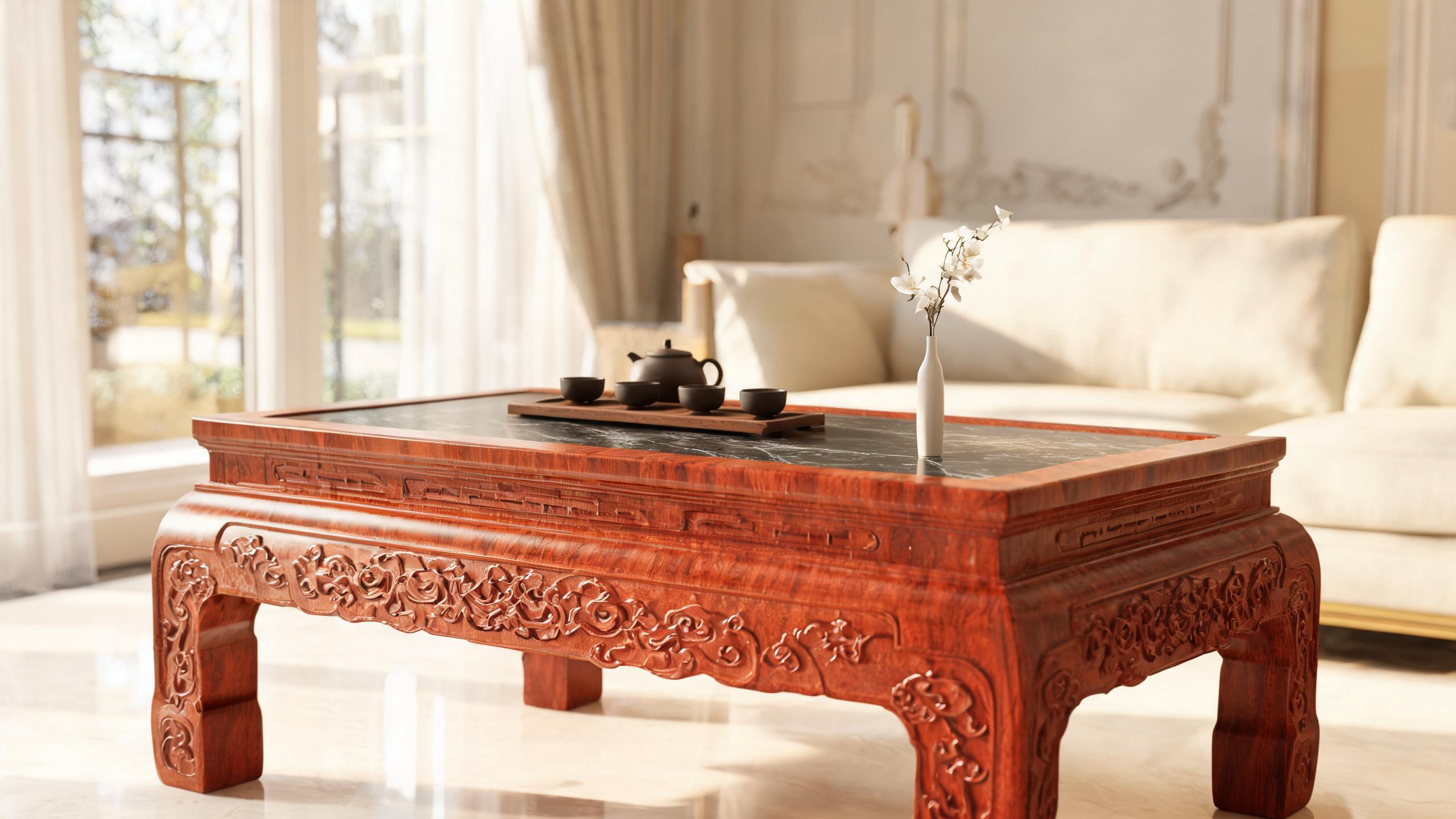
Panduan B2B praktis untuk memilih meja teh kayu sonokeling Siam klasik untuk proyek vila dan lobi hotel, mencakup material, pengeringan, sambungan, finishing, kepatuhan, dan kustomisasi.
Which Rosewood Tea Table Should You Choose for Villa and Hotel Lobby Projects?
Choosing a rosewood tea table for a villa living room, a hotel lobby, or a resort reception area is not the same as choosing one for a private home. The buyer is usually an importer, a furniture wholesaler, an interior designer, or a procurement manager working on a hospitality project, and the decision carries real commercial consequences: container space, compliance paperwork, installation timelines, and the expectations of an end client who may be a five-star hotel operator or a luxury villa developer. A tea table that looks beautiful in a catalog can still fail a project if the wood species is misdeclared, the joinery loosens in a dry heated climate, or the finish does not survive commercial cleaning routines.
This guide is written for B2B buyers who are evaluating classical Chinese rosewood tea tables — sometimes described in trade documents as redwood tea tables or classical solid wood tea tables — for export projects in Europe, North America, Southeast Asia, and Australia. It draws on the actual manufacturing practice of Yunxiao Rosewood Furniture Co., Ltd, a factory founded in 2008 in Xianyou County, Putian City, Fujian Province, the recognized hometown of traditional hardwood craft in China. Everything described here — the 12,000 square meter workshop, the 36-day constant-humidity drying cycle, the mortise-and-tenon assembly without metal nails, the beeswax and lacquer finishing that meets EU REACH and US CARB expectations, the FSC chain-of-custody documentation and CITES export permits — reflects the way this factory actually builds and ships its furniture. The goal is to give you a practical, evidence-based framework for choosing the right rosewood tea table for your next villa or hotel project, and for choosing the right factory to build it.
Why the Tea Table Is the Centerpiece of a Classical Rosewood Project
In classical Chinese furniture composition, the tea table occupies a position that Western buyers sometimes underestimate. In a villa living room, it anchors the seating group and carries the visual weight of the entire arrangement. In a hotel lobby, it is often the first piece of furniture a guest touches — the surface where a welcome tea is served, where luggage is briefly set, where concierge staff place documents. In a tea room, a clubhouse, or a resort reception, it is literally the stage on which the hospitality experience is performed.
This functional centrality has three practical consequences for procurement. First, the tea table is seen and touched more often than almost any other piece, so surface finish quality and edge detailing must withstand close inspection. Second, it carries loads in ways that differ from a dining table: hot teapots, water spills, occasional impact from trays and luggage, and the weight of decorative stone or ceramic objects. Third, it is usually photographed — by the hotel for its marketing, by the designer for the portfolio, and by your own company for the next sales cycle — so the grain, the carving, and the proportions must hold up in images as well as in person.
When buyers ask us which piece of a whole-house rosewood furniture program they should spend the most time evaluating, our answer is consistently the tea table and the dining table, because these are the two surfaces where material quality, joinery precision, and finishing discipline become visible within weeks of installation. A sofa frame can hide a mediocre rail; a tea table cannot hide a poorly dried panel.
Understanding the Material: What "Rosewood" Actually Means in Export Trade
The word "rosewood" covers several distinct timber species, and the differences matter enormously for a B2B buyer. In Chinese classical furniture, the premium category is hongmu — literally "red wood" — a term defined by the Chinese national standard GB/T 18107, which lists the species permitted to be called hongmu. Within that standard, Siamese rosewood, known botanically as Dalbergia cochinchinensis and in the trade as Burmese rosewood or padauk-family timber, is one of the most sought-after species for classical furniture destined for export markets.
Siamese rosewood offers a combination that is difficult to replicate: a dense, oily heartwood with interlocked grain that polishes to a deep reddish-brown luster; natural resistance to warping when properly dried; and a fine texture that accepts detailed hand carving without splintering. For a hotel lobby table that will be cleaned daily and photographed constantly, these properties are not luxuries — they are the difference between a piece that looks better in year five and a piece that looks tired in year one.
Yunxiao builds its classical ranges from legally certified Siamese rosewood, aged red wood, and Grade-A tropical hardwood, with material selection documented per shipment. Buyers should always ask a prospective supplier three questions about material: Which species, by botanical name, is being supplied? What is the moisture content at the time of assembly? And what documentation — FSC chain-of-custody certificates, CITES Appendix II export permits, and re-export certificates — accompanies the shipment? A factory that answers all three without hesitation is a fundamentally different risk profile from one that answers only the first.
The Drying Question: Why 36 Days of Constant Humidity Matters More Than Any Marketing Claim
If there is a single technical factor that determines whether a rosewood tea table survives its first overseas winter, it is drying. Rosewood is dense — Siamese rosewood typically exceeds the density of most furniture hardwoods — and dense timber moves as it releases moisture. If a table is assembled from wood that still carries internal moisture gradients, the panels will shrink unevenly, the tenons will loosen, and within one heating season in a North American villa or a European hotel, the buyer will see hairline cracks along the apron and gaps at the joints.
The industry shorthand for preventing this is kiln drying, but the real discipline is longer and more nuanced. Yunxiao subjects every component to a 36-day constant-humidity drying cycle before assembly. This is not a marketing number; it is a production constraint that shapes lead times and costs. The purpose is to bring the wood to a moisture content appropriate for the destination climate — lower for heated interiors in Europe and North America, moderate for the humid conditions of Southeast Asia — and to equalize moisture through the full thickness of the stock, not just at the surface.
For buyers, the practical takeaway is this: when you compare quotations between factories, a factory that dries properly will often be slightly more expensive and slightly slower, and both of those differences are worth paying for. Ask each candidate supplier to describe their drying process in days, not adjectives, and to state the target moisture content for your destination market. A supplier who cannot answer has not made drying a controlled process, and your warranty claims will eventually pay for that gap.
Joinery: Mortise and Tenon, Wooden Dowels, and the Absence of Metal Nails
Classical Chinese furniture earned its reputation on joinery, and the tea table is one of the clearest demonstrations of why. In traditional construction, the apron, legs, and stretchers of a tea table are joined with mortise-and-tenon joints — precisely cut wooden sockets and tongues that interlock without glue dependence or metal fasteners. Yunxiao assembles all of its furniture without metal nails in the primary frame, using mortise-and-tenon joinery reinforced with wooden dowels.
Why does this matter to a B2B buyer rather than remaining a romantic detail? Three reasons. First, metal and wood move at different rates with temperature and humidity. A nail or screw rigidly fixing a rail to a leg creates a stress point; over seasons of expansion and contraction, the wood around the fastener compresses and cracks, and the joint loosens. Wooden joinery flexes with the wood itself. Second, metal fasteners in dense oily hardwoods such as rosewood can corrode and stain, leaving black streaks around the fixing point that are nearly impossible to repair invisibly. Third, joinery quality is a proxy for overall factory discipline: a workshop that cuts accurate mortises has calibrated machinery and trained hands, and that same discipline shows up in the carving, the sanding, and the finishing.
When you audit a supplier — in person or virtually — ask to see the joinery stage of production, not just the finished showroom. Look at whether tenons are cut to consistent depth, whether joints close without visible gaps, and whether the assembly area uses clamps and jigs systematically. These observations predict long-term structural performance better than any certificate.
Finishing: Beeswax and Lacquer That Meet EU REACH and US CARB Expectations
The finish on a rosewood tea table serves two audiences at once: the eye and the regulator. For the eye, the finish must deepen the natural luster of the grain, protect the carving from handling, and resist the specific hazards of tea service — hot vessels, water rings, and repeated wiping. For the regulator, especially in the European Union and North America, the finish must comply with chemical safety frameworks: REACH in the EU and CARB (the California Air Resources Board formaldehyde and emissions standards) in the United States.
Yunxiao finishes each piece with eco-friendly beeswax and lacquer applied in multiple hand-rubbed, cured coats. The traditional approach matters technically: hand-rubbed coats build thickness gradually, allowing each layer to cure before the next, which produces a finish that is more flexible and more repairable than a single thick sprayed coat. On a tea table, repairability is a genuine commercial advantage — a hotel client can have a surface re-rubbed and renewed on site, extending the service life of the piece and reducing replacement costs over the life of the property.
Buyers should request, in writing, the compliance status of the finishing system for their destination market, and should ask whether finish samples can be included with the pre-shipment sample or the trial order. A factory confident in its finishing will provide samples without hesitation.
The Product Range: Four Tea Table Constructions and Where Each Fits
Within the Yunxiao classical collection, the tea table line is not a single design but a family of constructions, each suited to a different project context. Understanding the range helps a buyer match product to project rather than defaulting to the lowest price.
Round Tea Table with Carved Apron
The classical round tea table with a carved apron is the most versatile piece in the range. The round form suits conversation seating in villa living rooms, hotel lounge corners, and tea rooms where guests face one another. The carved apron — typically cloud or scroll motifs executed by hand — gives the piece its classical identity while the round top keeps sightlines open, which interior designers value in lobby settings where visual permeability matters. In container planning, round tables nest and pack efficiently, which reduces freight cost per unit.
Square Tea Table with Inlaid Stone Top
The square tea table with an inlaid stone top is the workhorse for high-traffic hospitality. The stone insert — set into the rosewood frame — provides a surface that is highly resistant to heat, water, and scratching, which makes it the natural choice for hotel lobbies, club lounges, and resort reception areas where the table is in continuous service. The rosewood frame carries the classical character; the stone top carries the durability. For buyers supplying hotel projects, this construction typically generates the fewest after-sales complaints of any surface type.
Tea Table with Bamboo Carved Apron
The bamboo-carved apron table draws on one of the most beloved motifs in Chinese decorative art: bamboo, symbolizing resilience and integrity. The low-relief bamboo carving along the apron gives the piece a lighter visual rhythm than dragon or phoenix carving, which makes it well suited to contemporary-classical interiors, boutique hotels, and villa projects where the client wants classical material with a restrained decorative register. It is also a frequent choice for buyers in Southeast Asia, where bamboo motifs resonate culturally.
Tea Table with Carved Cloud Apron
The cloud-apron tea table is the most overtly classical expression in the range. The cloud motif — xiangyun, the auspicious cloud — is executed in flowing relief carving that wraps the apron, and the design pairs naturally with dragon- and phoenix-carved sofa sets in grand reception settings. For imperial-style villa projects, Chinese cultural venues, and premium hotel suites that aim for a full classical atmosphere, this is the statement piece. It rewards close inspection, which is precisely why hand-carving quality matters most in this construction.
Sizing the Table to the Project: Practical Dimensions for Villas and Hotels
Tea table sizing is a conversation between three constraints: the seating it serves, the circulation around it, and the container it ships in. As a rule of thumb used across hospitality projects, the table height should align with the seat height of the surrounding sofas — for classical rosewood seating, this typically means a table in the range of 45 to 55 centimeters for lounge settings, with low tea tables for floor-seating arrangements sitting lower. The distance between the table edge and the seat front should allow 30 to 45 centimeters of knee clearance for comfortable use.
In hotel lobbies, designers often specify a larger round or square table as the central anchor, flanked by smaller side tables. In villa projects, the tea table frequently coordinates with a full living room set — a seven-piece or nine-piece Ming-style sofa arrangement, for example — and the factory can supply the tea table as part of a coordinated whole-house program, ensuring grain matching and finish consistency across all pieces in the room.
Because Yunxiao operates flexible OEM and ODM custom sizing, buyers are not limited to catalog dimensions. Custom sizes and patterns are routinely produced for villas and resorts, and the factory provides free layout drawings for projects, which allows the design team to verify proportions against the actual floor plan before production begins. For a buyer, the discipline is simple: never approve a tea table dimension from a catalog image alone; always check it against the seating specification and the room drawing.
Hand Carving Versus Machine Carving: What Buyers Should Actually Look For
Carving is where classical rosewood furniture earns or loses its value, and it is also where low-cost imitations cut corners most aggressively. Machine carving has a legitimate role — it can rough out panels efficiently and keep costs accessible — but the depth, crispness, and artistic judgment of hand carving cannot be replicated by a spindle. On a cloud-apron tea table viewed at close range in a hotel lobby, the difference is immediately visible: hand-carved motifs show undercut depth, varied line weight, and clean transitions between elements; machine carving shows uniform shallow relief, rounded-over details, and sanding marks where the cutter chattered.
Yunxiao maintains a team of experienced carving artisans who hand-chisel dragon, cloud, and lattice motifs using traditional tools and generations-old regional methods from Xianyou. For buyers, the practical evaluation method is straightforward: request close-up photographs of carving on a current production piece, not showroom samples; look at the deepest recesses of the motif, where machines cannot reach; and ask how many artisan-hours a typical apron requires. A factory proud of its carving will answer with specifics.
Compliance Documentation: FSC, CITES, and the Paperwork That Protects Your Shipment
No discussion of rosewood procurement is complete without compliance, because Dalbergia species — including Siamese rosewood — are listed on CITES Appendix II. In practical terms, this means every international shipment of rosewood furniture requires CITES export permits issued by the exporting country's authorities, and many destination countries require re-export certificates or import documentation referencing the original permits. A shipment that arrives without correct CITES paperwork can be delayed, fined, or refused entry, and the commercial damage extends beyond the shipment itself to the buyer's relationship with their end client.
Yunxiao supplies CITES Appendix II export permits and re-export certificates with each shipment, alongside FSC chain-of-custody documentation. The factory's internal team prepares full export documents as a standard service, which means the buyer's customs broker receives a complete, consistent document set rather than a patchwork assembled at the last minute. For buyers in the European Union, the EU Timber Regulation due-diligence framework makes this documentation not just helpful but structurally necessary; for buyers in the United States, the Lacey Act declaration requirements point in the same direction.
The procurement lesson is to treat documentation capability as a supplier-selection criterion of equal weight with price and quality. Ask each candidate factory to show you a redacted copy of a CITES permit from a recent shipment. The factories that can, and do, are the ones whose shipments clear customs on schedule.
Packaging and Shipping: Protecting Carved Surfaces Across the Ocean
A rosewood tea table survives its journey only if the packaging is engineered for it. Carved aprons and inlaid stone tops are precisely the features that standard furniture packaging damages: corner impacts crush carving relief, and vibration wears through thin wrapping against hard edges. Yunxiao uses ISPM 15 heat-treated packaging — the international standard for wood packaging material in international trade — combined with custom crating, moisture barriers, and bracing protocols designed specifically for delicate relief-carved redwood furniture.
For buyers, the packaging conversation should cover four points: whether crates are ISPM 15 stamped; how carved surfaces are separated from crate walls; whether stone-top tables receive additional top-load protection; and how the packing list maps to the container loading plan. Factories that export regularly will have documented answers. Container orders from Yunxiao typically require 45 to 60 working days after deposit, and partial shipments are available for long-term partners — a meaningful option for hotel projects phased across multiple floors or buildings, where delivery must match the construction schedule rather than the factory's convenience.
Quality Control Before Shipment: A Buyer's Inspection Framework
Even with a capable factory, disciplined buyers inspect before shipment. For a rosewood tea table, a practical pre-shipment checklist covers six areas. First, moisture: verify the stated moisture content against the destination climate specification. Second, structure: check that the table sits level on a flat floor without rocking, and that all joints close without gaps. Third, surface: inspect the finish under raking light for orange-peel texture, dust inclusion, or thin spots, particularly on the top surface. Fourth, carving: examine the deepest relief for tool marks or sanding damage. Fifth, hardware and fit: confirm drawers (where present) slide smoothly and any stone insert is seated flush. Sixth, documentation: match the piece against the packing list, the CITES paperwork, and the FSC chain-of-custody records.
Yunxiao supports this process with refundable samples and trial single sets, which allow a first-time buyer to evaluate construction quality on a small commitment before a full container order. Remote installation guidance is provided for projects, and the factory's experience with export markets in Europe, North America, Australia, and Southeast Asia means the common failure modes of long-distance furniture projects are already designed out of the standard process.
OEM and ODM: When the Project Needs Something the Catalog Does Not Have
Villa and hotel projects frequently require customization: a tea table sized to an unusual lobby geometry, a carving motif drawn from the property's brand story, a stone top matched to the interior palette, or a coordinated program of tea tables, dining sets, and bedroom suites produced to a single design language. This is where OEM and ODM capability becomes decisive. Yunxiao offers flexible OEM and ODM custom sizes and patterns for villas and resorts, supported by free layout drawings so that the customization is verified on paper before any timber is cut.
Buyers approaching customization should follow a simple sequence: share the floor plan and the design intent; request a dimensioned drawing and a material specification; approve a sample or a detailed mock-up where the budget allows; and lock the specification into the purchase contract, including the wood species by botanical name, the finish system, and the documentation set. Custom work rewards buyers who specify precisely and penalizes those who rely on verbal descriptions.
Cost Structure: What You Are Actually Paying For in a Rosewood Tea Table
Understanding the cost structure of a classical rosewood tea table helps buyers compare quotations intelligently rather than simply chasing the lowest number. The major cost components are, in rough order of weight: the timber itself, which for legally documented Siamese rosewood represents a substantial and rising share of cost; the drying cycle, which consumes 36 days of controlled capacity per batch; the carving labor, which varies enormously between machine-assisted and fully hand-carved work; the joinery and assembly labor; the finishing, with multiple hand-rubbed coats adding both material and labor cost; the compliance documentation; and the packaging and freight.
When a quotation arrives significantly below the field, the difference is almost always hiding in one of these lines: undocumented timber, shortened drying, machine carving sold as hand carving, a single-coat finish, or missing permits. Each of these savings transfers risk to the buyer — in the form of cracks, complaints, customs delays, or reputational damage with the end client. The rational procurement posture is to compare quotations line by line against the cost structure above, and to treat unexplained cheapness as a finding, not a bargain.
Matching the Tea Table to the Whole-House Program
For buyers building a whole-house or whole-property rosewood program, the tea table should be selected as part of the composition, not in isolation. Yunxiao's collection is designed for coordination: Ming-style sofa sets in seven-piece and nine-piece living room arrangements, Qing-dynasty-style carved sofa sets, dining tables from four-seat compact sets to twelve-seat banqueting sets, and complete bedroom suites including four-poster beds, canopy beds, wardrobe suites, and dresser sets. A villa project might pair a Ming-style nine-piece grand living room set with a cloud-apron tea table and a Ming-style round eight-seat dining table, producing a coherent classical language across the reception spaces. A hotel project might combine square stone-top tea tables in the lobby with phoenix-carved reception sofa sets in the executive lounge.
Coordinated programs also simplify logistics and after-sales: one finish system, one documentation set, one container plan, and one installation guidance package. For the buyer's end client, coherence across rooms is precisely what distinguishes a designed interior from a furniture collection assembled piece by piece.
Climate Adaptation: Engineering the Same Table for Four Different Markets
One of the most common mistakes in rosewood furniture procurement is assuming that a design proven in one market will perform identically in another. Wood is a hygroscopic material: it absorbs and releases moisture as the surrounding air changes, and the equilibrium moisture content of a hotel lobby in Singapore is fundamentally different from that of a heated villa in Alberta or a chalet in the Alps. A tea table engineered without this awareness will move — and the visible symptoms are predictable: hairline checks on wide panels, slight cupping of the top, and in severe cases, audible creaking as joints work against each other.
This is why the drying specification must be tied to the destination, not to the factory's convenience. For European and North American heated interiors, where winter relative humidity can drop below 30 percent, the target moisture content at assembly should sit in the lower single digits to low teens. For Southeast Asian and coastal Australian projects, where humidity stays high year-round, a higher target prevents the wood from absorbing excess moisture after installation and swelling against its own joints. Yunxiao's 36-day constant-humidity cycle exists precisely so that this calibration can happen per order, and buyers should make the destination climate an explicit line item in the purchase specification rather than an assumption.
Beyond drying, three construction details contribute to climate resilience. Floating-panel construction — used in wardrobe and dresser doors across the collection and equally relevant to any wide tea table panel — allows the center panel to expand and contract inside a fixed frame without cracking. Mortise-and-tenon joints with wooden dowels accommodate seasonal movement mechanically instead of resisting it. And the multi-coat beeswax and lacquer finish slows moisture exchange through the surface, buying the wood time to adjust gradually rather than shock-responding to a sudden change. When you evaluate any supplier, ask which of these three mechanisms their construction actually employs; the answers reveal whether climate adaptation is engineering or marketing.
Matching Construction to Project Type: A Practical Comparison
Different project types stress a tea table in different ways, and the four constructions in the range map onto those stresses unevenly. The summary below reflects the patterns that recur across export projects.
- Villa living rooms: round tea tables with carved aprons suit conversation seating and photograph beautifully; cloud-apron tables work for imperial-style or strongly classical interiors.
- Hotel lobbies and club lounges: square tables with inlaid stone tops absorb the heaviest daily traffic, resist heat and water rings from tea service, and generate the fewest after-sales issues.
- Boutique hotels and contemporary-classical interiors: bamboo-carved apron tables deliver classical material with a lighter decorative register that does not overwhelm a modern design scheme.
- Grand reception and cultural venues: cloud-apron tables paired with dragon- or phoenix-carved sofa sets create a full classical statement for imperial-style villas and premium suites.
Two project scenarios illustrate how these choices play out in practice. Consider a resort in Southeast Asia commissioning furniture for a new reception wing. The design team specifies square stone-top tea tables for the open-air lounge, where humidity and heat exposure are constant, and bamboo-carved tables for the interior library lounge, where the motif connects to the local landscape. The factory produces both to custom dimensions against the floor plan, ships them in one container with phased delivery matching the construction schedule, and supplies the complete CITES and FSC documentation set so customs clearance in the destination country proceeds without delay.
Now consider a European villa developer furnishing a flagship property. The specification calls for a Ming-style nine-piece living room set with a cloud-apron tea table, all finished for a dry heated interior. The drying target is set lower for the destination climate, the layout drawing is approved before production, and the buyer orders a trial single set first — evaluating joinery, finish, and moisture behavior through one full heating season before committing to the remaining rooms. Both scenarios share the same underlying discipline: the construction choice follows the project's real stresses, and the specification is written down before timber is cut.
Working With Your Supplier: A Communication Cadence That Prevents Surprises
Long-distance furniture projects fail more often from communication gaps than from craftsmanship. A practical cadence for a tea table order — or any classical rosewood order — looks like this. At inquiry stage, share the floor plan, the destination climate, the intended use, and the documentation requirements, and ask for a dimensioned proposal rather than a catalog quote. At order confirmation, lock the specification: wood species by botanical name, moisture target, finish system, carving depth, dimensions, packaging standard, and the full document set. During production, request stage photographs at three checkpoints — after drying, after assembly, and after finishing — so that any deviation surfaces while it is still inexpensive to correct. Before shipment, review the pre-shipment inspection results against the checklist described earlier in this guide, and confirm the packing list maps to the container plan.
Yunxiao's service model supports this cadence directly: the internal export team prepares full documentation, remote installation guidance is available for project sites, refundable samples and trial single sets de-risk the first order, and free layout drawings verify proportions before production. Partial shipments for long-term partners mean a phased hotel project never has to choose between waiting for a full container and accepting an incomplete floor. Buyers who adopt this cadence consistently report fewer surprises — not because the factory changed, but because the information flow made deviations visible early enough to fix.
The final point deserves emphasis. A classical rosewood tea table is a long-service asset: with correct drying, joinery, and finishing, it will outlast the carpet, the lighting scheme, and quite possibly the interior designer. That longevity is exactly why the selection framework in this guide matters. The extra week spent verifying species, drying, joinery, finish, and packaging is repaid many times over the life of the property — in fewer complaints, fewer repairs, and a room that still photographs beautifully years after opening day.
Frequently Asked Questions from B2B Buyers
What is the minimum order quantity for rosewood tea tables?
Yunxiao supports trial single sets and refundable samples, so first-time buyers can evaluate quality before committing to a full container. Container orders are the standard commercial unit, and partial shipments are available for long-term partners whose projects phase over time.
How long does production take?
Container orders take 45 to 60 working days after deposit. The drying cycle alone accounts for 36 days of that window, which is why realistic lead times matter when aligning delivery with a hotel opening or a villa handover date.
What documentation comes with a shipment?
Each shipment includes CITES Appendix II export permits and re-export certificates, FSC chain-of-custody documentation, and the full export document set prepared by the factory's internal team, with ISPM 15 heat-treated packaging for the crates.
Can the factory match a specific design or size?
Yes. Flexible OEM and ODM custom sizes and patterns are produced for villas and resorts, and free layout drawings are provided for projects so the design can be verified before production.
How does the furniture perform in dry or humid overseas climates?
The 36-day constant-humidity drying cycle targets the moisture content appropriate to the destination climate, and the mortise-and-tenon construction with wooden dowels — no metal nails in the primary frame — allows the structure to move with seasonal humidity without loosening or cracking.
What finish is applied, and is it compliant?
Pieces are finished with eco-friendly beeswax and lacquer in multiple hand-rubbed cured coats, meeting EU REACH and US CARB standards. Finish samples can be arranged with samples or trial orders.
Conclusion: A Decision Framework You Can Apply This Week
Choosing a rosewood tea table for a villa or hotel project comes down to five verifiable checks. Verify the species by botanical name and the legality documentation — CITES permits and FSC chain of custody. Verify the drying process in days and the target moisture content for your market. Verify the joinery — mortise and tenon, wooden dowels, no metal nails in the primary frame. Verify the finish system against REACH and CARB, and ask for samples. Verify the packaging — ISPM 15 crates with engineered protection for carved surfaces and stone tops. A supplier who passes all five checks, as Yunxiao's documented production practice does, is a supplier whose tea tables will still look and perform well when your end client's hotel celebrates its fifth anniversary.
The tea table is a small footprint in the container and a large footprint in the room. Choose it with the same rigor you apply to the sofa set and the dining table, and it will repay the attention every time a guest sits down for tea.