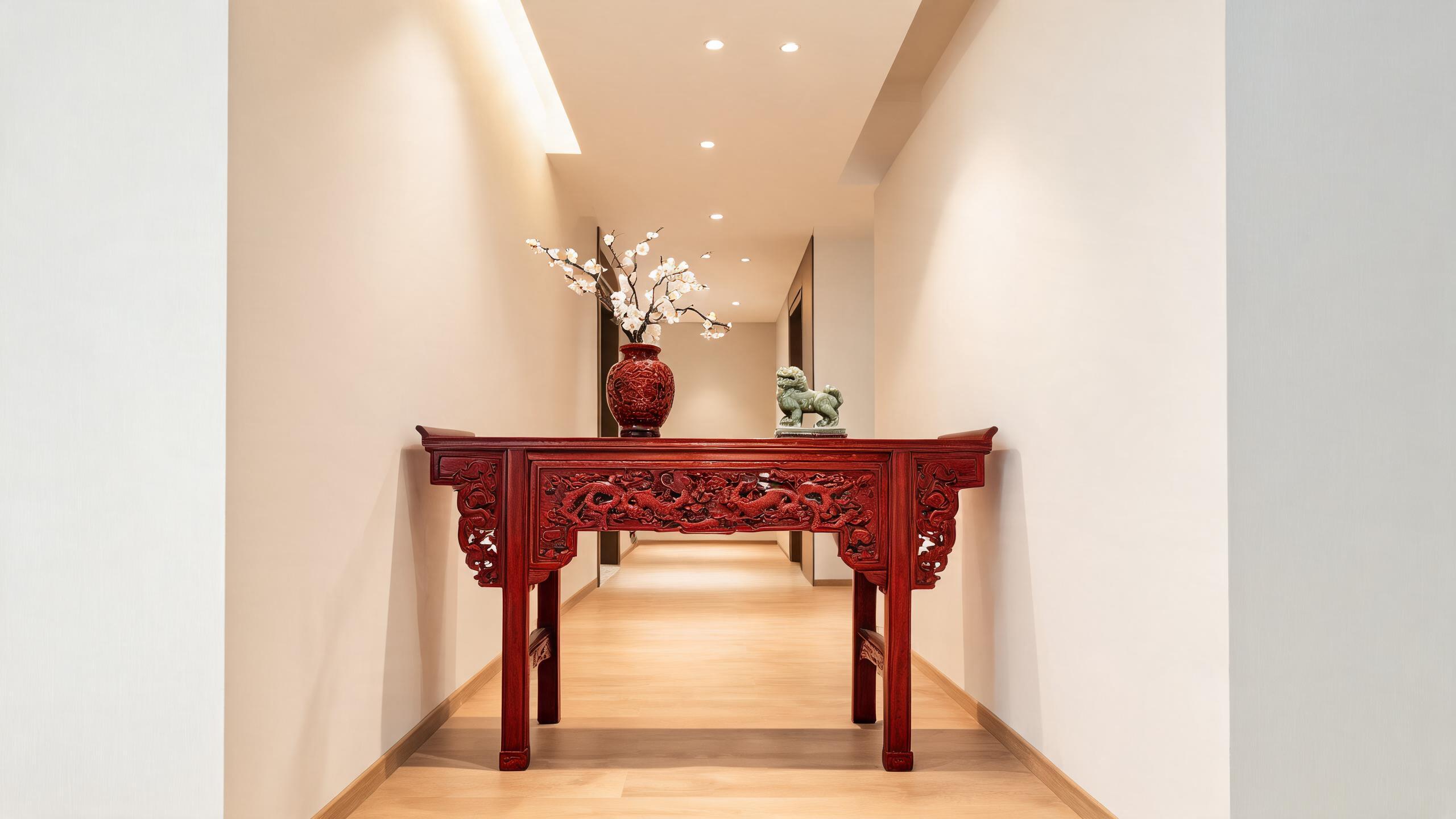
A practical B2B sourcing guide for importers and distributors buying rosewood console tables, entry tables, and hall tables. Covers species identification, carving quality assessment, construction red flags, compliance (CITES), and supplier evaluation criteria—with actionable checklists for your next RFQ.
BUYER GUIDE · CLASSICAL CARVED ROSEWOOD FURNITURE
# Rosewood Console Table & Entry Table: A B2B Sourcing Guide
If you are sourcing rosewood console tables, entry tables, or hall tables for a wholesale program, your risk is not finding a supplier—it is finding one who delivers consistent carving quality, correct wood species, and compliant documentation shipment after shipment. This guide covers what to check before you commit to a container.
## What Buyers Actually Ask Before Ordering
Importers and interior contractors searching for a "carved rosewood console" or "rosewood hall table" typically need answers to four questions:
1. Is the wood genuinely rosewood (Dalbergia), and does the supplier have CITES documentation?
2. Is the carving hand-done or machine-assisted, and how does that affect price and lead time?
3. What construction methods prevent warping, splitting, or joint failure in dry climates?
4. What MOQ, packaging, and lead times can a factory realistically commit to?
This guide addresses each point with specific criteria you can use in your next RFQ.
## Step 1: Verify the Wood Species Before You Talk Price
The term "rosewood" covers multiple species. In the classical furniture trade, the most common are:
| Common Name | Botanical Name | Typical Use in Furniture | CITES Status |
|---|
| Thai / Siamese Rosewood | Dalbergia cochinchinensis | High-end classical carving, solid pieces | Appendix II (restricted) |
| Burmese Rosewood | Dalbergia oliveri / bariensis | Carved consoles, dining sets, panels | Appendix II (restricted) |
| East Indian Rosewood | Dalbergia latifolia | Furniture, veneer, musical instruments | Appendix II (restricted) |
| Huanghuali (often mislabeled) | Dalbergia odorifera | Antique-style reproduction, high-end | Appendix II (restricted) |
**What to do:** Ask the supplier for the botanical name on the commercial invoice and packing list. If the supplier only says "rosewood" without a species name, treat that as a red flag. For any Dalbergia species, you need a CITES re-export certificate from the exporting country. Confirm the supplier can provide it before you negotiate price—not after.
**Practical check:** Request a photo of the CITES permit or the export license number in the initial RFQ stage. A legitimate factory will share this without hesitation.
## Step 2: Hand-Carved vs. Machine-Carved—Know What You Are Paying For
Classical carved rosewood consoles and hall tables sit at very different price points depending on the carving method.
| Carving Method | Typical Characteristics | Relative Cost | Lead Time Impact |
|---|
| Full hand-carving | Deep undercuts, irregular tool marks, organic flow of motifs, no repetition in leaf or cloud details | Highest | Longest (weeks per piece for dense patterns) |
| Machine-carved + hand finishing | Consistent depth, symmetrical patterns, hand-worked edges to remove tool marks | Mid-range | Moderate |
| Full CNC carving | Uniform depth, sharp edges, identical repeats, visible machine marks on flat surfaces | Lowest | Shortest |
**What to ask in your RFQ:**
- Specify the carving method you require. If you need hand-carved details, write "hand-carved with hand-finishing" in the spec, not just "carved."
- Request close-up photos of the back panel and underside—machine marks are easiest to spot there.
- Ask for the carving depth. Classical motifs on a console table typically range from 5 mm to 15 mm deep. Anything shallower may look flat.
## Step 3: Construction Checks That Prevent Returns
A carved rosewood console table is an investment piece. The most common quality failures importers see are:
**1. Solid wood vs. veneer confusion.** Some suppliers quote a "rosewood console table" but use rosewood veneer over MDF or rubberwood. If your buyer expects solid wood, this causes disputes. Specify "solid Dalbergia latifolia" or "solid rosewood" in the contract and require a cross-section photo of the leg or apron.
**2. Joint construction.** Traditional mortise-and-tenon joints hold up far better than dowels or screws under humidity changes. Ask the supplier to confirm the joint type. For a hall table with a long span, also ask whether the tabletop is floating (allowing wood movement) or fixed.
**3. Moisture content.** Rosewood is dense and slow-drying. If the wood is not properly seasoned, the table will crack in heated indoor environments. Ask for the moisture content range at the time of packing—typically 8–12% for export furniture. A factory that measures and states this number understands export requirements.
**4. Finish type.** Lacquer, PU, and wax each behave differently. For a carved surface, a harder finish (PU or lacquer) protects the recessed areas from dust accumulation and moisture. Confirm whether the finish is hand-rubbed or sprayed, and whether touch-up kits are included.
## Step 4: Sizing and Configuration for the US and EU Markets
Classical Chinese and European hall tables differ in proportion. If you are sourcing for Western interiors, confirm these dimensions in your spec:
| Application | Typical Length | Typical Depth | Typical Height |
|---|
| Entry / hall table (narrow) | 36–48 in (91–122 cm) | 12–16 in (30–41 cm) | 30–34 in (76–86 cm) |
| Console table (standard) | 48–60 in (122–152 cm) | 14–18 in (36–46 cm) | 30–32 in (76–81 cm) |
| Sofa table (behind sofa) | 60–72 in (152–183 cm) | 16–20 in (41–51 cm) | 28–30 in (71–76 cm) |
**What to do:** Send the supplier a dimension table like this with your target sizes. Ask them to confirm which sizes they can produce without custom tooling. Custom sizes are possible, but they add lead time and cost—know this before you plan your inventory.
## Step 5: Compliance and Documentation Checklist
For rosewood products, documentation is not optional. Use this checklist when evaluating a supplier:
- **CITES export permit** (re-export certificate) for the specific species
- **Phytosanitary certificate** from the exporting country
- **Commercial invoice** with botanical name, not just "rosewood"
- **Packing list** with piece count and dimensions
- **Wood treatment certificate** if fumigation or kiln-drying is required by your destination country
**Important:** CITES rules change. Verify the current appendix listing for the specific species at the time of your order, not based on this article. Regulations can be updated.
## Step 6: Supplier Evaluation—What to Verify Before You Commit
Beyond documentation, evaluate the factory on these operational points:
**Production capacity and lead time.** Ask how many carved rosewood console tables they produce per month. A factory that produces 50 pieces a month has different scheduling constraints than one producing 500. For hand-carved items, lead times of 4–8 weeks per 40-foot container are common—confirm this in writing.
**MOQ expectations.** Many factories set a minimum of 10–20 pieces per design for custom carving. If you need a mixed container with different sizes, ask whether they allow mixed designs at the same MOQ.
**Packaging standard.** Carved surfaces are fragile. Ask whether the factory uses foam corner protectors, inner carton, and outer plywood crate for sea freight. A table that arrives damaged costs you more than the table itself.
**Sample policy.** Always request a pre-production sample before mass production. For carved items, the sample is the only way to verify carving depth, finish, and joinery. Confirm whether the sample cost is deducted from the bulk order.
## Common Sourcing Mistakes to Avoid
**Mistake 1: Buying on photos alone.** Carving quality is difficult to assess from photos. Always request a video showing the table from multiple angles, including close-ups of joints and the underside.
**Mistake 2: Assuming "rosewood" means one thing.** As shown above, the term covers multiple species with different prices and CITES requirements. Lock the botanical name in the contract.
**Mistake 3: Ignoring the finish for carved surfaces.** Carved details trap dust and moisture. A poor finish will show wear within months. Specify a durable finish and ask for a finish sample on a carved offcut.
**Mistake 4: Not planning for humidity differences.** If your target market is dry (e.g., Arizona or the Middle East), ask the supplier to adjust the wood's moisture content accordingly. A table seasoned for humid Southeast Asia may crack in a desert climate.
## FAQ
**Q: What is the difference between a console table and a sofa table?**
A: Console tables are typically placed against a wall in entryways or hallways, usually 12–18 inches deep. Sofa tables are placed behind a sofa, usually 16–20 inches deep and often longer. The construction is similar, but dimensions and proportions differ.
**Q: Can I get a custom size for a carved rosewood entry table?**
A: Yes, most factories accept custom dimensions, but expect a higher unit price and longer lead time because the carving pattern must be adjusted. Confirm the cost impact before ordering.
**Q: How do I verify that the carving is hand-done?**
A: Ask for a video of the carving process or close-up photos showing the back of carved areas. Hand-carved pieces show subtle irregularity in depth and tool marks; CNC pieces are uniform and sharp.
**Q: What is the typical MOQ for a carved rosewood console table?**
A: MOQs vary by factory. For custom designs, 10–20 pieces per design is common. For standard designs, some factories accept lower quantities. Always confirm in writing.
**Q: What documentation do I need for importing rosewood furniture?**
A: At minimum, a CITES re-export certificate, phytosanitary certificate, and a commercial invoice listing the botanical name. Requirements vary by destination country—check with your customs broker before shipping.
## Final Takeaway for Buyers
Key takeaways for your next RFQ:
- Specify the botanical name (e.g., Dalbergia latifolia) and require CITES documentation upfront.
- Define the carving method (hand-carved, machine + hand-finish, or CNC) and request close-up photos of joints and undersides.
- Confirm joint construction (mortise-and-tenon preferred), moisture content (8–12%), and finish type for carved surfaces.
- Send a dimension table with your target sizes and ask which are standard vs. custom.
- Request a pre-production sample and confirm packaging standards for sea freight.
If you are evaluating suppliers for a carved rosewood console table, rosewood entry table, or rosewood hall table program, use the criteria above to shortlist factories. Send a detailed RFQ that includes the botanical name, carving method, dimensions, and documentation requirements—and ask for a pre-production sample before committing to bulk production.
For a quote or to discuss your specific project requirements, contact our team with your target sizes, quantities, and destination market. We will confirm feasibility, lead time, and documentation before you commit.