
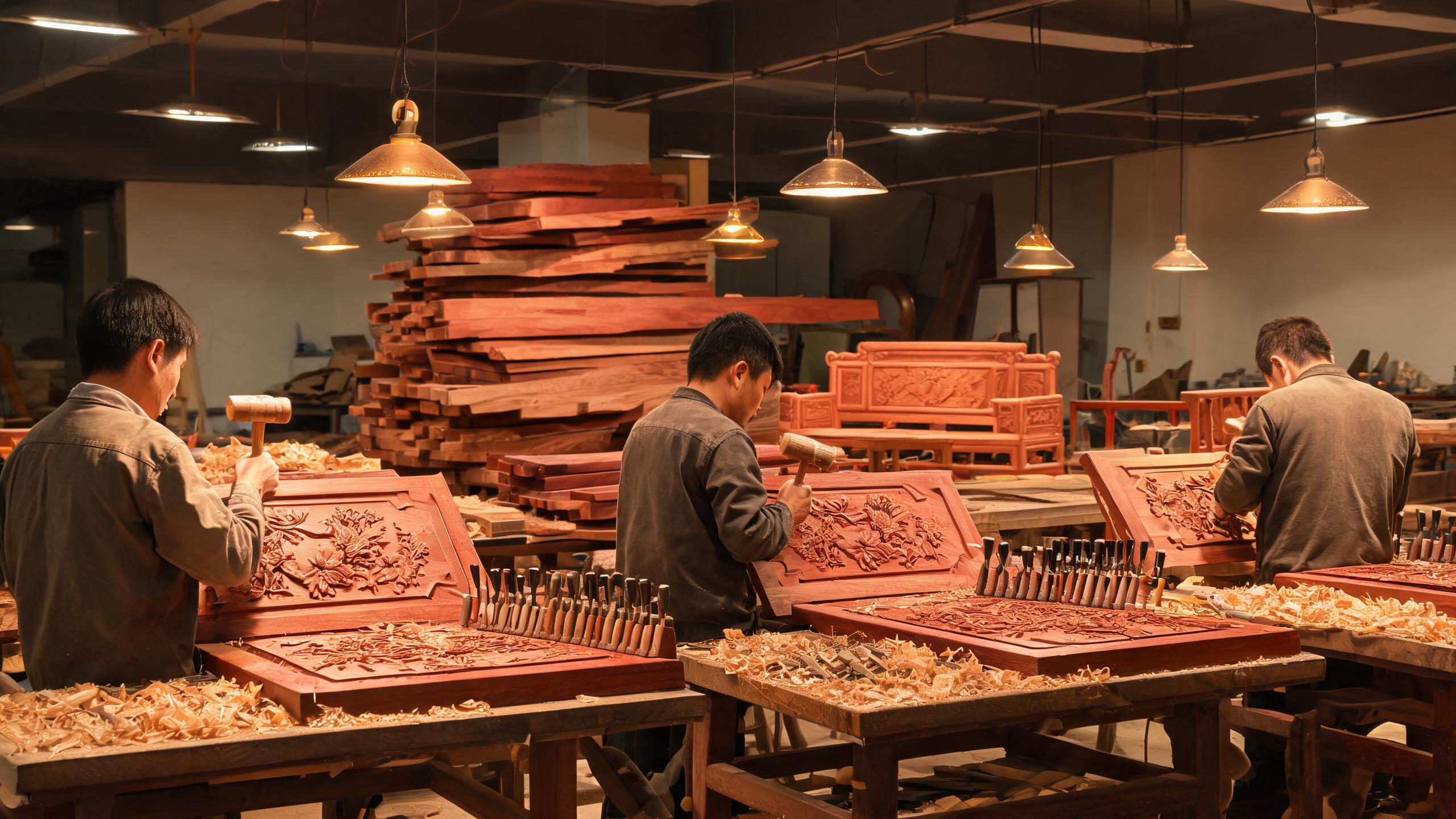
Panduan terperinci untuk pembeli antarabangsa tentang bagaimana set sofa kayu merah ukiran menggabungkan kemahiran ukiran tangan dengan sambungan tanggam dan duri, merangkumi pemilihan spesies kayu, kaedah pemeriksaan kualiti, pembungkusan eksport, dan apa yang menjadikan perabot klasik ini bernilai pelaburan.
What Makes a Carved Rosewood Sofa Set Worth the Investment for International Buyers?
A carved rosewood sofa set is not simply a seating arrangement. It is a statement piece that combines functional furniture with centuries of Chinese carving craftsmanship. For European and North American buyers sourcing classical furniture from China, understanding how these sets are made, what joinery techniques hold them together, and what quality markers to look for is essential to making a sound procurement decision. A well-made rosewood sofa set can serve a hotel lobby, a luxury villa, or a high-end showroom for decades without structural failure, provided the buyer knows how to evaluate the product before placing an order.
The value of a carved rosewood sofa set comes from three converging factors: the density and durability of the redwood material, the precision of the mortise and tenon joinery that holds the frame together without metal fasteners, and the depth and detail of the hand carving that decorates the back panels, armrests, and aprons. Each of these elements must meet export-grade standards for the furniture to perform in heated European homes and air-conditioned North American buildings.
How Does Hand Carving Transform a Rosewood Sofa Set?
Carving craftsmanship is the single most visible differentiator between a mass-produced sofa and an authentic carved rosewood sofa set. In the Xianyou production cluster, where Yunxiao Furniture is located, hand carving is performed by artisans who have trained for years in traditional relief techniques. The process begins with a design template drawn on the redwood panel, followed by roughing out the background with chisels and mallets, and finishing with fine detail work using small gouges and knives.
There are three levels of carving depth that buyers should understand. Shallow relief carving removes 2 to 3 millimeters of wood to create a pattern that is slightly raised from the surface. This is the most economical option and is suitable for armrests and side panels. Medium relief carving removes 5 to 8 millimeters and creates a more pronounced three-dimensional effect, typically used for back panel centerpieces. Deep relief carving, also called round carving or sculpture carving, removes 15 millimeters or more and creates fully three-dimensional floral, bird, or landscape scenes that appear to grow out of the wood. Deep relief is the most labor-intensive and is usually reserved for the central back panel of premium sofa sets.
When evaluating carving craftsmanship, buyers should inspect the transitions between carved and uncarved areas. A skilled carver creates smooth transitions with no visible tool marks or flat spots. The carved surfaces should have consistent depth across the entire panel, and the details should be crisp and defined, not rounded or blurred. Machine-carved imitation furniture often has a uniform, mechanical look that lacks the subtle variation of hand-carved work.
Why Is Mortise and Tenon Joinery Critical for a Rosewood Sofa Set?
The structural integrity of a carved rosewood sofa set depends entirely on mortise and tenon joinery. Unlike modern furniture that relies on metal screws and brackets, classical furniture uses wood-to-wood connections that expand and contract at the same rate as the surrounding material. This is why 300-year-old Ming dynasty chairs remain structurally sound while 20-year-old screw-assembled furniture falls apart.
A rosewood sofa frame typically uses four types of mortise and tenon joinery. The through tenon connects the front legs to the seat frame, passing completely through the rail for maximum strength. The blind tenon connects the back legs to the side rails without being visible from the outside. The mitered tenon creates a seamless 45-degree corner at the top of the back panel. The floating tenon joins the armrest to the front and back posts where grain direction prevents a through tenon.
The critical quality metric for mortise and tenon joinery is the clearance between the tenon and the mortise. At Yunxiao, our standard clearance is 0.1 millimeters, which creates a joint that slides together with firm hand pressure but holds securely without adhesive. A clearance of 0.3 millimeters or more means the joint is loose and will rattle, while a clearance of less than 0.05 millimeters means the joint is too tight and may split the wood during assembly in a dry climate.
What Redwood Species Are Best Suited for Export Sofa Sets?
The choice of wood species affects both the cost and the rosewood furniture export compliance requirements. For carved rosewood sofa sets, the most common species are Machilus Nanmu, aged redwood, and Dalbergia species. Each has distinct characteristics that influence carving quality, structural performance, and documentation needs.
Machilus Nanmu is a non-CITES species native to southern China. It has a warm golden-brown color and a fine, even texture that takes carving detail well. It is the most cost-effective option for classical furniture and requires no CITES permits, making it ideal for buyers who want authentic craftsmanship without regulatory complexity. Its density of 0.55 to 0.65 g/cm3 is sufficient for structural furniture, though it is lighter than true rosewood.
Aged redwood refers to legally certified tropical hardwood that has been aged for 10 or more years. It has a deeper reddish-brown color and higher density, typically 0.70 to 0.85 g/cm3. The tighter grain holds carving detail with exceptional crispness and the natural oil content gives the surface a lustrous patina that deepens over time.
Dalbergia species such as Siamese rosewood are CITES Appendix II listed. They offer the highest density and the deepest red color, but require export and import CITES permits that add 15 to 20 working days to the production timeline. For rosewood furniture export to Europe and North America, buyers must weigh the aesthetic premium against the documentation cost and lead time.
How Should Buyers Quality Check a Carved Rosewood Sofa Set Before Export?
Before a carved rosewood sofa set leaves the factory, buyers should verify four quality dimensions. These checks protect against the most common defects that appear after the furniture arrives in a different climate.
Moisture content verification. Use a calibrated pin-type moisture meter to test at least five points on each piece: the center of the back panel, both armrest ends, a seat rail, and a leg. For European destinations, the target is 8 to 10 percent MC. For North America, 9 to 11 percent. Any reading above 12 percent for temperate-climate destinations indicates insufficient kiln drying and a high risk of cracking within 3 to 6 months.
Joinery integrity test. Place the assembled sofa on a flat surface and press down firmly on each corner of the seat frame in sequence. A well-constructed frame will not creak, click, or show any visible movement at the joint lines. If you hear clicking, a tenon is loose inside its mortise and the joint will fail prematurely.
Carving detail inspection. Examine the carved panels under raking light, holding a flashlight at a low angle to the surface. This reveals tool marks, flat spots, and inconsistent depth that are invisible under normal lighting. The carved details should be crisp and uniform, with smooth transitions between carved and uncarved areas.
Finish quality check. Run a clean white cloth over all surfaces, especially carved recesses. The cloth should pick up no color, which confirms the finish is fully cured. Check for blistering, clouding, or orange-peel texture, which indicate that the finish was applied to wood that was not properly dried or that the application environment was too humid.
What Are the Export Packaging and Shipping Considerations?
A carved rosewood sofa set requires specialized rosewood furniture export packaging to survive the 30 to 45 day ocean transit from Xiamen to European or North American ports. The standard protocol uses four layers of protection. A foam wrap directly on the surface prevents abrasion. VCI anti-corrosion paper inhibits mold growth. A corrugated carton or wooden crate provides structural protection with corner protectors at every vertical edge. Silica gel desiccant bags at 1 gram per liter of crate volume absorb residual moisture.
All wooden crate material must be ISPM 15 heat-treated and stamped with the IPPC mark. Non-compliant packaging can result in the shipment being refused entry at European or North American customs. For carved sofa sets, the crate must provide a minimum 50-millimeter gap between the furniture and the crate interior, filled with foam blocks, to ensure that carved surfaces are not crushed by crate movement during transit.
Container loading requires careful weight distribution. A 7-piece carved rosewood sofa set can weigh 600 kilograms or more. Heavy pieces like the main sofa frame should be placed in the center of the container, with lighter pieces like side tables toward the doors. Cargo straps rated for 2,000 kilograms breaking strength must be anchored to the container lashing points to prevent any movement during the ocean voyage.
How Does Yunxiao Ensure Quality for Carved Rosewood Sofa Sets?
At Yunxiao Rosewood Furniture, every carved rosewood sofa set is produced through a controlled process that begins with 36-day kiln drying to achieve 8 to 10 percent moisture content for European orders and 9 to 11 percent for North American orders. Our carving craftsmanship is executed by artisans trained in the Xianyou tradition, using a combination of hand tools and precision machinery to achieve both dimensional accuracy and artistic detail.
Our mortise and tenon joinery is cut to a 0.1-millimeter clearance standard and every piece is fully assembled in the factory before disassembly for flat-pack shipping. This allows us to verify that every joint fits correctly and that the frame is square and level before it goes into a container. We provide kiln drying records, full-set assembly photos, and wood species test reports as part of our standard documentation package.
We offer OEM and ODM customization of dimensions, carving patterns, and wood species to meet the specific requirements of hotels, resorts, and retail buyers across Europe, North America, Australia, and Southeast Asia. Our standard lead time is 45 to 60 working days from deposit to container loading, with partial shipment available for long-term partners. This commitment to classical furniture quality and export documentation is why our carved rosewood sofa sets consistently perform in diverse international climates.