
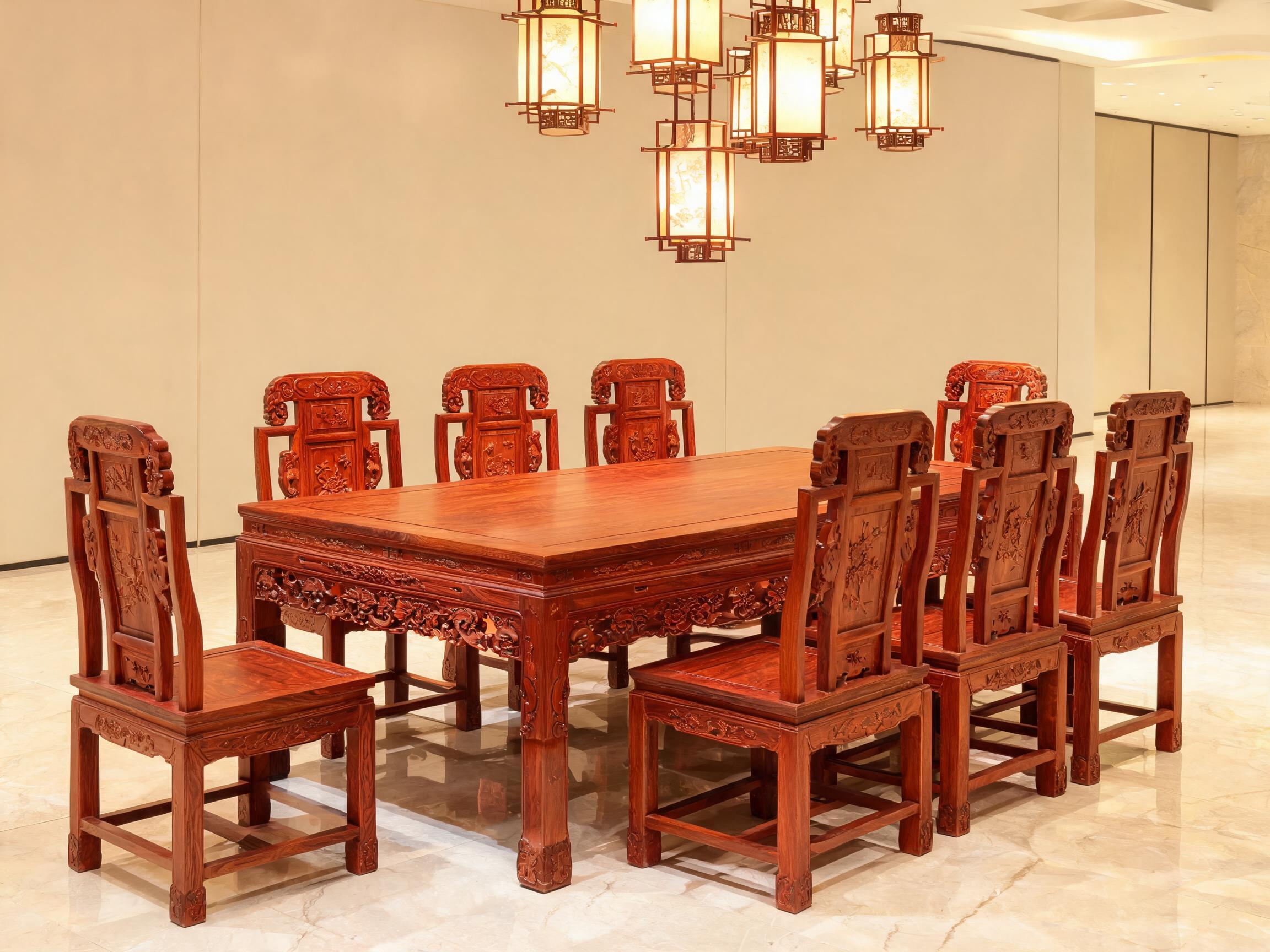
Panduan pembeli yang komprehensif tentang cara memilih set makan kayu merah yang tepat untuk eksport ke pasaran Eropah dan Amerika Utara, merangkumi pemilihan spesies kayu, piawaian pengeringan tanur, sambungan tanggam dan duri, penilaian kualiti ukiran, pematuhan kemasan, dan kaedah pengesahan pembekal.
Why Is Selecting the Right Redwood Dining Set Critical for International Buyers?
When international buyers source a redwood dining set from China, the decision extends far beyond aesthetics. A dining set is one of the most frequently used furniture pieces in any household or hospitality setting, and the wrong choice can lead to cracking joints, warped tabletops, and customer complaints within months of delivery. For European buyers and North American importers, the selection process must account for climate adaptation, structural durability, wood species compliance, and carving quality, all of which determine whether the furniture will perform in heated European homes and air-conditioned North American buildings.
The challenge is that not all redwood dining sets are created equal. A set produced for the domestic Chinese market may use wood dried to 14 percent moisture content, which is acceptable in humid southern China but will crack within months in a dry Berlin apartment or a heated Toronto home. A set built for export must meet stricter standards at every stage of production, from timber selection through kiln drying, joinery, carving, and finishing. Understanding these differences is the first step in making a procurement decision that protects your investment and your reputation.
What Redwood Species Should You Choose for a Dining Set?
The choice of wood species affects cost, appearance, durability, and regulatory compliance. For a redwood dining set destined for export, three species categories are commonly available, each with distinct trade-offs.
Machilus Nanmu is a non-CITES species native to southern China. It has a warm golden-brown color and a fine, even texture that takes carving detail well. With a density of 0.55 to 0.65 g/cm3, it is structurally sufficient for dining furniture and does not require CITES permits, making it the most cost-effective option for buyers who want authentic craftsmanship without regulatory complexity. This species is ideal for mid-range dining sets targeting retail customers who appreciate traditional Chinese design without the premium price tag.
Aged redwood refers to legally certified tropical hardwood aged for 10 or more years. It has a deeper reddish-brown color and higher density, typically 0.70 to 0.85 g/cm3. The tighter grain holds carving detail with exceptional crispness, and the natural oil content gives the surface a lustrous patina that deepens over time. This species is the most popular choice for export dining sets because it offers a balance of beauty, durability, and regulatory simplicity.
Dalbergia species such as Siamese rosewood offer the highest density and the deepest red color, but they are CITES Appendix II listed. All international trade requires export and import CITES permits that add 15 to 20 working days to the production timeline. Buyers must weigh the aesthetic premium against the documentation cost and extended lead time.
How Does Kiln Drying Affect Dining Set Performance?
Kiln drying is the single most important quality control step in dining set production. Freshly harvested redwood contains moisture content of 30 percent or higher. If this wood is crafted into furniture without proper drying, it will warp, crack, and lose structural integrity as it adjusts to drier indoor environments in Europe and North America.
A proper drying cycle for dense hardwoods takes a minimum of 15 to 36 days, depending on plank thickness. The process follows four phases: pre-conditioning at 40 degrees Celsius to prevent surface checking, main drying at 55 to 65 degrees Celsius with progressively reduced humidity, equalizing to achieve a moisture gradient of no more than 2 percent between surface and core, and conditioning to relieve drying stresses.
The target moisture content depends on the destination market. For Northern Europe, where indoor heating drives relative humidity down to 30 percent in winter, the target is 8 to 10 percent. For North America, where air-conditioned homes maintain 35 to 45 percent relative humidity year-round, 9 to 11 percent is ideal. Any reading above 12 percent for temperate-climate destinations indicates insufficient drying and a high risk of cracking within 3 to 6 months.
Buyers should request kiln drying records that show the temperature curve, humidity settings, and moisture content readings taken at intervals throughout the cycle. A factory that only air-dries its timber is not producing furniture suitable for export to climates with low indoor humidity. No amount of carving detail or finish quality can compensate for wood that was not dried correctly.
What Joinery Techniques Ensure Dining Set Durability?
The structural integrity of a redwood dining set depends on mortise and tenon joinery. Unlike modern furniture that relies on metal screws and brackets, classical Chinese furniture uses wood-to-wood connections that expand and contract at the same rate as the surrounding material. This is why 300-year-old Ming dynasty tables remain structurally sound while 20-year-old screw-assembled furniture falls apart.
A dining set frame typically uses four joint types. The through tenon connects the table legs to the apron, passing completely through the rail for maximum strength. The blind tenon connects chair legs to seat frames without being visible from outside. The mitered tenon creates a seamless 45-degree corner at the top of chair back panels. The floating tenon joins chair stretchers where grain direction prevents a through tenon.
The critical quality metric is the clearance between tenon and mortise. A clearance of 0.1 millimeters creates a joint that slides together with firm hand pressure but holds securely without adhesive. A clearance of 0.3 millimeters or more means the joint is loose and will rattle. Buyers can test this by placing an assembled chair on a flat surface and gently rocking it diagonally. A well-constructed chair will not creak, click, or show any visible movement at the joint lines.
How Do You Evaluate Carving Quality on a Dining Set?
Carving is the most visible differentiator between a mass-produced dining set and an authentic hand-carved piece. Buyers should understand three levels of carving depth. Shallow relief carving removes 2 to 3 millimeters of wood for a slightly raised pattern, suitable for chair armrests and side panels. Medium relief carving removes 5 to 8 millimeters for a pronounced three-dimensional effect, typically used for chair back centerpieces. Deep relief carving removes 15 millimeters or more for fully three-dimensional floral and landscape scenes, usually reserved for the central back panel of premium chairs.
When evaluating carving detail, inspect transitions between carved and uncarved areas. A skilled carver creates smooth transitions with no visible tool marks or flat spots. Carved surfaces should have consistent depth across the entire panel, and details should be crisp and defined, not rounded or blurred. Examine carved panels under raking light by holding a flashlight at a low angle to the surface. This reveals tool marks, flat spots, and inconsistent depth that are invisible under normal lighting.
Buyers should also check whether the carving is genuinely hand-done or machine-carved. Hand-carved panels have subtle variations in depth and tool marks that reflect the individual artisan skill. Machine-carved panels have a uniform, mechanical precision that lacks organic quality. Place two supposedly identical chair backs side by side. If they are pixel-perfect identical, they are machine-carved. Hand-carved panels will have slight, natural variations.
What Finish Standards Should Export Dining Sets Meet?
The surface finish on a redwood dining set serves both aesthetic and protective functions. Traditional beeswax and lacquer finishes enhance the natural wood grain while providing a moisture barrier. For export to Europe and North America, the finish must comply with EU REACH and US CARB Phase 2 standards, which regulate formaldehyde and volatile organic compound emissions.
Run a clean white cloth over all surfaces, especially carved recesses. The cloth should pick up no color, confirming the finish is fully cured. Check for blistering, clouding, or orange-peel texture, which indicate that the finish was applied to improperly dried wood or in an environment that was too humid. A properly finished surface should feel smooth and warm to the touch, with a consistent sheen across the entire piece.
How Does Yunxiao Ensure Export-Grade Dining Set Quality?
At Yunxiao Rosewood Furniture, every redwood dining set is produced through a controlled process that begins with 36-day kiln drying to achieve 8 to 10 percent moisture content for European orders and 9 to 11 percent for North American orders. Our carving is executed by artisans trained in the Xianyou tradition, using hand tools for all carving work from rough background removal to fine detail finishing.
Our mortise and tenon joinery is cut to a 0.1-millimeter clearance standard, and every piece is fully assembled in the factory before disassembly for flat-pack shipping. This allows us to verify that every joint fits correctly and that the set is square and level before it goes into a container. We provide kiln drying records, full-set assembly photos, and wood species test reports as part of our standard documentation package.
We offer OEM and ODM customization of dimensions, carving patterns, and wood species to meet the specific requirements of hotels, resorts, and retail buyers across Europe, North America, Australia, and Southeast Asia. Our standard lead time is 45 to 60 working days from deposit to container loading, with partial shipment available for long-term partners. This comprehensive approach to timber selection, drying, joinery, carving, and finishing is why our dining sets consistently perform in diverse international climates.