
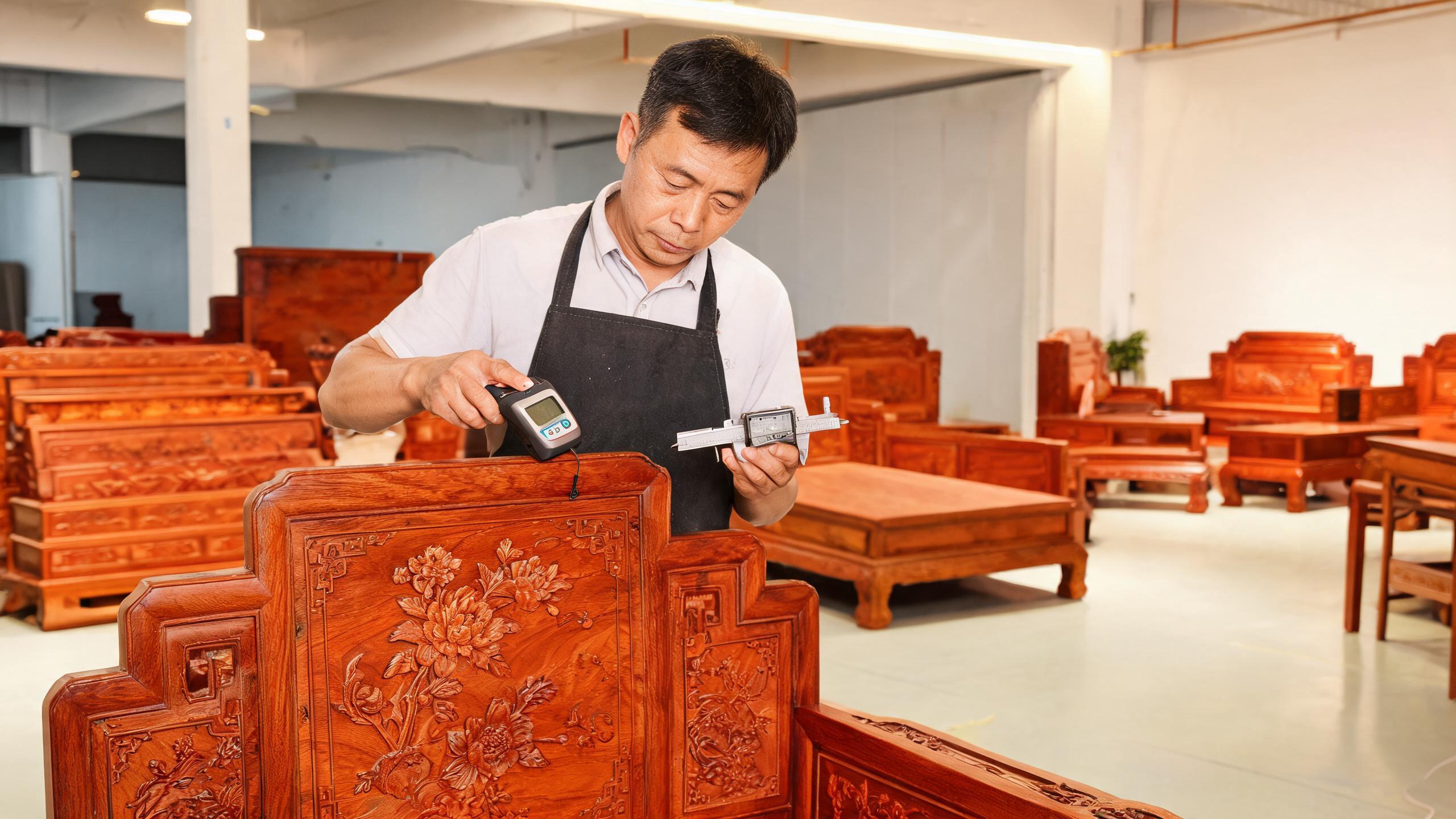
Penerangan terperinci tentang sistem kawalan kualiti tujuh peringkat Yunxiao Rosewood Furniture yang merangkumi pemilihan kayu mentah, pengesahan pengeringan kiln, pemeriksaan mortise dan tenon, penilaian ukiran tangan, ujian pematuhan kemasan, pemeriksaan pemasangan set penuh, dan penyeliaan pembungkusan eksport untuk pembeli B2B antarabangsa.
Company News · Quality Control System
For international B2B buyers sourcing rosewood furniture quality control is not a slogan but a measurable system of checkpoints, documentation, and accountability. When a European wholesaler or a North American hospitality procurement team places a container order for classical furniture inspection standards, they need assurance that every piece arrives in the same condition as the approved sample. At Yunxiao Rosewood Furniture Co., Ltd, we operate a seven-stage quality control system across our 19-product catalogue, covering every phase from raw timber selection to final container loading. This article walks through each stage in detail, explains what documentation buyers receive, and shows how our QC process aligns with international compliance requirements.
Why Does Quality Control Matter More Than Price in B2B Furniture Sourcing?
In B2B furniture sourcing, the true cost of a furniture order is not the unit price quoted by the factory. It is the unit price plus the cost of returns, warranty claims, reputation damage, and lost customers caused by defective products. A container of solid wood furniture manufacturing defects, such as cracked tabletops, warped panels, loose joints, or finish blemishes, can cost a buyer 15,000 to 40,000 USD in losses, not counting the intangible damage to their brand. This is why experienced importers treat quality control as the primary evaluation criterion when selecting a Chinese rosewood furniture factory, ranking it above price, lead time, and even customization flexibility.
Quality control in rosewood furniture is particularly complex because the material itself is living wood. Unlike metal or plastic furniture, solid redwood expands, contracts, and breathes with changes in temperature and humidity. A sofa frame that is perfectly square in a Fujian workshop at 70 percent humidity can develop joint gaps in a heated Berlin apartment at 25 percent humidity if the wood was not properly dried. This means quality control must address not only visible defects at the time of production but also latent defects that may appear months after delivery. Our seven-stage QC system is designed to catch both categories of risk before the furniture leaves the factory.
Stage 1: Raw Timber Selection and Species Verification
Quality control begins before any cutting or carving starts. Our timber procurement team inspects every shipment of raw wood that arrives at our 12,000-square-meter factory in Xianyou County, Putian City, Fujian Province. The first check is visual: examining the grain pattern, color consistency, and density of each plank to confirm it matches the ordered species. For legally certified Machilus Nanmu, aged redwood, and Grade-A tropical hardwood, we verify that the supplier documentation, including harvest permits and origin certificates, matches the physical wood.
For CITES-listed species such as Siamese rosewood (Dalbergia cochinchinensis), we cross-check the CITES export permit number against the Chinese CITES Management Authority database. Any discrepancy in species name, quantity, or permit validity results in the entire batch being quarantined until the issue is resolved. This is the foundation of rosewood furniture quality control because no amount of downstream craftsmanship can compensate for raw material that is misidentified, illegally sourced, or substituted with a cheaper lookalike species.
Each accepted timber batch is assigned a tracking number that follows it through every subsequent production stage. This tracking number appears on the kiln drying log, the production batch record, and the final product specification sheet, giving buyers full traceability from forest to factory to container.
Stage 2: Kiln Drying Verification and Moisture Content Control
Kiln drying is the single most critical quality determinant for export-grade solid wood furniture manufacturing. Timber that is not dried to the correct moisture content will warp, crack, or develop joint failures after shipping to a different climate zone. Our standard drying cycle runs 36 days in a constant-humidity kiln, bringing the moisture content down to 8 to 10 percent for European destinations and 9 to 11 percent for North American orders.
After the drying cycle is complete, our QC team tests every batch using calibrated pin-type moisture meters. Each plank is tested at no fewer than five points: both end-grain surfaces, the center of the board, and two intermediate points. The readings are recorded on the kiln drying log along with the temperature curve, humidity settings, and duration. Any plank that reads above 12 percent moisture content for temperate-climate destinations is returned to the kiln for an additional equalizing cycle.
Buyers can request these kiln drying records as part of their documentation package. The log shows the complete drying history of the timber used in their order, providing verifiable evidence that the wood was properly conditioned for the destination climate. This level of classical furniture inspection transparency is what separates a manufacturer that builds for long-term use from one that simply ships product and hopes for the best.
Stage 3: Mortise and Tenon Joinery Precision Check
All our furniture is assembled using traditional mortise and tenon joinery, a nail-free construction method that allows the wood to expand and contract naturally without loosening joints. But mortise and tenon is only effective when the joint is cut to the correct clearance. Our standard clearance between tenon and mortise is 0.1 millimeters, which creates a joint that slides together with firm hand pressure but holds securely without adhesive.
Our QC team checks joinery precision at three points during production. First, after the initial machine cutting, a sample of tenons and mortises is measured with digital calipers to verify dimensional accuracy. Second, during assembly, each joint is test-fitted dry, without glue, to confirm the friction hold. A joint that is too loose, meaning the tenon falls out of the mortise under its own weight, is rejected and recut. A joint that is too tight, meaning it requires a mallet strike to assemble, is also rejected because it may split the wood in a dry climate.
Third, after full assembly, every piece is placed on a flat surface and tested with the rock test. The inspector presses down firmly on each corner in sequence. Any clicking, creaking, or visible movement at the joint lines signals a loose fit that must be corrected before the piece proceeds to the carving and finishing stages. This mortise and tenon inspection protocol ensures that every sofa, dining table, and bedroom piece meets the same structural standard.
Stage 4: Hand Carving Quality Assessment
Hand carving is the most visible differentiator between mass-produced furniture and authentic Chinese rosewood furniture factory craftsmanship. Our master carvers, trained in the Xianyou tradition, use traditional hand tools including flat chisels, gouges, V-parting tools, and detail knives to create dragon motifs, cloud patterns, lattice designs, and floral scenes on furniture surfaces. But hand carving is also the most difficult stage to standardize, because each carver brings individual variations in depth, pressure, and tool angle.
To maintain consistency across a multi-piece order, our QC team inspects carved panels under raking light, holding a flashlight at a low angle to the surface. This reveals tool marks, flat spots, inconsistent depth, and transitions between carved and uncarved areas that are invisible under normal lighting. The inspector checks that the carved depth is consistent across the panel, that details are crisp and defined, and that transitions are smooth with no visible flat spots or geometric shoulders that indicate machine carving.
For repeating motifs across multiple pieces in the same set, such as chair back panels in a 10-seat dining set, the inspector compares two panels side by side to verify that they are similar but not pixel-perfect identical. Perfect identical panels would indicate CNC machine carving, not hand carving. This hand carving quality check ensures that every piece carries the authentic variation of individual artisan work.
Stage 5: Surface Finishing and Compliance Testing
The surface finish on rosewood furniture serves both aesthetic and protective functions. We apply a multi-coat hand-rubbed raw lacquer and eco-friendly beeswax finish that meets EU REACH and US CARB Phase 2 standards. Each lacquer coat is cured for 24 hours and hand-rubbed with pumice stone, producing a breathable, food-safe satin sheen that penetrates the wood rather than sitting on the surface like polyurethane.
Our finishing QC protocol includes three checks. First, the inspector runs a clean white cloth over all surfaces, especially carved recesses, to verify that no color transfers, confirming the finish is fully cured. Second, the inspector examines the surface under direct light for blistering, clouding, or orange-peel texture, which indicate that the finish was applied to improperly dried wood or in an environment that was too humid. Third, for orders requiring compliance documentation, we provide VOC emissions test reports from accredited laboratories, valid for one year, confirming that the finish meets the formaldehyde and volatile organic compound limits for the destination market.
For buyers who need FSC certified furniture documentation, we maintain Forest Stewardship Council chain-of-custody certification for select product lines and can provide the certificate number for verification on the FSC International database. This compliance layer is an integral part of our quality control system, not a separate afterthought.
Stage 6: Full-Set Assembly and Pre-Packaging Inspection
Before any piece is disassembled for flat-pack shipping, our QC team conducts a full-set assembly inspection. Every sofa set, dining set, and bedroom suite is fully assembled in the factory, arranged as it would appear in the buyer showroom or project site, and inspected as a complete collection. This is where we catch issues that only become visible when multiple pieces are placed together: color mismatches between chairs and tables, proportion imbalances within a set, and carving inconsistencies across matching panels.
The inspector photographs the fully assembled set from multiple angles under daylight conditions. These photos serve two purposes: they provide the buyer with pre-shipment visual confirmation of the order, and they create a permanent record that can be referenced if any post-delivery dispute arises. The buyer receives these assembly photos before the furniture is disassembled and packed, giving them the opportunity to raise concerns before the container leaves the factory.
During this inspection, the QC team also verifies dimensional accuracy against the approved production drawings. Every critical dimension, such as table height, chair seat height, sofa overall length, and wardrobe interior depth, is measured and recorded. Any deviation exceeding the tolerance specified in the production drawing, typically plus or minus 3 millimeters for standard pieces, triggers a rework before the piece is approved for packaging.
Stage 7: Export Packaging and Container Loading Supervision
The final quality control stage protects the furniture during the 30 to 45 day ocean transit from Xiamen port to European or North American destinations. Our four-layer packaging system begins with a foam wrap directly on the furniture surface to prevent abrasion. A VCI anti-corrosion paper layer inhibits mold growth and prevents moisture from penetrating the finish. A corrugated carton or ISPM 15 heat-treated wooden crate provides structural protection with corner protectors at every vertical edge. Silica gel desiccant bags are placed at 1 gram per liter of crate volume to absorb residual moisture.
Our QC team inspects every crate before it enters the container. The inspector verifies that the ISPM 15 IPPC stamp is visible and legible on the wooden crate material, that the corner protectors are in place, and that the minimum 50-millimeter gap between the furniture and the crate interior is filled with foam blocks. For carved pieces, the inspector confirms that the foam conforms to the carved contours without compressing the details.
During container loading, our team supervises the entire process. Weight is distributed evenly across the container floor, with heavy pieces in the center and lighter pieces toward the doors. Crates are stacked no more than two layers high, separated by timber dunnage. Cargo straps rated for 2,000 kilograms breaking strength are anchored to the container lashing points. The container interior is photographed at three stages: one-third loaded, two-thirds loaded, and fully loaded before the doors close. These photos, along with the condition report signed by the loading supervisor, are provided to the buyer as part of the shipping documentation.
Documentation Package Included With Every Container Order
Our quality control system generates a documentation package that accompanies every container shipment. This package includes:
- Kiln drying records showing the 36-day temperature curve, humidity settings, and moisture content readings for each timber batch used in the order.
- Full-set assembly photos taken under daylight conditions before disassembly for packaging, showing every piece in the order from multiple angles.
- Wood species test reports from recognized laboratories confirming the scientific identity of the timber, available for high-value orders where species authenticity is contractually guaranteed.
- FSC chain-of-custody certificate for orders requiring certified timber, with the certificate number verifiable on the FSC International database.
- VOC emissions test report from an accredited laboratory confirming compliance with EU REACH and US CARB Phase 2 standards, valid for one year.
- CITES export permit for orders containing Dalbergia species, with the permit number cross-checked against the Chinese CITES Management Authority database.
- ISPM 15 compliance documentation confirming that all wooden packaging material has been heat-treated and stamped with the IPPC mark.
- Container loading photos taken at three stages during loading, along with a condition report signed by the loading supervisor.
How Does Our QC System Handle Custom OEM and ODM Orders?
For buyers who request export furniture quality customization through OEM or ODM collaboration, our QC system adapts to the specific requirements of each project. When a buyer provides custom dimensions, carving patterns, or finish specifications, our engineering team creates detailed production drawings that specify every dimension, joinery method, carving motif reference, finish formula, and packaging configuration. These drawings become the single source of truth for the production team and the QC inspectors.
For repeating carving motifs across large OEM orders, we create master templates that guide every carver to produce consistent depth, proportion, and detail. This is especially important when multiple carvers work on the same design simultaneously. The QC team uses these master templates as the reference standard during the carving inspection stage, ensuring that every piece in a 50-unit or 100-unit order meets the same visual standard as the approved prototype.
For custom finish colors, our finishing team adjusts the stain and lacquer application to achieve the buyer specified color target. Because natural wood varies in color, the team works in small batches, verifying each batch against the approved finish sample before proceeding. The QC inspector checks finish consistency by comparing each piece against the sample under standardized lighting conditions, flagging any piece that deviates from the approved color target.
What Happens When a Piece Fails Quality Control?
A piece that fails any QC checkpoint is immediately removed from the production line and tagged with a red rejection tag. The tag identifies the stage where the failure was detected, the nature of the defect, and the corrective action required. The piece is then routed to the appropriate rework station, whether that is the kiln for additional drying, the joinery shop for recutting, the carving workshop for detail correction, or the finishing room for re-sanding and re-coating.
After rework is complete, the piece re-enters the QC pipeline at the stage where it originally failed. It must pass the same inspection criteria as a new piece. If a piece fails the same checkpoint twice, it is permanently rejected and a replacement piece is started from raw material. This zero-tolerance policy for repeated defects is what ensures that the furniture arriving at the buyer warehouse meets the same standard as the prototype that was approved during the order confirmation process.
Our rejection rate, tracked monthly across all 19 products in our catalogue, consistently runs below 3 percent at the final inspection stage. This means that over 97 percent of pieces pass all seven QC stages on the first attempt. The rejection rate data is available to buyers upon request, providing a quantitative measure of our manufacturing consistency.
How Does Yunxiao Continuously Improve Its Quality Control System?
Quality control is not a static system. We review our QC protocols quarterly, analyzing rejection rate data, buyer feedback, and post-delivery issue reports to identify areas for improvement. When a buyer reports a post-delivery issue, such as a hairline crack or a finish blemish, our team traces the issue back through the production records to identify which QC checkpoint should have caught it. The protocol is then updated to include a more rigorous check at that stage.
For example, several years ago we noticed a pattern of hairline cracks appearing on the end-grain surfaces of dining tabletops shipped to Northern Europe during winter. Our analysis traced the issue to insufficient equalizing time during the kiln drying cycle. We extended the equalizing phase from 5 days to 7 days, and the incidence of end-grain cracking dropped to near zero. This kind of data-driven continuous improvement is what keeps our quality control system effective as we expand our product range and enter new markets.
We also invest in QC team training. Our inspectors attend annual training sessions on the latest international compliance standards, including updates to EU REACH, US CARB, and CITES regulations. This ensures that our QC system evolves in step with the regulatory landscape, not behind it. For B2B furniture sourcing partners, this means that the documentation and compliance support we provide today will remain current as regulations tighten in the years ahead.
Conclusion: Quality Control as the Foundation of Long-Term B2B Partnerships
For international buyers, selecting a Chinese rosewood furniture manufacturer is ultimately a decision about trust. The factory that can demonstrate a systematic, documented, and continuously improving quality control process is the factory that will deliver consistent products order after order, year after year. Yunxiao Rosewood Furniture Co., Ltd, with its seven-stage QC system, 12,000-square-meter integrated factory in Xianyou, 36-day kiln drying protocol, 0.1-millimeter joinery clearance standard, hand carving inspection under raking light, multi-coat finish compliance testing, full-set assembly verification, and supervised container loading, provides the level of manufacturing accountability that serious B2B buyers require.
If you are planning a furniture sourcing project and would like to discuss our quality control process, request kiln drying records, or arrange a factory tour, visit our website or contact our export team directly. We welcome both new and experienced buyers to evaluate our capabilities firsthand and build a sourcing partnership grounded in transparency, documentation, and measurable quality.