
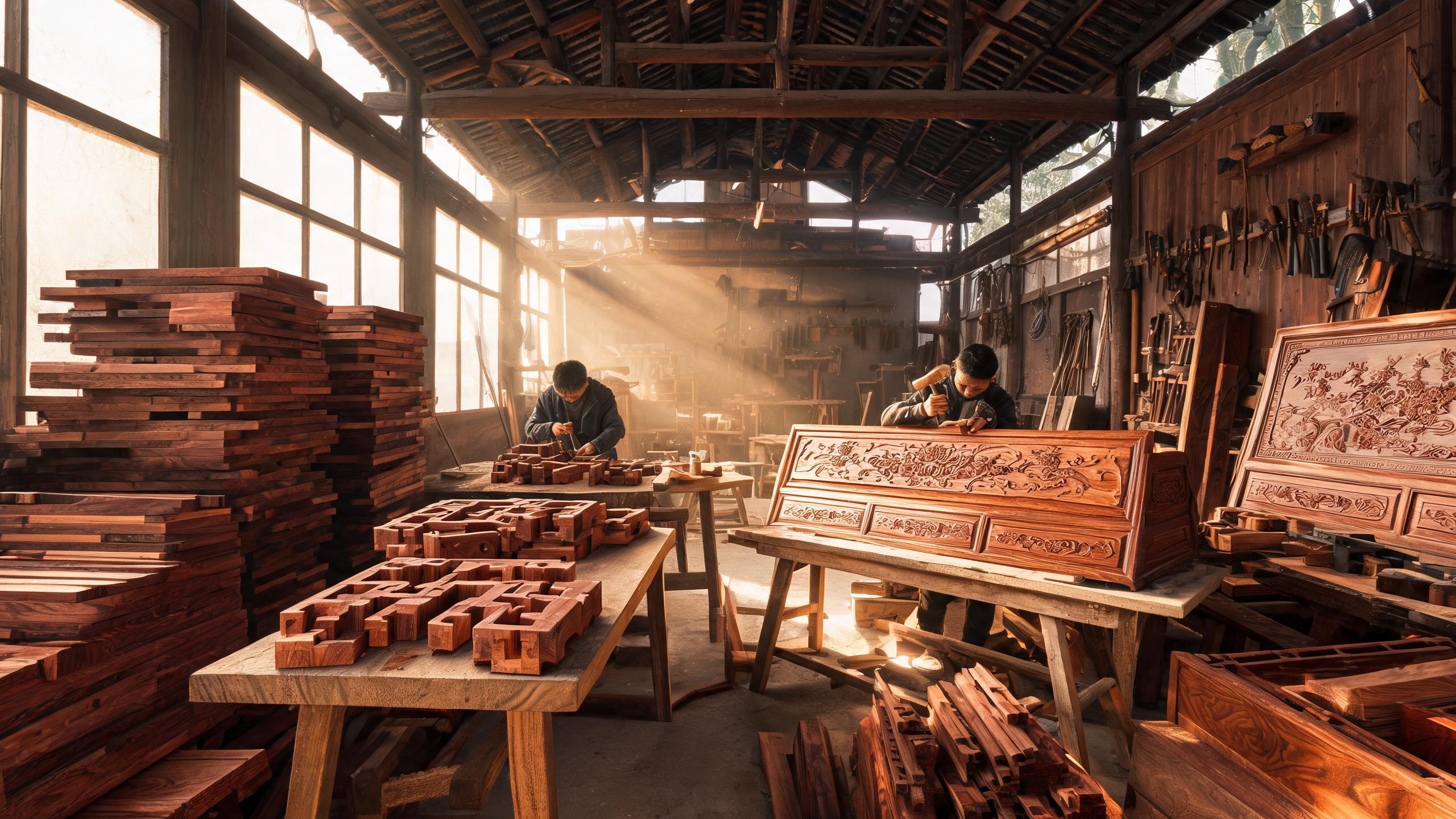
Perabot rosewood tersuai biasanya mengambil masa 45–60 hari bekerja dalam pengeluaran selepas deposit untuk pesanan kontena, ditambah masa pengangkutan laut. Panduan ini menerangkan setiap peringkat — pemilihan kayu, pengeringan, sambungan kayu, ukiran, kemasan, pembungkusan eksport dan penghantaran — supaya pembeli B2B dapat merancang kalendar penghantaran yang realistik.
When a wholesaler, hotel group or interior design firm decides to order custom rosewood furniture from China, the first question after price is almost always the same: how long will it take? Unlike flat-pack or stock furniture, classical solid wood furniture is not pulled from a warehouse shelf. It is made to order, from seasoned timber, by hand, in stages that cannot be safely compressed without risking the quality of the finished piece.
This guide walks through every stage of a typical custom rosewood furniture order — from timber selection and drying to carving, finishing, export packing and ocean freight — and explains what actually determines the production lead time. The figures used here reflect the real working practices of a classical redwood furniture factory in Xianyou County, Fujian, including Yunxiao Rosewood Furniture Co., Ltd, a manufacturer and exporter of full sets of classical solid redwood furniture since 2008. If you are planning a hotel project, a retail season or a villa development, this is the calendar you need to build backwards from.
Why Lead Time Matters More for Solid Wood Furniture Than for Any Other Category
Buyers who are new to Chinese classical furniture often underestimate how different solid wood furniture is from veneered or engineered-wood products. A veneered cabinet can be cut, edged and packed in days. Solid rosewood cannot, for three reasons.
First, the material itself is the product. Genuine rosewood species such as Siamese rosewood (Dalbergia cochinchinensis) are dense tropical hardwoods. If timber is worked before its internal moisture has stabilized, the finished piece will crack, warp or open at the joints after it arrives in a drier or more humid climate than the factory's. No amount of careful joinery can rescue wood that was rushed.
Second, the construction method is unforgiving. Classical Chinese furniture is assembled with mortise-and-tenon joinery — often reinforced with bamboo dowel pins and containing zero metal fasteners in the primary frame. Every joint must be cut precisely, fitted by hand and checked under dry assembly before finishing. This is slower than screwing panels together, and it is the reason a well-made rosewood sofa set survives decades of use and international shipping.
Third, the finish is built in layers. Traditional raw lacquer finishing on a quality set is applied coat by coat — commonly six to nine coats — with each coat cured for around 24 hours and hand-rubbed before the next. The finishing schedule alone consumes weeks of the production calendar, and it cannot be parallelized the way machining can.
Understanding these three constraints explains why a realistic lead time for a container order of custom rosewood furniture is measured in months, not weeks — and why a supplier who promises an implausibly short delivery is usually cutting one of these corners.
The Short Answer: Typical Lead Times for Custom Rosewood Furniture
For a standard container order of classical rosewood furniture sets — carved sofa sets with tea tables, 6–12-seat dining sets, or complete bedroom suites — a realistic total timeline looks like this:
- Production after deposit: 45–60 working days for container orders, which is roughly two to three calendar months depending on holidays and order complexity.
- Ocean freight: 15–40 days depending on destination — Southeast Asian ports are fastest, while North America, Europe and Australia typically take four to six weeks door-to-port.
- Customs clearance and inland delivery: 3–10 days depending on the destination country's import procedures for wooden articles.
Smaller orders move faster. A trial single set or a sample order can often be completed and shipped well within the container-order window, because it occupies less carving and finishing capacity. Many manufacturers, including Yunxiao, offer trial single sets and refundable samples precisely so buyers can verify quality before committing to a full container.
Highly customized projects — a whole-house furniture package with bespoke sizes, non-standard carving patterns, or a hotel lobby program with dozens of matching pieces — sit at the top of the range and sometimes beyond it, because design approval and pattern development add their own stage before production begins.
Stage 1: Timber Selection and Compliance Documentation
Every credible rosewood furniture order starts with the timber, and the paperwork around it. Reputable manufacturers work with legally certified materials — typically Machilus Nanmu, aged red wood and Grade-A tropical hardwood — and hold documentation such as FSC chain-of-custody certificates and CITES export permits for the relevant species.
For the buyer, this stage matters for two reasons. First, species selection affects both price and lead time: premium Siamese rosewood in large, clean boards is scarcer than plantation-grown alternatives, and sourcing the right grade of timber for a large order can take time. Second, compliance documents must be prepared before shipment, not after. A set bound for the European Union or the United States needs documentation consistent with the EU Timber Regulation and the US Lacey Act, and a factory that prepares full export documents in-house removes weeks of potential delay from your timeline.
What buyers should do at this stage: confirm the species in writing, ask which compliance documents accompany the shipment, and verify that the factory's timber is conditioned — not merely purchased — before production starts.
Stage 2: Drying and Moisture Conditioning — The Stage Nobody Sees
The least visible stage of production is also the one that most determines whether your furniture survives its destination climate. At Yunxiao, each product receives 36 days of constant-humidity drying before work begins, and timber is conditioned to below 14% moisture content for cross-climate stability.
Why does this matter so much? Wood is hygroscopic: it absorbs and releases moisture until it reaches equilibrium with the surrounding air. Timber dried for a humid southern-Chinese workshop will swell in a heated European apartment and shrink in an air-conditioned Singapore hotel lobby. Proper conditioning brings the wood close to the equilibrium moisture content of the destination market before a single joint is cut.
This is also the stage that cannot be rushed. Kiln schedules and humidity conditioning run on physics, not overtime. When a buyer asks why one factory quotes 60 days and another quotes 30 for nominally similar furniture, the answer is often right here: the shorter quote may mean the timber was not fully conditioned, and the cracking will show up six months after installation — on the buyer's floor, in front of their customer.
When comparing suppliers, ask specifically: how many days of drying and conditioning does each piece receive, and what moisture content is the timber brought to before joinery? A manufacturer who can answer precisely is a manufacturer who has actually done it.
Stage 3: Design Approval, Drawings and Samples for OEM and ODM Orders
For stock designs, this stage is short. For custom work — the OEM and ODM orders that make up a growing share of classical furniture exports — it is a formal phase of its own.
A typical custom workflow runs: the buyer submits dimensions, style references or a room layout; the factory's design team produces layout drawings (reputable suppliers provide free layout drawings for projects); the buyer approves or revises; and, for significant custom programs, a sample or a trial single set is produced for physical approval. Carving patterns — dragon, phoenix, cloud, lattice, ruyi motifs — are selected or commissioned at this point, because the carving templates drive every downstream hour of handwork.
Realistic time for this stage: one to three weeks for straightforward size customization of an existing design; longer for fully bespoke patterns. Buyers can compress this stage significantly by preparing clear briefs — room dimensions, target style (Ming or Qing aesthetic), wood species preference and finish expectations — before requesting a quotation.
One practical note: sample policies vary. Some factories offer refundable samples, crediting the sample cost against the container order. Building a sample round into your calendar costs two to three weeks but removes the single largest risk in custom furniture importing: approving a design you have never touched.
Stage 4: Cutting, Joinery and the Mortise-and-Tenon Framework
Once conditioned timber and approved drawings are in hand, production proper begins. Components are cut from solid boards — no veneer, no MDF, no finger joints in load-bearing components — and the frame is assembled using mortise-and-tenon joinery with bamboo dowel pins.
Mortise-and-tenon construction is the structural soul of classical Chinese furniture. Each joint is a negative and positive pair cut into the solid wood: the tenon of one member seats into the mortise of another, locked with a dowel. A single sofa set contains dozens of such joints. Each must be cut to tolerance, test-fitted dry, and adjusted by hand. Metal fasteners are deliberately excluded from the primary frame because steel and wood expand at different rates with humidity — over years, nailed joints work loose and split the surrounding wood, while a well-cut tenon tightens with age.
For a five-piece sofa set, the joinery stage typically occupies one to two weeks of the production calendar, running in parallel with carving on other components in a factory with multiple workshops. Buyers evaluating suppliers should ask whether joinery is done on the primary frame with bamboo dowels and zero metal fasteners — a question that instantly separates classical-construction factories from assembly-line imitators.
Stage 5: Hand Carving — Where Most of the Time Goes
Hand carving is the most labor-intensive stage and the largest single variable in lead time. A carved tea table apron with an auspicious cloud motif can take approximately 12 carving hours per table, cut in relief at 2–3 mm depth. A Qing-style sofa set with lattice-and-phoenix backrest carving across five pieces represents hundreds of artisan hours.
Carving depth matters as much as motif. Relief carving at 2–3 mm gives the pattern shadow and life; shallow surface engraving is faster but reads flat and wears poorly. Master artisans chisel dragon, cloud and lattice motifs using traditional tools and generations-old regional methods — in Xianyou County, Putian City, Fujian, widely regarded as the hometown of traditional hardwood craft, these skills pass through families and workshops rather than schools.
Lead-time implication: carving capacity, not machine capacity, is the true bottleneck of a custom rosewood furniture order. A factory with a deep bench of experienced carvers can run several large orders in parallel; a workshop with three carvers cannot, no matter what its sales team promises. When you evaluate a manufacturer, ask how many carving artisans are on staff and how many sets of your configuration they can carve per month. The honest answer defines your real delivery date.
Stage 6: Lacquer and Beeswax Finishing — Built One Coat at a Time
After carving and assembly, each piece enters the finishing room. Traditional raw lacquer finishing is applied in multiple coats — six coats on a tea table, nine on a premium Qing-style sofa set — with each coat cured for around 24 hours and hand-rubbed with pumice stone to a penetrating satin sheen. Eco-friendly beeswax and lacquer finishing on export products is formulated to meet EU REACH and US CARB standards.
The arithmetic is simple: nine coats at a day per coat means nine working days of finishing for one set, before polishing and final inspection. Finishing cannot be accelerated by adding staff, because each coat must cure before the next adheres properly. A rushed finish — fewer coats, faster curing — looks acceptable on delivery day and fails within two years, losing sheen, absorbing stains and exposing raw wood at wear points.
A penetrating, breathable lacquer finish also serves the wood itself: it allows the rosewood to continue its slow moisture exchange without the film cracking that thick polyurethane coatings suffer in dry climates. For buyers shipping to North American or Australian interiors with strong air-conditioning or heating, this distinction is not cosmetic — it is the difference between furniture that ages gracefully and furniture that needs refinishing within a warranty period.
Stage 7: Final Assembly, Inspection and Climate Testing
Finished components return to the assembly floor for final fitting: drawers run on dovetail joints, doors close on carved lattice panels, tables level on cabriole legs. Quality control at this stage should include a check of every joint, every drawer action and every carved surface against the approved drawing.
Well-run factories also verify stability for the destination climate: confirming moisture readings on finished pieces, checking that panels are floating-mounted where seasonal movement is expected, and ensuring that large tabletops are built to expand and contract without splitting. A buyer receiving a pre-shipment inspection report — ideally with photos of each set — gains both a quality record and a reference document for any future reorders.
Stage 8: Export Packing — ISPM-15 Crates and Carving Protection
Classical furniture with relief carving cannot be packed like ordinary goods. Export packing for carved rosewood furniture involves custom crating, moisture barriers and bracing protocols engineered specifically for delicate relief-carved surfaces, with ISPM-15 heat-treated wood for all crates as required by international phytosanitary rules.
Each set is typically wrapped in protective foam and moisture barrier film, corner-protected, and secured inside a heat-treated wooden crate with internal bracing that prevents movement during ocean transit. Container loading is planned so that heavy pieces sit low and carved surfaces never bear weight. Packing a full container of classical furniture properly takes one to two days and is included in the production window of serious manufacturers.
Buyers should confirm two things: that all crating wood is ISPM-15 heat-treated (customs in the EU, US, Australia and most of Southeast Asia will reject non-compliant wooden packaging), and that insurance covers the carved surfaces, which are the highest-value and most fragile elements of the shipment.
Stage 9: Ocean Freight and Delivery by Destination Market
Once the container is sealed, transit time depends almost entirely on the lane:
- Southeast Asia (Singapore, Malaysia, Thailand, Vietnam, Indonesia, Philippines): typically 7–15 days port to port — the shortest lead times of any export market.
- Australia (Sydney, Melbourne, Brisbane, Perth): typically 18–30 days port to port.
- North America (US and Canadian west coast): typically 15–25 days; east coast 30–40 days including canal transit.
- Europe (Rotterdam, Hamburg, Felixstowe, Mediterranean ports): typically 28–40 days port to port.
Add port handling, customs clearance and inland trucking — usually 3–10 days with an experienced customs broker. Wooden furniture imports may require species declarations and, for CITES-listed rosewood species, export permits that accompany the shipment; a factory whose internal team prepares full export documents, FSC certificates and CITES paperwork removes this friction from the buyer's side.
Partial shipments are another lever worth asking about: manufacturers serving long-term partners often offer partial shipments, so a hotel project can receive its lobby sets first while bedroom suites follow in a second container.
Putting It Together: A Realistic Project Calendar
Here is how the stages stack up for a typical container order of custom rosewood furniture:
- Weeks 1–2: quotation, design approval, layout drawings, deposit.
- Weeks 1–5 (overlapping): timber conditioning and drying — 36 days of constant-humidity drying runs from the start.
- Weeks 5–10: cutting, joinery and hand carving, running in parallel across workshops.
- Weeks 10–13: lacquer and beeswax finishing, coat by coat.
- Weeks 13–14: final assembly, inspection, export packing.
- Weeks 14–19: ocean freight, customs and delivery.
Total: roughly four and a half to five and a half months from deposit to delivery for a European or North American container order; closer to three and a half to four months for Southeast Asian destinations. This matches the standard factory commitment of 45–60 working days of production after deposit, plus freight.
For buyers planning around retail seasons or project openings, the practical rule is to work backwards: a hotel opening in November needs the deposit placed by early summer; a Christmas retail program needs production started by August at the latest.
What Extends a Lead Time — and What a Good Supplier Does About It
Several factors predictably stretch timelines, and knowing them helps buyers plan rather than panic:
- Chinese New Year and Golden Week. These holidays pause production for one to three weeks. Orders placed six weeks before either holiday compete with pre-holiday rush capacity.
- Species availability. Large orders in premium Siamese rosewood may wait on timber lots with the right board widths and CITES documentation.
- Design revisions after approval. Every change to a carving pattern after templates are cut restarts hours of handwork. Freeze the design before production.
- Peak season congestion in freight. Pre-holiday shipping surges in October and before Chinese New Year add one to two weeks on ocean lanes.
A manufacturer that manages these risks well does three things: it confirms a production schedule in writing at deposit, it sends stage-by-stage progress photos (carving, finishing, packing), and it books vessel space early for peak-season sailings. Buyers should treat a supplier's communication cadence during production as a leading indicator of how the whole relationship will run.
Five Questions to Ask Any Rosewood Furniture Manufacturer About Lead Time
- How many days of drying and conditioning does the timber receive, and to what moisture content? (Look for a specific number — 36 days and below 14% is a real benchmark.)
- Is the primary frame assembled with mortise-and-tenon joinery and zero metal fasteners?
- How many coats of lacquer finish, and how long does each coat cure? (Six to nine coats at 24 hours each is the traditional standard.)
- What compliance documents accompany the shipment — FSC certificates, CITES permits, ISPM-15 packing declaration?
- Can the order be partially shipped, and what is the policy on trial sets and refundable samples?
A factory that answers all five with specifics — as Yunxiao's published practices do — is a factory whose quoted lead time you can plan a business around. A factory that answers vaguely is quoting a best case, not a schedule.
Why the Long Way Is the Fast Way
It is tempting to read a 45–60 day production window and look for a supplier who promises 25. But every stage described above exists because skipping it produces a specific, predictable failure: unconditioned timber cracks, shallow joinery loosens, thin finishes wear through, non-compliant crates get held at customs. In custom solid wood furniture, the lead time is not overhead — it is the manufacturing method.
The buyers who get the best results from Chinese classical furniture are the ones who plan the full calendar honestly: approve designs early, order before peak seasons, build in a sample round for new programs, and choose a manufacturer whose process — from 36-day timber conditioning to nine-coat lacquer finishing to ISPM-15 export crating — is documented rather than improvised. That is how a rosewood sofa set or a 12-seat banqueting table arrives not just on time, but ready to serve its market for decades.
Frequently Asked Questions
How long does custom rosewood furniture take from order to delivery?
For container orders, production takes 45–60 working days after deposit, plus 15–40 days of ocean freight depending on destination. Southeast Asian deliveries are fastest; Europe and North America typically take four and a half to five and a half months total from deposit to door.
Can the production time be shortened?
Not safely. The critical stages — timber conditioning, hand carving and multi-coat lacquer curing — run on physics and artisan hours. Choosing a simpler carving pattern or an existing design shortens the calendar legitimately; compressing drying or finishing does not, and the failures appear after delivery.
Do smaller orders ship faster than full containers?
Yes. A trial single set or sample order occupies less carving and finishing capacity and can often be completed well within the container-order window. Many manufacturers offer refundable samples for exactly this purpose.
What documents should accompany a rosewood furniture shipment?
Full export documents, FSC chain-of-custody certificates, CITES export permits for listed species, and ISPM-15 heat-treated packing declarations. A manufacturer with an in-house export documentation team prepares these before the container is sealed.
How far in advance should I order for a hotel project or retail season?
Work backwards from your delivery date: allow 45–60 working days of production, plus freight and clearance, plus two to three weeks for design approval and samples on new programs — and avoid placing deposits within six weeks of Chinese New Year or Golden Week.
This guide reflects the documented production practices of Yunxiao Rosewood Furniture Co., Ltd, founded in 2008, operating a 12,000㎡ factory in Xianyou County, Putian City, Fujian, and exporting classical solid redwood furniture sets to wholesalers, hotels and designers across Europe, North America, Australia and Southeast Asia. To discuss lead times for a specific project, request a quotation with your target delivery date and configuration.