
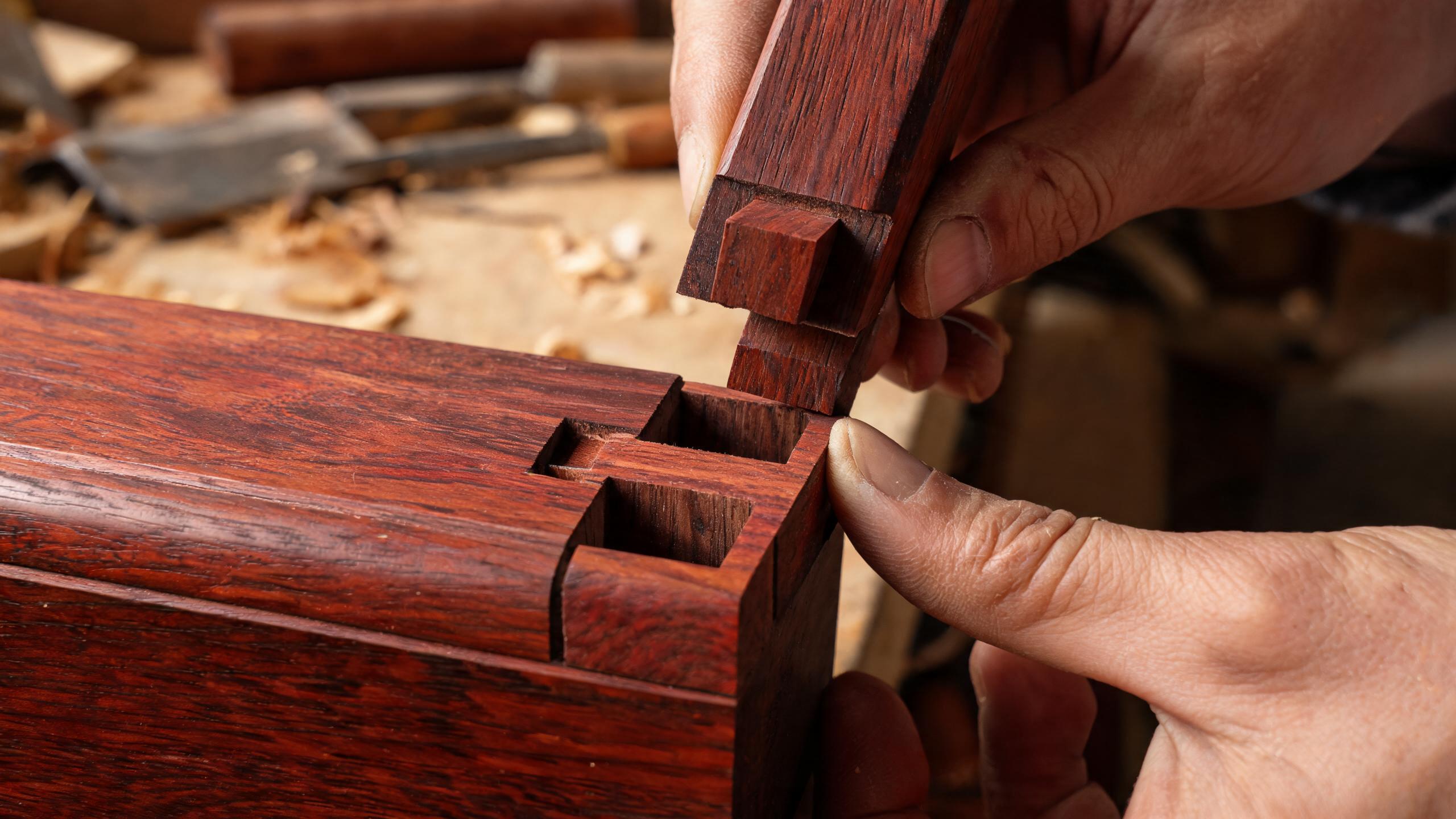
Sambungan duri dan lubang adalah asas perabot kayu rosewood klasik China. Panduan ini menerangkan jenis sambungan, mengapa pembinaan tanpa paku lebih tahan lama daripada pengikat logam, dan bagaimana pembeli boleh menguji kualiti sambungan apabila mendapatkan sumber dari kilang China.
What Is Mortise and Tenon Joinery in Classical Chinese Furniture?
Mortise and tenon joinery, known in Chinese as sunmao, is the traditional woodworking technique that defines classical Chinese rosewood furniture. A mortise is a precisely cut cavity in one piece of wood, and a tenon is a matching projection cut on the end of another piece. The tenon fits into the mortise with a friction hold, creating a joint that is stronger than the wood itself when cut correctly. This technique has been used in Chinese furniture for over 2,000 years and remains the gold standard for classical furniture construction today.
Unlike modern furniture that relies on metal screws, brackets, and glue blocks, traditional Ming and Qing dynasty style redwood furniture uses only wood-to-wood connections. The sunmao joints are cut by hand or with precision machinery, fitted dry without adhesive, and held together by the geometric precision of the cut and the natural friction of the wood fibers.
Why Is Mortise and Tenon Joinery Superior to Metal Fasteners?
Buyers unfamiliar with woodworking traditions often ask why nail-free construction matters. The answer lies in how wood behaves over time and across different climates.
Metal nails and screws create weak points. When wood expands and contracts with seasonal humidity changes, it exerts tremendous force on any fastener embedded in it. Over years, metal nails will loosen as the surrounding wood fibers compress and wear. A screw hole that starts at 4mm will widen to 5mm or 6mm after a decade of thermal cycling, and the joint becomes wobbly.
Mortise and tenon joints move with the wood. Because both the mortise and tenon are made of the same material, they expand and contract at the same rate. A well-cut joinery joint actually tightens over time as the wood seasons and the fibers interlock. This is why 300-year-old Ming dynasty chairs are still structurally sound while 20-year-old screw-assembled furniture is falling apart.
Metal corrodes and stains wood. In humid shipping containers and tropical climates, iron fasteners will rust and leave dark stains in the surrounding wood. Brass screws are better but still create a visual blemish on fine rosewood furniture where the joinery itself is considered a decorative element.
What Are the Main Types of Mortise and Tenon Joints Used in Redwood Furniture?
Chinese craftsmanship has developed dozens of joint variations for different structural applications. The following five are the most common in classical furniture sets produced for export.
1. Through tenon (Tou sun). The tenon passes completely through the mortise and is visible on the opposite side. This is the strongest joint type and is used for chair legs connected to seat frames. The protruding tenon is trimmed flush and sanded smooth.
2. Blind tenon (An sun). The tenon does not penetrate through the full thickness of the receiving piece. This is used where the joint should not be visible from the outside, such as on cabinet face frames and drawer fronts.
3. Dovetailed tenon (Yanjiao sun). The tenon is shaped like a dovetail, wider at the tip than at the base, creating a joint that cannot pull apart. This is used for drawer sides and box constructions. A quality drawer should have at least four dovetails per corner.
4. Mitered tenon (Jiaojiao sun). The mortise and tenon are cut at a 45-degree angle so the joint appears as a seamless miter from the outside while the internal tenon provides structural strength. This is used on visible corner joints of tables and cabinets.
5. Floating tenon (Cha sun). A separate piece of wood is used as the tenon, fitting into matching mortises on both pieces being joined. This is used when the grain direction of both pieces runs parallel and a through tenon is not possible.
How Can Buyers Assess Joinery Quality When Sourcing?
European and North American buyers ordering rosewood furniture from China need practical methods to evaluate joinery quality without dismantling the furniture. Here are four tests that work.
The rock test. Place a chair on a flat surface and gently rock it diagonally by pressing down on one corner of the seat. A well-constructed chair with tight joints will not click, creak, or show any visible movement at the joint lines. Any clicking sound means a tenon is loose inside its mortise.
The gap inspection. Examine every visible joint with a bright flashlight held at a low angle. The seam between two joined pieces should be nearly invisible, with no gap wider than 0.2mm. If you can slide a business card into the joint, the fit is too loose.
The drawer test. Open and close a drawer 20 times. It should slide smoothly without binding or sticking, and the dovetail joints should show no sign of separation. Pull the drawer out fully and inspect the underside of the dovetails for clean cuts without tear-out.
The knock-down test. If you are buying sample pieces, ask the factory to ship one chair or table partially disassembled. A quality sunmao joint should slide together with firm resistance and hold without glue. If the tenon falls out of the mortise under its own weight, the cut is too loose.
How Does Yunxiao Ensure Mortise and Tenon Precision?
At Yunxiao Rosewood Furniture, every joint in our classical furniture is cut by experienced craftsmanship artisans who trained in the Xianyou tradition. We use a combination of traditional hand tools and precision machinery. The initial mortise and tenon cuts are made with a router and table saw for dimensional accuracy, then hand-fitted with a chisel and shoulder plane to achieve the final friction fit.
Our standard clearance between tenon and mortise is 0.1mm, which creates a joint that slides together with hand pressure but holds firmly without adhesive. For export orders, we assemble every piece fully in the factory before disassembling it for flat-pack shipping. This allows us to verify that every joint fits correctly and that the piece is square and level before it goes into a container.
We also document the joinery type used in each product on the specification sheet, so buyers know exactly what construction method they are getting. This transparency is part of our commitment to producing rosewood furniture that will last for generations, not just for a single sales cycle.