
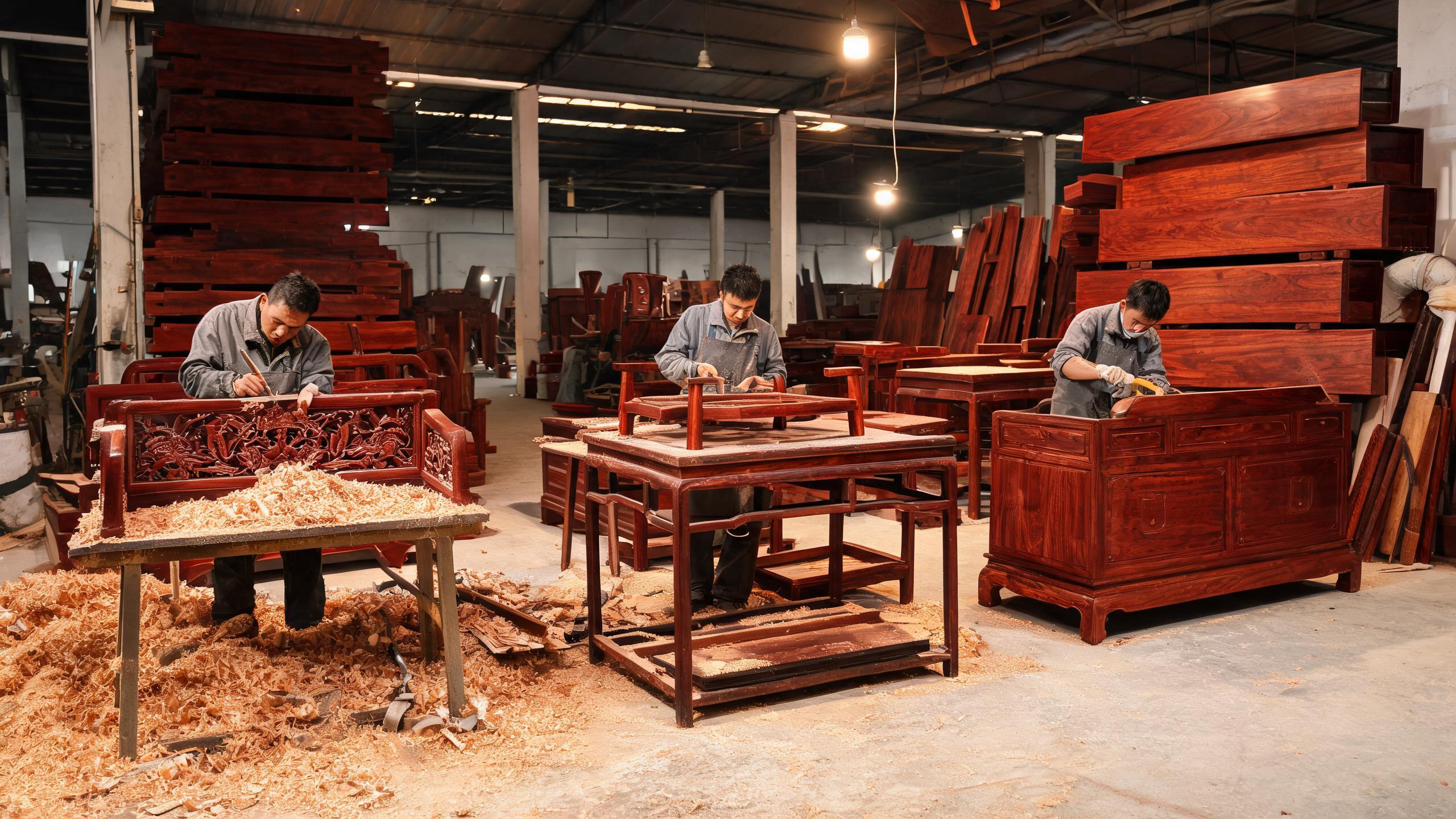
Pembeli Eropah dan Amerika Utara yang mencari sumber set perabot kayu merah dari Yunxian harus mengesahkan kandungan lembapan kering tanur antara 8 dan 12 peratus, konsistensi ira merentas kepingan sepadan, dan toleransi pertukangan tanggam-dan-pasak gaya Ming sebelum membuat pesanan.
Why Does Moisture Content Matter When Sourcing Redwood Furniture?
European buyers and North American importers ordering classical redwood furniture sets from the Yunxian production cluster should treat moisture content as the first checkpoint. Wood shipped from subtropical Fujian at 14% or higher MC will shrink, crack, and loosen joints once it sits in a heated Berlin apartment or an air-conditioned Toronto home. The target kiln-dried moisture content is 8 to 12 percent, measured with a pin-type meter on multiple points of each panel.
Ask your supplier for kiln-drying records that show the temperature curve over a minimum 15-day cycle. A factory that only air-dries its timber is not producing furniture suitable for export to climates with low indoor humidity. The redwood furniture sourcing process must start with verification of proper kiln drying, because no amount of craftsmanship can compensate for wood that was not dried correctly.
How Do You Check Grain Consistency Across a Furniture Set?
Classical redwood furniture sets typically include a table, chairs, and side cabinets. Grain consistency across these pieces determines resale value at the retail end. When evaluating samples or factory photos, look for straight, even grain with minimal color variation between boards in the same piece.
Burl and figured grain are acceptable on visible surfaces, but hidden structural parts should use straight-grain stock. Request that the factory assemble the full set before crating so you can photograph color matching under daylight. A set assembled piecemeal from different wood batches will show visible tone shifts that buyers notice immediately.
The Yunxian furniture cluster has access to consistent timber stocks because the production area is concentrated, with multiple suppliers drawing from the same wood trading networks. This is an advantage over scattered workshops that may source from different batches and produce visually inconsistent sets.
How Strong Is Ming-Style Joinery and How Do You Test It?
Authentic Ming-style joinery redwood furniture relies on mortise-and-tenon construction without metal fasteners. This is a selling point, but only if the joints are cut precisely. A loose joint will rattle and eventually fail, while a properly fitted joint will tighten over time as the wood seasons.
Test a sample chair by rocking it gently side to side. Any clicking or visible movement at the joint line signals a loose fit. The tenon should fill the mortise completely with a friction fit. Dovetailed corners on drawers should have at least four tails per corner. Ask the factory whether they use hide glue or polyurethane glue for assembly. Hide glue is traditional and reversible for repairs, which European buyers and antique dealers prefer.
The Yunxian furniture cluster is known for its Ming-style joinery tradition, with artisans who have trained in the local craft schools. This concentration of skill means buyers can expect higher joinery precision than from workshops in regions without this heritage.
What Are the Advantages of the Yunxian Production Cluster?
The Yunxian area in Fujian Province has concentrated redwood furniture workshops for over two decades. redwood furniture sourcing from this cluster offers several practical advantages for international buyers.
Kiln-drying facilities. The cluster has dedicated kiln-drying facilities that can handle large volumes of timber. This means lead times are shorter and moisture content can be verified on-site before production begins.
Carving specialists. Xianyou is famous for its wood carving tradition. Buyers can request custom carvings, from simple molding profiles to deep relief sculpture, and expect a level of detail that workshops in other regions cannot match.
Finishing workshops. The cluster has specialized finishing workshops that apply traditional beeswax and lacquer finishes. These finishes meet EU REACH and US CARB standards when applied correctly.
Lead times. A typical order for a 7-piece dining set runs 45 to 60 days from deposit to container loading. Custom pieces with extensive carving may take 60 to 75 days. This is competitive compared to other redwood furniture production regions in China.
Buyers should still visit or send a third-party inspector to verify that the workshop uses the specified wood species and not a stained substitute. Rosewood species such as Dalbergia can look similar to cheaper woods after staining, and DNA or fiber testing is available through labs in Shanghai for about 150 USD per sample.
What Should Be on Your Procurement Checklist?
Before placing an order, European buyers and North American importers should confirm the following with their Yunxian supplier.
1. Exact redwood species and CITES appendix status. Specify the scientific name and verify whether the species is CITES-listed. If it is, confirm the supplier can obtain the export permit.
2. Kiln-dried MC between 8 and 12 percent with documented drying records. Request the kiln drying log showing the temperature and humidity curve over a minimum 15-day cycle.
3. Full-set assembly photos before packing. The factory should assemble the entire set and send photos for your approval before disassembling for packaging.
4. Joinery type and glue specification. Confirm Ming-style joinery construction and whether hide glue or polyurethane glue is used.
5. A sample piece shipped by air freight for hands-on evaluation. Order one piece by air freight before committing to a container order. This costs 300 to 800 USD but protects orders that routinely run 15,000 to 40,000 USD per container.
These steps cost a few hundred dollars upfront but protect orders that routinely run 15,000 to 40,000 USD per container. The cost of a sample and an inspection is insignificant compared to the cost of receiving a container of furniture that cracks, warps, or fails to meet specifications.
How Does Yunxiao Support European and North American Buyers?
At Yunxiao Rosewood Furniture, we understand the specific requirements of European buyers and North American importers. Our standard production process includes 36-day kiln drying to achieve moisture content of 8 to 10% for European orders and 9 to 11% for North American orders. We provide kiln drying records, full-set assembly photos, and wood species test reports as part of our standard documentation package.
We offer sample pieces by air freight, welcome third-party inspections at any production stage, and maintain transparent redwood furniture sourcing records. Our Ming-style joinery is executed by artisans trained in the Yunxian furniture tradition, and we document the joinery type for each product on the specification sheet. This level of transparency and quality control is what distinguishes a reliable export supplier from a factory that simply ships product and hopes for the best.