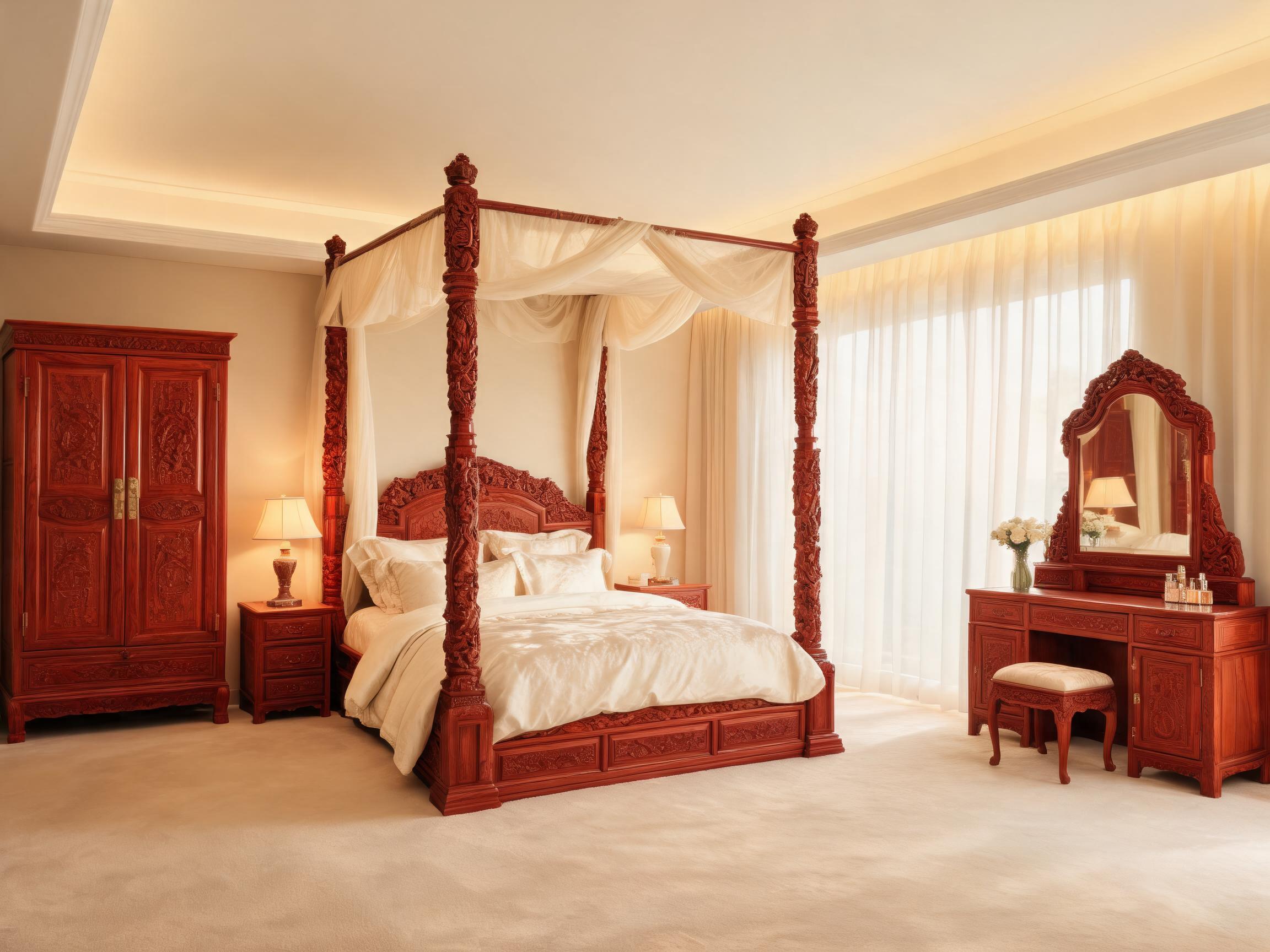
A practical B2B guide for overseas buyers sourcing classical rosewood furniture. Learn how to verify genuine solid wood construction — mortise-and-tenon joinery, floating panels, moisture control, and the absence of metal fasteners — and why these details matter for hospitality projects and overseas climates. Includes a pre-shipment inspection checklist.
BUYER'S CONSTRUCTION GUIDE
# Solid Wood vs. Veneer and Engineered Wood: An Export Buyer's Construction Guide for Classical Rosewood Furniture
For a B2B buyer sourcing classical rosewood furniture, the difference between solid wood and veneer is not a cosmetic preference. It is a structural specification that determines whether your shipment survives its first year in a Dubai hotel lobby, a London apartment, or a Singapore resort.
Veneer and engineered wood are legitimate products. But they are not substitutes for solid wood construction when the buyer's contract specifies it. This guide covers how to verify genuine solid wood construction before you pay, why it matters for overseas climates, and what to check before the container leaves the factory.
Key takeaways for buyers:
- Verify mortise-and-tenon joinery by looking at the joint itself — do not rely on photos of the finished piece.
- Floating panels are a sign of proper moisture engineering; a glued-down panel will crack in dry climates.
- No metal fasteners in load-bearing joints. Screws and brackets are a red flag for solid wood claims.
- Moisture content should be in the 8–12% range at the time of packing. Ask for the meter reading, not a verbal assurance.
- For hospitality projects, specify the wood species, the joinery standard, and the finish system in the purchase order — verbal agreements do not survive a container inspection.
## What "Solid Wood" Actually Means in Classical Rosewood Furniture
The term "solid wood" is used loosely in the industry. In a strict export context, solid wood furniture means the primary structural components — legs, rails, posts, frame — are cut from a single piece of timber, not from particleboard, MDF, or plywood with a wood veneer on top.
For classical rosewood furniture, the distinction matters for three reasons:
1. **Repair and refinishing.** Solid wood can be sanded and refinished multiple times over decades. Veneer over MDF can be refinished once, at most, before the substrate is exposed.
2. **Structural integrity.** A solid wood frame with traditional joinery holds together under load and movement. Engineered wood frames rely on adhesives and mechanical fasteners that degrade over time.
3. **Value retention.** Solid wood bedroom sets and solid wood dining tables in classical styles are long-term assets. Veneer pieces are not.
There is a common misconception that "solid wood" means every visible surface is solid timber. In classical Chinese furniture, that is not how it works — and it should not be. Large table tops and cabinet doors are traditionally built as **floating panels** within a frame. The frame is solid wood; the panel is solid wood; but the panel is not glued to the frame. It floats, allowing the wood to expand and contract with humidity changes.
A buyer who opens a cabinet, sees a panel that moves slightly when pressed, and assumes it is loose or defective is misreading a correct construction. That movement is the panel doing its job.
## Why Construction Matters More for Overseas Climates
Wood is hygroscopic. It absorbs and releases moisture depending on the surrounding air. A piece of furniture built in a factory in southern China with 70% ambient humidity will behave differently in Riyadh (arid, 20% humidity) or in Chicago (heated indoor air in winter, often below 20% humidity).
Here is what happens with each construction type:
| Construction Type |
Response to Dry Climate |
Response to Humid Climate |
Typical Failure Mode |
| Solid wood with mortise-and-tenon + floating panels |
Panels shrink slightly within the frame; joints tighten |
Panels expand; frame absorbs the movement |
Minor hairline cracks at panel edges if finish is too rigid |
| Solid wood with glued panels or fixed joints |
Panels crack because they cannot move |
Panels buckle or push joints apart |
Split tops, popped joints |
| Veneer over MDF / particleboard |
Veneer cracks at edges; substrate may warp |
MDF swells at edges, veneer bubbles |
Edge delamination, bubbling, warping |
| Engineered wood frame with screws / brackets |
Frame loosens as wood shrinks around screws |
Adhesive lines fail with moisture cycling |
Wobbly legs, failing joints |
For hospitality projects — hotels, resorts, executive offices — the furniture is expected to last 10–15 years under continuous use. A veneered nightstand that fails at year three is not just a replacement cost. It is a maintenance call, a guest complaint, and a procurement headache. Solid wood construction, properly built, does not fail that way. It ages.
## How to Verify Genuine Solid Wood Construction: The Inspection Checklist
You cannot verify solid wood construction from a catalog photo. You verify it at the factory, during production, or through a third-party inspection. Here is what to check, in order of importance.
### 1. Mortise-and-Tenon Joinery (榫卯结构)
The hallmark of classical rosewood furniture is the mortise-and-tenon joint: a projecting tenon on one piece fits into a corresponding mortise (socket) on the other, locking the two pieces together without metal fasteners.
**How to verify:**
- Ask the supplier for photos or video of the **unassembled joints** — before the frame is glued and finished.
- Look at the corners of a drawer, the junction of a leg to the apron, and the top rail to the post. You should see the end grain of the tenon or a visible joint line, not a smooth, seamless corner.
- A genuine mortise-and-tenon joint has a visible seam. If the corner looks perfectly seamless, it may be a glued butt joint with a wood filler hiding the seam.
- Ask for a **cutaway sample** or an unfinished piece. Reputable factories have these.
**What to avoid:**
- Joints held together with screws, dowels, or metal brackets. These are faster to produce and cheaper, but they are not classical construction.
- "Hidden" joints that the supplier refuses to show. If they will not show you the joinery, assume it is not there.
### 2. Floating Panels (浮动面板)
As discussed, large panels (table tops, cabinet doors, side panels) should float within a frame, not be glued down.
**How to verify:**
- Press on the center of a large panel. It should have a small amount of give — 1–2 mm of movement.
- Look at the edges. There should be a small gap (1–3 mm) between the panel and the frame, sometimes covered by a thin molding.
- On the underside of a table top, you should see the panel sitting in a groove, not screwed or nailed to the frame.
**Why it matters:**
A table top that is glued or screwed down will crack when the wood shrinks in a dry climate. The crack usually appears at the end grain, and it is not repairable without replacing the top.
### 3. No Metal Fasteners in Load-Bearing Joints
This is a non-negotiable for classical construction. Screws, nails, and metal brackets are used in modern furniture assembly, but they have no place in a solid wood classical piece.
**How to verify:**
- Inspect the underside of chairs, tables, and cabinets. Look for screw heads, nail heads, or metal L-brackets.
- Check the inside of drawers. The drawer front should be joined to the drawer sides with a dovetail or a mortise-and-tenon joint, not screws.
- For beds, check the rail-to-post connection. Traditional construction uses a mortise-and-tenon with a wooden locking pin. Some modern adaptations use a metal hook-and-bolt system — this is a compromise, and you should decide if it is acceptable for your project before ordering, not after receiving the container.
**A note on metal in non-structural areas:** Hinges, drawer slides, and locking mechanisms are metal, and that is normal. The rule applies to the wood-to-wood structural joints.
### 4. Moisture Control and Kiln Drying
The single most common cause of overseas furniture failure is moisture. Wood that is packed at 15% moisture content and shipped to a dry climate will lose moisture in transit and in the first months of use. The result is cracking, warping, and loose joints.
**What to check:**
- Ask the supplier for the kiln-drying specification. Rosewood species should be dried to 8–12% moisture content, depending on the destination market.
- Ask for the **moisture meter reading at the time of packing**. A reputable factory will have this on file. If they cannot produce it, that is a red flag.
- Ask about the factory's **acclimation process**. Wood should be allowed to rest in the factory environment for a period after machining and before finishing, so it reaches equilibrium with the local humidity.
Buyer's note: If your destination is a dry climate (Middle East, inland US, parts of Australia), specify in the purchase order that the furniture must be packed at a moisture content below 10%. This is a written specification, not a request. It changes how the factory schedules production and packing.
### 5. Finish System
The finish is not just aesthetics. It is the first line of defense against moisture exchange.
**What to check:**
- Ask what finish is used. For classical rosewood furniture, common options are lacquer, polyurethane, and traditional wax/oil finishes.
- Lacquer and polyurethane form a film that slows moisture exchange. Wax and oil finishes allow more exchange but are easier to repair.
- Check the **underside and back surfaces**. If the factory only finishes visible surfaces and leaves the underside raw, moisture exchange will be uneven, causing warping. A quality finish covers all surfaces, including drawer interiors and undersides.
### 6. Wood Species Verification
"Rosewood" is a broad term. It can refer to genuine Dalbergia species (such as Dalbergia odorifera or Dalbergia sissoo) or to other woods marketed as "rosewood" for commercial reasons.
**What to check:**
- Ask for the **scientific name** of the wood species, not just the commercial name.
- Be aware of CITES regulations. Several Dalbergia species are listed under CITES Appendix II, which requires export permits. A supplier who cannot provide the CITES documentation is not a viable source for international trade.
- Ask for a sample of the unfinished wood to verify color, grain, and density.
## Solid Wood Bedroom Sets and Dining Tables: What to Specify
For buyers sourcing **solid wood bedroom sets** and **solid wood dining tables**, the specification should go beyond "solid wood." Here is a minimum specification template:
| Item |
Specification to Include |
| Wood species |
Scientific name, not commercial name |
| Moisture content |
8–12% at packing; specify lower for dry climates |
| Joinery |
Mortise-and-tenon for all load-bearing joints; no metal fasteners |
| Panels |
Floating panels in frames; 1–3 mm expansion gap |
| Finish |
Specify type (lacquer, PU, wax) and coverage (all surfaces, including underside) |
| Adhesives |
Water-resistant (Type II or better) for all glue joints |
| Inspection |
Third-party inspection at 100% or AQL sampling before packing |
## Pre-Shipment Inspection: The Practical Checkpoints
You do not need to be a wood expert to run a basic pre-shipment inspection. Here is a practical checklist to use before the container is sealed.
### At the Factory, Before Packing
1. **Open every carton in the sample batch.** Do not rely on a factory "quality pass" report.
2. **Check for metal fasteners.** Look at the underside of tables and chairs, the inside of drawers, and the back of cabinets.
3. **Press the panels.** Confirm floating panels move slightly.
4. **Check the moisture content.** Use a pin-type moisture meter on the underside of a table top or the inside of a drawer. Acceptable range: 8–12%.
5. **Check the finish coverage.** Look at the underside of the table and the inside of drawers. They should be finished, not raw.
6. **Check for cracks, splits, and glue marks.** These are not "character." They are defects.
7. **Verify the wood species.** Compare the sample against the unfinished wood sample you approved.
### At Packing
1. **Check the packaging specification.** For overseas shipping, furniture should be wrapped in moisture-barrier film (not just plastic sheeting), with desiccant packs inside the carton.
2. **Confirm the carton strength.** Double-wall corrugated cartons with foam or honeycomb board protection for corners and edges.
3. **Check the container loading plan.** Furniture should not be packed so tightly that panels are under compression, which can cause warping.
### Documentation to Request
- Kiln drying certificate or moisture content records
- CITES documentation (if applicable)
- Third-party inspection report (SGS, Bureau Veritas, or similar)
- Packing list with carton dimensions and weights
- Loading photos or video
## FAQ: Common Buyer Questions
**Q: Can I tell solid wood from veneer by looking at a photo?**
A: No. Veneer is designed to look like solid wood. You need to see the unfinished construction, the end grain, or the edges. Ask for unassembled joint photos or an unfinished sample.
**Q: Is it acceptable to use veneer for the back panel of a cabinet?**
A: In some cases, yes. Back panels and drawer bottoms are traditionally made of thinner wood, and some factories use plywood for these non-structural parts. This is a compromise, and it should be disclosed in the specification. If your contract says "all solid wood," then even the back panel should be solid.
**Q: What is the acceptable moisture content for furniture shipped to a dry climate?**
A: For arid destinations, aim for 8–10%. For temperate and humid climates, 10–12% is acceptable. The key is that the wood is in equilibrium with the destination's average indoor humidity.
**Q: How do I verify mortise-and-tenon joinery without cutting the furniture open?**
A: You can see the joint line at the corners. A genuine mortise-and-tenon joint has a visible seam where the tenon meets the mortise. You can also ask the factory for an unfinished sample or a production-stage video. If they refuse, treat it as a red flag.
**Q: Are metal brackets ever acceptable in classical furniture?**
A: For non-structural connections — such as attaching a decorative molding — metal may be used. For load-bearing joints (leg to apron, rail to post), no. Specify this in your purchase order.
## Final Word for Buyers
Sourcing classical rosewood furniture is a long-term procurement decision. The difference between a solid wood piece that lasts 20 years and a veneer piece that fails in 3 is not visible in a catalog photo. It is in the construction — the joinery, the panels, the moisture control, and the finish.
Verify before you order. Specify in writing. Inspect before you ship. These three steps will save you from the most common failure modes in overseas furniture trade: cracked panels, loose joints, and delaminated veneer.
If you are sourcing **solid wood bedroom sets**, **solid wood dining tables**, or other classical rosewood pieces for hospitality or residential projects, ask your supplier for the construction details outlined in this guide. A factory that can show you the joinery, the moisture records, and the unfinished construction is a factory you can work with. One that cannot is a risk you do not need to take.