
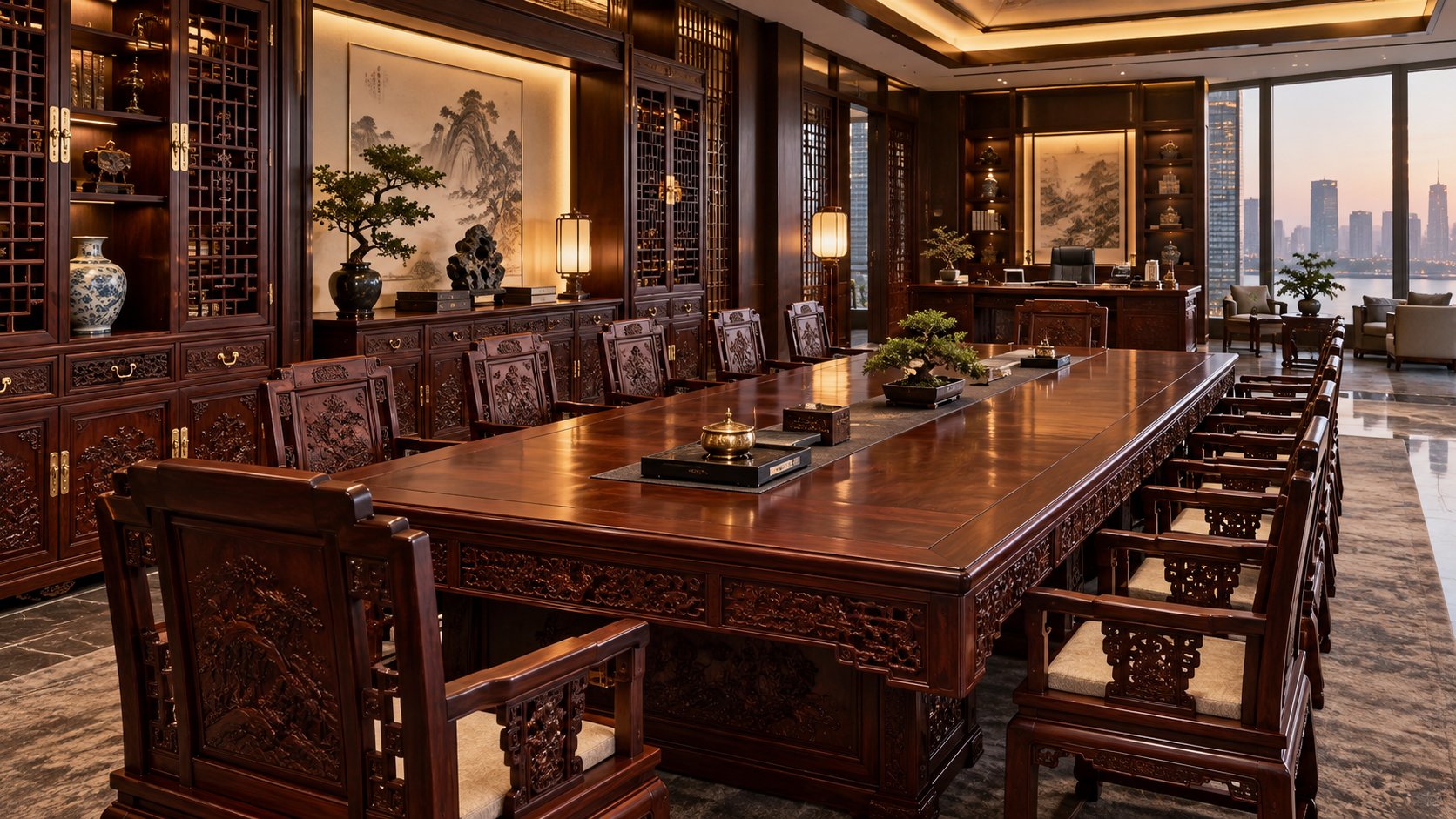
Executive offices and boardrooms are no longer just functional meeting spaces — they are statements of a company's values, stability, and long-term vision. For corporate buyers, interior designers, and procurement teams sourcing premium furniture for headquarters, boardrooms, and executive suites, the choice of materials and craftsmanship carries real weight. This guide explains how classical rosewood furniture can elevate executive office and boardroom interiors, what to look for when sourcing it for corporate projects, and how to work with a factory that can deliver consistent, compliant, and durable pieces.
Why Executive Office and Boardroom Interiors Are Turning to Solid Rosewood Furniture
Across Europe, North America, Southeast Asia, and Australia, corporate clients are moving away from mass-produced, veneer-based office furniture toward solid wood pieces that convey permanence and craft. A boardroom table is the single most photographed object in many companies — it appears in annual reports, investor presentations, and media coverage. When a CEO or board sits around a table, the furniture silently communicates the firm's standards.
Rosewood furniture, with its deep reddish-brown tones, dense grain, and hand-carved detailing, brings a gravitas that lighter woods and laminates cannot match. It is a material that ages well, develops a richer patina over time, and signals a commitment to quality that aligns with the values of established financial, legal, professional-services, and family-owned businesses.
For B2B buyers, the appeal is also practical. When properly dried, crafted, and maintained, solid rosewood furniture can serve for decades, which lowers the total cost of ownership compared with furniture that needs replacement every few years. In high-traffic corporate environments — reception areas, boardrooms, executive offices, and client-facing lounges — durability is not a luxury; it is a requirement.
The shift toward solid wood in corporate interiors is also driven by a broader movement toward authenticity and sustainability. Companies want interiors that tell an honest story about how they are built and what they value. A hand-carved rosewood boardroom table is a tangible expression of craft, patience, and respect for natural materials — qualities that resonate with clients, employees, and investors alike. Unlike synthetic materials that can look dated within a few years, well-maintained rosewood furniture becomes more beautiful with age, developing a warm patina that no factory-fresh laminate can imitate.
What Makes Rosewood Furniture Suitable for Corporate and Executive Spaces
Not every solid wood is appropriate for a corporate boardroom. The material must combine visual authority, dimensional stability, and the ability to be crafted into large, seamless pieces. Rosewood — and in particular the legally certified tropical hardwoods used by specialist factories — offers several properties that matter for executive interiors.
Density and Stability
Rosewood is a dense hardwood. The Janka hardness of Dalbergia cochinchinensis, the species commonly known as Siamese rosewood, is approximately 2,430 lbf (10,790 N), according to reference data from The Wood Database. This is an industry reference value for the species; the actual hardness of a specific piece depends on the timber grade and should be confirmed with the factory's material test report. High density means the wood resists dents, scratches, and wear in busy corporate settings. It also means the material holds fine carving detail without chipping, which is why traditional artisans can produce intricate motifs on table aprons, chair backs, and cabinet doors.
Dimensional stability is equally important. A boardroom table that warps, cracks, or develops gaps after a season of air-conditioning would be a costly embarrassment. Factories that control moisture content through proper kiln drying and constant-humidity conditioning produce furniture that remains stable across the climate changes typical of air-conditioned offices.
Density also affects how the furniture feels and sounds. A solid rosewood table has a satisfying weight and resonance that signals quality the moment you touch it. This tactile experience is difficult to quantify but impossible to ignore — it is one of the reasons clients and executives instinctively trust a room furnished with solid wood.
Craftsmanship and Joinery
Traditional Chinese furniture is assembled using mortise-and-tenon joinery rather than metal nails or screws. This is not merely an aesthetic choice. Mortise-and-tenon joints allow the wood to expand and contract naturally with changes in humidity, which reduces the risk of cracking and deformation over time. For a corporate buyer, this translates into furniture that stays tight and true for decades.
Hand-carved detailing — dragon motifs, cloud patterns, lattice work, and ruyi symbols — gives each piece a level of individuality that machine-made office furniture cannot replicate. In a boardroom, this craftsmanship becomes a talking point and a reflection of the company's appreciation for quality.
The absence of metal fasteners also matters for long-term maintenance. Metal screws and nails can corrode, loosen, and telegraph through the wood as the piece ages. Mortise-and-tenon joinery, by contrast, relies on the natural interlocking of wood and wooden dowels, which keeps the structure stable without introducing materials that can fail. For a piece intended to last decades in a corporate environment, this is a meaningful advantage.
Finish and Indoor Air Quality
Corporate buyers increasingly care about indoor air quality and environmental compliance. Traditional finishes such as beeswax and raw lacquer, applied in multiple hand-rubbed coats, are low-VOC and safe for occupied office environments. Factories that use eco-friendly finishing that meets EU REACH and US CARB standards give buyers confidence that the furniture will not off-gas harmful compounds into a sealed boardroom.
Indoor air quality is a growing concern in modern office design, particularly in buildings pursuing green-building certifications. Furniture that emits volatile organic compounds can undermine those efforts and affect occupant health and productivity. A low-VOC, natural finish is therefore not just an environmental nicety — it is a practical requirement for many corporate projects.
Which Rosewood Furniture Pieces Belong in an Executive Office or Boardroom
A complete corporate interior rarely needs a single piece; it needs a coordinated set that works as a whole. The following pieces are the most relevant for executive and boardroom environments, and each can be sourced as part of a custom program.
| Space | Recommended Rosewood Pieces | Why It Works |
|---|---|---|
| Boardroom | Large carved conference table, matching executive chairs, sideboard, display cabinet | A substantial table anchors the room; storage and display pieces add function and visual balance |
| Executive office | Executive desk, lounge chairs, tea table, armchairs, bookcase or display cabinet | Creates a private, prestigious environment for meetings and daily work |
| Reception / client lounge | Carved sofa set, tea table, armchairs, side tables | Welcomes clients with a sense of stability and refined taste |
| Conference anteroom | Display cabinet, sideboard, occasional chairs | Provides storage and a comfortable waiting area |
For corporate projects, the most common configuration is a large conference or boardroom table paired with matching chairs, complemented by a sideboard and a display cabinet for storage and presentation. Executive offices typically combine a desk with lounge seating and a tea table for informal meetings.
Beyond these core pieces, a corporate project may also include display cabinets for awards and artifacts, bookcases for executive libraries, and occasional tables for waiting areas. The key is to design a coordinated program where every piece shares the same wood species, finish, and level of craftsmanship, so the interior reads as a single, intentional design rather than a collection of unrelated items.
How to Specify Rosewood Furniture for a Corporate Project
Specifying furniture for a corporate project is different from buying a single residential set. You are planning for scale, consistency, and long-term service. Here are the key decisions to make before you approach a factory.
Define the Scope and Quantities
Start by mapping every room that needs furniture: boardrooms, executive offices, reception areas, conference anterooms, and client lounges. List the number of tables, chairs, desks, and storage pieces required. This gives you a clear picture of the order size and helps the factory plan production and lead times.
A detailed room-by-room schedule also helps you identify opportunities to standardize. For example, if several executive offices need the same desk model, you can order them together and achieve better consistency and pricing. If the boardroom and reception area need different pieces, you can still coordinate the wood species and finish across the entire program.
Choose the Wood Species and Grade
Rosewood is a broad term. Clarify whether you want Siamese rosewood (Dalbergia cochinchinensis), aged red wood, Machilus Nanmu, or another legally certified hardwood. Each has a different color, grain, and price point. For a corporate project where consistency across many pieces matters, specify the species and the acceptable grade range, and ask the factory how it matches color and grain across a full order.
Color and grain matching is one of the most important quality considerations for a corporate program. A boardroom with a table, chairs, and sideboard that all show noticeably different tones would look unprofessional. A skilled factory will select and match timber so that the entire order presents a coherent, harmonious appearance.
Decide on Customization
Corporate interiors rarely fit standard dimensions. Boardroom tables may need to seat 12, 16, or 20 people; executive desks may need specific cable-management cutouts; reception areas may need curved or custom-shaped pieces. A factory with OEM and ODM capability can adjust sizes, patterns, and finishes to match your layout drawings and brand aesthetic.
Customization also extends to carving motifs. Some companies prefer traditional Chinese motifs such as dragons and clouds; others want more restrained, contemporary detailing. A flexible factory can adapt the carving style to suit your brand and the architectural character of the building.
Confirm Compliance and Documentation
For imports into the EU and North America, timber compliance is non-negotiable. Confirm that the factory can supply FSC chain-of-custody documentation, CITES export permits where required, and evidence of compliance with the EU Timber Regulation and the US Lacey Act. A factory that prepares these documents internally, as part of its standard export process, saves you significant time and risk.
Compliance is not just a customs formality. It protects your company from legal and reputational risk. Importing timber that is not properly documented can result in confiscation, fines, and negative publicity. Working with a factory that treats compliance as a standard part of its export service gives you peace of mind and a clear audit trail. To verify a factory's claims, ask for valid, in-date copies of its certificates and permits, and where possible confirm them through the issuing body's official channels. Note that a factory stating it "meets" a standard is not the same as holding a current, verifiable certificate.
Plan for Packaging and Shipping
Carved rosewood furniture is delicate and heavy. Confirm that the factory uses ISPM 15 heat-treated packaging, custom crating, moisture barriers, and bracing designed to protect carved pieces during overseas shipping. Ask about container loading plans and whether partial shipments are available if you are phasing a project.
Proper packaging is an investment in protecting your order. A single damaged carved piece can delay a project and create significant cost. A factory that has engineered its packaging for delicate relief-carved furniture — with custom crating, moisture barriers, and bracing — demonstrates that it understands the realities of overseas shipping.
What to Look for in a Rosewood Furniture Factory for Corporate Orders
The quality of your corporate furniture depends heavily on the factory you choose. Here are the capabilities and evidence to verify before committing to a large order.
Proven Craftsmanship and Skilled Artisans
Hand-carved rosewood furniture requires experienced artisans. Ask how the factory trains its carvers and whether it has a stable, in-house team. A factory in a region with a long tradition of hardwood craft — such as Xianyou County in Fujian, China, the historic home of traditional hardwood furniture — is more likely to have the depth of skill you need.
The stability of the artisan team matters. A factory that relies on a rotating pool of freelance carvers may produce inconsistent quality. A factory with a dedicated, in-house team of master carvers is more likely to deliver uniform craftsmanship across a large order.
Controlled Drying and Conditioning
Moisture control is the single most important factor in whether rosewood furniture cracks in an overseas climate. Look for a factory that kiln-dries timber and then conditions it under constant humidity — for example, a 36-day constant-humidity drying process — before and during production. This reduces the risk of movement after the furniture reaches your market.
The drying process is not a one-time step. Responsible factories condition the wood at multiple stages — after rough milling, after joinery, and before finishing — to ensure the moisture content is stable throughout production. This attention to detail is what separates furniture that survives overseas climates from furniture that arrives cracked and warped.
Quality Control and Inspection
Ask about the factory's quality-control process at each stage: timber selection, drying, joinery, carving, finishing, and final assembly. If possible, arrange a virtual factory audit or a pre-shipment inspection. A reputable factory will welcome this scrutiny because it demonstrates confidence in its work.
A robust quality-control process should include checks for wood defects, joinery tightness, carving accuracy, finish consistency, and dimensional accuracy. For a corporate order where consistency matters, ask how the factory verifies that every piece in the batch meets the same standard.
Export Documentation and Compliance Support
Confirm that the factory prepares full export documents, including FSC certificates and CITES permits where applicable, and that it understands the compliance requirements of your target market. This is a strong signal of a professional, export-oriented partner rather than a domestic-only workshop.
An export-oriented factory will also be familiar with the documentation required by different markets — the EU Timber Regulation for Europe, the Lacey Act for the United States, and CITES for protected species. This expertise saves you from navigating complex regulations on your own.
Flexible Ordering and Service
For first-time corporate buyers, the ability to order a trial single set or a refundable sample before committing to a full container is valuable. Also ask about remote installation guidance and free layout drawings, which help your local team place and assemble the furniture correctly.
After-sales support is another consideration. Ask whether the factory provides guidance on care and maintenance, and whether it can supply replacement parts or refinishing advice if needed. A factory that stands behind its work is a more reliable long-term partner.
Cost Considerations for Rosewood Office and Boardroom Furniture
Solid rosewood furniture is a premium purchase, and corporate buyers should understand what drives the price before budgeting.
- Wood species and grade: Rare and legally certified species such as Siamese rosewood command higher prices than more common hardwoods.
- Carving complexity: Hand-carved detailing adds significant labor cost. Intricate motifs take skilled artisans many hours per piece.
- Size and scale: A 12-seat boardroom table uses far more timber and labor than a compact residential table.
- Finish: Multiple hand-rubbed coats of beeswax and lacquer add time and cost but improve durability and appearance.
- Compliance and documentation: FSC chain-of-custody and CITES permits add administrative cost but are essential for legal import.
- Packaging and freight: Custom crating and ISPM 15 heat-treated packaging protect the investment but add to the landed cost.
Rather than comparing only unit prices, corporate buyers should evaluate total cost of ownership. A well-made rosewood boardroom table that, with proper care and in a normal office environment, serves for decades and retains its value is often more economical than a cheaper table replaced every five years.
It is also worth considering the value that premium furniture adds to a corporate brand. A boardroom that impresses clients and investors can contribute to winning business and building trust. While this value is difficult to quantify, it is real, and it is one reason many successful companies invest in high-quality executive interiors.
How to Integrate Rosewood Furniture into a Modern Corporate Design
Some buyers worry that classical rosewood furniture will look out of place in a modern office. In practice, it integrates beautifully when handled with intention.
Balance Traditional and Contemporary Elements
Use rosewood as the anchor of the room — the boardroom table, the executive desk, the reception sofa — and pair it with contemporary lighting, neutral wall colors, and modern artwork. The contrast between the warm, carved wood and clean modern lines creates a sophisticated, timeless look.
This balance is the key to avoiding a dated or museum-like appearance. By letting rosewood be the hero and keeping the surrounding elements restrained and contemporary, you create an interior that feels both prestigious and current.
Let the Wood Be the Focal Point
Resist the urge to over-decorate. Rosewood's rich grain and carving are the statement. Keep surfaces relatively clear, use restrained accessories, and allow the furniture to carry the visual weight of the room.
Too many competing elements can overwhelm the space and diminish the impact of the furniture. A few well-chosen accessories — a vase, a sculpture, a stack of books — are enough to complement the wood without competing with it.
Consider Scale and Proportion
In a large boardroom, a substantial table with matching chairs fills the space with authority. In a smaller executive office, a well-proportioned desk and a pair of lounge chairs create intimacy without crowding. Work with the factory's layout drawings to ensure every piece fits its intended space.
Scale is particularly important for boardroom tables. A table that is too small for the room looks lost; one that is too large makes the space feel cramped. Provide accurate room dimensions and seating requirements so the factory can recommend the right size.
Plan for Lighting
Warm, layered lighting brings out the depth of rosewood's color. Avoid harsh, cool overhead light, which can flatten the wood's richness. Accent lighting on carved details and display cabinets highlights the craftsmanship.
Lighting design should be considered early in the project. Pendant lights over a boardroom table, wall sconces, and spotlights on display pieces all contribute to showcasing the furniture's beauty. A lighting plan that complements the wood will make the entire room feel more inviting and prestigious.
Case Study: A Typical Corporate Sourcing Scenario
To illustrate how this works in practice, consider a typical professional-services firm planning a new headquarters with a 14-seat boardroom, four executive offices, and a client reception lounge. This is an illustrative sourcing scenario, not a specific client project. The procurement team needs furniture that reflects the firm's stability and quality, must comply with EU timber regulations, and must arrive on a defined schedule.
The team specifies a large carved rosewood conference table with matching chairs for the boardroom, executive desks and lounge seating for the offices, and a carved sofa set with a tea table for the reception area. They choose Siamese rosewood for its color and density, and request custom dimensions to fit the room layouts.
They select a factory that can supply FSC chain-of-custody documentation and CITES permits, uses ISPM 15 heat-treated packaging, and offers a trial set before the full order. The factory prepares free layout drawings, confirms a 45–60 working day production window after deposit, and arranges partial shipments so the reception area can be furnished first while the boardroom is completed.
The result is a cohesive, prestigious corporate interior that meets compliance requirements, arrives on schedule, and will serve the firm for decades.
This scenario illustrates the importance of planning and partnership. By defining the scope clearly, choosing the right wood and factory, and confirming compliance and logistics early, the firm avoids the common pitfalls of corporate furniture sourcing and delivers an interior that reflects its brand for years to come.
Common Mistakes to Avoid When Sourcing Rosewood Office Furniture
Corporate buyers can avoid costly errors by steering clear of these common pitfalls.
- Choosing on price alone: The cheapest quote often reflects lower-grade wood, thinner carving, or missing compliance documentation. Verify what you are actually buying.
- Ignoring moisture control: Furniture that is not properly dried and conditioned can crack in an air-conditioned office. Confirm the factory's drying process.
- Skipping compliance checks: Importing rosewood without proper FSC and CITES documentation can lead to customs delays, fines, or confiscation. Verify documentation before ordering.
- Ordering without samples: For a large corporate order, a trial set or refundable sample lets you verify quality, color, and finish before committing.
- Underestimating lead times: Hand-carved furniture takes time. Plan production and shipping into your project schedule, and confirm partial-shipment options if you have a phased timeline.
- Neglecting packaging: Carved pieces are vulnerable in transit. Confirm the factory uses proper crating, moisture barriers, and bracing.
Beyond these, corporate buyers should also avoid assuming that all rosewood is the same. The species, grade, drying process, and craftsmanship vary widely between factories. Taking the time to verify these details before ordering is the single best way to protect your investment.
Frequently Asked Questions
Is rosewood furniture suitable for air-conditioned corporate offices?
Yes, provided the wood has been properly kiln-dried and conditioned under constant humidity. This reduces the risk of cracking and movement when the furniture is exposed to the dry, stable environment of an air-conditioned office. Ask the factory about its drying and conditioning process.
Can rosewood boardroom tables be made to custom sizes?
Yes. Factories with OEM and ODM capability can adjust table dimensions, seating capacity, patterns, and finishes to match your layout drawings and brand requirements. Provide your room dimensions and seating plan to get an accurate quote.
What compliance documents do I need to import rosewood furniture into the EU or US?
For the EU, you need evidence of compliance with the EU Timber Regulation (EUTR), which requires due diligence on the legality of the timber. For the US, the Lacey Act requires accurate declarations of the wood species and its origin. FSC chain-of-custody documentation and CITES export permits, where applicable, support these requirements. A professional export-oriented factory prepares these documents internally.
How long does it take to produce and deliver a corporate rosewood furniture order?
For a full container order, production typically takes 45–60 working days after the deposit. Shipping time depends on your destination. Partial shipments are often available for long-term partners, which helps with phased project timelines.
Can I order a sample before committing to a full corporate order?
Yes. Many factories offer trial single sets and refundable samples. This is a sensible way to verify the quality, color, finish, and craftsmanship before placing a large order.
How do I care for rosewood furniture in an office environment?
Dust regularly with a soft, dry cloth. Avoid direct, prolonged sunlight and extreme temperature swings. Use coasters and protective pads under hot or wet items. Periodically apply a suitable wood polish or beeswax to maintain the finish. The factory can provide specific care guidance for the finish used on your pieces.
What is the difference between Siamese rosewood and other hardwoods used in classical furniture?
Siamese rosewood (Dalbergia cochinchinensis) is prized for its deep reddish-brown color, fine grain, and high density, which make it ideal for fine carving and long-lasting furniture. Other hardwoods such as Machilus Nanmu and aged red wood offer different colors and characteristics. The right choice depends on your aesthetic preferences, budget, and the specific requirements of your project.
Can rosewood furniture be combined with modern office technology and cabling?
Yes. A factory with OEM and ODM capability can incorporate cable-management cutouts, grommets, and other technical features into custom desks and tables while preserving the furniture's aesthetic. Discuss your technology requirements with the factory during the specification phase.
How to Start Your Corporate Rosewood Furniture Project
If you are planning an executive office, boardroom, or corporate reception project, the first step is to define your scope and gather your requirements. Map the rooms, list the pieces you need, choose your wood species, and confirm your compliance and timeline needs.
Then, approach a factory with a proven track record in classical rosewood furniture for export. Share your layout drawings and ask for a proposal that includes specifications, customization options, compliance documentation, packaging, and lead times. A professional factory will guide you through the process, from sample to full container, and help you deliver a corporate interior that reflects your company's standards for years to come.
Remember that a corporate furniture project is a partnership, not a one-time transaction. The best results come from working with a factory that understands your brand, your market, and your compliance requirements, and that is willing to invest in getting the details right. Take the time to evaluate potential partners carefully, request samples, and verify their capabilities before committing to a large order.
Working with a specialist factory: A factory with in-house artisans, controlled drying, eco-friendly finishing, and full export documentation support gives corporate buyers the confidence to invest in furniture that will represent their brand for decades.
Rosewood Furniture for Different Corporate Sectors
Different industries have different needs and expectations for executive interiors. Understanding how rosewood furniture serves each sector helps buyers specify the right pieces and communicate their requirements to a factory.
Financial and Professional Services
Banks, law firms, accounting practices, and investment houses rely on trust and discretion. Their boardrooms and executive offices must project stability, confidentiality, and long-term thinking. Rosewood's deep, authoritative tones and solid construction align perfectly with these values. A substantial carved boardroom table signals that the firm is established and confident, while the natural materials convey a sense of permanence that clients find reassuring.
Technology and Innovation Companies
Technology firms often favor clean, modern interiors, but many are now incorporating natural materials to soften the high-tech environment and create a more human, grounded atmosphere. A single statement piece — a rosewood boardroom table or an executive desk — can anchor a modern space and provide a warm counterpoint to glass, steel, and screens. This blend of tradition and innovation reflects the values of companies that respect both heritage and progress.
Family-Owned and Heritage Businesses
Family-owned companies and heritage brands often have a deep appreciation for craftsmanship and tradition. Rosewood furniture resonates with their identity, reflecting values that have been passed down through generations. A hand-carved rosewood boardroom table can become a family heirloom in its own right, symbolizing the continuity and values of the business.
Hospitality and Real Estate Groups
Real estate developers and hospitality groups that furnish corporate offices, showrooms, and project headquarters often use rosewood to convey the quality of their developments. A rosewood-furnished executive suite or sales center tells prospective clients that the company builds to a high standard and values premium materials.
Government and Institutional Clients
Government buildings, embassies, and cultural institutions often require furniture that reflects dignity, stability, and national heritage. Classical rosewood furniture, with its traditional craftsmanship and cultural significance, is a natural fit for these settings. Compliance with timber regulations and the ability to provide full documentation are particularly important for institutional buyers.
Sustainability and Ethical Sourcing in Corporate Furniture
Corporate buyers are under increasing pressure to demonstrate environmental responsibility in their procurement decisions. When sourcing rosewood furniture, sustainability is not just a marketing consideration — it is a legal and ethical requirement.
Legally Certified Timber
Rosewood species are protected under CITES, and responsible factories source only legally certified timber. Confirm that your factory can provide FSC chain-of-custody documentation and CITES export permits. This ensures that the wood was harvested legally and sustainably, and that your company is not inadvertently supporting illegal logging.
Durability as Sustainability
One of the most sustainable choices a company can make is to buy furniture that lasts. A solid rosewood boardroom table that, with proper care, serves for decades reduces the demand for new materials and keeps furniture out of landfills. When evaluating the environmental impact of your furniture, consider the full lifecycle rather than just the initial footprint.
Low-VOC Finishes
Eco-friendly finishes such as beeswax and raw lacquer, applied in multiple hand-rubbed coats, are low-VOC and safe for occupied spaces. This supports indoor air quality and aligns with green-building certifications. Confirm that your factory's finishing process meets relevant standards such as EU REACH and US CARB.
Responsible Manufacturing
Ask about the factory's manufacturing practices, including waste management, energy use, and labor conditions. A responsible factory will be transparent about its processes and willing to share evidence of its environmental and social commitments.
The Role of Rosewood in Corporate Brand Identity
Furniture is more than a functional necessity — it is a component of brand identity. The way a company furnishes its headquarters, boardrooms, and reception areas communicates its values to clients, employees, and visitors.
A rosewood boardroom table is a powerful brand statement. It says that the company values quality, craftsmanship, and permanence. It signals that the firm is willing to invest in the details and that it respects the natural world. For companies in sectors where trust and stability are paramount, this message is invaluable.
Rosewood also has cultural resonance. In many Asian markets, and increasingly in Western markets, rosewood is associated with prestige, heritage, and good fortune. A company that chooses rosewood furniture is aligning itself with these positive associations, which can enhance its reputation with clients and partners.
Finally, rosewood furniture creates memorable experiences. Clients who meet in a beautifully furnished boardroom remember the space and the company. Employees who work in a prestigious environment feel valued and proud. These intangible benefits compound over time, making premium furniture a sound investment in brand and culture.
Planning the Timeline for a Corporate Rosewood Furniture Project
Corporate projects run on schedules, and furniture is often a critical path item. Understanding the timeline helps you plan effectively and avoid delays.
Design and Specification
The specification phase — mapping rooms, choosing pieces, selecting wood, and confirming customization — typically takes several weeks. The more detailed your requirements, the faster the factory can produce an accurate proposal.
Sampling
If you order a trial set or sample, add time for production and shipping of the sample. This is a worthwhile investment that lets you verify quality before committing to the full order.
Production
For a full container order, production typically takes 45–60 working days after the deposit. Hand-carved furniture cannot be rushed, so build this into your schedule.
Shipping and Delivery
Shipping time depends on your destination and the shipping method. Sea freight to Europe, North America, Southeast Asia, or Australia typically takes several weeks. Confirm the factory's packaging and container loading plan to ensure the furniture arrives intact.
Installation
Plan for installation time at your site. The factory can provide remote installation guidance and layout drawings to help your local team place and assemble the furniture correctly.
By planning each phase and confirming partial-shipment options if you have a phased timeline, you can keep your project on schedule and avoid last-minute surprises.
Working with a Factory on Custom Corporate Programs
A corporate furniture program is a significant investment, and the relationship with your factory is a key factor in its success. Here is how to build a productive partnership.
Communicate Clearly and Completely
Provide the factory with complete information: room dimensions, seating requirements, design preferences, wood species, finish, compliance needs, and timeline. The more the factory understands your project, the better it can serve you.
Request and Review Samples
Before committing to a large order, request a sample or trial set. Review the quality, color, finish, and craftsmanship carefully. This is your opportunity to catch any issues before they multiply across a full container.
Agree on Quality Standards
Discuss the factory's quality-control process and agree on the standards for your order. Clarify how color and grain matching will be handled, what level of carving detail is expected, and how defects will be addressed.
Plan for Communication and Updates
Establish a clear communication channel and agree on how the factory will keep you updated during production. Regular progress updates, photos, and inspection reports give you confidence that the order is on track.
Build a Long-Term Relationship
Corporate furniture needs evolve over time. A factory that understands your brand and standards can support you with future projects, replacements, and expansions. Building a long-term relationship with a reliable factory is a strategic advantage.
Conclusion: Investing in Rosewood Furniture for Your Corporate Interior
Rosewood furniture offers corporate buyers a unique combination of beauty, durability, craftsmanship, and brand value. A well-specified, well-made rosewood boardroom table, executive desk, or reception sofa set can transform an office into a space that reflects your company's standards and impresses everyone who enters.
The key to success is careful planning and the right partner. Define your scope, choose your wood and customization, confirm compliance and logistics, and work with a factory that has the craftsmanship, drying control, finishing quality, and export expertise to deliver consistent results.
Whether you are furnishing a single executive office or a complete corporate headquarters, rosewood furniture is an investment that pays dividends for decades — in durability, in brand image, and in the daily experience of the people who use it.
Ready to specify rosewood furniture for your executive office or boardroom project?
Request a Corporate Furniture Proposal