
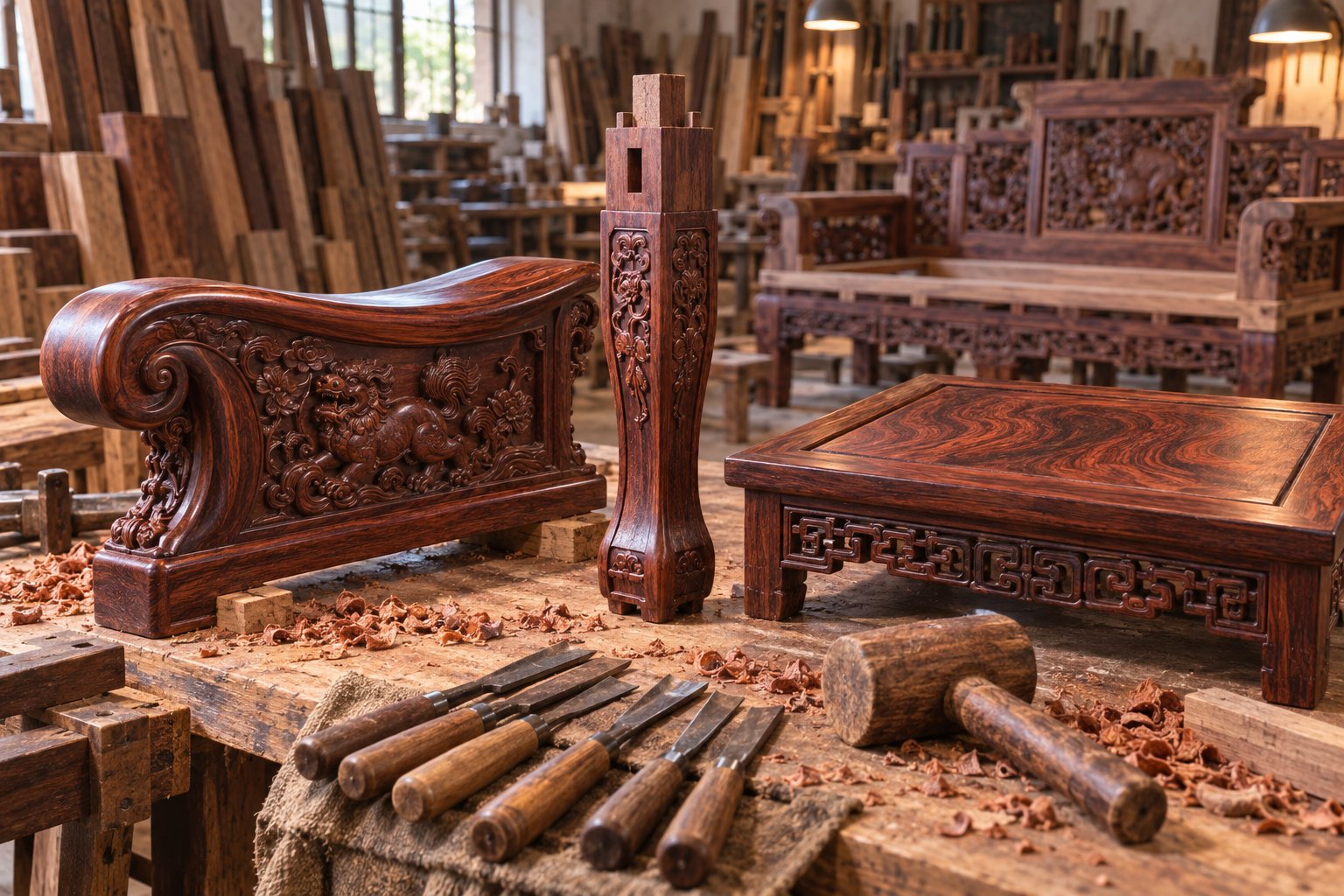
Руководство для B2B-покупателя о том, как фабрика мебели из палисандра разрабатывает образцы и прототипы для индивидуальных заказов: от рассмотрения дизайна, подбора древесины, резьбы, столярных работ, сушки, отделки до утверждения и контейнерного производства.
Why Sample Development Is the First Real Test of a Rosewood Furniture Factory
For any B2B buyer importing classical rosewood furniture, the moment that separates a reliable factory from a risky one is not the first phone call or the glossy catalog. It is the sample. A sample is the only physical proof that a factory can turn your drawings, your dimensions, your finish preferences, and your quality expectations into a real piece of furniture that will survive a container journey and years of use in an overseas climate.
Yet sample development is also the stage where most misunderstandings happen. Buyers assume a sample is simply a smaller version of the final product. Factories assume buyers understand how carving, drying, and finishing constrain what can be changed. When neither side is clear, the result is a sample that looks nothing like what was agreed, a wasted deposit, and a relationship that starts with distrust.
This guide explains, step by step, how a professional rosewood furniture factory develops samples and prototypes for custom B2B orders. It is written for importers, wholesalers, hotel and villa project buyers, and interior designers who need to know exactly what to expect, what to ask for, and how to judge whether a factory's sample process is genuinely professional. The information reflects how a real, established factory such as Yunxiao Rosewood Furniture Co., Ltd operates, drawing on the actual production practices of a 12,000-square-metre facility in Xianyou County, Putian City, Fujian, the traditional home of Chinese hardwood craft.
What a Sample Really Tells You About a Rosewood Furniture Factory
Before we walk through the process, it is worth being precise about what a sample can and cannot prove. A well-made sample demonstrates that a factory has the timber, the skilled carvers, the drying capacity, and the finishing discipline to produce a piece to your specification. It does not, by itself, prove that the factory can repeat that quality across a full container of fifty or a hundred pieces. That is why the sample stage must be paired with a clear understanding of the factory's production controls, quality inspection, and documentation.
For rosewood furniture specifically, the sample is more demanding than for many other product categories. Rosewood is a dense, oily hardwood. It moves with changes in humidity. It requires careful drying before it is worked, and it demands joinery that allows for seasonal expansion and contraction. A factory that skips these steps may produce a sample that looks beautiful in the showroom but cracks, warps, or splits after it reaches a dry climate in Australia, North America, or the Middle East. The sample process is therefore not only about appearance; it is about whether the factory understands the material well enough to build furniture that lasts.
The Sample Development Process: An Overview
A professional rosewood furniture factory follows a structured sample development process. While the exact steps vary by factory and by the complexity of the piece, the core stages are consistent. Understanding these stages helps you communicate clearly and avoid costly revisions.
- Design and specification review — turning your requirements into a buildable drawing and a clear technical brief.
- Material selection and timber sourcing — choosing the right rosewood species, grade, and moisture content for the piece.
- Pattern and template making — creating the full-size templates that guide carving and joinery.
- Carving and joinery — the hand work that gives classical rosewood furniture its character and stability.
- Drying and conditioning — ensuring the timber is stable before and after assembly.
- Finishing — applying the lacquer or beeswax finish that protects the wood and meets market compliance standards.
- Inspection and approval — checking the sample against the agreed specification and sending it for your review.
- Revision and finalisation — incorporating your feedback and locking the approved design for production.
Each of these stages is examined in detail below, with the specific questions you should ask at each point.
Stage One: Design and Specification Review
Every good sample starts with a clear specification. Before a factory cuts a single piece of timber, it must know exactly what you want. This is the stage where vague instructions cause the most problems later.
When you approach a rosewood furniture factory with a custom order, you should be prepared to provide several pieces of information. The first is the type of piece you need: a sofa set, a dining table set, a bedroom suite, a tea table, a wardrobe, or a combination for a whole-house project. The second is the style direction: Ming style, Qing style, or a contemporary adaptation of classical forms. The third is the dimensions, either in millimetres or inches, and the number of seats or pieces in the set. The fourth is the finish preference: a natural beeswax finish that shows the wood grain, a traditional lacquer finish, or a custom colour. The fifth is any special requirements, such as carved motifs, inlaid stone tops, or specific hardware.
A professional factory will respond to this brief with a technical drawing or a detailed written specification that confirms the dimensions, the materials, the joinery method, and the finish. This document becomes the contract for the sample. If the factory does not provide a written specification, or if it simply says "we will make it and show you," that is a warning sign. You cannot approve a sample against a specification that does not exist.
At Yunxiao, the design review also includes a conversation about what is realistic for the material. Rosewood is a dense hardwood, and some very thin or highly cantilevered designs are structurally risky. A good factory will tell you honestly when a design needs adjustment for stability, rather than silently building something that will not last. This honesty is part of what makes a factory trustworthy.
Stage Two: Material Selection and Timber Sourcing
The timber is the soul of any rosewood furniture piece. The species, the grade, and the moisture content all determine how the piece looks, how stable it is, and how long it lasts. This is also the stage where compliance becomes critical, because rosewood is a regulated timber under the Convention on International Trade in Endangered Species (CITES).
There are several rosewood and related hardwoods used in classical Chinese furniture. The most prized is Siamese rosewood, botanically Dalbergia cochinchinensis, a dense, richly coloured hardwood with a Janka hardness of approximately 2,430 pounds-force, according to reference data for the species. Other materials used by established factories include legally certified Machilus nanmu, aged red wood, and Grade-A tropical hardwood. Each has a different grain, colour, and working characteristic, and the choice affects both the appearance and the price of the finished piece.
When you discuss material with a factory, ask three questions. First, what species will be used, and is it the same species in the sample and in the production run? Second, what is the moisture content of the timber, and how has it been dried? Third, what documentation will accompany the shipment to prove the timber is legally sourced and compliant with CITES and the importing country's timber regulations?
A responsible factory will answer all three clearly. It will use legally certified timber, it will dry the wood to a stable moisture content, and it will provide the export documentation, including FSC chain-of-custody certificates and CITES export permits where required, that allow the shipment to clear customs in Europe, North America, Australia, or Southeast Asia. If a factory cannot or will not provide this documentation, the sample is irrelevant, because the production order will never clear customs.
Stage Three: Pattern and Template Making
Once the design and material are confirmed, the factory moves to pattern making. For carved rosewood furniture, this is a critical step. The carvers do not work freehand from a photograph. They work from full-size patterns and templates that define the exact curves, proportions, and carving motifs of the piece.
Pattern making is where the factory's experience shows. A skilled pattern maker understands how the proportions of a Ming-style chair differ from a Qing-style sofa, how the curve of an armrest should flow, and how the scale of a carved dragon or cloud motif should relate to the size of the piece. The patterns ensure that every piece in a set matches, and that the sample is a true representation of what the production run will look like.
For a custom order, the factory will create new patterns based on your specification. This is one reason custom samples take time and cost more than ordering from an existing catalog. The pattern-making stage is also where you can request changes most cheaply. If you want a different curve on an armrest, a different carving motif, or a different proportion, it is far easier and less expensive to change the pattern than to change a finished piece of carved rosewood.
Stage Four: Carving and Joinery
This is the heart of classical rosewood furniture, and the stage that most clearly separates a genuine craftsman from a mass-production operation. Two things define the quality of this stage: the carving and the joinery.
Carving is the hand work that gives classical Chinese furniture its character. Master artisans hand-chisel motifs such as dragons, clouds, lattice patterns, ruyi symbols, and floral designs into the solid rosewood using traditional tools and methods passed down through generations. The depth, the sharpness, and the flow of the carving are what make a piece look alive rather than mechanical. When you examine a sample, look at the carving closely. Are the lines crisp and clean? Does the motif have depth and dimension, or does it look flat and rushed? Is the carving consistent across the piece?
Joinery is equally important, and it is the reason classical rosewood furniture can last for generations. Traditional Chinese furniture uses mortise-and-tenon joinery, in which precisely cut tenons fit into matching mortises, often reinforced with wooden dowels, to hold the piece together without metal nails or screws. This is not a stylistic choice; it is an engineering decision. Rosewood expands and contracts with changes in humidity, and a rigid metal fastener will eventually loosen or cause the wood to split. Mortise-and-tenon joinery allows the wood to move naturally while keeping the structure stable.
When you inspect a sample, ask to see the joinery. A professional factory will be proud to show you how the frame is assembled. Look for tight, clean joints with no gaps, no visible glue squeeze-out, and no metal fasteners in the primary frame. The absence of metal nails is a hallmark of quality classical furniture, and it is directly relevant to how the piece will behave in an overseas climate.
Stage Five: Drying and Conditioning
Drying is the stage that most buyers never see, but it is the single most important factor in whether rosewood furniture survives in an overseas climate. Rosewood is a dense, oily hardwood that holds moisture. If it is not dried correctly, it will crack, warp, or split after it reaches a different climate.
A professional factory dries its timber in a controlled process. At Yunxiao, each product undergoes a 36-day constant-humidity drying process. This is not a quick kiln cycle; it is a deliberate, slow conditioning that brings the timber to a stable moisture content and allows it to adjust to the humidity it will experience in service. The goal is to minimise the risk of cracking and deformation once the furniture is in a home, hotel, or villa in a dry or seasonally variable climate.
When you evaluate a factory, ask about its drying process. How long does the timber dry? Is the drying done in a controlled environment? What is the target moisture content? A factory that can explain its drying process in specific terms is far more likely to produce furniture that lasts than one that treats drying as an afterthought. The sample is your chance to verify this, because a properly dried piece will feel stable and well-conditioned, while a poorly dried piece may already show signs of stress.
Stage Six: Finishing
The finish protects the rosewood, enhances its natural colour and grain, and determines how the piece feels to the touch. Classical Chinese furniture uses traditional finishes that are both beautiful and practical.
Two common finishes are beeswax and lacquer. A beeswax finish is applied in thin, hand-rubbed coats that allow the natural wood grain to show through while providing a protective, low-sheen surface. A traditional lacquer finish is applied in multiple cured coats, building up a durable, glossy surface that protects the wood and is easier to clean. The choice depends on the style of the piece and the buyer's preference.
Finishing is also where compliance matters. The finishes used by a professional factory should meet the chemical safety standards of the markets it serves. At Yunxiao, the eco-friendly beeswax and lacquer finishing meets EU REACH and US CARB standards, which means the finished furniture is safe for use in homes, hotels, and commercial spaces in Europe and North America. When you discuss finishing with a factory, ask whether the finishes meet the relevant compliance standards for your market, and ask for documentation if needed.
When you inspect a sample, look at the finish closely. Is it even and smooth, with no runs, bubbles, or cloudy patches? Does it enhance the wood grain rather than hide it? Does the surface feel consistent to the touch? A high-quality finish is one of the clearest signs of a factory that cares about the final product.
Stage Seven: Inspection and Approval
Once the sample is complete, the factory inspects it against the agreed specification before sending it to you. This inspection checks the dimensions, the carving, the joinery, the finish, and the overall quality against the technical brief. A professional factory will not send a sample it has not inspected, because a flawed sample wastes everyone's time.
When you receive the sample, you should inspect it just as carefully. Measure the dimensions against the specification. Examine the carving and joinery. Check the finish. Test the stability of the piece by applying gentle pressure to the joints. Look for any cracks, warping, or defects. Take photographs from multiple angles so you have a record of what was approved.
This is also the time to verify that the sample matches the material you agreed on. If you specified Siamese rosewood, the sample should be made of Siamese rosewood, not a cheaper substitute. If you specified a particular finish, the sample should show that finish. Any discrepancy at the sample stage will only grow at the production stage, so it is essential to catch it now.
Stage Eight: Revision and Finalisation
Very few samples are approved on the first attempt. Most custom orders go through at least one round of revision, and sometimes several. This is normal and expected. The sample process exists precisely so that you can refine the design before committing to a full production run.
When you request a revision, be specific. Instead of saying "the armrest looks wrong," say "the armrest curve should be shallower, and the carving motif should be a cloud pattern rather than a dragon." Specific feedback allows the factory to make the change correctly the first time, saving time and money for both sides.
A professional factory will track revisions carefully and keep a record of what was changed and why. This record becomes the basis for the final approved design, which is then locked for production. Once you approve the final sample, the factory should provide a clear written confirmation of the approved design, the materials, the finish, and the dimensions. This approved sample becomes the quality benchmark against which the entire production run is measured.
From Sample to Container Production
Approving a sample is not the end of the process; it is the beginning of production. Understanding how the factory scales from one sample to a full container is essential, because this is where quality can drift.
A full container of rosewood furniture typically holds a large number of pieces, and the factory must reproduce the approved sample's quality across every one of them. This requires disciplined production controls: consistent material sourcing, standardised patterns, trained carvers, and a quality inspection process at each stage.
Ask the factory how it ensures consistency across a production run. Does it use the same patterns and templates for every piece? Does it inspect each piece against the approved sample? Does it have a final inspection before packing? A factory that can answer these questions specifically is more likely to deliver a container that matches your approved sample.
At Yunxiao, container orders typically take 45 to 60 working days after the deposit, depending on the size and complexity of the order. This lead time reflects the drying, carving, finishing, and inspection that go into each piece. A factory that promises an unrealistically short lead time for carved rosewood furniture is probably cutting corners on drying or craftsmanship.
Sample Costs, MOQ, and Lead Times
Cost is one of the first questions every buyer asks, and it deserves a straight answer. Sample development for custom rosewood furniture involves real costs: the timber, the pattern making, the carver's time, the finishing, and the shipping. A professional factory will quote a sample cost that reflects these inputs, and it will be transparent about what the sample cost covers and whether it is refundable against a production order.
Many established factories offer refundable samples, meaning the sample cost is credited toward your first production order. This is a sign of confidence in the relationship and a practical way to reduce the buyer's risk. At Yunxiao, refundable samples and trial single sets are available, allowing buyers to verify quality before committing to a full container.
Minimum order quantities (MOQ) also vary. Some factories require a full container for custom orders, while others offer lower MOQs or trial single sets for first-time buyers. If you are new to importing rosewood furniture, a trial single set or a low-MOQ first order is a sensible way to test the factory's quality and reliability before scaling up.
Lead times for samples are shorter than for production, but they are not instant. A custom sample of a carved rosewood piece typically takes several weeks, because it involves pattern making, carving, drying, and finishing. Ask the factory for a realistic sample lead time and build it into your project schedule.
Quality and Compliance Documentation
For rosewood furniture, documentation is not a formality; it is a legal requirement. Rosewood is a CITES-regulated timber, and importing it into Europe, North America, Australia, or other markets requires proof that the timber was legally sourced and that the shipment complies with the relevant regulations.
A professional factory will provide the documentation you need to clear customs. This includes the export documents prepared by its internal team, FSC chain-of-custody certificates where applicable, CITES export permits issued by the Chinese CITES Management Authority, and ISPM 15 heat-treated packaging certificates. The packaging itself is also important, because ISPM 15 compliance ensures the wooden crates and pallets meet international phytosanitary standards.
When you discuss a sample or a production order, ask exactly what documentation will be provided. A factory that can list the documents it will supply, and that treats compliance as a routine part of its service, is far more reliable than one that is vague on the subject. The sample stage is a good time to confirm this, because you do not want to discover a documentation problem after the container has shipped.
Common Mistakes Buyers Make During Sample Development
Even experienced buyers make mistakes during sample development. Knowing these pitfalls in advance can save you time, money, and frustration.
- Not providing a written specification. If you rely on verbal descriptions or a single photograph, the factory cannot build to your exact requirements. Always provide written dimensions, materials, finish, and style details.
- Approving a sample without checking the material. Confirm that the sample is made of the exact species and grade you agreed on, not a substitute.
- Ignoring the joinery. A beautiful carving can hide poor joinery. Always inspect how the frame is assembled and confirm there are no metal nails in the primary structure.
- Not asking about drying. The drying process determines whether the furniture will survive in your climate. Ask about it explicitly.
- Requesting vague revisions. Specific feedback produces correct revisions. Vague feedback produces more rounds of back-and-forth.
- Forgetting about compliance documentation. Confirm the export and CITES documentation before production, not after the container has shipped.
- Assuming the sample guarantees the whole container. The sample is a benchmark, not a guarantee. Ask how the factory ensures consistency across the production run.
How to Judge Whether a Factory's Sample Process Is Professional
By this point, you have a clear picture of what a professional sample process looks like. Here is a practical checklist you can use to evaluate any rosewood furniture factory.
- Does the factory provide a written specification or technical drawing before cutting timber?
- Can it name the exact timber species and explain its drying process in specific terms?
- Does it use mortise-and-tenon joinery without metal nails in the primary frame?
- Does it offer refundable samples or trial single sets?
- Can it provide the export, FSC, CITES, and ISPM 15 documentation you need?
- Does it give a realistic sample and production lead time?
- Does it track revisions and lock the approved design for production?
- Does it explain how it ensures consistency across a full container?
If a factory answers yes to most of these questions, its sample process is likely professional. If it is vague, evasive, or unable to answer, treat that as a warning sign, regardless of how attractive its catalog looks.
Why Yunxiao's Sample Process Is Built for B2B Buyers
Yunxiao Rosewood Furniture Co., Ltd was founded in 2008 and operates a 12,000-square-metre factory in Xianyou County, Putian City, Fujian, the traditional home of Chinese hardwood craft. The company manufactures and exports full sets of classical solid redwood furniture for global wholesalers, hotels, and designers across Europe, North America, Australia, and Southeast Asia.
Its sample process is built around the needs of B2B buyers. The factory uses legally certified Machilus nanmu, aged red wood, and Grade-A tropical hardwood, and it assembles all furniture without metal nails to avoid cracking and deformation. Each product undergoes a 36-day constant-humidity drying process and an eco-friendly beeswax and lacquer finish that meets EU REACH and US CARB standards. The company supplies carved sofas with tea tables, 6-to-12-seat dining sets, and complete bedroom suites, with flexible OEM and ODM custom sizes and patterns for villas and resorts.
For buyers, the practical benefits are clear. Yunxiao offers trial single sets and refundable samples, so you can verify quality before committing to a full container. Its internal team prepares full export documents, FSC certificates, and ISPM 15 heat-treated packaging. Container orders take 45 to 60 working days after deposit, and partial shipments are available for long-term partners. The company also provides remote installation guidance and free layout drawings for projects, which is especially valuable for hotel and villa buyers who need to plan the placement of multiple sets.
Frequently Asked Questions
How much does a custom rosewood furniture sample cost?
Sample costs vary with the size, complexity, and material of the piece. A professional factory will quote a transparent sample cost that reflects the timber, pattern making, carving, finishing, and shipping. Many established factories, including Yunxiao, offer refundable samples, meaning the sample cost is credited toward your first production order.
How long does a custom sample take to produce?
A custom sample of a carved rosewood piece typically takes several weeks, because it involves pattern making, carving, drying, and finishing. Ask the factory for a realistic sample lead time and build it into your project schedule.
Can I order a single set before committing to a full container?
Yes. Many factories, including Yunxiao, offer trial single sets for first-time buyers. This is a sensible way to test the factory's quality and reliability before scaling up to a full container order.
Is the sample made of the same material as the production run?
It should be. Confirm with the factory that the sample is made of the exact species and grade you agreed on, and that the production run will use the same material. This is essential for consistency.
What documentation will I receive with the shipment?
A professional factory will provide the export documents, FSC chain-of-custody certificates where applicable, CITES export permits, and ISPM 15 heat-treated packaging certificates needed to clear customs in your market. Confirm this before production.
What if I want to change the design after approving the sample?
Changes after sample approval are possible but may affect the lead time and cost, because they require new patterns or rework. It is far more efficient to refine the design during the sample stage, before production begins.
How do I know the sample quality will be repeated across the whole container?
Ask the factory how it ensures consistency across a production run: whether it uses the same patterns and templates, inspects each piece against the approved sample, and performs a final inspection before packing. A factory with disciplined production controls is more likely to deliver a consistent container.
Conclusion: The Sample Is Your Best Risk-Management Tool
For any B2B buyer of classical rosewood furniture, the sample is the single most valuable risk-management tool you have. It is the only way to verify, with your own eyes and hands, that a factory can turn your specification into a real piece of furniture that meets your quality, material, and compliance requirements.
The process is not complicated, but it demands discipline on both sides. Provide a clear written specification. Ask the right questions about material, drying, joinery, finishing, and documentation. Inspect the sample carefully. Give specific feedback. And confirm, before production, how the factory will maintain consistency across the full container.
When you work with a factory that treats sample development seriously, you are not just buying a piece of furniture. You are building a relationship with a partner who understands that your reputation, and theirs, depends on every piece that leaves the workshop. That is the kind of factory worth importing from.
If you are planning a custom rosewood furniture project, whether for a hotel, a villa, a restaurant, or a wholesale catalog, start by discussing your requirements with a factory that can show you its sample process. Ask for a trial single set or a refundable sample, and judge the factory by how it responds. The sample you approve today is the quality you will receive in every container tomorrow.
OEM versus ODM: How the Sample Process Differs
When you discuss custom rosewood furniture with a factory, you will hear two terms that are often confused: OEM and ODM. Understanding the difference matters, because it changes what the sample process looks like and what you are responsible for.
OEM, or Original Equipment Manufacturing, means the factory produces furniture to your design and specification. You provide the drawings, the dimensions, the materials, and the finish requirements, and the factory manufactures the pieces to your exact specification. In an OEM relationship, the design belongs to you, and the factory's role is to execute it faithfully. The sample process for OEM is focused on verifying that the factory can reproduce your design accurately, with the right material, joinery, and finish.
ODM, or Original Design Manufacturing, means the factory provides the design as well as the manufacturing. The factory has its own catalog of classical rosewood furniture designs, and you select from those designs, possibly with modifications. In an ODM relationship, the factory brings its design expertise, and you benefit from its experience with what works in different markets. The sample process for ODM is often faster, because the factory already has patterns and templates for its existing designs, and the sample may be closer to a finished catalog piece with minor customisation.
For a B2B buyer, the choice between OEM and ODM depends on your needs. If you have a specific design in mind, or if you want exclusive pieces that no other buyer can offer, OEM gives you that control. If you want to move quickly and benefit from the factory's design expertise, ODM is often more efficient. Many factories, including Yunxiao, offer both, with flexible custom sizes and patterns for villas and resorts.
Whichever model you choose, the sample process follows the same core stages. The difference is in how much design work you do yourself and how much you delegate to the factory. Be clear about which model you are using, because it affects the sample cost, the lead time, and who owns the design.
Whole-House and Project Orders: Planning Beyond a Single Sample
Many B2B buyers are not ordering a single sofa or dining set. They are furnishing a hotel, a villa, a restaurant, a banquet hall, or a whole residential project, which means coordinating multiple sets that must work together as a cohesive whole. This changes the sample process in important ways.
For a whole-house or project order, the factory must ensure that the different pieces share a consistent style, finish, and material. A sofa set, a dining set, and a bedroom suite from the same project should look like they belong together, even though they are different types of furniture. This requires careful planning at the design stage, and it often means developing samples of the key pieces first, then using those approved samples as the benchmark for the rest of the order.
Layout is also a practical concern for project buyers. A hotel lobby, a villa living room, or a restaurant dining area has specific dimensions, and the furniture must fit the space and the traffic flow. This is why a professional factory offers free layout drawings for projects. These drawings help you visualise how the furniture will sit in the space, check the dimensions against the room, and plan the placement of multiple sets before you commit to production.
When you plan a whole-house or project order, discuss the full scope with the factory at the start. Provide the room dimensions, the number of pieces you need, and the overall style direction. The factory can then advise on how to sequence the sample development, which pieces to sample first, and how to ensure consistency across the entire project. This upfront planning saves time and money later, and it is the difference between a project that comes together smoothly and one that requires constant rework.
Comparing Common Rosewood and Hardwood Species
Because the material is so central to the quality and price of classical furniture, it helps to understand the main species a buyer will encounter. The table below summarises the characteristics of the materials commonly used by established factories.
| Material | Characteristics | Typical Use |
|---|---|---|
| Siamese Rosewood (Dalbergia cochinchinensis) | Dense, richly coloured hardwood; Janka hardness approximately 2,430 lbf; fine grain; takes a high polish | Premium carved sofas, dining sets, bedroom suites, tea tables |
| Machilus Nanmu | Legally certified timber with a warm, even tone; stable and workable | Classical furniture frames and panels |
| Aged Red Wood | Mature timber with deep colour and stable grain | Classical and reproduction furniture |
| Grade-A Tropical Hardwood | High-grade, dense hardwood suitable for structural frames | Frames and structural components |
When you compare materials, remember that the species affects not only the appearance but also the price, the stability, and the compliance requirements. Siamese rosewood is a CITES-regulated species, so shipments require proper documentation. A professional factory will be transparent about which species it uses and will provide the documentation that allows the shipment to clear customs. Do not assume that a lower price means a lower grade of the same species; it may mean a different species entirely, so always confirm the material in writing.
How to Prepare for Your First Sample Discussion
If you are new to importing custom rosewood furniture, the sample discussion can feel overwhelming. Here is a practical checklist to help you prepare, so that you get the most value from the conversation and avoid common misunderstandings.
- Write down the type of piece you need and the number of pieces or seats in the set.
- Decide on the style direction: Ming, Qing, or a contemporary adaptation.
- Provide the dimensions in millimetres or inches, and note any space constraints.
- Specify the finish: natural beeswax, traditional lacquer, or a custom colour.
- List any special requirements, such as carved motifs, inlaid stone tops, or specific hardware.
- Ask about the material species, the drying process, and the target moisture content.
- Ask about the sample cost, whether it is refundable, and the sample lead time.
- Ask about the MOQ, the production lead time, and whether trial single sets are available.
- Confirm the documentation that will accompany the shipment, including FSC and CITES documents.
- Ask how the factory ensures consistency across a full container.
Bringing this information to your first discussion shows the factory that you are a serious, organised buyer, and it helps the factory give you an accurate quote and a realistic timeline. The more specific you are, the better the sample will match your expectations.
Building a Long-Term Relationship Through the Sample Process
The sample process is not just a one-time transaction. For buyers who plan to import rosewood furniture repeatedly, the first sample is the foundation of a long-term relationship. A factory that handles your first sample well, communicates clearly, meets its commitments, and delivers a sample that matches your specification is a factory worth building a partnership with.
Long-term partners often benefit from arrangements that are not available to one-time buyers. At Yunxiao, partial shipments are available for long-term partners, which allows buyers to receive goods in stages rather than waiting for a full container. This is valuable for buyers who need to manage cash flow, test the market, or furnish a project in phases.
When you find a factory that earns your trust through the sample process, invest in the relationship. Communicate openly, provide clear specifications, pay on time, and give constructive feedback. A good factory will reciprocate with consistent quality, reliable lead times, and honest advice. Over time, this partnership becomes one of your most valuable assets as an importer of classical rosewood furniture.