
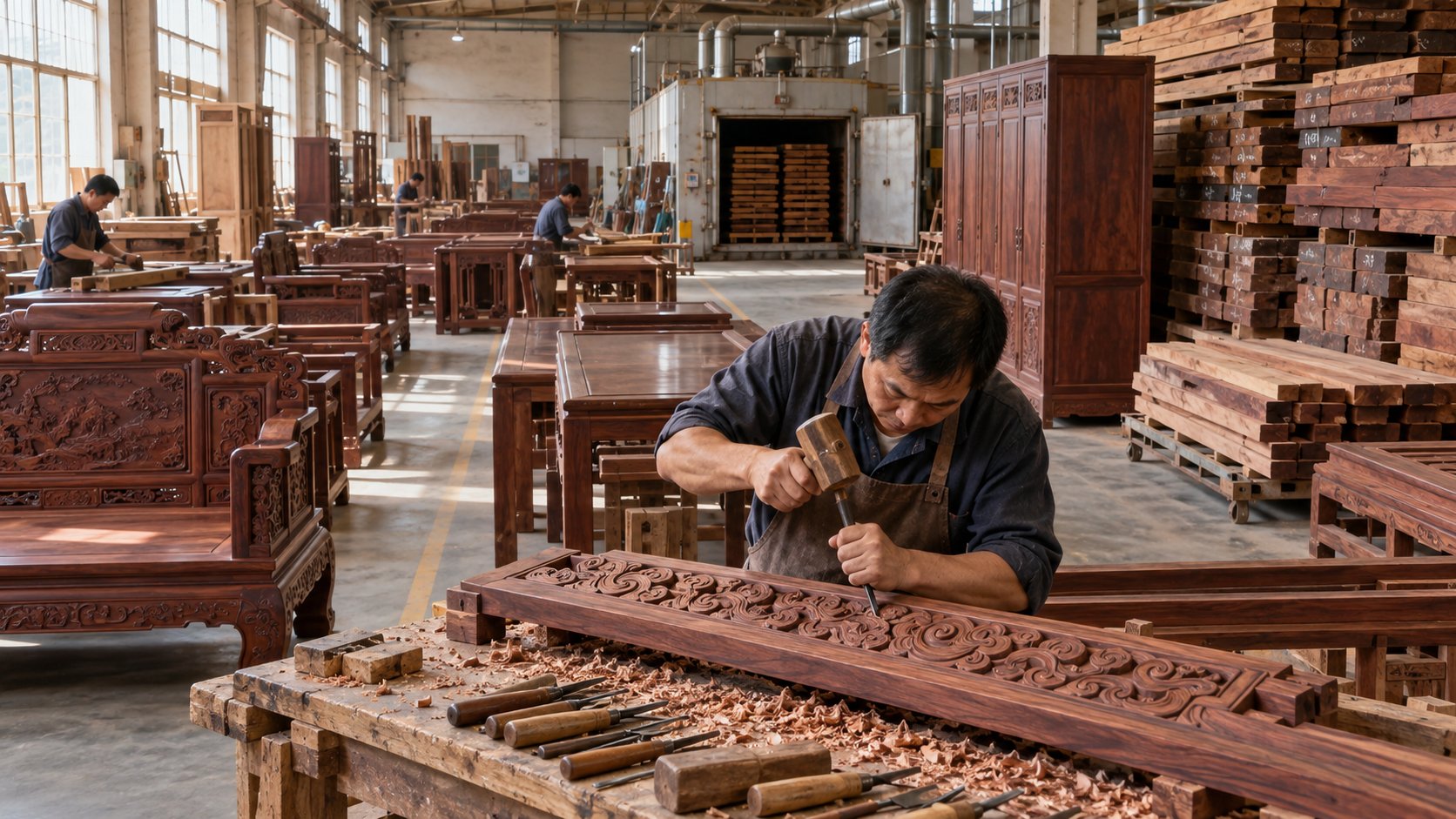
Repeat container orders test a rosewood furniture factory far more than a first order. This guide explains how capacity planning, production scheduling, batch quality control, documentation discipline and container coordination keep repeat orders on time for B2B importers.
Repeat container orders are where a rosewood furniture factory either proves itself or quietly falls apart. A first order is a test of capability; a repeat program is a test of system. Importers who buy classical rosewood furniture for hospitality, residential or retail projects rarely stop at one container. They come back, season after season, and each return order carries the same expectation: the same quality, the same finish, the same delivery window, and no surprises.
This guide explains how a Chinese rosewood furniture factory manages production capacity and delivery reliability across repeat container orders. It is written for B2B importers, distributors and project buyers who need to understand what happens inside a factory between the purchase order and the loaded container, and what to ask before committing to a long-term supply relationship.
Why Repeat Orders Are a Different Problem from First Orders
A first order is usually negotiated around price, sample approval and a single delivery date. A repeat order is negotiated around trust that has already been earned and must now be sustained. The commercial pressure is different. On a first order, a buyer can absorb a small delay. On a repeat order, a delay can break a retail launch, a hotel opening date or a distributor's commitment to its own customers.
The operational pressure is also different. A factory that is running several repeat programs at once is juggling timber procurement, drying schedules, carving capacity, finishing capacity, packing and container booking simultaneously. The question is not whether the factory can make one beautiful set. It is whether it can make the four hundredth set to the same standard as the first, on a date that was promised months earlier.
The three failure modes of a repeat-order program
In practice, repeat-order programs fail in three predictable ways. Understanding them helps a buyer ask the right questions.
- Capacity drift. The factory accepts more orders than its carving or drying capacity can absorb, and lead times quietly stretch. The buyer learns about it only when the shipping date slips.
- Quality drift. Timber batches change, artisan teams rotate, and finishing consistency loosens. The second container looks subtly different from the first.
- Communication drift. Milestone updates stop arriving, documentation becomes inconsistent, and the buyer is left chasing information instead of planning.
A factory with a real repeat-order system has an answer for each of these. A factory without one will answer vaguely.
How a Rosewood Furniture Factory Plans Capacity
Capacity planning is the foundation of delivery reliability. For a rosewood furniture factory, capacity is not a single number. It is a set of constraints, and the tightest constraint sets the real ceiling on output.
Carving capacity is the hardest constraint to expand
Hand carving is the signature of classical rosewood furniture, and it is also the least elastic part of production. A skilled carver cannot be hired and productive within a week. Training takes years, and the finest work is concentrated in a small number of experienced hands. This means a factory's true output ceiling is often set not by its floor space or its machinery, but by how many qualified carvers it can keep working steadily.
When a factory plans capacity honestly, it plans around carving first. It knows how many carver-hours a given sofa set, dining set or bedroom suite consumes, and it refuses orders that would push the carving team beyond a sustainable pace. A factory that accepts everything and hopes to catch up is a factory that will eventually deliver late.
Drying capacity sets the floor on lead time
Solid hardwood must be dried properly before it is cut and joined. In a humid production region, rushed drying is the single most common cause of cracking and movement in overseas climates. A disciplined factory uses controlled drying that cannot be compressed without risking the furniture's long-term stability.
Because drying is a physical process with a fixed minimum duration, it sets a floor on how fast any order can move. Capacity planning therefore has to account for drying chamber availability, not just assembly benches. When a factory tells a buyer that a container will ship in a certain number of working days, that number should already include the drying time, not assume it away.
Finishing and packing capacity complete the picture
Finishing and packing are the last stages before shipment, and they are frequently underestimated. Traditional lacquer and wax finishing involves multiple coats with drying intervals between them. Packing carved furniture for a sea container is skilled work that takes time to do properly. A factory that plans capacity only up to the assembly stage will discover a bottleneck at finishing, exactly when the shipping date is closest.
What to ask: "How many carvers do you have, and how many carver-hours does one of my sets consume? How many drying chambers do you run, and what is the minimum drying cycle you will accept?" A factory that can answer these with specific numbers is planning capacity. A factory that answers with adjectives is not.
Production Scheduling: How a Factory Allocates Slots
Capacity is what a factory can do. Scheduling is what it chooses to do first. For repeat clients, scheduling discipline is the difference between a predictable program and a permanent state of firefighting.
Slot allocation and the production calendar
A well-run factory maintains a production calendar that maps orders to time slots across each production stage. When a repeat order is confirmed, it is not simply added to a pile; it is assigned slots in drying, carving, assembly, finishing and packing. This is what allows the factory to give a realistic shipping date rather than an optimistic one.
For the buyer, the practical implication is that the shipping date should be traceable to a schedule, not to a sales promise. If a factory can explain which stage your order occupies and when it will move to the next, the date is credible.
How mixed and custom orders are sequenced
Repeat orders are rarely identical. A distributor may reorder a best-selling sofa set but add a new dining configuration, or a hotel project may expand from one floor to three. Sequencing mixed and custom work alongside standard repeat work is a genuine scheduling challenge, because custom pieces consume more design and setup time.
A disciplined factory separates the two streams where possible, running standard repeat items on a steadier rhythm while giving custom items dedicated setup windows. This prevents custom work from repeatedly interrupting the standard line, which is a common cause of delay for repeat clients.
Protecting committed clients under load
The real test of scheduling discipline comes when a factory is busy. Under load, the temptation is to accept new orders and let existing ones slip. A factory that values repeat business does the opposite: it protects committed clients first and declines or defers new work that would compromise them.
Buyers should ask directly how the factory behaves when it is at capacity. The answer reveals whether the relationship is treated as a program or as a series of transactions.
Holding Quality Steady Across Batches
Quality consistency across batches is the hardest promise a factory makes to a repeat client. Timber is a natural material, artisans are human, and finishing is partly craft. Consistency is not automatic; it is engineered.
Timber selection and batch matching
Color and grain vary between logs, and even within a single log. For a repeat order, the factory must match new timber to the character of the previous batch so that a customer receiving a second container does not see a visibly different product. This requires either reserved stock from the same source or careful selection and grading against a retained reference sample.
Retaining a physical reference sample from the original order is one of the simplest and most effective consistency tools. It gives the factory a concrete standard to match against, rather than relying on memory or photographs.
Carving consistency and artisan assignment
Carving style is personal. Two carvers working from the same drawing can produce subtly different results. For repeat orders, consistency is best protected by assigning the same carving team, or at least the same lead carver, to the recurring product line. This is a scheduling decision as much as a craft decision, and it is one reason why carving capacity and scheduling are so tightly linked.
Finishing consistency
Finishing is where small variations become visible. Sheen level, color depth and surface texture all depend on the number of coats, the interval between them, and the conditions in the finishing area. A factory that documents its finishing specification for each product line, and holds to it batch after batch, gives the buyer a product that looks the same on the tenth container as on the first.
Quality Checkpoints Across the Production Cycle
Quality is not inspected at the end; it is built in at each stage. A repeat-order program should have defined checkpoints that catch problems while they are still cheap to fix.
Incoming timber and drying checkpoints
Before any cutting begins, incoming timber should be checked for species, grade and moisture content. Drying should be monitored and recorded, because moisture content at the point of assembly determines how the finished piece behaves in a different climate. A factory that records these values can show a buyer evidence, not just assurance.
In-process checkpoints
Joinery, carving and assembly each deserve their own inspection points. Checking joinery before finishing, for example, catches structural issues while the piece can still be corrected without refinishing. In-process checkpoints are what prevent a defect from travelling all the way to the packed container.
Pre-shipment inspection
Before loading, every piece should be inspected against the approved sample and the order specification. This is the buyer's last practical opportunity to catch a problem before it becomes an international claim. A factory that welcomes third-party inspection, rather than resisting it, is signalling confidence in its own process.
Milestone reporting for repeat clients
For repeat clients, inspection results should be reported as milestones, not saved for a single end-of-production summary. Photographs at defined stages, moisture readings, and inspection sign-offs give the buyer a running picture of progress and reduce the anxiety that leads to constant chasing.
Documentation and Export Process Discipline
Documentation is unglamorous and decisive. A container that is ready but undocumented does not ship. For repeat programs, documentation discipline compounds: a small inconsistency in one shipment becomes a pattern that creates friction at every subsequent customs clearance.
The standard document set
A well-organised export shipment typically includes a commercial invoice, packing list, bill of lading, certificate of origin where applicable, and any timber-related compliance documentation required by the destination market. For hardwood furniture, documentation of legal and, where relevant, certified timber sourcing is increasingly expected by buyers in Europe and North America.
Why documentation discipline matters more on repeat orders
On a first order, a buyer may tolerate a slow document turnaround. On a repeat program, the buyer's own customs broker, warehouse and retail schedule depend on predictable paperwork. Consistency in document format, product descriptions and HS classification across shipments keeps clearance smooth and avoids the delays that come from mismatched paperwork.
Packing standards as a non-negotiable
Carved furniture is vulnerable in transit. Corners, carved details and protruding elements need protection that survives stacking, vibration and humidity changes at sea. Packing standards should be fixed for a product line and applied identically on every repeat shipment. A factory that changes packing methods between shipments is introducing a variable that the buyer cannot control.
Container Coordination and Shipping Reliability
The container is where production meets logistics, and it is where many otherwise well-run orders lose their schedule.
Loading plans and damage prevention
A loading plan determines how pieces are arranged, braced and protected inside the container. For irregular, carved and heavy items, a considered loading plan prevents both damage and wasted space. Repeat clients benefit when the factory retains a loading plan for their product line, so each shipment is loaded the same proven way.
Partial shipments and staged delivery
Large project orders sometimes need to ship in stages. Staged delivery can be an advantage, but only if the factory can sequence production so that the first shipment is complete and correct rather than a random subset of the order. This requires the scheduling discipline described earlier.
Communication through the shipping window
The period between production completion and vessel departure is when uncertainty peaks. Booking confirmation, container pickup, loading date and departure should be communicated proactively. A factory that reports these milestones without being asked is managing the relationship; one that only responds to enquiries is managing the transaction.
After-Sales Continuity Across a Program
Repeat business is built on what happens after delivery as much as before it. A buyer who has never needed after-sales support still cares deeply about whether it exists.
Defect resolution and root-cause handling
When a defect appears, the useful question is not only how it will be resolved but why it happened. A factory that investigates root causes and adjusts its process prevents the same defect from recurring in the next container. This is the difference between fixing a problem and ending a pattern.
Remote installation guidance and project support
For project buyers, installation guidance matters. Large carved pieces, modular sets and whole-house configurations benefit from clear assembly and placement instructions. Remote support, layout drawings and installation guidance reduce the risk of damage during installation and improve the end client's experience.
Warranty and long-term accountability
A warranty is only meaningful if the factory behind it is still engaged years later. For repeat programs, warranty terms should be clear, documented and consistent across shipments. Buyers should understand what is covered, what is not, and how a claim is handled in practice.
What to Ask a Factory Before Committing to a Repeat Program
The following questions separate a factory with a real repeat-order system from one that is improvising.
| Area | Question to ask | What a good answer looks like |
|---|---|---|
| Capacity | How many carvers and drying chambers do you run, and how do you cap intake? | Specific numbers and a stated limit on concurrent orders |
| Scheduling | How is my order slotted across production stages? | A stage-by-stage calendar with dates |
| Consistency | How do you match a new batch to my previous order? | Retained reference samples and reserved timber |
| Quality | What checkpoints exist, and will you share records? | Defined checkpoints with documented results |
| Documentation | What is your standard document set and turnaround? | A fixed list and a realistic timeline |
| Logistics | Do you keep a loading plan for my product line? | A retained plan reused each shipment |
| After-sales | How are defects investigated and prevented? | A root-cause process, not just a replacement promise |
Red Flags in a Repeat-Order Relationship
Certain signals suggest that a factory's repeat-order capability is weaker than its sales presentation.
- Shipping dates that are given instantly, without reference to a production calendar.
- Reluctance to share in-process photographs or inspection records.
- No retained reference sample from previous orders.
- Packing methods that change between shipments without explanation.
- Milestone updates that only arrive after the buyer asks.
- Willingness to accept unlimited new orders while existing clients wait.
None of these is fatal on its own. A pattern of them is a warning that the factory is selling capacity it does not have.
How Yunxiao Structures Repeat-Order Programs
Yunxiao Rosewood Furniture Co., Ltd has manufactured classical rosewood furniture in Xianyou County, Putian, Fujian since 2008, operating a 12,000 square metre factory. The company works with legally certified Machilus Nanmu, aged redwood and A-grade tropical hardwoods, and builds with mortise and tenon joinery rather than metal nails.
For repeat-order clients, several practices support delivery reliability. Timber is dried under controlled humidity conditions over a 36-day cycle, which protects stability in overseas climates. Finishing uses beeswax and traditional lacquer processes formulated to meet EU REACH and US CARB requirements. FSC documentation is available, and export packing follows ISPM 15 heat-treatment standards.
Container orders typically ship within 45 to 60 working days after deposit. The factory supports trial orders, offers refundable samples, provides remote installation guidance and supplies free layout drawings for project buyers. Its markets include Europe, North America, Southeast Asia and Australia.
These are the operational facts a buyer can verify. They are also the foundation on which a repeat program is built: a factory that knows its own drying cycle, its own finishing specification and its own export documentation is a factory that can repeat them.
Destination-Market Considerations for Repeat Programs
Repeat-order reliability is not identical across markets. Different destinations place different demands on documentation, packing and product specification.
Europe
European buyers typically expect clear timber legality documentation and finishing that meets EU chemical requirements. Repeat programs to Europe benefit from a stable document set and consistent HS classification, because customs scrutiny tends to increase with shipment frequency.
North America
North American importers often combine retail and project business, which means repeat orders may mix standard sets with custom configurations. Finishing compliance with US CARB requirements and consistent packing for long inland transit are practical priorities.
Southeast Asia
Shorter shipping distances and humid climates put the emphasis on moisture control and packing that resists humidity. Repeat programs in this region benefit from consistent drying records and packing that protects against condensation.
Australia
Australian importers face strict biosecurity requirements, which makes ISPM 15 compliant packing and clean documentation essential. Consistency across shipments reduces the risk of inspection delays.
A Worked Example: Planning a Season of Repeat Orders
Consider a distributor who orders one container of classical rosewood sofa and dining sets, then plans three more containers across the following year for a retail and hospitality client base.
In a well-run program, the first order establishes the reference: approved samples, a retained timber reference, a fixed finishing specification, a packing standard and a loading plan. The factory records these and treats them as the baseline for every subsequent container.
Before each repeat order is confirmed, the factory checks capacity against its production calendar and confirms a shipping window that already includes drying time. As production proceeds, milestone photographs and inspection records are shared at defined stages. Documentation is prepared in the same format as the previous shipment. The container is loaded using the retained plan.
The result is not that nothing ever goes wrong. It is that problems are caught early, communicated honestly and prevented from recurring. That is what a repeat-order program actually delivers: predictability, which is worth more to an importer than any single low price.
Planning a repeat container program for classical rosewood furniture? Share your product list, target market and delivery window, and we will confirm capacity, lead time and documentation requirements.
Request production and delivery details