
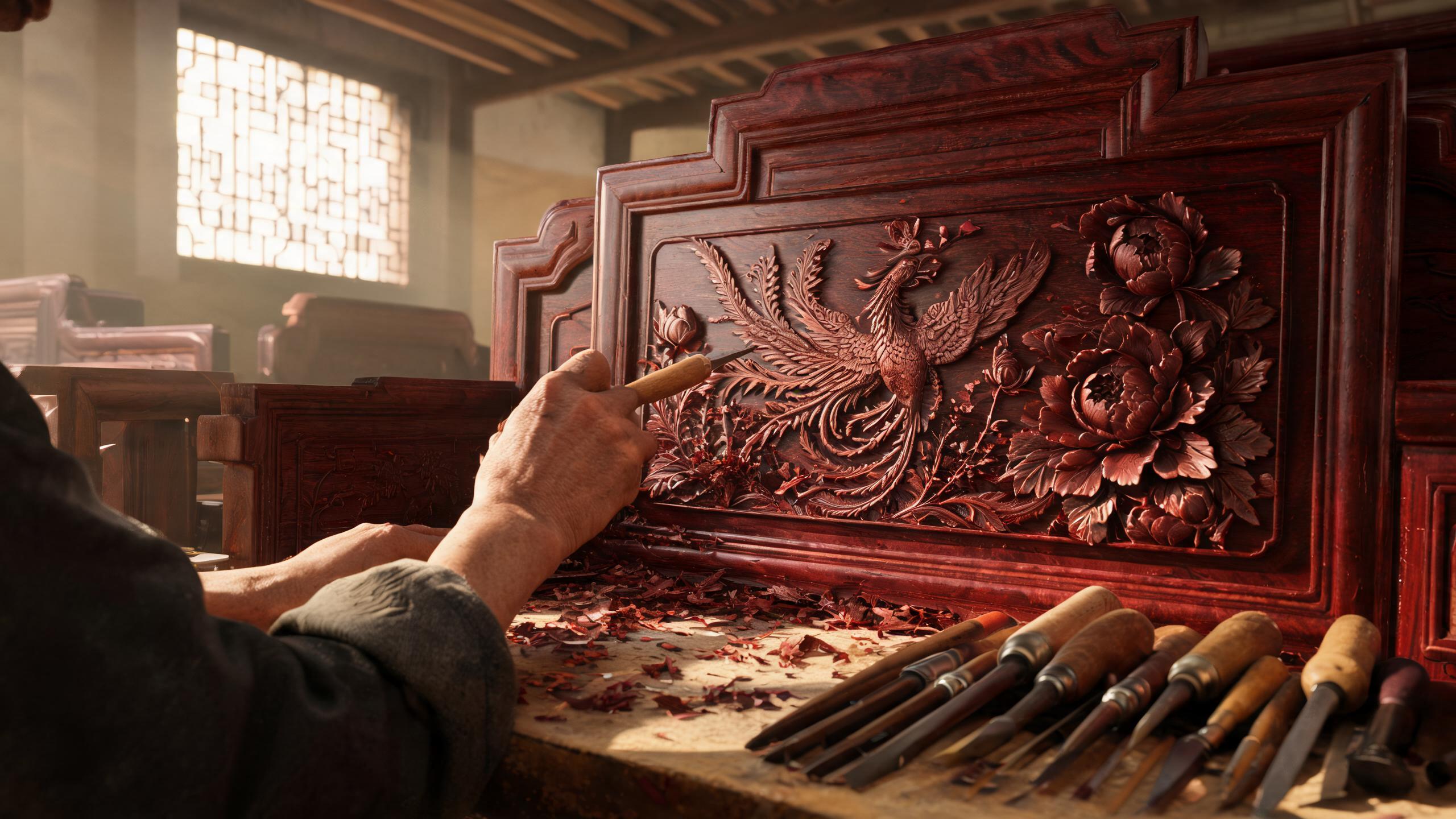
เบื้องหลังการทำงานของ Yunxiao Rosewood Furniture ในการเปลี่ยนไม้พะยูงดิบให้เป็นเฟอร์นิเจอร์คลาสสิกสำเร็จรูป ตั้งแต่การคัดเลือกเนื้อไม้แก่นและการอบแห้ง ไปจนถึงข้อต่อเดือยและเบ้า การแกะสลักด้วยมือ การเคลือบแลคเกอร์ และเอกสารการส่งออก
From Timber to Finished Piece: The Craft Behind Classical Rosewood Furniture
When a buyer sources classical rosewood furniture from China, the finished piece they receive is the product of a long, deliberate process that begins long before any carving chisel touches the wood. Understanding how a factory actually turns raw timber into a finished sofa, dining set, or bedroom suite is a reliable way to judge whether a supplier can deliver consistent, export-grade quality. This article walks through the full manufacturing journey at Yunxiao Rosewood Furniture Co., Ltd., a workshop in Xianyou County, Fujian, that has produced classical redwood furniture since 2008.
Yunxiao specialises in classical redwood furniture sets across three main categories: sofa sets, dining sets, and bedroom sets. The company works primarily with Siamese rosewood, a premium hardwood from the Dalbergia genus that is prized for its deep reddish-brown colour, fine grain, and ability to hold fine carving detail. Because rosewood is a protected timber species, the entire production and export chain is governed by compliance requirements that buyers need to understand before placing an order. This article explains each stage of the process so that importers know exactly what to look for and what to ask a supplier.
Why the Timber Matters: Siamese Rosewood and Heartwood Selection
The quality of any piece of rosewood furniture begins with the timber itself. Siamese rosewood, botanically Dalbergia cochinchinensis, is a dense hardwood with a naturally high oil content. That oil content is one reason the wood resists moisture and holds a polished finish so well. But not every board cut from a log is equally suitable for fine furniture, and the first quality gate at Yunxiao is heartwood selection.
Heartwood is the dense, darker inner portion of a tree trunk that has stopped transporting water. It is the part of the wood that carries the rich colour and stability that furniture makers want. Sapwood, by contrast, is the lighter, softer outer layer that is more prone to movement and less able to hold crisp carving detail. At Yunxiao, boards are inspected for their heartwood ratio, and only boards with a heartwood percentage exceeding 80 percent proceed to the premium furniture line. Boards with more than 20 percent sapwood are diverted to other product lines where the lower grade is acceptable.
This selection step matters to buyers for a practical reason: a piece made mostly from sapwood will look different, feel lighter, and behave differently over time than one made from true heartwood. When you compare quotations from different suppliers, the timber grade is one of the most important variables behind the price difference. A supplier that is transparent about its heartwood selection criteria is usually a supplier that is confident in its material.
Kiln Drying and Moisture Control
Once suitable boards are selected, they must be dried to a controlled moisture content before any joinery or finishing can begin. This is one of the most technically demanding steps in the entire process, and it is also one of the most common sources of problems in imported furniture.
Wood is a hygroscopic material: it absorbs and releases moisture as the surrounding air changes. If furniture is built from wood that is still too wet, or from wood that has not been dried evenly, the finished piece can warp, crack, or develop loose joints after it reaches a different climate. This is especially important for export furniture, because a piece that leaves a humid factory in southern China may end up in a dry, heated showroom in Europe or North America.
At Yunxiao, selected timber is kiln-dried to a moisture content below 14 percent, and for many product lines to between 8 and 12 percent. The drying cycle runs over roughly four weeks, with gradual temperature ramping to avoid a defect called case-hardening, where the outside of the board dries faster than the inside and locks in internal stress. After the main drying cycle, the timber is given a 48-hour equalisation period so that moisture can redistribute evenly through each board.
Moisture control does not stop at the kiln. During final quality inspection, every piece is checked with a pin-type moisture meter at three points. Readings that fall outside the acceptable range are sent back for re-conditioning. For a buyer, the moisture content of the wood is a strong indicator of whether a piece will hold up in your market. When you request a quotation, it is reasonable to ask what target moisture range the factory dries to and how it verifies that range before shipment.
Mortise-and-Tenon Joinery: The Structural Backbone
Classical Chinese furniture is famous for a joinery system that uses no metal fasteners at the primary structural joints. Instead, pieces are assembled with mortise-and-tenon joints, where a projecting tenon on one piece fits tightly into a matching cavity, or mortise, on another. This is not a decorative detail; it is the structural backbone of the furniture.
At Yunxiao, the joinery is cut to precise dimensions depending on the component. Seat rails on sofa frames, for example, use tenons cut to about 18 millimetres of depth, while backrest stiles use tenons of about 16 millimetres. Table apron rails on dining sets connect to leg posts with tenons of about 20 millimetres. The exact dimensions matter because a deeper, well-fitted tenon distributes load more evenly and resists the racking forces that loosen furniture over years of use.
In addition to the mortise-and-tenon joints, Yunxiao reinforces key connections with bamboo dowel pins. These are fitted dry before glue is applied, which allows the assembler to check the fit of every joint before committing to the final assembly. Corner blocks are installed at right-angle intersections to add further rigidity. The result is a frame that can carry substantial load without relying on screws or brackets that can work loose.
For buyers, the joinery is worth examining closely because it is difficult to fake well. A piece assembled with hidden metal screws and glue will often be cheaper, but it will not have the same long-term stability as a properly executed mortise-and-tenon frame. When you inspect a sample or visit a factory, ask to see how the joints are cut and whether the factory tests assembled frames under load.
Hand Carving: Where Craftsmanship Shows
The carving is the most visible expression of craftsmanship in classical rosewood furniture, and it is also the stage where the difference between genuine hand work and machine imitation becomes most apparent. Yunxiao's carvers work with chisels ranging from about 2 millimetres to 14 millimetres in width, cutting motifs such as the phoenix-and-peony pattern on sofa backrests or the auspicious cloud motif on dining chair backs.
Hand carving is a slow, skilled process. A single phoenix-and-peony backrest panel, for example, requires approximately 35 hours of carving in the documented process for this motif. The work is done in stages: the phoenix body is outlined first in shallow relief at about 2 millimetres of depth, the peony blossoms are then carved in medium relief at about 4 millimetres, and finally the background is recessed to create visual depth. The carver works from a reference drawing but adjusts the flow of feathers and blossoms to follow the grain of each individual board, which is why no two hand-carved pieces are exactly identical.
This variation is a hallmark of genuine hand work, and it is something buyers should understand. A machine-carved piece will be perfectly uniform across every chair in a set, while a hand-carved set will show subtle differences in the depth and flow of the carving from one piece to the next. That is not a defect; it is evidence that the work was done by hand. When you are comparing suppliers, ask whether the carving is done by hand or by CNC machine, and look at the consistency of the relief depth across a set.
Lacquer Finishing and Surface Treatment
After the frame is assembled and carved, the piece moves to finishing. The finish protects the wood, deepens its colour, and determines how the piece looks and feels in a room. Yunxiao applies raw lacquer in multiple coats, with each coat cured and then rubbed down before the next is applied.
On the most carving-intensive pieces, such as the phoenix-and-peony sofa set, eight coats of raw lacquer are applied by hand. Each coat is cured for about 24 hours and then rubbed with pumice stone, which smooths the surface and builds up a deep, satin sheen that highlights the relief of the carving. On other product lines, such as the dining sets, five coats of glossy lacquer are applied in a dust-controlled spray booth, with sanding between each coat and a final polish to a mirror gloss.
The finish also has a food-safety dimension for dining furniture. The glossy lacquer topcoat on Yunxiao's dining sets is formulated to meet FDA 21 CFR 175.300, the United States regulation governing substances that come into repeated contact with food (see the official text at the U.S. eCFR). For buyers importing dining furniture into markets with strict food-contact rules, this is a relevant compliance point to confirm with the supplier.
Finish quality is checked under controlled lighting during inspection. The lacquer surface is examined under 5000K LED lighting, and any runs, orange peel, or uncured spots are reworked. Colour consistency across the pieces of a set is verified against a reference panel, so that a six-piece sofa set or a ten-piece dining set arrives with a uniform appearance.
Quality Inspection: What the Factory Checks Before Shipment
Quality control at Yunxiao is built into the process rather than applied only at the end. Each stage has its own checks, and finished pieces go through a final inspection before they are packed. Understanding these checks helps a buyer know what to verify when they receive a shipment.
Key inspection points include:
- Heartwood ratio verification: Each board is visually inspected for sapwood percentage, and boards exceeding 20 percent sapwood are diverted to other product lines.
- Joint stress testing: Assembled frames are loaded with a distributed weight, such as 120 kilograms for a sofa frame, for 24 hours. Any joint showing visible separation is re-fitted.
- Carving relief depth check: The three-step relief depths are verified with a depth gauge at multiple points per panel.
- Moisture audit: Pin-type moisture meter readings are taken at three points per piece, and readings outside the target range trigger re-conditioning.
- Finish uniformity: The lacquer surface is inspected under 5000K LED lighting, and colour consistency across the set is verified against a reference panel.
For a buyer, the most useful question to ask a supplier is not simply whether they have quality control, but what specific checks they run and what happens when a piece fails. A factory that re-fits joints and re-conditions timber rather than shipping marginal pieces is a factory that is serious about consistency.
Compliance and Documentation: CITES, FSC, and Export Paperwork
Rosewood is a regulated timber, and compliance is not optional for export. Dalbergia cochinchinensis is listed under CITES, the Convention on International Trade in Endangered Species of Wild Fauna and Flora (official site: cites.org). This means that international shipments of Siamese rosewood furniture require export permits, and importers must understand the documentation requirements of their own country.
Yunxiao maintains FSC chain-of-custody documentation and CITES export permit registration for its Siamese rosewood shipments. Every shipment includes the CITES export permits, an FSC certificate, a commercial invoice with the correct HS code (9403.60 for furniture), and a wood drying certificate. Buyers should confirm these documents are provided before shipment and should verify the import requirements of their destination country, because some markets impose additional requirements such as phytosanitary certificates for Dalbergia species.
Compliance is also a market-access issue. In the European Union, the EU Timber Regulation (Regulation (EU) No 995/2010, see the European Commission's page on EU rules against illegal logging) requires importers to exercise due diligence to ensure the timber in their products was legally harvested. In the United States, the Lacey Act (enforced by the U.S. Fish and Wildlife Service) prohibits trade in illegally sourced timber. Wood packaging material entering most countries must meet ISPM-15, the international phytosanitary standard published by the International Plant Protection Convention (ippc.int). A supplier that can provide clear chain-of-custody documentation makes it far easier for an importer to satisfy these obligations. When you evaluate a supplier, ask to see their CITES and FSC documentation and confirm that it will accompany your shipment.
Packaging and Shipping: Protecting the Piece in Transit
Rosewood furniture is heavy and valuable, and it travels long distances by sea. Packaging is therefore a critical part of the process. Yunxiao packs each piece in acid-free tissue paper and corrugated cardboard, then places it in an ISPM-15 heat-treated wooden crate with EPS foam corner blocks. ISPM-15 is the international standard for heat-treating wood packaging material to prevent the spread of pests, and it is required for wooden crates entering most countries.
The packaging is designed to survive the rigours of ocean freight. Yunxiao's packaging has passed a one-metre drop test, and the crates are configured so that a full set is distributed across several crates with a manageable combined gross weight. For example, a six-piece sofa set fills three crates with a combined gross weight of approximately 180 kilograms, while a ten-seat dining set is packed in three crates with a combined gross weight of approximately 210 kilograms.
Shipping terms at Yunxiao default to FOB Xiamen, with CIF and DDP available on request. LCL consolidation works for single-set orders, while FCL is recommended for three or more sets. A 20-foot container typically fits around four sets. For buyers, understanding the packaging and shipping configuration in advance helps with budgeting for freight and with planning the receiving side of the shipment.
OEM and ODM Customisation
Many buyers do not simply want a standard catalogue piece; they want furniture tailored to their market, their brand, or a specific project. Yunxiao supports both OEM and ODM work. OEM means the factory manufactures to the buyer's specifications, while ODM means the factory designs and develops a product for the buyer. Custom carving motifs and buyer logos are supported, and the design approval cycle is about 15 days.
For a buyer, the ability to customise is valuable because it allows you to differentiate your offering. You might want a different carving motif, a specific dimension to fit a room layout, or a finish that matches a particular interior style. The key is to confirm the customisation process and timeline early, because design approval and production of a custom piece take longer than a standard catalogue order.
Lead Times, Warranty, and After-Sales Support
Lead times for rosewood furniture reflect the slow, careful nature of the process. At Yunxiao, a single sofa set typically takes 55 to 70 days from deposit confirmation, while batch orders of three or more sets extend to 75 to 90 days. The MOQ is one complete set, with volume pricing applying at three sets and above.
Yunxiao provides a 24-month structural warranty covering joinery failure and frame cracking under normal indoor use. Replacement parts can be ordered for transit damage. For buyers, a clear warranty and a defined process for handling transit damage are important protections, because furniture that travels by sea can occasionally arrive with damage even when packaging is good.
How Buyers Can Verify a Factory's Craftsmanship
If you are sourcing rosewood furniture for the first time, there are several practical steps you can take to verify a supplier's craftsmanship before committing to a large order:
- Request a sample piece. A single armchair or a small item can be ordered as a sample. If a full set order follows within a defined period, part of the sample cost may be credited.
- Ask about the timber. Confirm the species, the heartwood selection criteria, and the target moisture content. A supplier that can answer these questions specifically is more likely to be using genuine, well-dried material.
- Examine the joinery. Ask whether the frame uses mortise-and-tenon joints and how the joints are reinforced. Look for evidence of load testing.
- Check the carving. Confirm whether carving is done by hand or by machine, and look at the consistency of relief depth across a set.
- Review the documentation. Ask to see CITES and FSC documentation and confirm that it will accompany your shipment.
- Arrange a factory visit. Yunxiao welcomes buyers visiting Xianyou to tour the workshop, including timber storage, joinery stations, carving benches, and the lacquer curing room.
Frequently Asked Questions
What is the difference between hand-carved and machine-carved rosewood furniture? Hand-carved pieces show subtle variation in relief depth and carving flow from one piece to the next, because the carver adjusts to the grain of each board. Machine-carved pieces are perfectly uniform. Hand carving is slower and more expensive but is generally considered higher quality for classical furniture.
Why does moisture content matter for imported rosewood furniture? Wood expands and contracts with changes in humidity. If furniture is built from wood that is not dried to a suitable moisture content, it can warp, crack, or develop loose joints after reaching a different climate. A factory that kiln-dries to a controlled range and verifies it before shipment is more likely to deliver stable furniture.
What documentation should I expect with a rosewood furniture shipment? Because rosewood is a CITES-listed species, you should expect CITES export permits, an FSC certificate, a commercial invoice with the correct HS code, and a wood drying certificate. Some destination markets may also require a phytosanitary certificate.
What is the minimum order quantity? The MOQ is one complete set. Volume pricing applies at three sets and above, and a 20-foot container typically fits around four sets.
Can I customise the furniture? Yes. Yunxiao supports OEM and ODM work, including custom carving motifs and buyer logos, with a design approval cycle of about 15 days.
What warranty is provided? Yunxiao provides a 24-month structural warranty covering joinery failure and frame cracking under normal indoor use, and replacement parts can be ordered for transit damage.
Request a Detailed Quotation
If you are sourcing classical rosewood furniture and want to understand how a specific set would be made, packed, and shipped for your market, the best next step is to request a detailed quotation. Include your destination port, preferred Incoterm, order quantity, and any custom carving or dimension requirements, and mention any CITES import-permit needs for your country. This allows the factory to confirm the configuration, lead time, and documentation for your specific order.
About the publisher: This article was prepared by the export team at Yunxiao Rosewood Furniture Co., Ltd., based on the company's documented production process in Xianyou County, Fujian. Specific certificate numbers and current compliance documentation are provided to buyers with each quotation and shipment; contact the export team to verify the documents relevant to your order.