
คู่มือจากโรงงานโดยตรงสำหรับผู้นำเข้า B2B เกี่ยวกับแหล่งซื้อเฟอร์นิเจอร์ไม้จริง: วิธีแยกไม้จริงจากไม้วีเนียร์และไม้วิศวกรรม เปรียบเทียบเส้นทางการจัดหา 3 รูปแบบ ต้นทุนเฟอร์นิเจอร์สั่งทำเกิดจากอะไร และสิ่งที่ผู้ซื้อในเอเชียตะวันออกเฉียงใต้ ออสเตรเลีย และอเมริกาเหนือควรตรวจสอบก่อนสั่งซื้อเป็นตู้คอนเทนเนอร์
Why the Question "Where to Buy Solid Wood Furniture" Is Harder Than It Looks
Every week, importers, hotel procurement managers and furniture distributors send us the same question in slightly different words: where to buy solid wood furniture that will actually hold up in their market, at a price that still leaves room for margin. On the surface it is a sourcing question. In practice it is a materials question, a factory question and a risk question bundled together.
The reason the question is hard is that the phrase "solid wood furniture" is used loosely across the industry. A buyer who searches for where to buy real wood furniture may be shown a catalogue of pieces that contain solid wood frames, veneered panels, engineered cores, or a mix of all three. All of them can be described as wood furniture. Only some of them are what a buyer picturing solid timber actually wants.
This guide is written from the factory floor rather than from a marketing desk. We manufacture and export classical solid redwood furniture sets from Xianyou County, Putian City, Fujian, and we have watched buyers make expensive mistakes because nobody explained the difference between a solid board and a veneered panel before the deposit was paid. What follows is the practical version: how to tell solid wood from veneer and engineered wood, how a factory-direct sourcing path actually works, and what buyers in Southeast Asia, Australia and North America should check differently from one another.
What Is Solid Wood Furniture, and What Is It Not?
Before comparing suppliers, it helps to fix the vocabulary, because most sourcing disputes start with a definition that two people assumed they shared.
Solid wood in the strict sense
Solid wood furniture is built from timber that is cut, shaped and joined as a single continuous piece of wood in each component. A solid wood table top is one board, or several boards joined edge to edge, with the grain running through the full thickness. If you look at the end grain of a solid leg or apron, you see the same material all the way through, with growth rings and pores that continue from face to edge.
In our own production, the solid components include the sofa frames, table tops, chair legs, bed posts and the structural rails of case goods. These are the parts that carry load, absorb impact and define how the piece behaves over ten or twenty years.
Veneered furniture
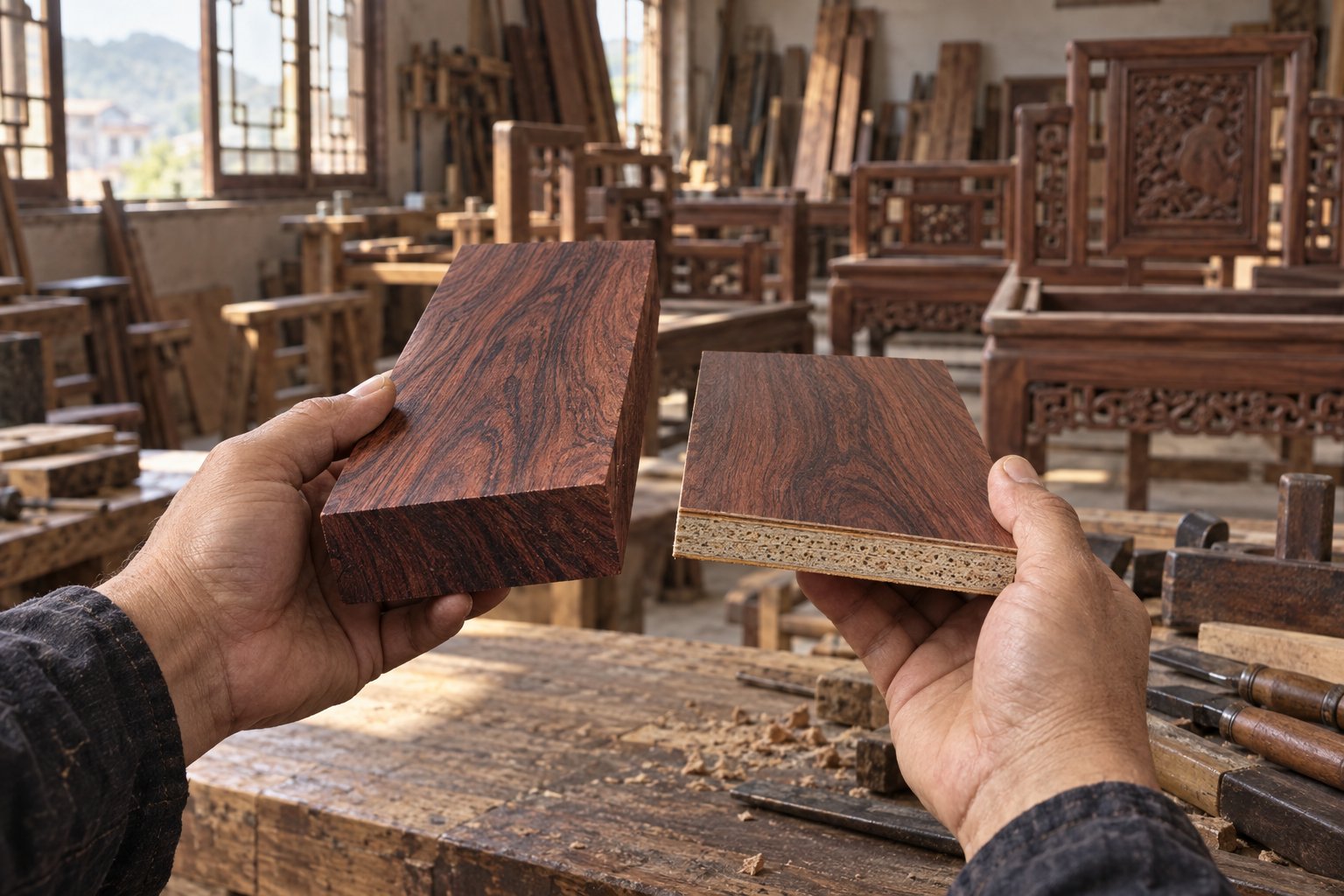
Veneered furniture uses a thin slice of real wood, typically between 0.5 mm and 2 mm, glued onto a substrate. The substrate may be plywood, MDF, particleboard or a lower-grade solid wood core. The visible face can look genuinely beautiful, and a well-made veneered panel is not automatically a bad product. The problem is that the veneer is a surface, not a structure. It cannot be sanded and refinished repeatedly, it delaminates if moisture reaches the glue line, and its edge tells a different story from its face.
Engineered and composite wood
Engineered wood covers a wide family of products: MDF, HDF, particleboard, blockboard and various glued laminates. These are dimensionally stable and inexpensive, which is why they dominate flat-pack and contract furniture. They are also the category most often mislabelled in export catalogues, because a piece with an engineered core and a wood veneer face can be photographed to look indistinguishable from solid timber.
Why the distinction matters commercially
The distinction is not academic. It changes the weight of a container, the behaviour of the furniture in a humid or dry climate, the resale value in the destination market, the repair options available to your customer, and the documentation you may need to provide at customs. A buyer who orders veneered panels believing they are solid timber will discover the difference the first time a customer returns a piece with a swollen edge.
How to Tell Solid Wood from Veneer and Engineered Wood Before You Order
You do not need a laboratory to make this judgement. You need to know where to look, and you need the supplier to let you look there.
Look at the end grain and the edges
This is the single most reliable test. On a solid wood component, the end grain shows continuous fibres and growth rings that match the face. On a veneered panel, the edge shows a layered sandwich: a thin decorative skin, a glue line, and a core of different material. On particleboard, the edge shows compressed chips. On MDF, it shows a uniform fibrous density with no grain at all.
Ask for close-up photographs of the end grain of a table top, a chair leg and a drawer front. A supplier who cannot or will not provide these has told you something important.
Check the weight and the sound
Solid hardwood is dense. A solid redwood dining table for eight people is heavy enough that two people notice it when they lift it. Engineered furniture of the same dimensions is noticeably lighter. Tapping a solid panel produces a dull, short, dense sound; tapping a veneered panel over a hollow or low-density core produces a lighter, more resonant tone.
Weight is not a perfect test on its own, because some engineered boards are heavy and some solid species are light. Used together with the edge inspection, however, it is a fast filter.
Examine the grain continuity across joints
On a solid wood top made from several boards joined edge to edge, the grain pattern changes from board to board in a natural, irregular way, and the colour varies slightly. On a veneered panel, the grain is often perfectly mirrored or repeated, because the veneer leaves are cut from the same flitch and book-matched. Perfect symmetry across a wide surface is a strong hint that you are looking at veneer.
Ask what happens at the drawer and door edges
Drawer boxes and door edges are where construction honesty shows. Hand-cut dovetail joints in solid wood, with the tails and pins visible on the corner, indicate a solid drawer box. Stapled or glued butt joints, or a drawer side with a paper-thin edge, indicate engineered construction. In our bedroom suites, the drawer boxes use hand-cut through-dovetails and half-blind dovetails, and the wardrobe doors are built as floating panels so the solid wood can expand and contract without splitting the frame.
Request a sample and cut it
The most decisive test is destructive, and it is worth doing once. Ask for a sample of the actual material used in the quoted product, then cut it across the grain. A solid sample reveals continuous timber. A veneered sample reveals the skin, the glue line and the core. Reputable factories expect serious buyers to do this and will supply a sample that matches production.
What Is Solid Hardwood Furniture, and Which Species Should You Specify?
Buyers often use "solid wood" and "solid hardwood" interchangeably, but the second term carries a stricter meaning. Solid hardwood furniture is made from the timber of deciduous, broad-leaved trees rather than softwoods such as pine or fir. Hardwood species are generally denser, more dimensionally stable and more suitable for carved and load-bearing furniture.
Species selection drives cost, appearance, weight and compliance requirements, so it should be a deliberate decision rather than whatever the supplier happens to have in stock.
Rosewood and redwood families
Rosewood species are prized for their density, deep colour and figure, and they take carving exceptionally well. They are also the most regulated category in the trade, which is why documentation matters as much as appearance. Siamese rosewood, for example, is a premium timber used in our classical armchairs, tea tables, sideboards and wardrobes, and it requires careful chain-of-custody records.
Nanmu and other classical hardwoods
Machilus Nanmu is a traditional Chinese hardwood valued for its fine, even texture and its stability. It is frequently specified for classical interiors where a lighter, warmer tone is wanted than the darkest rosewoods provide.
How to specify species in a purchase order
Name the species precisely, including the botanical name where possible, and state which components must be solid and which may be veneered. A purchase order that says only "solid wood dining table" leaves the door open to a wide range of interpretations. A purchase order that says "solid Siamese rosewood top, legs and aprons; no veneer on any structural component" removes the ambiguity.
Where to Buy Real Wood Furniture: The Three Sourcing Routes Compared
Once you know what you are buying, the next question is who you buy it from. There are three main routes into the market, and each carries a different balance of price, control and risk.
Route one: buying from a trading company
Trading companies aggregate products from multiple factories. They are convenient for buyers who want a single point of contact across many categories, and they can be efficient for small, mixed orders. The trade-off is that the trading company may not control the factory, may not know the exact construction of every item, and adds a margin layer. When a quality problem appears, the resolution path runs through an intermediary.
Route two: buying from a factory directly
Buying directly from a manufacturer gives you access to the people who actually build the furniture. You can ask about joinery, drying schedules, finishing systems and timber sourcing and get answers from the workshop rather than from a sales script. You can usually negotiate on specification as well as price, because the factory controls the production process. The trade-off is that you take on more responsibility for due diligence, and you need to be comfortable communicating technical requirements.
Route three: buying through an agent or sourcing platform
Agents and platforms can be useful for first-time importers who need help with inspection, consolidation and documentation. Their value depends entirely on how transparent they are about which factory is producing your order and whether they allow you to verify it.
Which route fits which buyer
If you are placing a first trial order and your volumes are small, a trading company or agent may reduce your administrative burden. If you are building a repeat programme with consistent specifications, factory-direct sourcing usually gives you better control, better pricing at volume and a faster path to resolving problems. Most of our long-term partners started with a trial set through an intermediary and moved to direct ordering once they had verified the construction for themselves.
How to Choose a Reliable Factory When You Buy Solid Wood Furniture Directly
Factory-direct sourcing only works if the factory is genuinely reliable. Price is the easiest thing to compare and the least useful thing to rely on. Here is what actually predicts whether an order will arrive as specified.
Timber sourcing and legality
Ask where the timber comes from and how it is documented. A factory that can explain its supply chain, provide chain-of-custody records and register export permits per shipment is a factory that has thought about compliance. A factory that answers vaguely is a factory that may leave you exposed at customs.
Drying and moisture control
This is the most underrated factor in furniture that travels. Timber must be dried to a moisture content appropriate for the destination climate, and it must be conditioned so that the outer and inner layers reach equilibrium. In our production, timber is dried over a 36-day constant-humidity schedule and conditioned to a moisture content of roughly 8 to 12 percent before machining. Furniture made from improperly dried timber will move, crack or open at the joints after it crosses an ocean and enters a heated or air-conditioned building.
Joinery method
Ask whether the furniture is assembled with mortise-and-tenon joints or with metal fasteners and glue alone. Traditional mortise-and-tenon construction allows the wood to move with humidity changes while keeping the joint tight. It is slower and more skilled work, and it is one of the clearest signals of a factory that builds for longevity rather than for a single shipment.
Finishing system
Ask what finish is applied and whether it meets the standards of your destination market. Traditional raw lacquer and beeswax finishing gives a deep, repairable surface, but the formulation matters for regulatory compliance. Finishes used on furniture shipped to the European Union and the United States need to satisfy restrictions on hazardous substances, and buyers should ask for the relevant documentation rather than assume it.
Quality control process
A reliable factory has a defined inspection sequence: incoming timber inspection, in-process checks at joinery and assembly, and a final inspection before packing. Ask at which stages inspection happens, who performs it, and what happens when a piece fails. Vague answers here usually mean there is no system.
Communication and documentation
Test the factory's responsiveness before you place a large order. Send a technical question and see whether the answer comes from someone who understands the product. Ask for the export documents you will need and see whether they can describe them accurately. The quality of pre-sale communication is the best available predictor of post-sale support.
How Much Does Custom Furniture Cost, and What Drives the Price?
Buyers searching for how much does custom furniture cost usually want a number. The honest answer is that custom solid wood furniture is priced from a specification, not from a catalogue, and the specification is where the cost is decided.
The factors that move the price
- Species and grade. A premium regulated rosewood costs several times more per cubic metre than a common hardwood. Grade within a species also matters: clearer, straighter, thicker stock costs more.
- Solid versus veneered construction. Solid components use far more timber by volume than veneered panels, and the difference shows up directly in the material cost.
- Joinery complexity. Hand-cut mortise-and-tenon joints and dovetailed drawers take skilled labour hours. Stapled and glued construction is faster and cheaper.
- Carving. Hand-carved relief work is priced by complexity and by the number of pieces. A carved sofa set with elaborate dragon and cloud motifs carries far more labour than a plain Ming-style frame.
- Finishing. A multi-coat hand-rubbed lacquer finish takes more time and material than a sprayed sealer.
- Order volume and container fill. Unit cost falls as volume rises, because setup, tooling and freight are spread across more pieces.
- Custom dimensions and patterns. Non-standard sizes and bespoke carving patterns require new drawings, new templates and additional trial work.
How to get a comparable quotation
To compare quotations fairly, send every supplier the same specification: species, dimensions, which components are solid, joinery method, finish type, quantity, packing requirements and destination port. A quotation that arrives without a specification behind it cannot be compared with anything. When you ask where to get custom furniture made, the quality of the questions you ask determines the quality of the answers you receive.
What is custom furniture, in a factory context?
Custom furniture means the piece is made to your specification rather than selected from a fixed catalogue. In practice this covers a spectrum. At one end, a buyer takes an existing model and changes the dimensions or the finish. At the other end, a buyer supplies drawings or reference images and the factory develops a new pattern, builds a prototype, and produces the piece to match. Understanding where your requirement sits on that spectrum helps you set realistic expectations for lead time and cost.
Where to Get Custom Furniture Made: How the OEM and ODM Process Works
Buyers who want their own designs or their own brand on the product need to understand the difference between OEM and ODM, because the two follow different development paths.
OEM: made to your design
In OEM production, you provide the design, the drawings or the reference sample, and the factory manufactures to that specification. You own the design, and the factory's role is to execute it accurately and consistently. This route suits importers and distributors who already have a product line and want a manufacturing partner behind it.
ODM: adapted from the factory's designs
In ODM production, the factory offers existing designs that can be adapted to your requirements, including dimensions, finish, carving pattern and branding. This route is faster and usually cheaper to develop, because the core design already exists and has been proven in production.
The development sequence
- Requirement brief. You describe the piece, the intended use, the target market and any constraints on size, weight or budget.
- Drawing and specification. The factory produces a technical drawing showing dimensions, materials and construction.
- Prototype or sample. A sample is built so both sides can inspect the actual construction, finish and proportions.
- Sample approval. You approve the sample, and it becomes the reference standard for production.
- Production. The order is manufactured to the approved sample, with in-process inspection.
- Pre-shipment inspection. The finished goods are inspected before packing and loading.
Two points are worth emphasising. First, the approved sample is the contract: everything in production is measured against it, so it is worth taking the time to get it right. Second, a sample that passes inspection does not automatically guarantee that every unit in a large batch will match it, which is why in-process and pre-shipment inspection matter.
What Buyers in Southeast Asia, Australia and North America Should Check Differently
The same furniture behaves differently in different climates and faces different regulatory expectations. A specification that works in one market may fail in another.
Southeast Asia: humidity and stability
Buyers in Southeast Asia deal with high year-round humidity. The main risks are swelling, mould on inadequately finished surfaces, and movement at joints if the timber was dried to a moisture content suited to a drier climate. Ask how the timber is conditioned for a humid destination, and ask about the finish's resistance to moisture. Ventilation in storage and transit also matters, because furniture that sits in a sealed container through a tropical rainy season can arrive with surface mould even if the construction is sound.
Australia: biosecurity and timber documentation
Australia applies strict biosecurity controls to imported timber products. Packaging must meet the relevant treatment standard, and buyers should confirm that the factory understands the requirements for solid wood packing material and can supply the associated documentation. Species identification and legality documentation also matter, because Australian importers are expected to demonstrate that timber was legally harvested.
North America: chemical compliance and dimensional expectations
Buyers shipping to the United States and Canada need to think about chemical compliance for finishes and adhesives, and about the documentation required under timber legality rules. North American residential interiors are often heated in winter and air-conditioned in summer, producing significant seasonal swings in relative humidity. Furniture must be built to tolerate that movement, which brings the conversation back to drying, conditioning and joinery.
Europe: regulation and documentation
European buyers face timber regulation requirements that place a due diligence obligation on the importer. This makes chain-of-custody documentation a commercial necessity rather than a formality. Buyers should confirm what documentation the factory provides and how it is issued per shipment.
Common Mistakes Buyers Make When Sourcing Solid Wood Furniture
Most sourcing failures we see are not caused by bad luck. They follow recognisable patterns.
Comparing prices without comparing specifications
A quotation for a veneered table and a quotation for a solid wood table are not comparable, even if the dimensions match. Always normalise the specification before comparing numbers.
Accepting photographs as proof of construction
Photographs show the face of a piece. They rarely show the end grain, the drawer interior or the underside. Ask for the specific views that reveal construction, and consider a physical sample for anything you intend to reorder.
Skipping the sample stage to save time
Buyers under time pressure sometimes approve production without a physical sample. This saves a few weeks and frequently costs a container. The sample is the cheapest place to discover a misunderstanding.
Ignoring moisture content and drying
Drying is invisible in a finished piece and decisive in its long-term behaviour. Ask for the drying schedule and the target moisture content, and treat a vague answer as a warning.
Assuming all documentation is automatic
Export permits, chain-of-custody records and packing treatment certificates are issued per shipment and depend on the specific timber and destination. Confirm what is provided and when, rather than discovering a gap at the port.
Not planning for the destination climate
A piece specified for a temperate showroom may not suit a tropical hotel lobby. Tell the factory where the furniture is going, not just what it should look like.
How to Structure a First Order and Scale Up
Buyers who are new to a supplier often ask how to start without taking on too much risk. The answer is to stage the relationship.
Start with a trial order
A trial order of one or a few sets lets you verify construction, finish, packing and documentation on a small scale. It also tests the factory's communication under real conditions. Many factories, including ours, offer trial single sets and refundable samples for exactly this purpose.
Verify before you commit to volume
Inspect the trial order carefully. Cut a sample if you can. Compare the delivered goods against the approved sample and against the specification. Only then commit to a container order.
Plan the container
Container planning affects both freight cost and damage risk. Carved furniture needs protection around protruding elements, and heavy pieces need to be braced so they cannot shift in transit. Ask how the factory plans the load and how it protects carved surfaces.
Agree on lead time and payment terms in writing
Production lead time for container orders depends on the specification, the volume and the factory's current schedule. Payment terms should be documented clearly, including the deposit, the balance trigger and the documents released against payment. Ambiguity here causes more disputes than quality issues do.
Build a repeat programme
Once a specification is proven, repeat orders become faster and more predictable, because the drawings, samples and quality standards already exist. This is where factory-direct sourcing delivers its real advantage: consistency across shipments.
How Timber Is Prepared Before It Becomes Furniture
Buyers rarely see the part of the process that determines whether their furniture survives its first winter in a heated showroom. That part happens long before any carving begins, and it is worth understanding because it explains why two factories can quote very different prices for what looks like the same table.
Selection and grading at the timber yard
Timber arrives at the factory in rough sawn boards of varying width, thickness and quality. The first task is grading: separating boards by species confirmation, by colour and figure, and by the presence of defects such as knots, checks, sapwood and insect damage. Boards destined for visible surfaces are selected more strictly than boards destined for internal frames. A factory that grades carefully wastes less material and produces more consistent colour across a set; a factory that does not grade carefully produces a set where one chair is noticeably darker than another.
Air drying and kiln drying
Freshly sawn timber contains a large amount of free water and bound water. Air drying removes the free water slowly and reduces the risk of surface checking and internal stress. Kiln drying then brings the timber down to a target moisture content under controlled temperature and humidity. The schedule matters: drying too fast causes case hardening, where the outer shell dries and shrinks while the core remains wet, and the board later distorts or cracks when the core finally dries. Drying too slowly is safer but ties up capital and capacity.
In our production, timber passes through a 36-day constant-humidity drying schedule and is conditioned to a moisture content of roughly 8 to 12 percent before it is machined. That range is chosen because it sits between the equilibrium moisture content of a humid tropical interior and that of a heated North American or European interior, giving the finished piece room to move in either direction without opening at the joints.
Conditioning and stress relief
After kiln drying, timber is allowed to rest and equalise so that moisture is distributed evenly through the thickness of each board. Machining timber that is dry on the outside and wet in the middle produces components that move after assembly. Conditioning is unglamorous and invisible in the finished product, and it is one of the clearest differences between a factory that builds for export and one that builds for the domestic market.
Machining and joinery cutting
Once conditioned, boards are planed, squared and cut to size. Mortises and tenons are cut so that the joint fits tightly without forcing. A well-cut mortise-and-tenon joint relies on the precision of the cut and the natural swelling of the wood, not on glue alone, which is why traditional Chinese furniture can be disassembled and reassembled decades later.
Understanding Joinery: Why Mortise and Tenon Still Matters
Joinery is the part of furniture construction that buyers most often take on trust, and it is the part that most directly determines how a piece behaves over time.
What a mortise-and-tenon joint actually does
A mortise is a rectangular cavity cut into one component; a tenon is a projecting tongue cut on the end of another. When the tenon is inserted into the mortise, the joint resists twisting, racking and pulling apart. Because the joint is mechanical rather than purely adhesive, it continues to hold even as the wood expands and contracts with seasonal humidity changes.
Why metal fasteners and glue alone behave differently
Screws, staples and dowels rely on the surrounding wood remaining dimensionally stable. When the wood moves, the fastener does not, and the joint loosens or the wood splits around the fastener. Glue lines can also fail if the joint is stressed or if moisture reaches the bond. This is why furniture assembled with fasteners alone tends to develop wobble and squeaks after a few years of use.
Dovetails in drawer construction
Drawer boxes take constant load and constant movement. Hand-cut through-dovetails and half-blind dovetails interlock the drawer sides and front so that pulling the drawer actually tightens the joint. In our bedroom suites, the drawer boxes are built this way, and the wardrobe doors are constructed as floating panels within a frame, allowing the solid wood panel to expand and contract without splitting the surrounding frame.
How to verify joinery before you buy
Ask for photographs of an exposed joint, a drawer corner and the underside of a table. Ask whether the factory can supply a cutaway sample showing the joint in cross-section. If a supplier cannot show you the joinery, assume the joinery is not a selling point.
Finishing: What the Surface Tells You About the Piece
Finish is both a protective layer and a diagnostic. The way a surface is prepared and coated tells you how much time the factory was willing to spend on the piece.
Surface preparation
Before any finish is applied, the surface must be planed, scraped and sanded through progressively finer grits. Carved areas require hand work with small tools, because sandpaper cannot reach into the recesses of relief carving without blurring the detail. A piece with crisp carving and a smooth, even surface has been prepared carefully; a piece with fuzzy carving and visible sanding scratches has not.
Traditional raw lacquer and beeswax
Traditional Chinese finishing uses raw lacquer, a natural resin that builds a hard, deep, translucent surface over multiple coats, often finished with beeswax to produce a soft satin sheen. The advantage of this system is depth and repairability: a scratch can often be blended locally rather than requiring the whole surface to be refinished. The disadvantage is time, because each coat must cure before the next is applied.
Regulatory considerations for export finishes
Finish formulations are regulated in major markets. Furniture shipped to the European Union and the United States must satisfy restrictions on hazardous substances in coatings and adhesives, and buyers should ask for documentation rather than assume compliance. Our own finishing uses eco-friendly beeswax and lacquer systems formulated to meet EU REACH and US CARB requirements, and we provide the relevant documentation with export orders.
How to assess a finish
Look at the surface under raking light to reveal sanding marks, drips and uneven sheen. Run a hand over the surface to feel for roughness. Check the inside of a drawer and the underside of a table, because these areas reveal whether the factory finished the whole piece or only the parts a photograph would show.
Packing and Loading: Where Damage Usually Happens
Furniture that leaves the factory in perfect condition can still arrive damaged. Most transit damage is caused by packing and loading decisions rather than by handling accidents.
Protecting carved surfaces
Carved relief work is the most vulnerable part of a classical furniture set, because protruding elements can be snapped off by contact with other pieces or with the container wall. Effective packing wraps carved areas in soft material, separates pieces with padding, and prevents any hard surface from pressing directly against a carved edge.
Moisture barriers
A container crossing an ocean passes through temperature and humidity changes that can cause condensation inside the container. Moisture barriers and desiccants reduce the risk of surface mould and of moisture reaching the glue lines and joints. This matters most for shipments into humid tropical markets and for shipments that sit in port for extended periods.
Bracing and load planning
Heavy pieces must be braced so they cannot shift during transit. Shifting loads cause impact damage and can also destabilise the container. Load planning balances weight distribution, protects the most fragile pieces and uses the container volume efficiently, which affects both freight cost and damage risk.
Documentation that travels with the goods
Packing treatment documentation for solid wood packing material, timber legality records and export permits should travel with the shipment. Buyers should confirm in advance which documents will be issued, when they will be issued, and how they will be delivered, because a missing document at the port can delay a container for days.
Building a Specification That Protects You
The single most effective protection against sourcing disappointment is a specification detailed enough that both sides know exactly what will be delivered.
What a solid specification contains
- Product identification. Model name or drawing number, quantity, and the set composition.
- Dimensions. Overall dimensions and critical internal dimensions, with tolerances.
- Species. Species name for each component, with the botanical name where available.
- Construction. Which components are solid, which may be veneered, and the joinery method for each joint type.
- Finish. Finish system, sheen level, colour reference and compliance requirements.
- Hardware and fittings. Any metal components, their material and finish.
- Packing. Packing method, protection for carved areas, and packing treatment standard.
- Inspection. Inspection stages, acceptance criteria and who performs the inspection.
- Documentation. The exact list of documents to be provided and when.
- Delivery. Lead time, shipping terms and destination port.
Why tolerances matter
Solid wood is a natural material and moves with humidity. A specification that demands absolute dimensional precision ignores this reality and creates disputes that neither side can win. Sensible tolerances acknowledge that a solid wood top may vary slightly with the season while still meeting the buyer's requirements.
Using the approved sample as the standard
Once a sample is approved, it should be retained by both parties and referenced in the purchase order. During production and pre-shipment inspection, the finished goods are compared against that sample. This converts a subjective conversation about quality into an objective comparison against a physical reference.
Working with a Factory Across Time Zones and Languages
International sourcing involves communication across distance, language and working hours. The practical quality of that communication often determines whether a project succeeds.
Written confirmation over verbal agreement
Confirm every important decision in writing, including specification changes, schedule changes and price changes. A written record prevents the situation where two parties remember a conversation differently. Where language is a barrier, use drawings, dimensions and photographs alongside words, because a dimensioned drawing is less ambiguous than a sentence.
Photographs and video during production
Ask for progress photographs at defined milestones: after joinery, after assembly, after finishing and before packing. Video walkthroughs of the finished goods before loading are particularly useful for carved pieces, because they show the whole set rather than a selected angle.
Third-party inspection
For larger orders, a third-party inspection before shipment provides independent verification. A reputable factory will cooperate with inspection rather than resist it. If a supplier discourages independent inspection, that is itself a signal worth weighing.
Planning for the time difference
Build the time difference into your schedule. A question sent at the end of your working day may not be answered until the following day in your time zone, and a decision that requires a factory visit or a sample photograph can take longer than expected. Buyers who plan for this avoid the last-minute pressure that leads to skipped inspections.
Comparing Solid Wood Furniture with Other Materials
Buyers sometimes ask whether solid wood is the right choice at all, particularly when engineered alternatives are cheaper and more dimensionally predictable. The answer depends on the application.
Where solid wood is the right choice
Solid wood is the right choice where longevity, repairability, weight, tactile quality and resale value matter. Hospitality projects, luxury residential interiors, executive offices and heritage-style fit-outs generally justify solid construction because the furniture is expected to remain in service for many years and to be repaired rather than replaced.
Where engineered materials make sense
Engineered materials make sense where the furniture is expected to be replaced within a short cycle, where extreme dimensional stability is required, or where budget constraints dominate. Flat-pack contract furniture and temporary installations often fall into this category.
The hybrid approach
Many commercial products combine the two: solid wood for structural components and visible edges, engineered panels for large flat surfaces that are not subject to load. This can be a legitimate engineering decision, provided the buyer knows which is which and prices accordingly. The problem is never the hybrid itself; the problem is a hybrid sold as fully solid.
Frequently Asked Questions About Sourcing and Construction
How do I know whether a supplier is a factory or a trading company?
Ask for the factory address, the production capacity, and whether you can visit or conduct a remote video walkthrough of the workshop. A factory can show you its own production lines, drying facilities and finishing area. A trading company will typically redirect the conversation to product and price rather than process.
Should I pay for a sample?
Many factories charge for samples and refund the cost against a subsequent order. Paying for a sample is normal and reasonable, because it represents real material and labour. What matters is that the sample matches production and that the refund terms are documented.
What is a reasonable lead time for a custom order?
Lead time depends on the complexity of the design, the volume and the factory's schedule. A single custom piece may take several weeks; a full container of carved sets takes considerably longer. For our own container orders, production typically takes 45 to 60 working days after deposit. Always confirm the specific lead time for your order in writing rather than relying on a general figure.
How can I reduce the risk of colour variation across a set?
Ask whether the factory allocates timber for a set from a single batch. Single-batch allocation, combined with careful grading, is the most effective way to keep colour and grain consistent across a sofa, dining and bedroom set. Ask about this specifically, because it is a production decision rather than a marketing claim.
What should I do if the delivered goods do not match the sample?
Document the discrepancy with photographs and a written description, compare the goods against the approved sample and the specification, and raise it with the supplier promptly. A clear specification and a retained sample make this conversation factual rather than subjective.
Does solid wood furniture require more maintenance?
Solid wood furniture generally requires less structural maintenance than engineered furniture, because joints can be tightened and surfaces can be refinished. Routine care involves keeping the surface clean, avoiding prolonged direct sunlight and extreme dryness, and applying a suitable wax or oil periodically depending on the finish system.
What to Ask Before You Place a Container Order
If you take one thing from this guide, take this checklist. It converts a vague conversation about quality into a set of specific questions with verifiable answers.
- Which components of this product are solid wood, and which are veneered or engineered?
- What species is used for each component, and how is legality documented?
- What is the drying schedule, and what is the target moisture content?
- Which joints are mortise and tenon, and which use fasteners or glue?
- What finish system is used, and does it meet the requirements of my destination market?
- At which stages does quality inspection happen, and who performs it?
- What packing method protects carved surfaces, and what packing treatment standard applies?
- Which documents will be issued with the shipment, and when?
- What is the confirmed lead time for this specific order?
- Can I inspect the goods before shipment, and will you cooperate with a third-party inspection?
A supplier who answers all ten questions clearly is a supplier worth developing. A supplier who deflects several of them has told you where the risk sits.
Choosing a Partner Rather Than a Price
The question of where to buy solid wood furniture is ultimately a question about who you want to work with for the next several years. Price matters, but price is only meaningful against a specification you understand and a factory you can verify.
If you are sourcing classical solid redwood furniture for wholesale, hospitality or residential projects, the practical path is straightforward. Decide which components must be solid. Specify the species precisely. Ask for the end grain, the drying schedule and the joinery method. Order a sample and inspect it properly. Then scale up once the specification is proven.
We build classical redwood furniture sets in Xianyou County, Fujian, using legally certified timber, traditional mortise-and-tenon joinery and hand-carved detailing, and we export to wholesalers, hotels and designers across Europe, North America, Australia and Southeast Asia. If you are evaluating suppliers and want to compare construction rather than catalogue photography, send us your specification and we will tell you exactly how we would build it.