
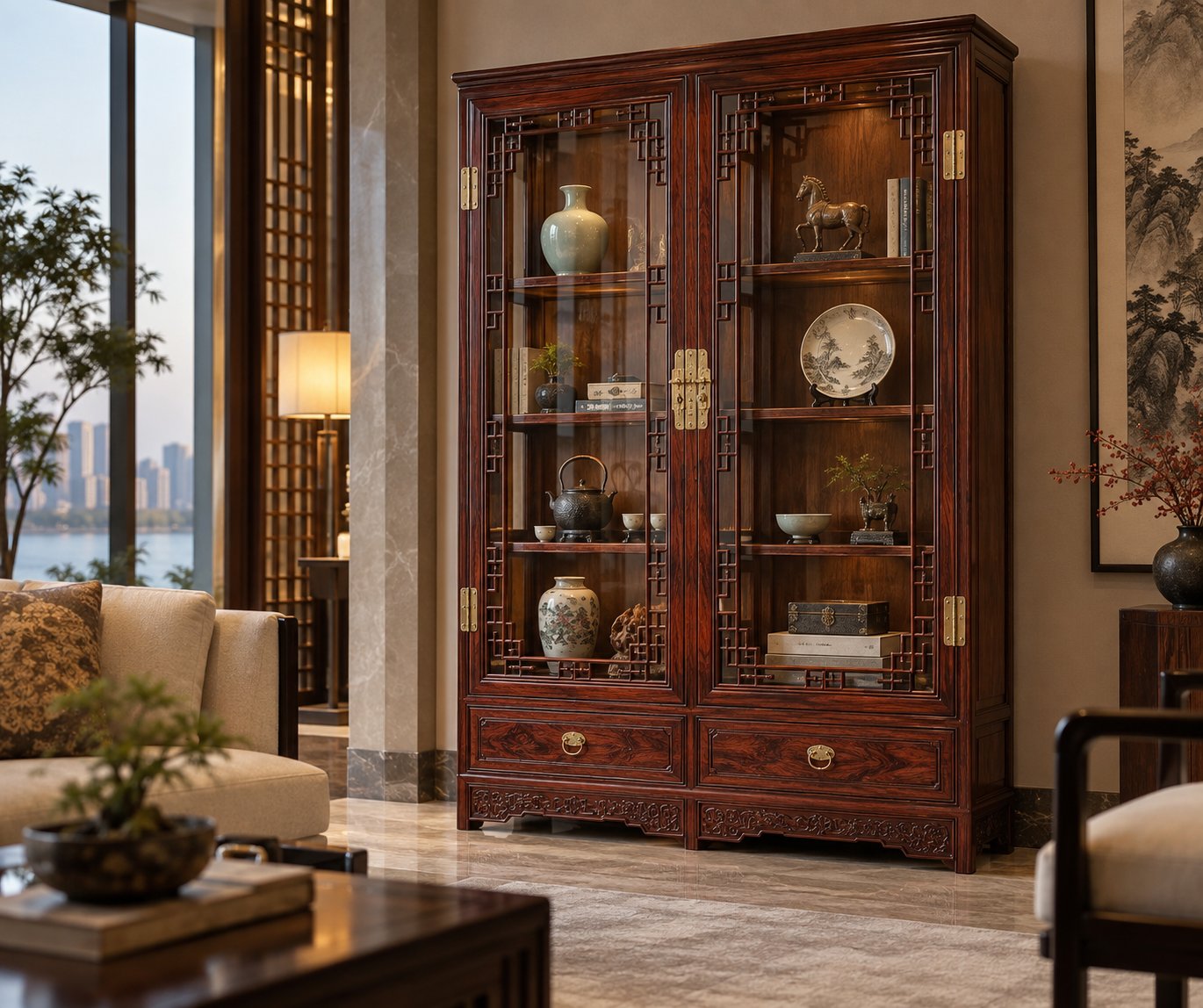
คู่มือ B2B เชิงปฏิบัติสำหรับการเลือกตู้โชว์ไม้ชิงชันสำหรับโชว์รูม วิลล่า และโครงการโรงแรม: ความถูกต้องตามกฎหมายของไม้และการอบ งานเข้าไม้แบบเดือยและร่อง การแกะสลักและบานประตูตาข่าย การตกแต่งผิวด้วยแลคเกอร์เจ็ดชั้น ข้อกำหนดกระจกและอุปกรณ์ การปรับแต่ง OEM-ODM เอกสารการปฏิบัติตามข้อกำหนด และการจัดส่งสินค้าส่งออก
Why the Rosewood Display Cabinet Deserves a Central Place in Your 2026 Product Plan
If you import, distribute, or specify classical Chinese furniture, you have probably watched buyers shift their attention from large statement pieces toward pieces that combine display, storage, and cultural storytelling in one footprint. The rosewood display cabinet sits exactly at that intersection. It showcases collectibles, tea sets, art objects, or retail merchandise; it fills vertical space in rooms with high ceilings; and it carries the carved detail that makes classical Chinese furniture instantly recognizable to customers in Europe, North America, Southeast Asia, and Australia.
Yet choosing the right display cabinet for a showroom, a private villa, or a hotel project is not a simple catalog exercise. Solid rosewood is a demanding material. Joinery traditions, moisture behavior, lacquer chemistry, glass specification, hardware quality, and shipping protection all interact. A cabinet that delights a homeowner in Milan can disappoint a hotel operator in Sydney if it was specified without understanding those interactions. This guide walks through the decisions that matter, from wood selection and construction methods to customization, compliance documentation, and container logistics, so that your next order converts into repeat business rather than warranty claims.
What Exactly Is a Classical Rosewood Display Cabinet?
In the Chinese classical furniture tradition, the display cabinet family includes several related forms. The best known in Western markets are the glass-fronted display cabinet, often called a curio cabinet in North America, and the open shelved bogu shelf, sometimes translated as a curiosity shelf, which appeared in scholars' studios during the Ming dynasty as a place to arrange antiques, bronzes, ceramics, and scholar's objects. A third related form is the tall side cabinet with solid carved doors, which prioritizes storage over visibility.
A well-made modern rosewood display cabinet typically stands between 170 and 200 centimeters tall, with a footprint around 100 by 40 centimeters, and combines three functional zones. The upper zone presents objects behind tempered glass doors framed by carved lattice. The middle zone may hold drawers or an open alcove for frequently used items. The base zone provides closed storage on solid or floating-panel doors. This vertical arrangement is one reason the form works so well in commercial settings: it delivers museum-grade display at eye level, where visitors actually look, while hiding service clutter below.
Why Rosewood Remains the Material of Choice for Display Furniture
Density, Stability, and the Feel of Genuine Hardwood
Genuine rosewood species, including Siamese rosewood, are dense tropical hardwoods with tight grain, natural oil content, and a rich reddish-brown color that deepens with age and handling. Those properties matter for a display cabinet in ways they do not for a simple stool. Tall cases carry significant leverage loads; doors must remain square so glass seats properly; carved lattice members are thin and must resist splitting. Dense hardwood gives carvers clean detail and gives the finished case long-term dimensional stability when the wood has been properly dried.
The Legal and Environmental Dimension Buyers Now Ask About
Because rosewood species fall under international timber regulation, serious buyers increasingly ask for documentary proof of legal sourcing before they will place a container order. A credible manufacturer works with legally certified timber, maintains traceable documentation, and can support customers with FSC-related paperwork where applicable, along with the export documents required under the EU Timber Regulation and the US Lacey Act. When you shortlist suppliers, ask specifically what documentation accompanies the wood, not just the finished furniture. A factory that hesitates on this question is a factory that will hesitate at your customs border too.
Responsible Pairing of Materials
Not every component of a large case must be the most expensive timber. Reputable makers commonly pair Grade-A tropical hardwood in visible and structural areas with complementary certified hardwoods such as Machilus nanmu in less visible interior zones, matching material cost to function without compromising appearance or strength. Ask how a prospective supplier allocates materials across the case; a transparent answer is itself a quality signal.
Construction Standards That Separate a Lasting Cabinet from a Short-Lived One
Mortise and Tenon Joinery Throughout
The defining feature of authentic classical Chinese furniture is joinery without metal fasteners in the frame. Legs, stiles, rails, and corner members are connected with hand-fitted mortise and tenon joints that allow the structure to flex microscopically with seasonal humidity changes instead of resisting them. In a tall display cabinet this matters enormously: a rigid, glue-and-screw case that ships from humid south China to a heated European apartment will fight its new environment and eventually crack. A properly jointed case moves with the seasons and stays tight for decades. When you inspect samples, look inside the case, not just outside. Quality is visible in the fitting of hidden joints.
Floating-Panel Construction on Side Panels
Solid wood panels expand and contract across the grain with humidity. A cabinet whose side panels are glued rigidly into their frames will eventually split those frames. The traditional solution, still the correct one, is floating-panel construction: the panel is cut slightly undersized and held in a groove that lets it move without opening gaps. Ask any supplier directly whether side and back panels float. It is a one-sentence question that reliably separates craft factories from volume producers.
Hand-Cut Dovetail Drawers
Display cabinets with drawers reveal another diagnostic. Machine-dovetailed drawers are fast and cheap; hand-cut half-blind dovetail drawers cut to the traditional ratio used in Chinese hardwood furniture hold for generations and signal a workshop with genuine cabinetmaking depth. Run your fingers along the drawer front joint. You will feel the difference before you see it.
Drying Before Construction, Not After
No joinery survives if the timber was not dried correctly before cutting. Wood for export furniture destined for North American, European, or Australian interiors must be brought to a moisture content appropriate for those destination climates. Leading manufacturers run multi-week constant-humidity kiln programs; a thirty-six day controlled drying cycle is a realistic benchmark for cabinet-grade stock. Then the assembled case should be given time to rest and acclimate before finishing. A factory that quotes suspiciously short production lead times is often compressing exactly these steps, and the failures appear eighteen months later in your customers' living rooms.
Carving and Lattice Doors: The Visual Signature
The glazed upper section of a display cabinet is where carving earns its keep. Classic lattice patterns filter light, protect glass edges, and cast geometric shadow patterns that change through the day. Deeper relief carvings, often featuring cloud scrolls, bamboo, dragons, phoenixes, or floral motifs, add narrative and value. Carving hours are a real cost driver: a single pair of lattice doors can absorb roughly twenty hours of skilled hand work, with each motif cut in shallow relief using chisels passed down through generations of craftspeople.
For B2B buyers the practical question is not whether carving is beautiful but whether it is consistent across an order. Ask to see photographs of several cabinets from the same production batch. Hand carving varies slightly piece to piece, which collectors value, but the motif vocabulary, depth, and finish quality should be uniform. A factory that cannot show batch consistency will not survive a hotel fit-out inspection.
Finishing: What Seven Coats of Raw Lacquer Actually Mean
Finishing is where many importers get burned, because finish failures surface months after delivery. The traditional approach uses multiple coats of natural raw lacquer, each coat allowed to cure fully, often around twenty-four hours, and hand-rubbed between coats with pumice to build a deep satin sheen rather than a plastic-looking gloss. Seven coats is a demanding, time-consuming standard, and it is worth specifying explicitly in your purchase contract.
Finish chemistry also carries compliance weight. Furniture sold into the European Union must meet REACH chemical requirements, and US-bound furniture must satisfy CARB formaldehyde standards. Natural lacquer systems and eco-friendly beeswax finishing help meet those thresholds, but you should request the relevant test documentation rather than accepting marketing language. Compliance paperwork is part of the product, exactly like the glass and the hardware.
Glass, Hardware, and Interior Fit-Out Details
Tempered Glass and Safe Door Operation
Display cabinet doors hold glass at head height in rooms where children and hotel guests move around. Tempered glass is the only acceptable specification; ask for it explicitly and confirm the glass thickness. Hinges should be solid brass or high-grade stainless with soft close action, because a door slamming on carved lattice will damage the carving long before it damages the glass.
Traditional Brass Hardware Done Properly
Classical Chinese cabinets use surface-mounted brass fittings, face plates, pull handles, and lock plates, often with auspicious motifs. Quality fittings are cast or stamped from solid brass, hand-finished, and attached with slotted screws that follow the grain logic of the design. Cheap plated fittings pit and discolor within two years, especially in coastal hotel environments. Specify solid brass with a lacquer-sealed or aged finish and inspect samples under raking light.
Interior Shelving and Lighting Provision
For hospitality and retail projects, discuss interior fit-out at order time. Adjustable hardwood shelf pins, discreet LED strip provision with concealed wiring channels, and plate grooves for displaying dishes or tea sets can all be engineered during production but are difficult to retrofit. A factory that offers free layout drawings for project customers will typically integrate these details into the drawing set, which is the right moment to lock them down.
Matching the Cabinet to the Project Type
Showrooms and Retail Display
In a showroom, the cabinet itself is merchandise, but it also frames other merchandise. Retail buyers usually want consistent pairs, identical dimensions, symmetric carving, and reinforced interior lighting so objects read clearly under retail illumination. Durability against public contact matters: corners take knocks, so slight edge profiles and robust corner joinery pay for themselves. Ordering a matched pair or a run of four with sequential timber selection produces a far more professional floor than mixed singles.
Private Villas and Luxury Residences
Villa clients buy emotion and provenance. They respond to timber figure, carving depth, and story: which motif, what it traditionally signifies, how the piece was made. For this segment, offer customization of carving themes and proportions, and provide a material and craft narrative the end client can retell. One-off or short-run cabinets with personalized motifs, for example family-related symbols or a favorite blossom, command the strongest margins and generate referrals.
Hotels, Resorts, and Boutique Hospitality
Hospitality projects prioritize durability, consistency, and schedule. Cabinet runs must match across dozens of rooms, finishes must withstand housekeeping chemicals, and deliveries must phase with the construction program. Here the manufacturer's project capability matters more than any single piece: capacity for repeat container orders, phased partial shipments, sample approval workflow, and installation guidance for local teams. Ask prospective suppliers how they handled their last multi-room hotel order, and request a reference contact if possible.
Offices, Boardrooms, and Cultural Spaces
Corporate and cultural buyers use display cabinets to present awards, art, or heritage objects, and they often need nonstandard dimensions to fit architectural niches. This is classic ODM territory: the buyer brings drawings or site measurements, and the factory engineers a case around them while preserving classical proportions. Factories experienced in whole-house custom work handle this well because the underlying joinery does not change.
Customization and OEM-ODM: What a Capable Factory Can Actually Change
Because the classical cabinet form is built from a grammar of joints, panels, and carved members rather than from molded parts, it is highly customizable without losing authenticity. Realistic customization points include overall dimensions and proportion, carving motif selection and density, lattice pattern geometry, drawer configuration, glass type and tint, hardware style and finish, interior lighting provision, and the finish tone from lighter honey to deeper oxblood. Genuine OEM work, where the factory builds to your brand and specifications, extends to packaging design, labeling, and documentation formatted for your market.
What a responsible factory will not change is the engineering logic: joinery ratios, panel float, and drying standards are not negotiable downward, because relaxing them converts a purchase into a future claim. When you compare quotes, treat a quote that is cheaper because it skips those standards as the expensive option.
From Timber Selection to Loading: What Happens Inside the Factory
Understanding the production sequence helps you read lead times honestly. Timber arrives certified and is graded, then enters the controlled drying program. After drying, stock rests and is machined: frames cut, joints fitted, panels prepared. Carving runs in parallel on doors and decorative members. Assembly follows, then the case rests again before the lacquer program begins, coat by cure-gapped coat. Hardware, glass, and interior fit-out complete the piece, which then cures, is inspected, and is packed. For container orders of classical solid wood furniture, forty-five to sixty working days after deposit is a realistic, honest range, and partial shipments can phase larger project orders.
Quality control should be layered rather than a single final glance: moisture checks on incoming and dried stock, joinery fit checks at dry assembly, carving depth and motif checks against the approved sample, finish film and appearance checks per coat, and a pre-packing inspection covering hardware operation, glass seating, and door alignment. Factories that publish their inspection process, as opposed to just their products, are usually the ones whose containers open without surprises.
Packing and Shipping Carved Furniture Without Damage
Export damage is almost always a packing failure, not a production failure. Proper export packing for carved classical furniture uses custom crating with internal bracing, moisture barriers, corner protection over carved projections, and heat-treated wood packaging certified to ISPM 15 so containers clear quarantine without holds. Doors and removable shelves should be individually wrapped and, on tall cases, glass doors braced so vibration during ocean transit cannot work the lattice. Ask how the supplier packs specifically for your destination port and transit time; the answer should be specific, not generic.
Reading Price: What You Are Actually Paying For
Display cabinet pricing concentrates in four areas: timber grade and volume, carving hours, finishing coats and time, and hardware and glass specification. A price that seems low usually means one of those four has been quietly reduced, most often timber grade, drying time, or lacquer coats. When comparing quotes across suppliers, normalize the specification first: same dimensions, same timber declaration, same carving depth, same coat count, same glass and hardware, then compare. If your market position depends on quality reputation, the specification-locked comparison will show which factory is genuinely efficient and which is quietly cutting.
Compliance and Documentation Checklist for Importers
Before finalizing a supplier, confirm in writing that the factory can provide: timber legality documentation supporting your import declaration; FSC or equivalent chain-of-custody papers where your program requires them; REACH or CARB relevant finish and material documentation; ISPM 15 marked packaging; a commercial invoice and packing list formatted for your customs broker; and remote installation guidance for your local team. Suppliers who export regularly to the EU, US, Australia, and Southeast Asia maintain this file as a matter of routine; ask for a redacted sample pack from a previous shipment. The request costs nothing and filters quickly.
A Practical Pre-Order Checklist
- Confirm timber species and legality documentation in writing, species by species, not just hardwood in general.
- Ask whether side and back panels use floating-panel construction and whether frame joinery is mortise and tenon without metal fasteners.
- Verify the drying program length and destination-moisture targeting for your market's climate.
- Lock carving motifs, depth, and lattice patterns against a signed physical sample or detailed drawing.
- Specify lacquer coat count, cure time per coat, and request finish compliance documentation for your destination market.
- Confirm tempered glass, solid brass hardware, hinge quality, and any interior lighting provision.
- Agree production lead time, deposit terms, phased shipment options, and pre-shipment inspection rights.
- Review export packing specification including ISPM 15 certification for your route.
Frequently Asked Questions from B2B Buyers
Can we order a single display cabinet as a trial before committing to a container?
Yes. Established manufacturers offer trial single sets and refundable sample programs precisely so first-time buyers can evaluate build quality, finish, and packing before scaling. Ask whether the sample cost is credited against a subsequent container order, which is a common arrangement.
How much customization is realistic for a hotel project with forty rooms?
Dimensions, carving themes, hardware, and interior fit-out are all customizable at project scale, provided the order is placed with enough lead time for drying and carving scheduling. The factory should supply free layout drawings for sign-off before production begins.
Will solid rosewood furniture crack in a heated European or North American interior?
Furniture made from properly dried timber, assembled with traditional joinery that allows seasonal movement, and finished with multiple cured lacquer coats is engineered for overseas climates. Cracking incidents almost always trace back to inadequate drying or rigid glued construction, which is why those two points belong in your purchase specification rather than in a hope.
What documents accompany a typical export shipment?
A complete file includes the commercial invoice, packing list, bill of lading, timber legality and FSC-related papers where applicable, REACH or CARB documentation for the destination market, and ISPM 15 packaging certification. Confirm the list with your customs broker before the container books.
How should display cabinets be maintained in commercial settings?
Dust with a soft dry cloth, avoid silicone-based polishes that build film over lacquer, keep the cabinet away from direct heat sources and prolonged strong sunlight, and wipe glass with non-ammonia cleaner applied to the cloth rather than the wood. For hotels, brief housekeeping teams once; the routine is simple, but it must be the right routine.
Can carving motifs be matched to our brand or a client's cultural theme?
Within the classical motif vocabulary, and sometimes beyond it, yes. Factories with in-house master carvers can develop new patterns from drawings, though original motif development adds sampling time. Always approve a physical carved sample before the production run.
A Short History That Helps You Sell the Piece
Understanding where the display cabinet comes from gives your sales team language that closes deals, because buyers in every market respond to authenticity. Open shelved display furniture entered Chinese domestic life centuries before glass was commonly available. In the studios of Ming dynasty scholars, shelves held the objects of a cultured life: bronzes, ceramics, brush rests, and books, arranged with deliberate asymmetry that reflected taste rather than wealth alone. The bogu shelf, literally the shelf of abundant knowledge, turned arrangement into an art. When glassmaking matured and international trade brought large clear panes into Chinese ports, craftsmen married the old shelving grammar to glazed doors, producing the display cabinet as international buyers now know it: carved frames, lattice fronts, brass fittings, and dust-free presentation of treasured objects.
That history explains two things you can use commercially. First, the form is not a modern invention dressed in pseudo-tradition; it has a continuous lineage, which matters to heritage-minded buyers in Europe and design-led buyers in Australia alike. Second, the form adapts. It has already absorbed glass, and it can absorb lighting, tempered safety glazing, and contemporary proportions without losing identity, which is precisely what makes it suitable for 2026 hospitality and residential projects.
Regional Market Notes for Importers
Europe
European buyers of classical Chinese furniture tend to be design professionals, collectors, and boutique retailers. They scrutinize proportion and restraint. A display cabinet for a Milan or Paris showroom should favor cleaner Ming-influenced lines, shallower carving, and honest finishes; the Qing style, with denser carving, finds its home in more ornate interiors and in demand from clients who want visible opulence. Documentation discipline is highest in this region: timber legality papers, REACH-compliant finish documentation, and ISPM 15 packaging are treated as baseline, not bonus. Position your offer with the paperwork attached, and respond to proportion questions with real millimeter dimensions, because European buyers measure.
North America
The North American market consumes display cabinets through three channels: specialist Asian furniture retailers, interior designers serving luxury residential projects, and hospitality procurement. Buyers here ask about curio-style functionality first, glass quality, lighting readiness, adjustable shelves, and then about material authenticity. CARB compliance for composite components and finish safety matter to chains and franchised retail. Expect requests for impact-resistant packing and dock-to-floor delivery planning; tall glazed cases are unforgiving of rough last-mile handling, so discuss packing with the logistics provider as well as the factory.
Southeast Asia
In Singapore, Malaysia, Indonesia, and Vietnam, classical Chinese furniture carries living cultural resonance and strong gifting traditions. Humidity is the technical challenge: cabinets move into environments where seasonal swings and monsoon spikes test every joint. This is where the drying program and floating panels earn their money. Buyers in the region also frequently order paired cabinets for entrance halls and tea rooms, and they expect suppliers to understand motifs with local auspicious meanings. Lead times are often shorter because shipping distances are small, but quantity per order can be higher, so batch consistency again becomes the inspection focus.
Australia and New Zealand
Australian buyers combine a strong indoor-outdoor lifestyle with a growing appreciation of crafted timber furniture. Coastal interiors create salt-air exposure questions for hardware; specify solid brass with appropriate finishing. Timber legality and sustainability narratives resonate strongly, and buyers often ask pointed questions about species and certification. Heat and strong UV in many Australian homes argue for finish systems tested against sunlight and for placement guidance included in your after-sale materials. A distributor who ships with placement cards, keep out of prolonged direct sun, maintain ventilation gaps, is remembered for the care as much as the cabinet.
How Professional Buyers Actually Run the Sourcing Process
Experience across many container programs shows a repeatable sequence, and aligning with it makes you easier to buy from.
Discovery and shortlisting
Buyers gather three to five candidate factories through fairs, referrals, and verified platforms, then send a standardized inquiry: dimensions, timber species, carving themes, target market, compliance requirements, and annual volume. The factories that answer with specific, complete replies, including real photographs of their own workshops and cabinets rather than stock imagery, move to the next round.
Sample and specification lock
The shortlisted suppliers quote, and the buyer orders one sample cabinet, sometimes refundable against the future order. The sample is not merely a physical object; it is the specification anchor. Carving depth, lacquer tone, hardware finish, drawer action, and glass quality all get signed off against it. Change anything later without a new approval, and you have a dispute, not a specification.
Contract and production
The purchase contract should embed the agreed specification, lead time, payment terms, inspection rights, packing standard, and documentation list. Serious factories welcome this; they have written such contracts many times. Production updates at fixed milestones, timber booked, carving complete, finish underway, packed, keep the buyer's logistics calendar honest.
Inspection and shipment
Either the buyer inspects personally, appoints a third-party inspector, or relies on the factory's documented pre-shipment process with photographic evidence. For first orders, a third-party inspection is cheap insurance and signals professionalism to the factory that you will hold the line on future orders too. After delivery, a structured feedback loop on packing condition, finish behavior in the destination climate, and sell-through builds the partnership that earns priority scheduling during peak season.
What a Factory Visit or Virtual Audit Should Cover
Not every buyer can travel, but every buyer can audit. Whether in person or by video call, walk the same checklist. Timber yard: is stock stacked with spacers and air flow, are species segregated and labeled, does the yard look like ongoing trade or a photo set. Drying facility: ask to see kiln logs for a recent batch, note the cycle length and final moisture readings. Carving workshop: watch a carver work for five minutes; depth control and tool discipline are visible immediately. Assembly area: look for dry-fit stations and joint fitting benches, not just glue lines and nail guns, the latter should be absent from frame assembly entirely. Finishing room: coat racks, cure timing boards, rubbing stations with pumice, and ventilation tell you whether the seven-coat claim is a program or a phrase. Packing line: crating stock, ISPM 15 stamps, moisture barriers, and corner protection for carved members. A factory confident in each area will show each area. Hesitation concentrated in one station tells you where failures will originate.
Two Mini Cases from the Field
A Boutique Hotel in Melbourne
A distributor ordered twelve display cabinets for suites and the lobby lounge, all one design with a bamboo lattice motif. The factory produced free layout drawings first, locking dimensions against the suite joinery, then ran timber selection for visual consistency across the batch. Partial shipments phased with floor completion: six cabinets, then six. The buyer's inspector checked carving depth against the signed sample and found one cabinet with a shallower motif on a door pair; the factory rebuilt the doors before packing at its own cost. The hotel opened on schedule, and the distributor's reorder covered a second property.
A Villa Project in Vancouver
A designer specified two taller cabinets, 200 centimeters, for a double-height entrance. The lesson here went the other way: the first supplier skipped the destination-moisture question, and the following Canadian winter produced hairline checks on two panels. The replacement order, placed with a factory that documented a drying program targeted to heated interior conditions, has performed without incident for years. The specification you write is the warranty you get.
Reading Lead Time Promises Realistically
When a supplier quotes production time, decompose it mentally: drying is largely fixed and should not be compressed; machining and carving scale with order quantity and motif complexity; finishing time is fixed per piece because coats cure on their own schedule; packing and inspection take days, not hours. A quote of three weeks for a container of carved cabinets is not efficiency; it is arithmetic that omits steps. Forty-five to sixty working days after deposit for container orders of classical solid wood furniture is the honest band, and partial shipments allow large projects to start receiving while later batches finish. Buyers who respect the physics of wood get cabinets that respect their customers.
Trends Shaping Display Cabinet Demand in 2026
Three currents matter for catalog planning. First, the heritage luxury wave continues: buyers in North America, Europe, and Australia increasingly seek furniture with story and craft, and the display cabinet narrates craft better than almost any other form because its quality is visible in joinery and carving rather than hidden in upholstery. Second, hospitality design is importing residential warmth; boutique hotels want lobbies and suites that feel like collected homes, and classical Chinese display cabinets deliver that collected feel while remaining durable enough for commercial duty. Third, provenance transparency has moved from differentiator to expectation; distributors who can present documented legal timber and compliance paperwork win bids where competitors with similar products and no paperwork simply lose. Planning your year around those three currents, a tighter classical core range, project-ready consistency, and a documentation pack that travels with the quote, positions the display cabinet line for growth rather than margin erosion.
A Working Glossary for Buyer Conversations
- Bogu shelf: an open shelved display form from the scholars' studio tradition.
- Floating panel: a solid panel set in a groove so it can move with humidity.
- Mortise and tenon: interlocking joinery connecting frame members without nails.
- Half-blind dovetail: a drawer joint whose pins show only on the drawer sides, not the front.
- Raw lacquer: natural finish applied in multiple cured, hand-rubbed coats.
- Lattice: geometric carved framework, often on glazed doors.
- Relief carving: carved motif raised from a recessed background.
- ISPM 15: the international standard marking heat-treated wood packaging for export.
- REACH: the European Union framework governing chemical safety, relevant to finishes.
- CARB: California Air Resources Board standards on formaldehyde emissions, widely applied to US-bound furniture.
Keeping these terms in your team's vocabulary speeds quotes and prevents the misunderstandings that turn into claims.
More Questions Buyers Ask Before Ordering
Can cabinets be made in matched pairs or matched sets?
Yes, and it is the recommended approach for entrance halls and flanking arrangements. Sequential timber selection during production keeps color and grain consistent across the set; allow slightly longer lead time for set matching.
Do cabinets arrive fully assembled?
Tall classical cabinets ship fully assembled where feasible, with glass doors packed separately and installed on site, which protects both lattice and glass in transit. Confirm assembly scope and on-site requirements when booking.
Can interior lighting be fitted at the factory?
Yes, provision for low-heat LED strips with concealed wiring is engineered during production; retrofitting later is difficult, so decide before production starts.
What sizes are standard, and what is the practical custom range?
Standard cases commonly run around 100 by 40 by 180 centimeters; custom work commonly spans roughly 80 to 120 centimeters wide and up to about 220 centimeters tall while preserving classical proportion. Beyond that range, proportions start to fight the form, and a good factory will say so.
How do we handle spares and after-sale support?
Discuss hinge, glass, and touch-up finish spares at order time; established factories ship a small spares kit with container orders and provide remote installation and maintenance guidance.
What payment and trial structures are typical?
Deposit with balance before shipment is standard; trial single sets and refundable samples are common for first-time buyers, often with sample cost credited against a subsequent container order.
Seasonal Care Guidance You Can Pass to Your Customers
After-sales care content is a quiet competitive weapon, because it reduces claims and keeps your brand in front of the buyer long after delivery. Include a simple seasonal card with each cabinet. In heated winters, maintain moderate indoor humidity and keep the cabinet away from direct radiator or floor-heating airflow; dry air is the main enemy of solid wood furniture in cold climates. In humid summers, ensure ventilation behind the cabinet so air can circulate, and wipe surfaces with a soft dry cloth rather than wet ones. Refresh the surface once or twice a year with a thin coat of natural beeswax, applied with the grain and buffed gently, which feeds the lacquer system without building silicone film. Check hinges and brass fittings annually and tighten slotted screws gently; brass stays bright with a dry polish. Glass doors clean best with non-ammonia cleaner sprayed onto the cloth, never onto the wood. If a customer moves the cabinet, lift it, never drag it, and remove glass doors and shelves first. These few habits, printed on one page, prevent most of the service calls a distributor will otherwise receive, and they signal to end clients that the supplier behind their purchase thinks about ownership, not just the sale. Distributors who localize this card into the destination language and add their own service contact turn a factory instruction into a brand touchpoint.
Putting It All Together
Choose the market segment first, because it drives every later decision: retail consistency for showrooms, story and customization for villas, durability and schedule for hotels, engineered nonstandard dimensions for offices and cultural spaces. Then hold the specification line that protects all four: documented timber, honest drying, traditional joinery, floating panels, hand-cut drawers where drawers appear, carving locked to an approved sample, a finish program with documented compliance, tempered glass and solid brass hardware, and packing engineered for the specific route. Suppliers who meet that bar will not always be the cheapest quote on the page, but they are the cheapest per year of trouble-free service, and in furniture distribution, that is the number that decides who is still in the market in five years. When you are ready to specify, prepare your dimension list, target market, compliance requirements, and preferred carving vocabulary, and engage a factory that answers each point with specifics rather than reassurance. The display cabinet rewards exactly that kind of buyer.
Conclusion: Choose the Cabinet the Way Your Customers Will Live With It
A rosewood display cabinet is one of those rare products where craftsmanship, compliance, logistics, and merchandising all converge on a single piece of furniture. Buyers who specify it carefully, timber documented and properly dried, joinery traditional, carving consistent, finish compliant, glass and hardware genuine, packing engineered for the route, end up with a product that anchors showrooms, delights villa clients, and survives hotel duty for years. Buyers who treat it as a commodity buy claims, and then handle them. The difference is not luck; it is the checklist above, applied before the deposit leaves your account.
If you are planning a showroom refresh, a villa program, or a hospitality fit-out and want to discuss display cabinet options, dimensions, carving themes, and project scheduling, send your requirements, floor plans, and target market details. A supplier with deep classical furniture experience can prepare layout drawings, material recommendations, and a phased quotation matched to your project timeline.