
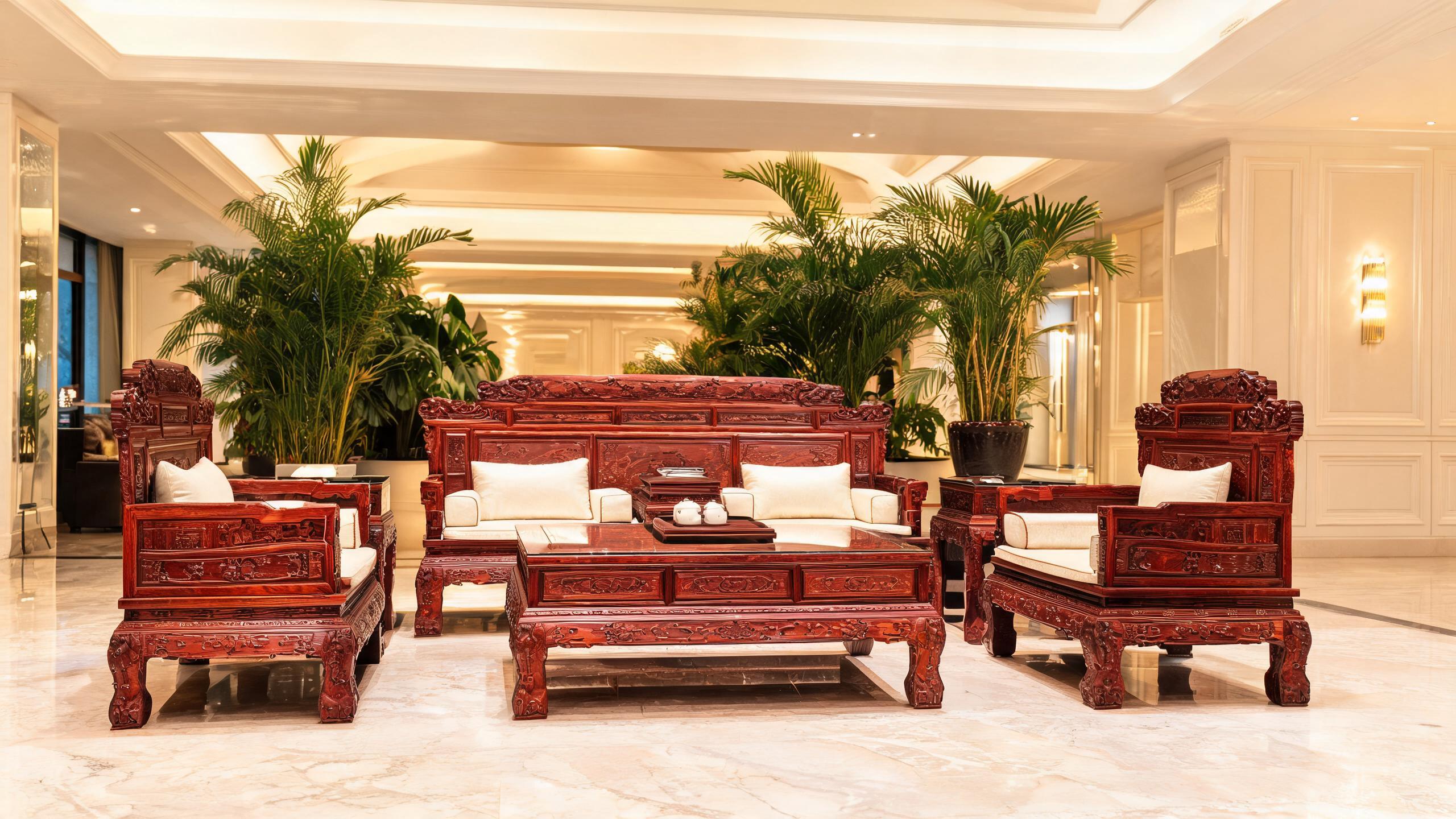
มุมมองเชิงปฏิบัติว่าทำไมผู้ซื้อในเอเชียตะวันออกเฉียงใต้และออสเตรเลียจึงหันมาใช้เฟอร์นิเจอร์ไม้โรสวูดคลาสสิกสำหรับโครงการโรงแรมและที่พักอาศัยในปี 2026 — ครอบคลุมปัจจัยขับเคลื่อนตลาด ประสิทธิภาพในสภาพอากาศ เอกสารการปฏิบัติตามข้อกำหนด การวางแผนโครงการ และการประเมินผู้จัดส่ง โดยอ้างอิงจากการดำเนินงานจริงของ Yunxiao Rosewood Furniture
Why Are Southeast Asian and Australian Buyers Turning to Classical Rosewood Furniture for Hospitality and Residential Projects in 2026?
For most of the past decade, the conversation about classical Chinese rosewood furniture has been dominated by European and North American importers. Walk into any sourcing conference and you will hear about EU Timber Regulation, the US Lacey Act, and the preferences of buyers in London, Paris, and New York. That focus is understandable — those markets have long been the largest destination for premium solid hardwood furniture. But it has also left a quieter, faster-growing story largely untold: the rise of Southeast Asian and Australian buyers who are now placing serious, repeat orders for classical rosewood furniture for hospitality and residential projects.
This article is written for wholesalers, hotel procurement teams, interior designers, and property developers across Southeast Asia and Australia who are evaluating classical rosewood furniture for the first time — or who have already started buying and want to source more confidently. We will look at why demand is shifting, what makes rosewood furniture genuinely suitable for tropical and coastal climates, what documentation you should expect from a compliant supplier, how to plan a project order, and the practical questions to ask before you commit. Everything here is grounded in the real operations of a working factory — Yunxiao Rosewood Furniture, founded in 2008 in Xianyou County, Fujian, China — rather than in generic marketing claims.
Why Southeast Asia and Australia Are Emerging as Serious Markets for Classical Rosewood Furniture
It is worth being precise about what has changed. Classical rosewood furniture is not a mass-market product. It is a premium, long-life category that buyers choose when they care about durability, craftsmanship, and the cultural weight a piece carries in a room. For years, that profile matched the tastes of European and North American collectors and high-end hospitality brands. Today, the same profile is increasingly matching the needs of buyers in Southeast Asia and Australia.
A growing base of premium hospitality and residential projects
Across Southeast Asia, the past several years have seen sustained investment in boutique hotels, resort villas, serviced residences, and high-end private homes. Bangkok, Singapore, Kuala Lumpur, Jakarta, Bali, Ho Chi Minh City, and Manila all have active pipelines of premium hospitality and residential development. These projects share a common design language: they want spaces that feel rooted in place, that use natural materials, and that offer guests or residents something they cannot get from a mass-produced import. Classical rosewood furniture — with its deep reddish-brown grain, hand-carved detail, and solid hardwood construction — fits that brief naturally.
Australia tells a related but distinct story. The Australian market has a strong tradition of solid timber furniture and a growing appetite for statement pieces in high-end homes, coastal residences, and boutique hospitality venues. Australian buyers tend to be quality-driven and willing to pay for craftsmanship, but they are also practical: they need furniture that performs in a climate that ranges from humid tropical zones in the north to dry, sun-exposed interiors in the south. That combination — an appreciation for craft plus a hard-nosed concern for climate performance — is exactly the profile that classical rosewood furniture, done properly, is built to satisfy.
Proximity and logistics favor the region
Geography matters in furniture sourcing. For Southeast Asian buyers, a factory in southern China is a short shipping route away, which shortens lead times and reduces freight cost relative to trans-Pacific or trans-Atlantic shipments. For Australian buyers, the shipping corridor from southern China to major Australian ports is well established and reliable. This proximity does not change the fundamentals of quality — a poorly dried or badly joined piece will fail in any climate — but it does make the region a practical, cost-effective sourcing base for buyers who want premium furniture without the logistics burden of sourcing from farther afield.
What Classical Rosewood Furniture Actually Is — and Why the Material Matters
Before discussing why buyers are turning to it, it helps to be clear about what "classical rosewood furniture" means in practice. The term covers furniture made from solid tropical hardwoods in the classical Chinese tradition — think carved sofas, dining sets, bedroom suites, and accent pieces built with traditional joinery rather than modern fasteners. The material is prized for its density, its rich color, and its stability when properly handled.
At Yunxiao, the materials used are legally certified Machilus nanmu, aged red wood, and Grade-A tropical hardwood. The factory does not use veneer, MDF, or finger joints in load-bearing components — the pieces are solid hardwood throughout. This matters for buyers because solid hardwood behaves differently from veneered or engineered furniture: it can be repaired, it develops a patina over time, and, when correctly dried, it holds its shape in a way that lighter materials cannot.
One of the most common misconceptions is that all "rosewood" furniture is the same. It is not. The density, grain, color, and working properties vary significantly by species. A serious supplier should be able to tell you exactly what timber is in the piece, where it came from, and what documentation supports its legality. If a supplier cannot or will not answer those questions, that is a red flag regardless of how attractive the price looks.
Why Classical Rosewood Furniture Performs Well in Tropical and Coastal Climates
This is the question that separates serious buyers from casual ones, and it is the reason climate performance deserves its own section. Southeast Asia and much of coastal Australia are hot, humid, and seasonally variable. Wood is a hygroscopic material — it absorbs and releases moisture as the surrounding air changes. If furniture is built from timber that was not properly dried, or if the joinery cannot accommodate natural movement, the result is predictable: cracking, warping, and joints that loosen within the first year.
Classical rosewood furniture, built the traditional way, is designed to handle this. Here is what a buyer should look for and what a responsible factory actually does.
Drying is the foundation of climate stability
At Yunxiao, every piece of timber goes through a 36-day constant-humidity drying process before it is worked. The goal is to bring the moisture content down to a stable level — in the factory's product specifications, kiln-dried timber is conditioned to roughly 8–12 percent moisture content, with an equalization period so the wood can settle before machining. This is not a cosmetic step. Timber that leaves the factory at the wrong moisture content will continue to move after it is installed, and no amount of beautiful carving will save a piece that is structurally unstable.
For buyers in humid climates, the drying question is not academic. A piece that was dried for a temperate climate and then shipped to a tropical one will absorb moisture on arrival and expand. A piece that was properly dried and equalized — and then finished with a breathable coating — will reach equilibrium with far less movement. When you evaluate a supplier, ask specifically about their drying process: how many days, at what humidity, to what target moisture content, and whether there is an equalization period. Vague answers should make you cautious.
Joinery without metal nails
The second pillar of climate performance is construction. Classical rosewood furniture is assembled with mortise-and-tenon joinery — interlocking joints cut into the wood itself — rather than with metal nails or screws. At Yunxiao, the primary frames are joined with mortise-and-tenon and concealed bamboo dowel pins, with zero metal fasteners in the load-bearing structure.
Why does this matter in a humid climate? Metal fasteners and the wood around them expand and contract at different rates. Over time, a nailed joint can loosen, and the metal can corrode or telegraph through the surface. A well-cut mortise-and-tenon joint, by contrast, allows the wood to move as a unit and actually gets tighter under load. This is one of the reasons classical rosewood furniture can last for generations — and why it is a sensible choice for projects where the furniture is expected to stay in place for decades.
Finishing that protects without sealing the wood in
The third pillar is the finish. Classical rosewood furniture is traditionally finished with raw lacquer and beeswax rather than with a thick plasticized coating. At Yunxiao, the finishing uses eco-friendly beeswax and lacquer that meets EU REACH and US CARB standards, and the raw lacquer is applied in multiple hand-rubbed coats — the factory's product specifications describe six-coat and seven-coat raw lacquer finishes, each coat cured and hand-rubbed for a penetrating satin sheen.
This approach matters for two reasons. First, a breathable finish lets the wood exchange moisture gradually rather than trapping it, which reduces the risk of surface cracking in a humid climate. Second, the finish is food-safe and low-VOC once cured, which is relevant for dining furniture and for projects that need to meet environmental standards. For buyers, the practical takeaway is to ask what the finish is, how many coats are applied, and whether it meets the VOC and chemical standards of your market.
The Hospitality Angle: Why Hotels and Resorts Are Choosing Rosewood
Hospitality is where the Southeast Asian and Australian demand story is most visible. Hotels, resorts, and serviced residences have very specific furniture needs, and classical rosewood furniture happens to answer several of them at once.
Durability under heavy use
Hotel furniture takes a beating. Guests sit, lean, move pieces, and occasionally mistreat them. A hotel operator cannot afford furniture that warps, cracks, or loses its joints after a season of use. Solid hardwood built with mortise-and-tenon joinery is one of the most durable furniture constructions available — it is designed to be repaired and refinished rather than replaced. For a hotel that expects to keep a lounge or dining room for ten or fifteen years, that durability translates directly into a lower total cost of ownership.
Distinctive design that supports a property's identity
Hospitality brands increasingly compete on identity. A resort in Bali or a boutique hotel in Melbourne does not want the same furniture as every other property. Classical rosewood furniture offers a distinctive, culturally rooted look that can anchor a lobby, a restaurant, or a suite. The hand-carved detail — dragon, cloud, bat, and lattice motifs — gives a property a sense of place and craftsmanship that is hard to replicate with standard contract furniture.
Because the furniture is made to order, it can be tailored to a project. Yunxiao supplies carved sofas with tea tables, six-to-twelve-seat dining sets, and complete bedroom suites, with flexible OEM and ODM custom sizes and patterns for villas and resorts. A hotel that needs a specific configuration, a particular carving motif, or a finish that matches its interior palette can work with the factory to produce exactly that — rather than adapting a project to a fixed catalog.
Whole-project coordination
Hospitality buyers rarely buy a single piece. They buy a lobby set, a dining room, a suite of bedrooms, or an entire property's furniture package. This is where working with a factory that can supply coordinated sets matters. A matching sofa, tea table, dining set, and bedroom suite — built to the same standard and finished to the same tone — reads as a coherent design, which is exactly what a hotel or resort needs. Yunxiao's product range is organized around this idea: carved sofa sets, dining sets from six to twelve seats, and complete bedroom suites that can be combined for whole-house or whole-property projects.
Matching Rosewood Furniture to Your Project Type
One of the most useful ways to think about a project is to map the type of space you are furnishing to the product configuration that fits it. Classical rosewood furniture is not a single product — it is a family of coordinated sets, and different project types call for different combinations. The table below is a practical starting point.
| Project type | Typical configuration | Why it fits |
|---|---|---|
| Hotel lobby and lounge | Carved sofa set with tea table, armchairs | Creates a distinctive arrival statement; durable under constant use |
| Resort villa and suite | Bedroom suite, sofa set, tea table | Coordinated whole-room look; made to order for villa layouts |
| Restaurant and banquet hall | Six-to-twelve-seat dining sets | Solid hardwood handles heavy daily use; food-safe finish |
| Private residence | Whole-house combination of sofa, dining, bedroom | Coherent design across the home; sized to actual rooms |
| Serviced apartment | Compact sofa set, dining set, bedroom suite | Premium feel with durable, low-maintenance construction |
Because Yunxiao supports OEM and ODM customization, these configurations can be adjusted — sizes, carving motifs, and finishes can be tailored to the specific dimensions and design language of a project. For a designer, this is the difference between fitting furniture to a space and fitting a space to furniture.
The Residential Angle: Whole-House and Premium Home Projects
Alongside hospitality, there is a growing residential story. High-end homeowners, interior designers, and property developers in Southeast Asia and Australia are increasingly choosing classical rosewood furniture for private residences — not just as a single accent piece, but as a coordinated whole-house approach.
For a premium home, the appeal is similar to hospitality but more personal. Buyers want furniture that will last, that carries craftsmanship, and that gives a home a distinctive character. A carved rosewood sofa set in a living room, a dining set for family gatherings, and a bedroom suite that anchors a master bedroom can together define the feel of an entire residence. Because the pieces are made to order, they can be sized and styled to fit the actual dimensions of a room — which is valuable in homes where standard catalog sizes do not work.
Yunxiao supports this with practical services that matter for residential projects: trial single sets, refundable samples, remote installation guidance, and free layout drawings for projects. For a homeowner or designer who is not sure how a piece will look in a real room, the ability to order a single trial set or a sample before committing to a full order reduces risk considerably. The free layout drawings help a designer plan where each piece will sit before anything is shipped.
The Role of OEM and ODM Customization in Project Furniture
Customization is not a luxury add-on in this category — it is often the reason a project chooses a factory at all. Standard contract furniture is designed to fit a generic floor plan. Classical rosewood furniture, made to order, can be built to fit the actual space, the actual design language, and the actual functional needs of a project.
OEM (original equipment manufacturing) means the factory builds to your specification — your sizes, your design, your finish. ODM (original design manufacturing) means the factory contributes its own design expertise and adapts it to your needs. Yunxiao offers both, with flexible custom sizes and patterns for villas and resorts. For a hotel that needs a specific number of seats in a dining room, or a residence that needs a sofa sized to an unusual wall, this flexibility is what makes the furniture work.
Customization also extends to the finish and the carving. A project may want a lighter or darker tone to match its interior palette, or a particular motif — dragon, cloud, bat, lattice — to carry a design theme through the space. Because the carving is done by hand, these elements can be specified rather than chosen from a fixed set. For a designer, this is a powerful tool: the furniture becomes part of the design language rather than an afterthought.
Compliance and Documentation: What a Compliant Supplier Should Provide
This is the section that separates a professional sourcing decision from a gamble. Classical rosewood furniture involves regulated timber, and buyers in Southeast Asia and Australia — like buyers everywhere — need to be confident that what they import is legal and properly documented. The good news is that a compliant supplier will provide this documentation as a matter of course. The bad news is that not every supplier is compliant, and the consequences of importing undocumented timber can be severe.
CITES and FSC documentation
Several of the tropical hardwoods used in classical rosewood furniture are listed under CITES (the Convention on International Trade in Endangered Species of Wild Fauna and Flora). This means that international trade in these timbers is regulated, and shipments require the appropriate permits. A serious supplier will hold CITES Appendix II export permits and include them with each shipment. Yunxiao includes FSC chain-of-custody documentation and CITES Appendix II export permits with its shipments, so buyers receive the paperwork they need to clear customs and demonstrate legal sourcing.
For buyers, the practical point is simple: before you order, ask what documentation will accompany the shipment. If a supplier cannot produce CITES and FSC documentation, treat that as a serious concern. The paperwork is not optional bureaucracy — it is the evidence that the timber was legally harvested and traded, and it is what protects you at the border.
Timber regulation and due diligence
Beyond CITES, buyers should be aware of the timber due-diligence requirements that apply in their own markets. The EU Timber Regulation and the US Lacey Act are the best-known examples, but similar expectations are spreading. The principle is the same everywhere: an importer is expected to exercise due diligence to ensure the timber they buy was legally harvested. A supplier that provides clear documentation makes that due diligence straightforward. A supplier that cannot is asking you to carry the risk.
Yunxiao's internal team prepares full export documents, including FSC certificates and the paperwork needed for timber compliance. For buyers who want to understand the requirements in detail, the factory has published practical guidance on timber compliance for EU and US markets — and the same principles of documentation and traceability apply to shipments bound for Southeast Asia and Australia.
Packaging and phytosanitary compliance
There is one more layer of compliance that is easy to overlook: packaging. Wooden crates and pallets used in international shipping must meet ISPM-15 phytosanitary standards — heat treatment that prevents the spread of pests. Yunxiao uses ISPM-15 heat-treated packaging, which means the crates themselves are compliant and will not be rejected at the border. For a buyer, this avoids a common and frustrating failure point: a shipment that is held up or turned away because the packaging was not treated.
Beyond compliance, packaging quality matters for the condition of the furniture on arrival. Carved rosewood furniture is heavy and has delicate relief work that can be damaged in transit. Yunxiao's export packing uses custom crating, moisture barriers, and bracing protocols engineered to protect relief-carved furniture during ocean freight. For a buyer, this is the difference between receiving furniture in showroom condition and receiving a claim for damaged goods.
Working with a Factory vs. a Trading Company
One of the most important sourcing decisions is whether to buy directly from a factory or through a trading company. Both models exist for a reason, but for a category like classical rosewood furniture, the distinction matters more than in many other products.
A factory controls the entire process — the timber, the drying, the joinery, the carving, the finish, and the documentation. This means it can answer detailed questions about the material and process, provide the necessary export documents, and support customization directly. A trading company, by contrast, sources from multiple factories and may not have the same depth of control or documentation. For a buyer who needs to verify compliance, confirm specifications, and rely on after-sales support, working directly with a factory is usually the safer choice.
Yunxiao is a factory, not a trading company. It owns its 12,000-square-meter facility in Xianyou County, employs its own carving artisans, and controls the drying, joinery, finishing, and export documentation in-house. For a buyer, this means the person you are negotiating with is the person who makes the furniture — and the documentation you receive comes from the source, not from a middleman.
How to Plan a Project Order: From Sample to Container
For buyers who are new to sourcing classical rosewood furniture, the ordering process can feel unfamiliar. Here is a realistic picture of how it works with a factory like Yunxiao, so you know what to expect at each stage.
Start with a sample or trial set
Because classical rosewood furniture is made to order and relatively expensive, it is wise to start small. Yunxiao offers trial single sets and refundable samples, which let you see and feel the actual quality before committing to a full order. For a hotel or designer, a sample also lets you verify that the finish, color, and carving match what you expect — and that the piece performs in your climate. This is a low-risk way to evaluate a supplier before scaling up.
Confirm specifications and customization
Once you are satisfied with the quality, the next step is to confirm the specifications. This includes the product configuration (sofa, dining, bedroom, or a combination), the sizes, the timber, the finish, and any custom carving or design elements. Because Yunxiao supports OEM and ODM customization, you can specify sizes and patterns that fit your project rather than adapting to a fixed catalog. For a whole-house or whole-property project, the free layout drawings help you plan where each piece will go before production begins.
Understand lead times
Classical rosewood furniture is not made from stock. Each piece is built to order, and the drying, joinery, carving, and finishing take time. Yunxiao's container orders take 45–60 working days after deposit. For a project with a fixed opening date or move-in date, you need to plan production and shipping around that lead time. This is one of the most common mistakes new buyers make — assuming that furniture can be delivered on the same timeline as a stocked product. Build the lead time into your project schedule from the start.
Plan for partial shipments if needed
For long-term partners, Yunxiao offers partial shipments. This can be useful for a large project where you want to receive and install furniture in phases — for example, furnishing a hotel floor by floor, or a residence room by room. Partial shipments also help manage cash flow and installation logistics. If your project is large or phased, ask about this option early.
Cost and Value: What You Are Actually Paying For
Classical rosewood furniture is not cheap, and it is worth being honest about why. The price reflects a specific set of inputs: legally certified solid hardwood, a 36-day drying process, hand-carved detail, mortise-and-tenon joinery, and multiple hand-rubbed coats of finish. Each of these takes time and skilled labor, and none of them can be skipped without compromising the result.
For a buyer, the value question is not "is it expensive?" but "what am I getting for the money, and how does it compare over the life of the piece?" A well-made rosewood dining set can last for decades and be refinished rather than replaced. A cheaper piece that warps, cracks, or loses its joints in a humid climate will need to be replaced — and the replacement cost, plus the disruption, usually exceeds the savings. For hospitality and premium residential projects, where furniture is expected to stay in place for years, the total cost of ownership tends to favor quality.
That said, price should never be the only consideration, and a low price should actually make you more cautious, not less. If a supplier is offering classical rosewood furniture at a price that seems too good to be true, ask what is being cut — the drying time, the joinery, the finish, the documentation. In a category where the material and process are the product, a suspiciously low price usually means something important is missing.
How to Evaluate a Rosewood Furniture Supplier
Whether you are buying for a hotel, a resort, a private residence, or a wholesale catalog, the same evaluation criteria apply. Here is a practical checklist to use when you compare suppliers.
- Ask about the timber. What species is it? Where did it come from? Is it legally certified? Can the supplier provide CITES and FSC documentation?
- Ask about drying. How many days, at what humidity, to what target moisture content? Is there an equalization period? This is the single most important factor for climate stability.
- Ask about construction. Is the frame joined with mortise-and-tenon, or held together with metal fasteners? Are load-bearing components solid hardwood or veneered?
- Ask about the finish. What is it? How many coats? Does it meet the VOC and chemical standards of your market, such as EU REACH and US CARB?
- Ask about documentation. What export documents will accompany the shipment? Is the packaging ISPM-15 heat-treated?
- Ask about lead times and terms. How long from deposit to delivery? Are trial sets and samples available? Are partial shipments possible for large projects?
- Ask about after-sales support. Is remote installation guidance available? Are layout drawings provided for projects?
A supplier that answers these questions clearly, with specifics and documentation, is demonstrating the transparency you need. A supplier that gives vague answers, or that cannot produce paperwork, is asking you to carry risk that you should not accept.
Common Mistakes Buyers Make — and How to Avoid Them
Having worked with buyers across markets for many years, we have seen the same mistakes recur. Here are the ones most worth avoiding.
Choosing on price alone
The most common mistake is choosing a supplier on price alone. In classical rosewood furniture, the material and process are the product. A cheaper piece is usually cheaper for a reason — shorter drying, weaker joinery, thinner finish, or missing documentation. The savings rarely survive contact with a humid climate or a customs inspection.
Ignoring the drying question
Buyers often focus on the visible craftsmanship — the carving, the finish — and forget to ask about drying. But drying is what determines whether the piece stays stable in your climate. A beautifully carved piece that was not properly dried will crack and warp. Ask the drying question before you admire the carving.
Underestimating lead times
Because classical rosewood furniture is made to order, lead times are longer than for stocked products. Buyers who do not plan for the 45–60 working day production window often find themselves with a project deadline that the furniture cannot meet. Build the lead time into your schedule from the start.
Skipping the sample
For a first order, skipping the sample or trial set is a false economy. A sample lets you verify quality, finish, and climate performance before you commit to a full order. It is a small cost compared to the risk of a full container that does not meet your expectations.
Overlooking documentation
Finally, buyers sometimes assume that documentation will simply be handled. It will not be — not by every supplier. Confirm in writing, before you order, what export documents will accompany the shipment, including CITES and FSC documentation and ISPM-15 packaging compliance. This protects you at the border and protects your reputation as a compliant importer.
Frequently Asked Questions
Is classical rosewood furniture suitable for humid tropical climates?
Yes, when it is built properly. The key factors are drying (timber conditioned to a stable moisture content), joinery (mortise-and-tenon without metal fasteners), and a breathable finish. A factory that controls these factors, as Yunxiao does with its 36-day constant-humidity drying and raw lacquer finishing, produces furniture that performs well in humid climates.
What documentation should I expect with a shipment?
A compliant supplier should provide CITES Appendix II export permits, FSC chain-of-custody documentation, full export documents, and ISPM-15 heat-treated packaging. Ask for these in writing before you order.
How long does an order take?
Yunxiao's container orders take 45–60 working days after deposit. Because the furniture is made to order, plan production and shipping around this lead time.
Can I order a sample before committing to a full order?
Yes. Yunxiao offers trial single sets and refundable samples, which let you verify quality and climate performance before scaling up.
Do you support custom sizes and designs?
Yes. Yunxiao supports OEM and ODM customization, including custom sizes and patterns for villas and resorts. Free layout drawings are provided for projects.
Can furniture be delivered in phases for a large project?
Yes. For long-term partners, Yunxiao offers partial shipments, which is useful for phased installation of a hotel or residence.
Do you provide installation support?
Yes. Yunxiao offers remote installation guidance, which helps your local team or contractor install the furniture correctly. For projects, free layout drawings are provided to plan the placement of each piece.
Is the furniture solid hardwood or veneered?
Yunxiao's classical rosewood furniture is solid hardwood throughout — no veneer, no MDF, and no finger joints in load-bearing components. The frames are joined with mortise-and-tenon and concealed bamboo dowel pins, with no metal fasteners in the primary structure.
Conclusion: A Market Worth Taking Seriously
The shift of Southeast Asian and Australian buyers toward classical rosewood furniture is not a passing trend. It reflects a genuine convergence of factors: a growing base of premium hospitality and residential projects, a design language that values natural materials and craftsmanship, a practical concern for climate performance, and a logistics route that makes southern China a sensible sourcing base for the region.
For buyers, the opportunity is real, but it rewards careful sourcing. The material is premium, the process is exacting, and the documentation is non-negotiable. Choose a supplier that can answer the hard questions — about timber, drying, joinery, finish, and documentation — with specifics and evidence. Choose a supplier that offers samples, trial sets, and project support, so you can verify quality before you commit. And choose a supplier that treats compliance as a matter of course, so your shipment clears the border without surprises.
Yunxiao Rosewood Furniture, founded in 2008 in Xianyou County, Fujian, has spent more than a decade building exactly this kind of operation: a 12,000-square-meter factory, experienced carving artisans, mortise-and-tenon joinery without metal nails, 36-day constant-humidity drying, eco-friendly beeswax and lacquer finishing that meets EU REACH and US CARB standards, FSC and CITES Appendix II documentation, ISPM-15 heat-treated packaging, and a service model built around trial sets, refundable samples, remote installation guidance, and free layout drawings. If you are evaluating classical rosewood furniture for a hospitality or residential project in Southeast Asia or Australia, that is the standard you should be looking for.
To discuss a project, request a sample, or get a layout drawing for your space, contact the Yunxiao team — they will help you plan the right configuration, sizes, and finish for your property.