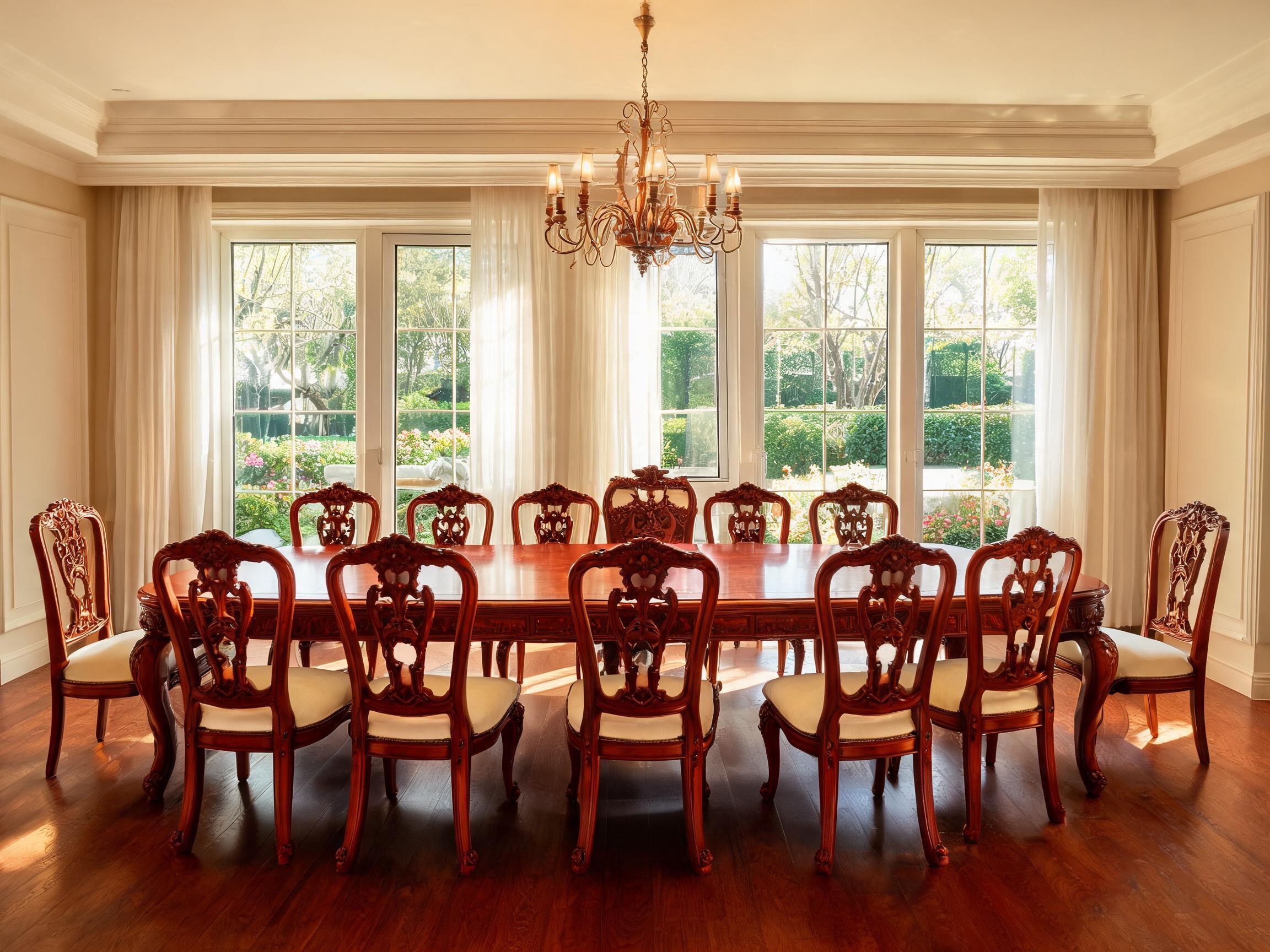
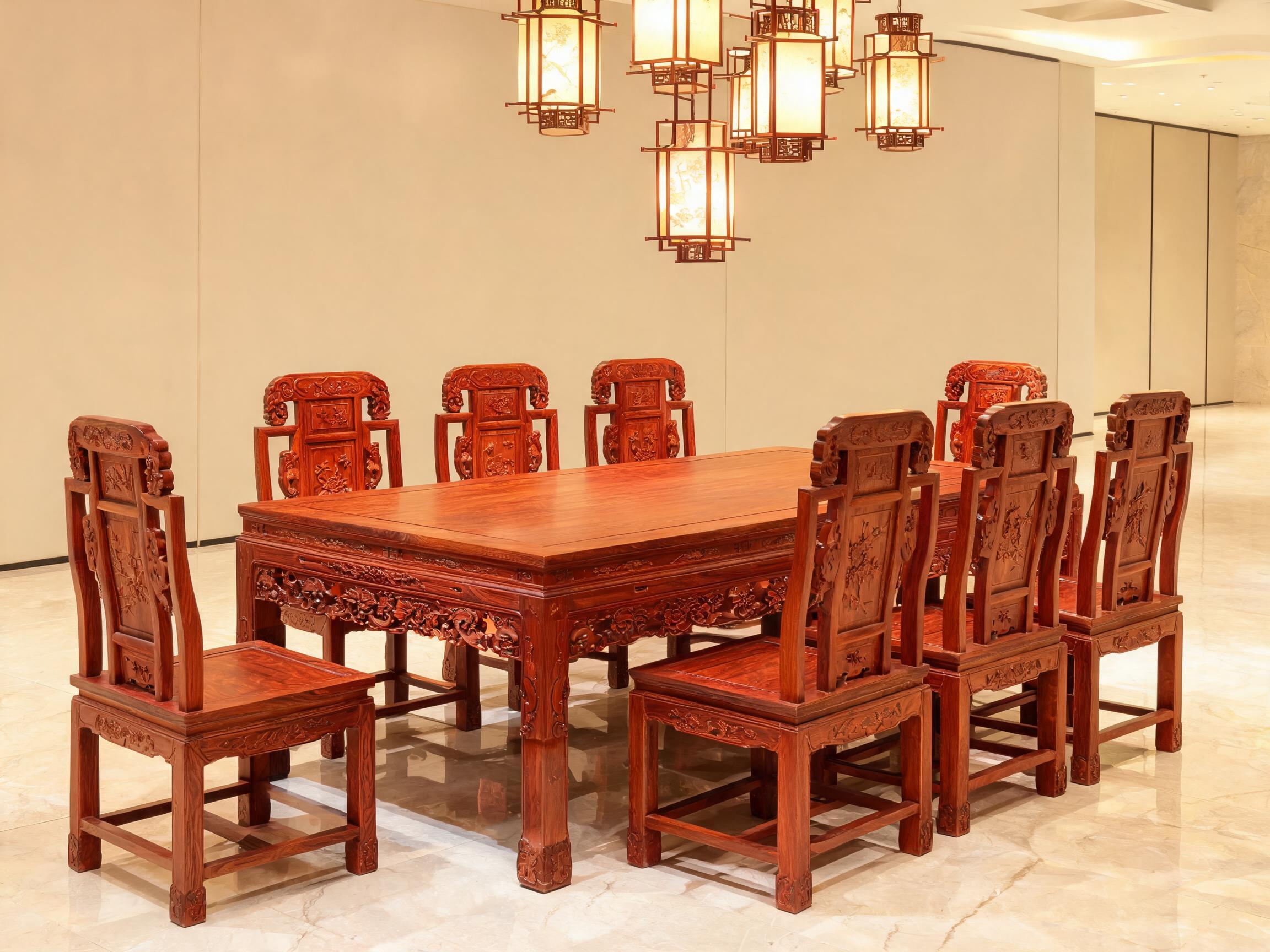
A practical procurement guide for hospitality and residential buyers sourcing 10-seat dining sets. Covers rectangular table dimensions (220cm x 100cm x 78cm), chair seat and backrest height standards (45cm / 98cm), Ming-style vs Qing-style carved chair options, wood species selection (Siamese rosewood, Machilus Nanmu, aged red wood), the OEM/ODM customization process, and quality benchmarks such as mortise-and-tenon joinery and FDA-compliant lacquer.
PROCUREMENT GUIDE
# 10-Seat Dining Set Buying Guide: Rosewood Table Specs, Chair Styles & OEM Customization for Mid-Size Projects Buying a 10-seat dining set for a mid-size hospitality project—a private dining room, a boutique hotel restaurant, or a large residential villa—is different from buying a single table. You are not just selecting a piece of furniture; you are specifying a product that must meet dimensional standards, survive daily commercial use, match a design theme, and arrive within a project timeline. This guide covers the practical procurement questions: what dimensions actually work, how to choose between chair styles, which wood species fit your budget and use case, and what the OEM customization process looks like from inquiry to delivery.
Key takeaways for buyers:
## 1. Start with the Table: Rectangular 10-Seat Dimensions
For a rectangular 10-seat dining table, the most common specification in both hospitality and residential projects is:
- **Length:** 220 cm
- **Width:** 100 cm
- **Height:** 78 cm
These dimensions accommodate five people per side, or three per side plus one at each end, depending on your seating plan. The 100cm width gives enough surface space for place settings and serving dishes without making conversation across the table difficult.
**Why these numbers matter for procurement:**
- **Room clearance:** A 220cm table needs at least 280–300cm of room length to allow chairs to pull out and people to walk behind seated guests. Confirm your floor plan before finalizing.
- **Chair spacing:** Each seated guest needs roughly 55–60cm of table edge width. At 220cm, five per side gives 44cm per person—slightly tight if you plan to seat five aside. Many buyers use this size for three per side plus one at each head.
- **Scale consistency:** The 78cm table height pairs with a 45cm seat height. This 33cm difference is the standard dining ergonomic drop.
If your project requires a different configuration—round, oval, or larger rectangular—discuss the custom size with your supplier. Most OEM factories can adjust dimensions, but lead times and material usage will change.
## 2. Chair Specifications: Seat Height and Backrest Standards
Chairs are where comfort and durability are decided. Two measurements matter most:
| Specification | Standard Value | Why It Matters |
|---|---|---|
| Seat height | 45 cm | Aligns with the 78cm table height for a comfortable 33cm lap clearance |
| Backrest height | 98 cm | Supports the mid-back; suitable for prolonged dining (2+ hours) |
| Seat width | 48–52 cm | Allows comfortable hip clearance without overcrowding the table |
| Armrest height (if applicable) | 22–25 cm above seat | Prevents shoulder strain during meals |
For commercial projects, specify chairs that can be reinforced at the joints. A dining chair in a restaurant or hotel dining room sees far more cycles of use than a residential chair. Ask your supplier about the joinery method (see Section 5) and whether the chair frame is designed for daily commercial loading.
## 3. Chair Styles: Ming vs. Qing Carved Options
The chair style defines the visual character of the entire dining set. For rosewood dining sets, two classical Chinese styles dominate, and each suits a different interior direction.
### Ming-Style Chairs
- **Characteristics:** Clean lines, minimal ornamentation, subtle curves, and a focus on the natural beauty of the wood grain.
- **Best for:** Modern minimalist interiors, contemporary hospitality spaces, and projects where the wood itself is the statement.
- **Typical forms:** Official's hat chairs (四出头官帽椅), southern official's hat chairs (南官帽椅), and simple yoke-back chairs.
- **Procurement note:** Ming-style chairs are generally easier to produce consistently across a set, which matters when you order 10 or more identical pieces.
### Qing-Style Carved Chairs
- **Characteristics:** Ornate carvings, scrollwork, dragon or floral motifs, and heavier visual presence.
- **Best for:** Traditional Chinese decor, luxury private dining rooms, and heritage-style hotel projects.
- **Typical forms:** Carved yoke-back chairs, throne-style chairs with armrests and footrests.
- **Procurement note:** Carving adds labor time and cost. Confirm the carving depth and motif details with the supplier before production. Ask for a sample or detailed CAD drawing, especially for large sets.
**Decision framework for buyers:**
- If your project uses a neutral palette and clean architectural lines, Ming-style is the safer choice.
- If the dining room is a feature space meant to convey luxury or cultural heritage, Qing-style carving delivers that impact—but budget for longer production time and higher per-unit cost.
## 4. Wood Species Selection: Matching Material to Use Case
The wood species determines both the look and the longevity of your 10-seat dining set. Three options are common in rosewood dining set OEM projects:
| Wood Species | Characteristics | Best Use Case | Price Indicator |
|---|---|---|---|
| Siamese rosewood (花梨木) | Rich red-brown color, visible grain, medium hardness, good carving response | Mid-to-high-end residential and boutique hospitality | Mid-to-high |
| Machilus Nanmu (楠木) | Lighter golden-brown tone, straight grain, stable and resistant to warping | Projects needing a lighter, more modern wood tone | Mid |
| Aged red wood (老红木) | Deep red, high density, very hard, takes high polish | High-end commercial, heritage restoration, luxury projects | High |
**Practical selection guidance:**
- **For heavy commercial use** (restaurants, hotel dining rooms), choose a denser wood like aged red wood or high-grade Siamese rosewood. These resist scratches and dents better.
- **For residential or light-use hospitality** (villa dining rooms, private clubs), Machilus Nanmu offers good stability at a more accessible price point.
- **For carving-heavy designs**, Siamese rosewood is a reliable choice—it holds fine detail without excessive tool wear.
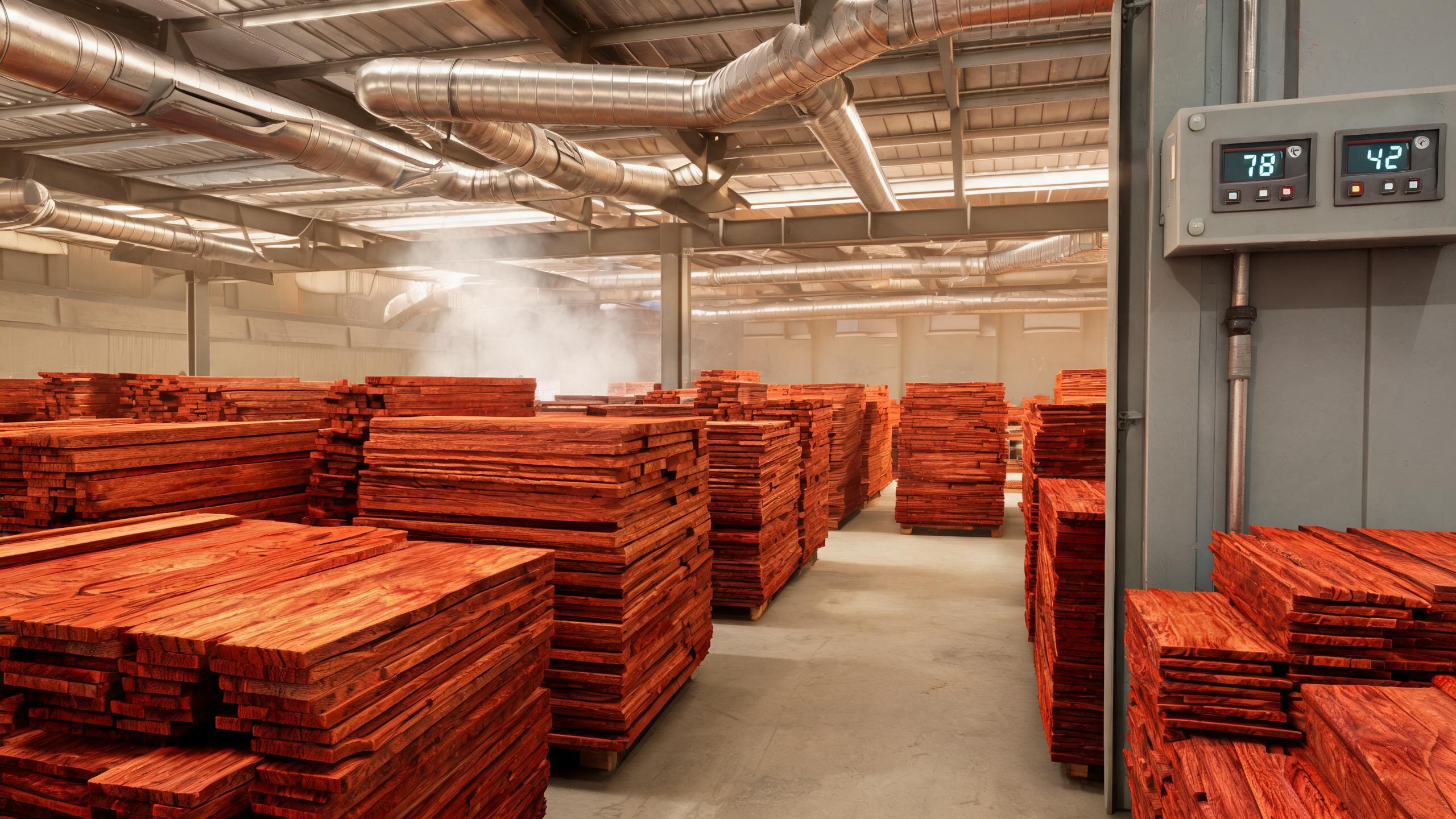
**Moisture content matters.** Wood that is not properly dried will warp, crack, or develop loose joints within months of arriving in a different climate. Ask your supplier for their drying process and moisture content specifications (see Section 5).
## 5. Quality Benchmarks: What to Verify Before You Order
A beautiful dining set that fails structurally is a liability. Use these four benchmarks to evaluate any potential supplier.
### 5.1 Mortise-and-Tenon Joinery (榫卯结构)
Traditional mortise-and-tenon joinery is the gold standard for solid wood dining furniture. It is stronger than metal-fastener assembly and allows natural wood movement without cracking. When inspecting a sample or production piece:
- Check that joints are tight with no visible gaps.
- Confirm that no nails or visible screws are used in primary load-bearing joints.
- Ask how many tenons are used in the table leg-to-apron connection—two is better than one.
### 5.2 Drying Process
Wood must be dried to a moisture content appropriate for the destination climate. A common benchmark is 36 days of controlled drying (either kiln or air-drying combined with kiln finishing). Ask your supplier:
- What is the target moisture content percentage? (8–12% is typical for indoor furniture)
- Is the drying process documented per batch?
- How is the wood acclimatized after drying?
### 5.3 Finish Compliance (FDA-Compliant Lacquer)
For dining surfaces that contact food, the finish must be safe. FDA-compliant lacquer means the cured finish meets U.S. Food and Drug Administration standards for food contact. Verify:
- The specific lacquer brand and compliance certificate.
- Whether the finish is applied to all surfaces or only food-contact areas.
- The number of finish layers and the curing time before packing.
### 5.4 Structural Testing
For commercial projects, ask if the supplier conducts any load or stability testing. A dining chair should withstand at least 150kg of static load without failure. Tables should be tested for wobble on uneven floors.
## 6. The OEM/ODM Customization Process: From Inquiry to Delivery
When you order a 10-seat dining set as an OEM or ODM project, the process typically follows these stages:
### Step 1: Define Your Specifications
Prepare a brief that includes:
- Table dimensions (or use the 220x100x78cm standard)
- Chair style (Ming or Qing, with reference images if possible)
- Wood species
- Number of sets and chairs per set
- Finish preference (gloss level, color tone)
- Destination country and port (for moisture content and packing decisions)
### Step 2: Supplier Quotation and Sample
Request a quotation based on your specifications. For mid-size projects (10–50 sets), most suppliers will provide a sample or a detailed 3D rendering before mass production. Confirm:
- Unit price (FOB or CIF)
- Sample cost and whether it is deducted from the bulk order
- Production lead time (typically 30–60 days for solid wood dining sets, depending on carving complexity)
### Step 3: Production and Inspection
During production, agree on an inspection point. Options include:
- Mid-production inspection (checking joinery, carving quality, and drying)
- Pre-shipment inspection (checking finish, assembly, and packing)
- Third-party inspection (SGS, BV, or similar, at buyer's cost)
### Step 4: Packing and Shipping
Solid wood dining sets are heavy. Confirm:
- Packing method (each piece wrapped, corner-protected, and crated)
- Container loading plan (how many sets per 40HQ container)
- Whether the supplier handles export documentation
## 7. Common Pitfalls in 10-Seat Dining Set Procurement
Avoid these mistakes that mid-size project buyers frequently make:
- **Ordering without a sample:** For carved Qing-style chairs, the difference between a good carving and a mediocre one is significant. Always approve a sample or high-resolution photos of an actual production piece.
- **Ignoring climate adaptation:** A rosewood table made in a humid factory environment may crack in a dry desert climate. Discuss moisture content and acclimatization with your supplier.
- **Under-specifying the finish:** For commercial dining, specify a scratch-resistant, food-safe finish. A standard furniture lacquer may not hold up to daily cleaning with commercial sanitizers.
- **Assuming all "rosewood" is the same:** Siamese rosewood, African rosewood, and aged red wood are different materials with different prices and performance. Confirm the exact species in writing.
## 8. FAQ: Quick Answers for Buyers
**Q: Can I get a 10-seat dining set in a round table configuration?**
A: Yes. Round 10-seat tables typically require a diameter of 180–200cm. Confirm your room dimensions and chair clearance before ordering, as round tables need more surrounding space than rectangular ones.
**Q: What is the typical MOQ for OEM customization?**
A: MOQ varies by supplier. For solid wood dining sets, a common MOQ is 5–10 sets, but this depends on the complexity of the design and the supplier's production capacity. Confirm directly with your supplier.
**Q: How long does production take for a carved Qing-style set?**
A: Carving adds significant labor time. A 10-seat set with detailed carving may require 45–75 days of production, versus 30–45 days for a simpler Ming-style set. Always confirm lead times in writing.
**Q: What should I specify for a commercial hotel dining room?**
A: Specify denser wood (aged red wood or high-grade Siamese rosewood), reinforced joinery, FDA-compliant scratch-resistant finish, and chairs with extra cross-bracing. Also confirm the finish can withstand commercial cleaning chemicals.
**Q: Do you provide after-sales support for structural issues?**
A: This depends on the supplier. Before ordering, confirm the warranty period and what it covers (structural defects, finish peeling, etc.). Most reputable suppliers will repair or replace defective pieces within a defined period, but the terms vary.
## Conclusion: Build Your Specification Before You Negotiate
The difference between a smooth procurement and a costly mistake lies in how specific you are before you contact a supplier. Start with the standard 220cm x 100cm x 78cm table dimensions, decide on your chair style and wood species based on your project's interior direction and usage intensity, and verify the four quality benchmarks—joinery, drying, finish compliance, and structural testing—before you commit.
A well-specified 10-seat dining set is a long-term asset. Take the time to define your requirements clearly, request samples, and confirm every technical detail in writing. If you are planning a mid-size project and need a rosewood dining set OEM partner, prepare your specification sheet and reach out to suppliers with your exact requirements—they will be able to quote you more accurately, and you will avoid costly revisions later.
- Standard 10-seat rectangular table dimensions are 220cm (L) x 100cm (W) x 78cm (H)—confirm your room clearance before ordering.
- Chair seat height should be 45cm; backrest height around 98cm for comfortable dining posture.
- Ming-style chairs suit minimalist interiors; Qing-style carved chairs fit traditional or opulent settings.
- Wood choice (Siamese rosewood, Machilus Nanmu, aged red wood) drives both cost and durability—match it to your usage intensity.
- For OEM orders, verify joinery, drying time, and finish compliance before committing to a supplier.
"Ordering a 10-seat dining set is a specification exercise, not a shopping exercise. The more precise your dimensions, wood choice, and quality benchmarks, the fewer surprises you will have at delivery."For buyers ready to move forward, the next step is to request a detailed quotation with your room dimensions, chair style preference, and destination port. A reliable supplier will respond with a clear specification sheet, production timeline, and sample offer.