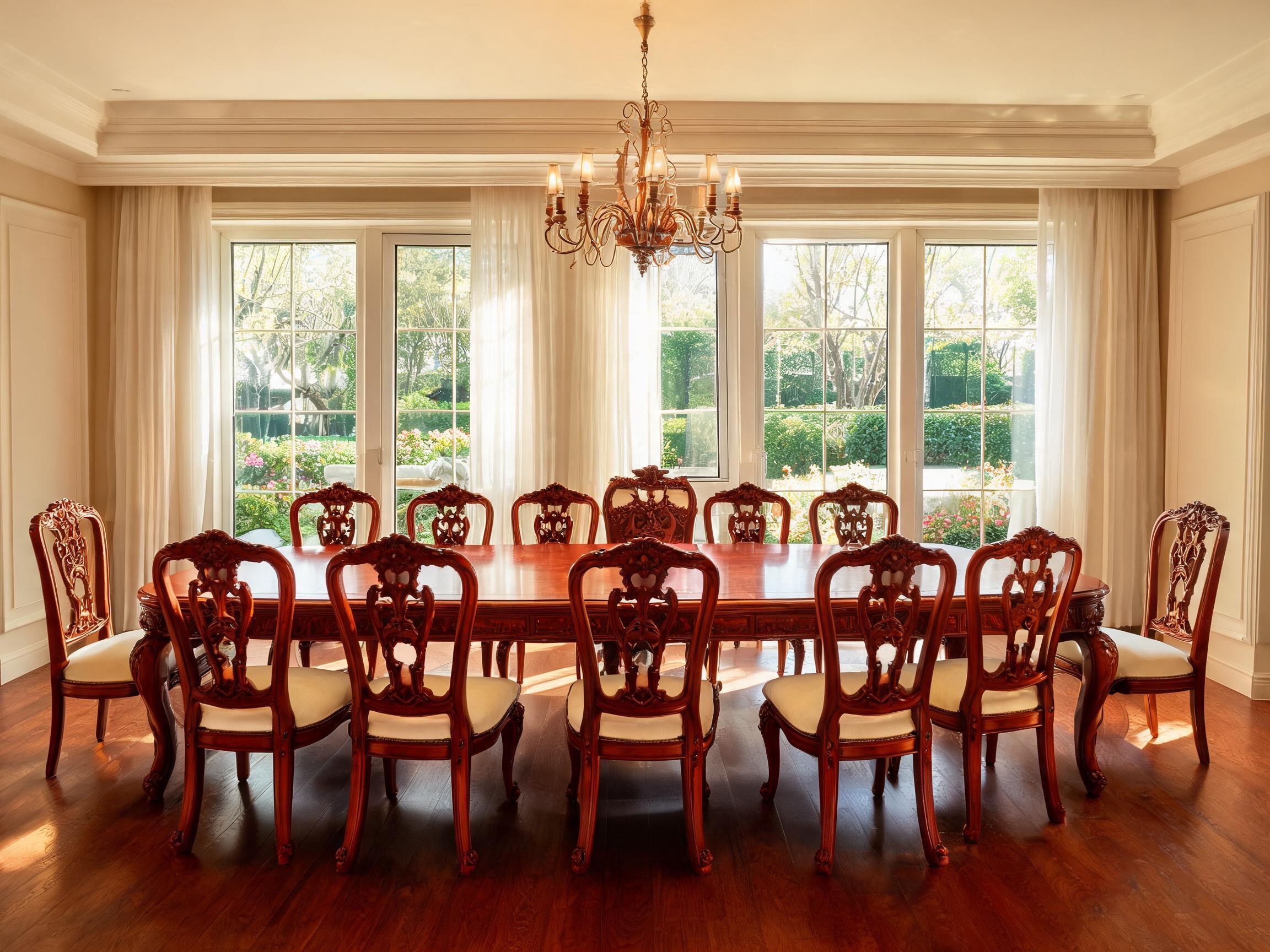
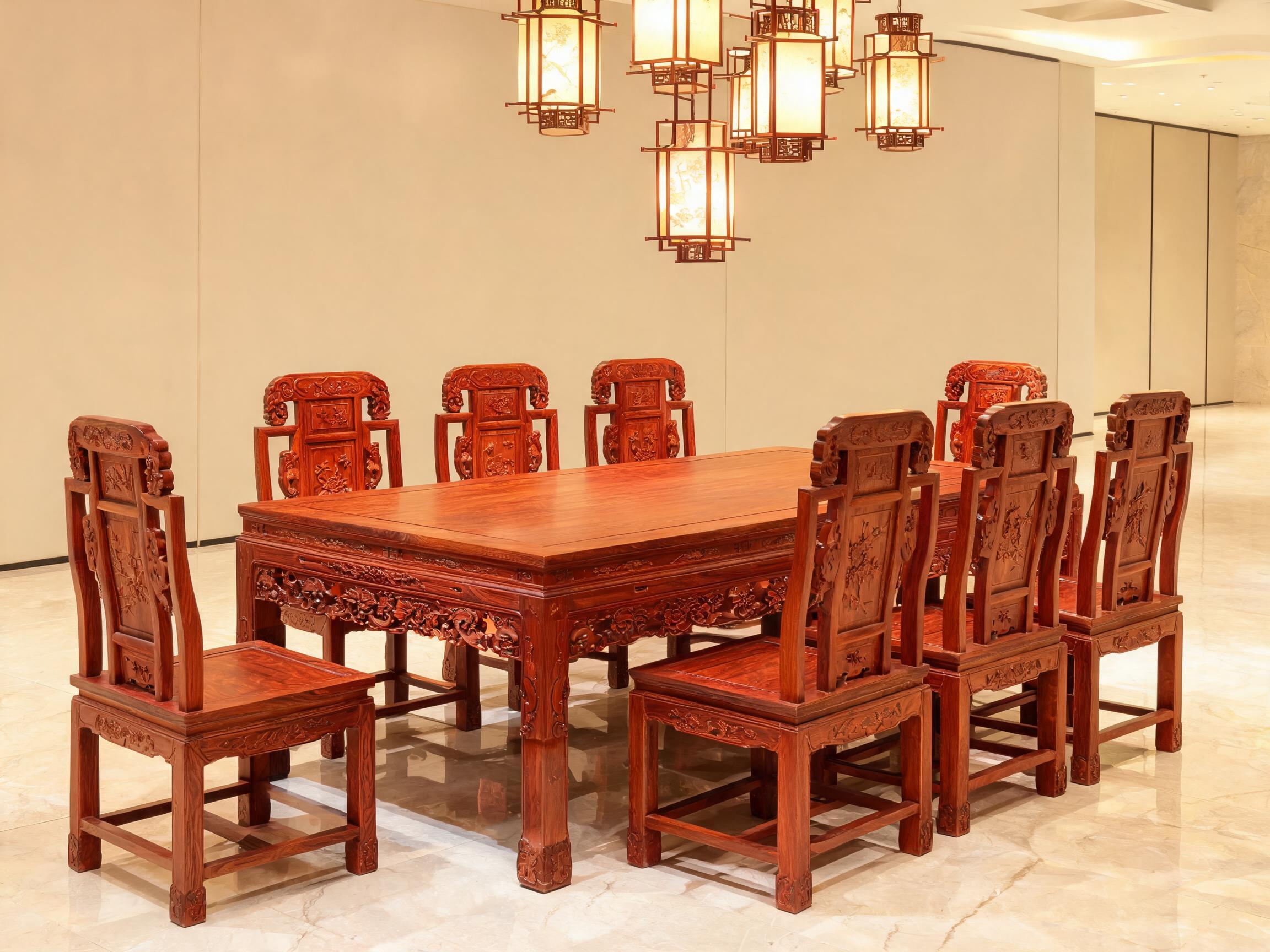
A practical procurement guide for hotel and hospitality buyers sourcing 12-seat rosewood dining tables. Covers 240cm square format specifications, Siamese rosewood grade selection, how carving complexity drives pricing, MOQ and trial order policies, ISPM-15 export packaging, and FSC/CITES compliance documentation.
BUYER GUIDE · HOSPITALITY FURNITURE
# 12-Seat Dining Table B2B Sourcing Guide: Rosewood Banqueting Sets for Hotels, Banquets & Hospitality Projects
Sourcing a 12-seat dining table for a hotel banquet hall or hospitality project is not the same as buying residential furniture. You are specifying a piece that must seat twelve adults comfortably, survive years of daily service, meet timber import regulations in your country, and arrive intact across 5,000 miles of ocean freight. This guide walks through the specifications, wood grades, pricing drivers, order terms, and compliance paperwork you need before sending an RFQ for a rosewood dining table wholesale.
## Start with the Table Format: Why 240cm Square?
The 12-seat dining table format is the first decision. For banqueting and hospitality, the square format at 240cm (approx. 94.5 inches) is the industry standard for a reason.
A 240cm square table seats three people per side. Each guest gets roughly 80cm (31.5 inches) of linear edge space, which is the minimum comfortable width for a place setting with a service plate, glassware, and elbow room. Drop below 75cm per person and guests feel cramped; go much above 85cm and conversation across the table becomes difficult.
Format
Dimensions
Seating
Per-Guest Edge Space
Best Use
Square
240cm × 240cm
12 (3 per side)
80cm
Banquet halls, private dining, boardrooms
Round
240cm diameter
10–12
63–75cm
Wedding venues, round-table events
Rectangular
300cm × 110cm
12 (6 per side)
50cm per side
Conference, long-banquet layouts
The square format is preferred for banqueting because it creates a more intimate social dynamic than a long rectangle, and it fits standard banquet hall grid layouts better than a 240cm round. When you specify a 12 seat dining set in square format, confirm the table height as well: standard dining height is 75cm (29.5 inches). Some hospitality projects request 72cm or 78cm to match chair specifications — confirm this early, as it affects leg and apron dimensions.
## Wood Grade Selection: Understanding Siamese Rosewood (Dalbergia cochinchinensis)
The wood species is the single largest cost and compliance driver in a rosewood dining table wholesale order. Siamese rosewood (Dalbergia cochinchinensis) is a premium hardwood native to Southeast Asia, prized for its deep reddish-brown heartwood, fine grain, and natural resistance to termites and decay.
When sourcing, you will encounter several grades. Grade is determined by colour consistency, grain figure, and the presence of sapwood or defects.
Grade
Colour & Grain
Defects
Typical Use
Relative Cost
Select / AAA
Uniform deep red-brown, tight grain
No sapwood, no knots, no cracks
Table tops, carved panels, high-end banqueting
Baseline +40–60%
First / AA
Mostly uniform, slight colour variation
Minimal sapwood, small sound knots allowed
Table bases, aprons, secondary components
Baseline
Commercial / A
Visible colour variation, mixed grain
Sapwood allowed, small checks
Frames, structural parts, hidden components
Baseline −15–25%
For a banqueting table, specify Select grade for the tabletop and any visible carved panels, and First grade for the base and legs. This combination gives you a consistent visual surface where guests look, while controlling cost on structural components. Ask your supplier to state the grade mix in the quotation — a single line saying "rosewood" is not a specification.
## How Carving Complexity Drives Pricing
Carving is where the price of a 12-seat dining table can vary by 200% or more between two pieces of identical dimensions and wood grade. Understand what you are paying for before you approve a design.
Carving cost is driven by three factors: depth, density, and symmetry.
- **Depth**: Shallow relief carving (5–8mm) is faster and cheaper. Deep relief (15–25mm) requires multiple passes, more skilled labour, and more material removal. Deep carving on a table apron can add 30–50% to the total piece cost.
- **Density**: A design with a few large motifs (e.g., four corner dragons or floral clusters) is cheaper than a continuous border pattern running the full perimeter. Continuous carving requires more hours and more tool changes.
- **Symmetry**: Hand-carved pieces with mirror-symmetry require the carver to match both sides precisely. Asymmetrical or free-flow designs are faster to execute but may not suit traditional banquet aesthetics.
For hospitality projects, consider a hybrid approach: a clean, flat tabletop in Select grade rosewood with carved apron panels on the two long sides only. This gives the "carved rosewood" look at the sightlines guests actually see, while keeping the cost per unit within budget for a 12 seat dining set order.
## MOQ and Trial Order Policies
Minimum order quantities (MOQs) for rosewood banqueting sets vary significantly by supplier. Large factories that export container volumes typically set MOQs of 20–50 sets per design. Smaller workshops that specialise in hand-carved pieces may accept orders of 5–10 sets, but at a higher per-unit price.
A practical sourcing strategy for a first order:
1. **Request a trial order of 1–3 sets** at full specification. This is not a sample — it is a production run at a smaller quantity. Confirm the supplier's policy on trial orders; many will accept them at 10–20% above the volume price.
2. **Use the trial order to verify** wood grade consistency, carving quality, finish durability, and packaging integrity. Photograph every piece on arrival.
3. **Negotiate volume pricing only after** the trial order passes inspection. Do not negotiate price on the trial order itself.
Confirm in writing whether the trial order price is credited against a subsequent volume order. Some suppliers offer this; others do not.
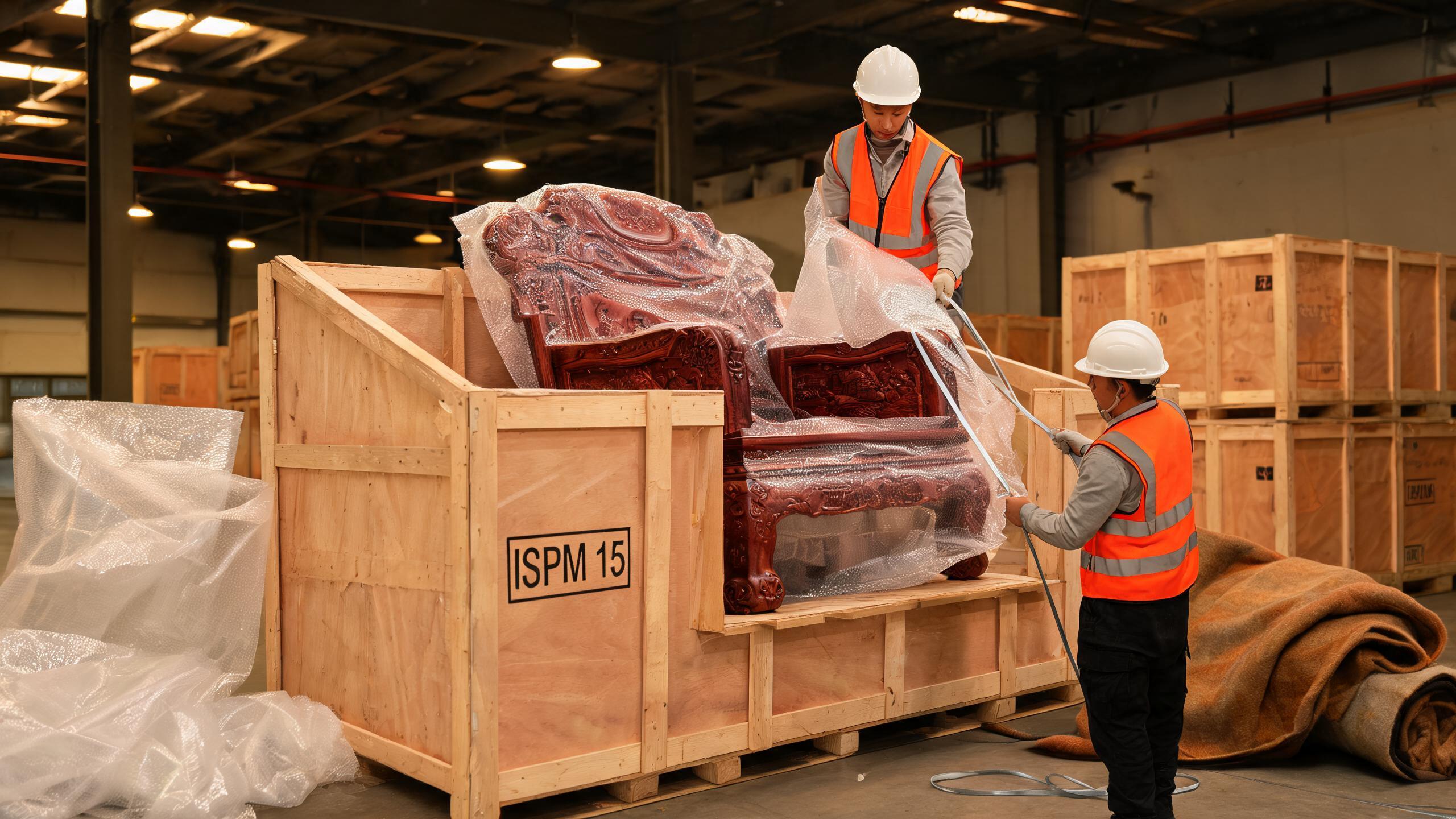
## Export Packaging: ISPM-15 Crates
A 240cm square rosewood table is heavy, rigid, and vulnerable to impact. Standard export packaging for this product category is a wooden crate built to ISPM-15 specifications.
ISPM-15 (International Standards for Phytosanitary Measures No. 15) requires that all solid wood packaging material (SWPM) be heat-treated or fumigated and marked with the IPPC logo. This applies to the crate frame, battens, and any solid wood blocking inside the crate. Plywood and MDF panels are exempt from ISPM-15 because they are manufactured products, but the solid wood components are not.
Specify in your purchase order that the supplier must provide the ISPM-15 mark on the crate and include the packaging declaration in the shipping documents. Without this mark, the crate may be rejected or destroyed at the destination port, and the cost of that is on you, not the supplier.
## Compliance Documentation: FSC and CITES
Rosewood is a regulated timber. Dalbergia cochinchinensis is listed under CITES Appendix II, which means international trade requires permits. This is not optional — shipping a 12-seat dining table without the correct CITES documentation can result in seizure, fines, and a permanent import ban for your company.
Two separate compliance tracks apply:
**CITES Appendix II** — For Dalbergia cochinchinensis, export from the country of origin requires a CITES export permit issued by the exporting country's management authority. Import into your country may require a corresponding import permit. The supplier must provide the export permit; you are responsible for the import permit in your jurisdiction. Confirm with your local CITES authority before placing the order, as processing times vary from weeks to months.
**FSC Chain-of-Custody** — FSC (Forest Stewardship Council) certification is a voluntary standard that verifies the wood comes from responsibly managed forests. While not legally required for CITES-listed species, many hospitality projects — particularly in Australia, the EU, and North America — specify FSC-certified timber as a procurement policy requirement. If your project requires FSC, confirm that the supplier holds a valid FSC chain-of-custody certificate and that the specific batch of wood is covered. Ask for the certificate number and verify it on the FSC database.
Key takeaways for your RFQ:
• Specify 240cm square, 75cm height, Select grade top + First grade base
• Get carving design and depth in writing — it is the biggest price variable
• Confirm trial order policy (1–3 sets) before negotiating volume pricing
• Require ISPM-15 stamped crates and CITES export permit in the PO
• Verify FSC chain-of-custody if your project policy requires it
## Checklist Before You Send the RFQ
A complete RFQ for a rosewood banqueting set should include:
- Table format, dimensions (240cm × 240cm × 75cm), and seating capacity
- Wood species (Dalbergia cochinchinensis) and grade mix (top / base)
- Carving design reference (drawing or photo) and depth specification
- Finish type (e.g., PU lacquer, NC lacquer, wax) and sheen level
- Quantity, target delivery date, and destination port
- Packaging requirement (ISPM-15 crates with desiccant)
- Compliance requirement (CITES export permit, FSC certificate if applicable)
Send the same RFQ to three suppliers. Compare not just price, but the completeness of their response: a supplier who answers every line item with specifics is more likely to deliver a compliant, well-packaged product than one who responds with a single price quote and no documentation commitment.
## FAQ
**Q: Can I get a 12-seat dining table in round format instead of square?**
A: Yes. A 240cm round seats 10–12 but gives less per-guest edge space. Specify round only if your venue layout requires it.
**Q: What is the typical lead time for a carved rosewood banqueting set?**
A: Carving is labour-intensive. Lead times of 45–90 days are common for carved pieces; plain tops are faster. Confirm the lead time in writing before ordering.
**Q: Is FSC certification mandatory for rosewood?**
A: No. FSC is voluntary. CITES Appendix II compliance is mandatory. Check whether your project procurement policy requires FSC.
**Q: What happens if the crate is not ISPM-15 marked?**
A: The crate may be rejected or destroyed at the destination port. Always require the ISPM-15 mark in your PO and verify it in the shipping documents.
**Q: Can I order a single table as a trial?**
A: Some suppliers accept single-piece trial orders, but expect a higher per-unit price. Confirm the trial order policy and whether it credits against volume orders.
---
Need help specifying a 12-seat dining table or banqueting set for your project? Contact us with your venue dimensions, seating layout, and design references — we will respond with a detailed specification and quotation.Square 12-seat Siamese rosewood banqueting set with dual-pedestal base and longevity character carved chair backrestsISPM-15 heat-treated export crates engineered for ocean freight protection of large rosewood dining sets