
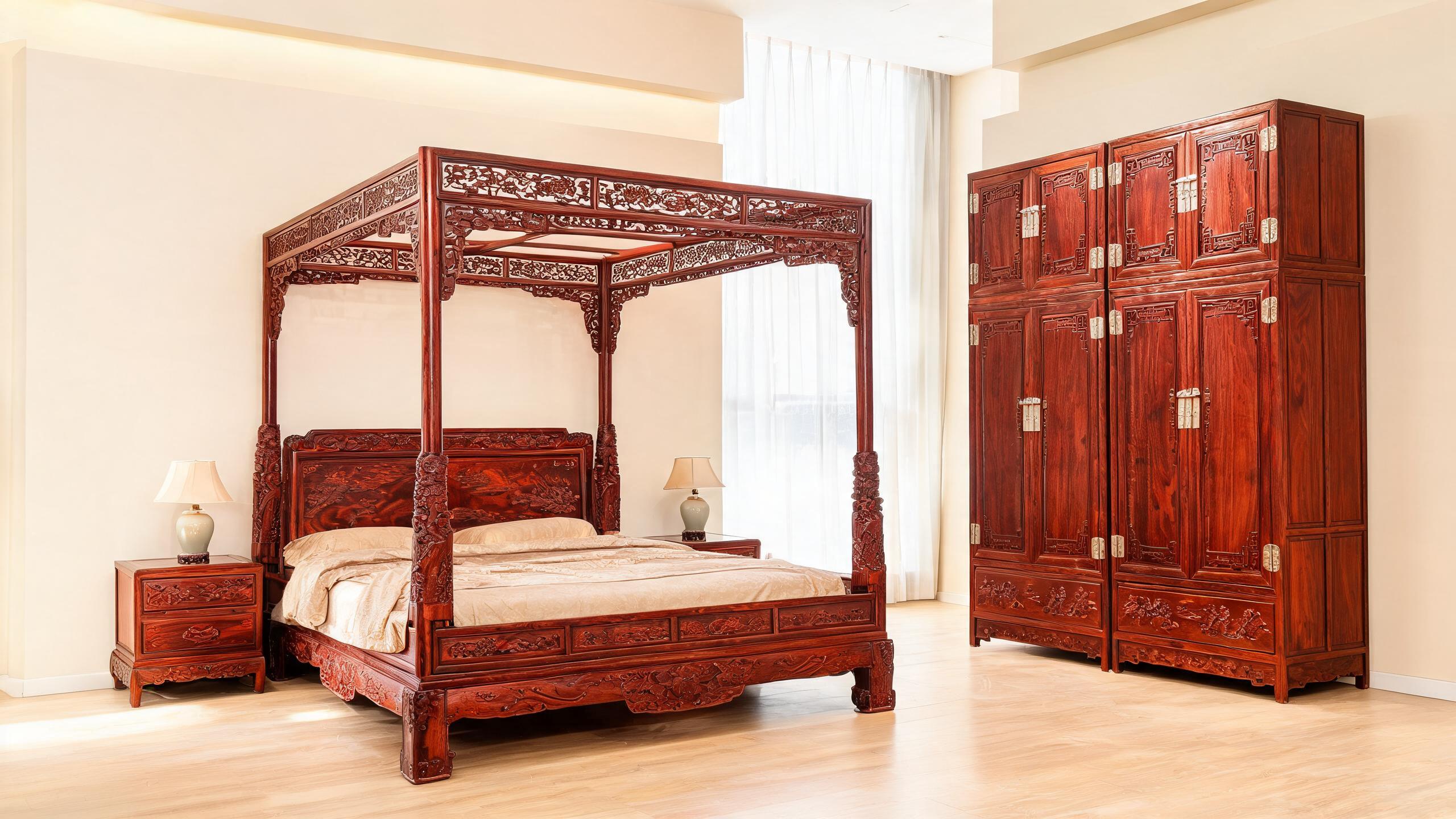
Isang praktikal na B2B sourcing guide para sa mga importer, wholesaler, hotel at interior buyer na pumipili ng solid rosewood bedroom set — sumasaklaw sa mga materyales, craftsmanship, sizing, customization, quality control, compliance, pricing,…
How Do You Choose the Right Rosewood Bedroom Set for Your Import Business?
If you are an importer, wholesaler, hotel buyer, interior designer or project contractor sourcing solid wood furniture from China, the bedroom is often the last room you plan and the first one that gets complicated. A rosewood bedroom set is not a single product. It is a coordinated suite of case goods — a bed, nightstands, a wardrobe, a dresser, sometimes a mirror — that must match in timber, colour, grain and finish across every piece. Get the sourcing decisions right and you have a high-value, long-life product line that sells to hotels, resorts, property developers and premium residential buyers. Get them wrong and you are left with mismatched panels, warped doors, compliance gaps at customs, or a set that arrives looking nothing like the sample.
This guide walks through what a B2B buyer actually needs to evaluate before placing an order for a rosewood bedroom set: the real materials behind the name, the craftsmanship that determines whether the suite will survive an ocean crossing and years of use, how to size and configure a suite for your market, how far customization can go, how to inspect quality, what compliance documents you must demand, how pricing is built, and how to tell a reliable factory from a reseller. It is written for buyers who want to import with confidence rather than guess.
Why the Bedroom Set Is a Different Sourcing Problem Than a Single Piece
Before we get into materials and joinery, it is worth understanding why a bedroom set deserves its own sourcing discipline. A single dining table or a sofa is one object. A bedroom suite is a system of objects that must read as one. The bed frame, the two nightstands, the wardrobe and the dresser all sit in the same room, often within a few metres of each other, under the same light. Any difference in timber tone, grain direction or finish sheen becomes immediately visible.
This is why the most important question a buyer can ask a supplier is not "how much does a rosewood bedroom set cost?" but "will all the pieces in this suite come from the same timber batch?" A factory that allocates a single batch of timber to one suite, conditions it together and finishes it together will deliver a set that looks coherent. A factory that assembles a suite from whatever stock is on hand will deliver a set that looks like it was bought piece by piece.
For a B2B buyer this matters commercially. Hotels and developers buy bedroom suites in volume and install them in identical rooms. If the first suite and the tenth suite do not match, the project looks unfinished. If the pieces within one suite do not match, the room looks wrong. Colour and grain consistency is not a cosmetic nicety; it is a specification that has to be written into the order and verified at inspection.
What "Rosewood" Actually Means in a Bedroom Set
The word "rosewood" is used loosely in the furniture trade, and that is exactly why a serious buyer has to pin down the species. In the classical Chinese furniture tradition, the most prized material is Siamese rosewood, botanically Dalbergia cochinchinensis. It is a dense, heavy hardwood with a rich reddish-brown to deep purple-brown colour, fine grain and natural oils that give it a subtle sheen. It is the timber behind many of the finest classical bedroom suites.
Yunxiao Rosewood Furniture, a factory in Xianyou County, Putian City, Fujian — the traditional home of Chinese hardwood craft — builds its bedroom suites from legally certified materials including Siamese rosewood, aged red wood and Grade-A tropical hardwood. When a supplier names the species, ask for the botanical name and the documentation that proves the timber was legally sourced. "Rosewood" on its own tells you almost nothing; Dalbergia cochinchinensis tells you exactly what you are buying.
There are a few other materials a buyer will encounter in this category. Machilus Nanmu is a legally certified hardwood used in classical furniture, prized for its stability and fine texture. Aged red wood refers to timber that has been seasoned over time, which reduces internal stress and makes the finished piece less likely to move. Grade-A tropical hardwood is a quality grade that signals selected, defect-free stock. Each of these has a place, but they are not interchangeable, and the price difference between them is real. Write the species and grade into your specification so there is no ambiguity at inspection.
Timber Species Compared: Siamese Rosewood, Machilus Nanmu and Aged Red Wood
Because the species determines so much of the value, it is worth comparing the main options a buyer will meet when sourcing a rosewood bedroom set. Siamese rosewood (Dalbergia cochinchinensis) is the premium choice. It is dense and heavy, which makes it stable and durable, and it has a rich colour and fine grain that take a beautiful finish. It is also a regulated species under CITES, which means the compliance burden is higher — and so is the price. For a high-end hotel or luxury residential project, Siamese rosewood is the material that justifies the investment.
Machilus Nanmu is a different hardwood that is also used in classical Chinese furniture. It is prized for its stability and fine, even texture, and it is legally certified, which makes it a compliant and reliable choice. It tends to be lighter in colour than rosewood and has a different grain character. For a buyer who wants the classical look with a slightly different tone, or who wants to manage cost while keeping a certified hardwood, Machilus Nanmu is a strong option.
Aged red wood refers to timber that has been seasoned over time rather than used fresh. Seasoning reduces the internal moisture and stress in the wood, which makes the finished piece far less likely to crack, warp or move after it is built. This is a quality signal: a factory that uses aged timber is investing in stability. Grade-A tropical hardwood is a grading term that indicates selected, defect-free stock, which again points to a factory that is controlling quality at the timber stage.
The practical takeaway is that these materials are not interchangeable, and the price difference between them is real and justified. When you compare quotes, make sure you are comparing the same species and grade. A quote for a Siamese rosewood suite and a quote for a Machilus Nanmu suite will differ, and that difference is not a negotiation point — it is a product difference. Decide which material fits your market and your price point, then compare like for like.
Why Moisture Content Decides Whether the Suite Survives
Wood moves. It absorbs and releases moisture, and it expands and contracts with changes in humidity. A bedroom suite that is shipped from the humid south of China to a dry climate in Australia, the Middle East or parts of North America will experience a significant change in environment. If the timber was not properly dried and conditioned before it was built, the panels will crack, the joints will loosen and the doors will stop fitting.
This is the single most common cause of warranty claims on imported solid wood furniture, and it is entirely preventable at the factory. A serious supplier conditions its timber to a stable moisture content — typically in the range of 8 to 12 percent — before machining, and it does so in a controlled way. Yunxiao, for example, runs a 36-day constant-humidity drying process on its timber before it is cut and assembled. That is not a marketing phrase; it is a measurable step that determines whether a wardrobe door stays square after six months in a different climate.
When you evaluate a supplier, ask directly how the timber is dried and to what moisture content. Ask whether the drying is done in-house or outsourced, and whether the moisture content is verified with a meter at the point of assembly. A factory that cannot answer these questions clearly is a factory that is not controlling the most important variable in the product.
Joinery: The Difference Between Furniture That Lasts and Furniture That Fails
Classical Chinese furniture is famous for a construction method that needs no metal fasteners: mortise-and-tenon joinery. A mortise is a slot cut into one piece of wood; a tenon is a matching projection on another piece. When the tenon is fitted into the mortise, the two pieces lock together. The joint is strong, it allows the wood to expand and contract naturally, and it does not rely on screws or nails that can loosen, rust or split the timber over time.
Yunxiao assembles its furniture without metal nails specifically to avoid cracking and deformation. In a bedroom set this matters most in the bed frame, which carries real weight, and in the wardrobe, which has doors that open and close thousands of times. A mortise-and-tenon frame with properly fitted joints will stay rigid for decades. A frame held together with screws and glue will work loose.
When you inspect a suite, look at the joints. They should be tight, with no gaps, no visible glue squeeze-out and no metal fasteners in the primary structure. In higher-end pieces the joinery is reinforced with bamboo dowel pins, which are traditional and allow the joint to flex with the wood. Ask the supplier how the joints are made and whether any metal is used in the primary structure. The answer tells you a great deal about the quality tier you are buying.
Hand Carving: What to Look For and What It Costs
Much of the value in a classical rosewood bedroom set is in the carving. The headboard, the wardrobe doors and the drawer fronts are where the craft shows. Traditional motifs include dragons, clouds, lattice patterns, floral scrolls and auspicious symbols, each with cultural meaning and each requiring a skilled hand.
There is a real difference between hand carving and machine carving, and it is visible to anyone who knows what to look for. Hand-carved work has depth, variation and a certain life to the lines; the undercuts are clean and the details are crisp because a craftsman can reach into the relief. Machine-carved work tends to be flatter, more repetitive and shallower, because a router or CNC follows a fixed path. For a premium product line aimed at hotels and luxury homes, hand carving is part of the value proposition. For a budget line, machine carving may be acceptable — but you should know which you are buying and price it accordingly.
Carving is also a major cost driver and a major lead-time driver. A single elaborately carved chair backrest can take twenty hours or more of a master artisan's time. A carved headboard takes longer still. When you are planning a bedroom suite order, ask how many carving hours are in the design, because that is a direct measure of both cost and delivery time. It also explains why two "rosewood bedroom sets" can be priced very differently: the difference is often the carving.
Design Styles: Ming, Qing and the Bedroom Suite
Classical Chinese furniture is broadly divided into two great design traditions, and they apply to bedroom furniture as much as to any other piece. The Ming style is known for clean lines, minimal ornament and a focus on proportion and the natural beauty of the wood. A Ming-style bedroom suite tends to be understated and elegant, with the timber doing the talking. The Qing style is more ornate, with heavier carving, more elaborate motifs and a richer, more decorative feel. A Qing-style suite is more dramatic and more obviously "carved".
For a B2B buyer, the choice between Ming and Qing is a market decision. Ming style tends to appeal to buyers who want a refined, contemporary-classical look that fits modern interiors. Qing style tends to appeal to buyers who want a statement piece with visible craftsmanship. Both have strong markets, and a factory that can produce both gives you flexibility to serve different customers.
When you source a bedroom set, ask which styles the factory produces and look at how the style is executed in the bedroom context. The headboard, the wardrobe doors and the dresser front are where the style shows most clearly. A factory that understands both traditions can help you match the bedroom suite to the rest of the house — a Ming-style bedroom with a Ming-style living room, or a Qing-style suite as a deliberate contrast.
Finishing: Beeswax, Lacquer and the Standards Behind Them
The finish on a rosewood bedroom set does more than make it look good. It protects the timber, seals the surface and determines how the piece behaves in a humid or dry room. In the classical tradition there are two main approaches: a natural beeswax finish that lets the wood breathe and shows the grain, and a lacquer finish that builds a protective film on the surface.
Yunxiao uses an eco-friendly beeswax and lacquer finishing system that meets EU REACH and US CARB standards. These are not aesthetic choices; they are regulatory requirements. REACH is the European regulation on chemicals, and it restricts substances that can be present in finished goods sold in the EU. CARB is the California Air Resources Board standard for formaldehyde emissions from composite wood products. If you are selling into Europe or the United States, you need a supplier whose finishes comply with these rules, and you need the documentation to prove it.
For a bedroom set, the finish also has to be appropriate to the room. A glossy lacquer is durable and easy to clean, which suits hotel use. A satin raw-lacquer finish is more traditional and shows the wood grain beautifully, which suits premium residential and heritage-style projects. Ask the supplier what finish options are available, what standards they meet, and whether the finish is food-contact safe where relevant. Then choose the finish that matches your market and your price point.
Sizing and Configuration: Matching the Suite to Your Market
A rosewood bedroom set is not one size. The bed alone comes in a range of dimensions, and the suite can be configured with different numbers of pieces. Getting the sizing right for your market is a commercial decision as much as a technical one.
Bed sizes are the starting point. A King bed in the international market is typically around 180 cm by 200 cm, and a Queen is around 150 cm by 200 cm. These are the two most common sizes for hotel and residential bedroom suites. But regional standards vary, and a buyer serving a specific market should confirm the exact dimensions with the factory rather than assume. The Yunxiao Classical Redwood Bedroom Wardrobe Suite, for example, is offered in King 180 cm x 200 cm or Queen 150 cm x 200 cm, which shows how a factory standardizes around the international sizes.
Piece count is the next decision. A basic suite might be a bed and two nightstands. A fuller suite adds a wardrobe, a dresser and a mirror. Yunxiao offers bedroom suites ranging from a 3-piece canopy bed set to a 4-piece bed-and-dresser set to a 5-piece four-poster suite and a 6-piece wardrobe suite that includes a panel bed, two nightstands, a two-door wardrobe, a dresser and a mirror. The right configuration depends on the room size, the project brief and the price point you are targeting.
For a B2B buyer, the practical question is whether the suite is sold as a coordinated set or as individual pieces that can be mixed. Hotels and developers often need to standardize on a fixed configuration across many rooms, so a supplier that offers a defined suite with a fixed piece list is easier to work with than one that only sells loose pieces. Ask for the exact contents of each suite and the dimensions of every piece, and put them in the order.
Customization and OEM/ODM: How Far Can a Factory Go?
Most serious buyers do not buy a rosewood bedroom set straight off a catalogue. They need custom sizes to fit a specific room, custom patterns to match a project's design language, or a private-label product under their own brand. This is where OEM and ODM capability matters.
OEM means the factory builds to your specification and your design. You provide the drawings, the dimensions and the finish requirements, and the factory manufactures to them. ODM means the factory designs the product — it may have its own designs or adapt its existing range — and you brand and sell it. Both are common in the furniture trade, and both require a factory with real engineering and production depth, not just a trading company.
Yunxiao offers flexible OEM and ODM custom sizes and patterns for villas and resorts. That is a meaningful capability for a B2B buyer, because it means the factory can adapt a standard suite to a project's specific room dimensions and design requirements. When you evaluate a supplier for customization, ask how they handle custom dimensions, how they manage pattern changes, whether they provide layout drawings, and what the minimum order is for a custom run. A factory that can draw, engineer and build to your spec is a partner; a factory that can only sell its own catalogue is a vendor.
Quality Control: What to Inspect and How
Quality control on an imported rosewood bedroom set is not a single inspection at the end. It is a set of checks that should happen at defined points in production, and a buyer should understand what those checks are and how to verify them.
The first check is the timber. Is it the species and grade you specified? Is the moisture content within range? The second is the joinery: are the mortise-and-tenon joints tight, with no gaps and no metal in the primary structure? The third is the carving: is the depth and detail consistent with the sample? The fourth is the finish: is it even, free of runs and bubbles, and compliant with the standards you require? The fifth is the assembly: do the doors align, do the drawers slide smoothly, do the panels sit flush?
For a B2B buyer, the practical tools are a pre-production sample, a mid-production inspection and a pre-shipment inspection. A reputable factory will offer a trial single set or a refundable sample so you can verify the quality before committing to a container. Yunxiao offers trial single sets and refundable samples, which is exactly the kind of low-risk entry point a buyer should look for. It also provides remote installation guidance and free layout drawings for projects, which helps you plan the rooms before the furniture arrives.
When you inspect, compare the production pieces directly against the approved sample. Colour and grain consistency across the suite is the most common point of failure, so check every piece in the set under the same light. If the supplier cannot show you a consistent suite, walk away.
Compliance: FSC, CITES, REACH, CARB and ISPM 15
Rosewood is a regulated material, and compliance is not optional. This is the area where an uninformed buyer can lose a shipment at customs, face fines, or damage their reputation with a retailer or hotel client. A serious buyer treats compliance documentation as part of the product, not an afterthought.
The two most important regimes for rosewood are FSC and CITES. FSC, the Forest Stewardship Council, certifies that timber comes from responsibly managed forests and that the chain of custody is documented from forest to finished product. CITES, the Convention on International Trade in Endangered Species of Wild Fauna and Flora, regulates the international trade of species at risk. Many rosewood species, including Dalbergia species, are listed under CITES Appendix II, which means they require export permits. A supplier that ships rosewood furniture must provide the CITES documentation and the FSC chain-of-custody certificates per shipment.
Yunxiao includes FSC chain-of-custody and CITES Appendix II export permits with each shipment, and its internal team prepares the full export documents. That is the standard a buyer should demand. If a supplier cannot produce these documents, do not buy from them — the risk is entirely on you as the importer.
Beyond timber legality, there are the finish and material standards. EU REACH restricts chemicals in finished goods sold in Europe, and US CARB regulates formaldehyde emissions from composite wood products. If you sell into those markets, your supplier's finishes must comply. Finally, ISPM 15 is the international standard for heat-treating wood packaging material. It requires that wooden crates and pallets used in international shipping are heat-treated and marked, to prevent the spread of pests. Yunxiao uses ISPM 15 heat-treated packaging, which is what you need for a clean customs clearance.
Ask your supplier for a complete compliance pack before you order: the species documentation, the FSC chain-of-custody certificate, the CITES export permit, the finish compliance statements and the ISPM 15 packaging certification. If any of these is missing, flag it immediately.
Pricing: How a Rosewood Bedroom Set Is Priced
Pricing on a rosewood bedroom set is built from a few transparent components, and understanding them helps you negotiate and compare quotes fairly. The largest component is the timber. Siamese rosewood is a premium, regulated hardwood, and its cost reflects both its quality and the compliance burden of sourcing it legally. The second component is the craftsmanship: the carving hours, the joinery and the finishing all add real labour cost. The third is the configuration: more pieces, larger sizes and more elaborate carving all push the price up. The fourth is compliance and packaging: the FSC and CITES documentation, the ISPM 15 heat-treated crating and the export paperwork all have a cost.
This is why two quotes for a "rosewood bedroom set" can differ by a wide margin. The difference is almost never pure margin; it is usually a difference in species, carving depth, finish quality, piece count or compliance. When you compare quotes, compare them on the same specification. Ask each supplier to break down the price by timber, carving, finish, configuration and compliance, and compare like for like.
It is also worth understanding that the global price of solid rosewood has been rising, driven by tighter regulation and limited legal supply. A buyer who locks in a reliable supplier and a stable specification is better positioned than one who chases the cheapest quote every order. Price matters, but on a regulated hardwood, supply security and compliance reliability matter more.
Supply, MOQ, Lead Time and Shipping
Once you have chosen the product and the supplier, the commercial terms determine whether the order actually works for your business. Three numbers matter most: the minimum order quantity, the lead time and the shipping terms.
Minimum order quantity varies by factory and by product. Some factories require a full container; others are willing to start with a trial single set or a small order. For a first order, a trial set or a small quantity is the smart way to verify quality before committing to volume. Yunxiao offers trial single sets and refundable samples, and it supports partial shipments for long-term partners, which gives a buyer flexibility to scale up as demand grows.
Lead time is the time from deposit to shipment. For a hand-carved rosewood bedroom suite, the lead time reflects the real production time: the timber conditioning, the carving, the finishing and the assembly. Yunxiao quotes 45 to 60 working days after deposit for container orders. That is a realistic range for this category, and a buyer should plan their inventory and project schedules around it. If a supplier quotes an implausibly short lead time for a hand-carved suite, be suspicious — either they are not doing the work, or they are cutting corners.
Shipping is the final piece. Rosewood furniture is heavy, valuable and delicate, and it needs proper export packing. The standard is ISPM 15 heat-treated crates with internal protection for the carved surfaces. Yunxiao uses custom crating, moisture barriers and bracing engineered for delicate relief-carved furniture. Ask your supplier how the furniture is packed, whether the crates are ISPM 15 compliant, and whether the packing is designed to protect the carvings specifically. A shipment that arrives damaged is a shipment that was not packed properly.
Applications: Where Rosewood Bedroom Sets Sell
Understanding where the product sells helps you choose the right configuration and the right supplier. Rosewood bedroom sets have three main application markets, and each has different requirements.
The first is hospitality. Hotels, resorts and serviced apartments buy bedroom suites in volume, and they need consistency across many rooms, durable finishes that withstand heavy use, and reliable supply. For hospitality, a defined suite with a fixed piece list, a durable lacquer finish and a supplier who can deliver volume on schedule is essential.
The second is premium residential. High-end homeowners and interior designers buy rosewood bedroom sets for their beauty, craftsmanship and longevity. For this market, the carving, the timber quality and the finish are the selling points, and customization to fit a specific room is often required.
The third is whole-house and project work. Developers and contractors furnishing multiple rooms — a master bedroom, a guest bedroom, a study — need a supplier who can coordinate a bedroom set with the rest of the house. Yunxiao's positioning as a supplier of classical redwood furniture sets across sofa, dining and bedroom means it can support whole-house projects where the bedroom suite has to match the living room and dining room in style and timber.
When you plan your product line, think about which of these markets you are serving, because it changes the specification. A hotel buyer needs durability and consistency; a residential buyer needs beauty and customization; a project buyer needs coordination across rooms. Choose the configuration and the supplier accordingly.
The Bedroom Set in a Whole-House Project
For many B2B buyers, the bedroom set is not an isolated purchase. It is part of a larger project that includes the living room, the dining room and sometimes the study. A hotel or a luxury home is furnished as a whole, and the rooms need to feel like they belong together. This is where a supplier's full range matters.
Yunxiao supplies classical redwood furniture sets across sofa, dining and bedroom, which means a buyer can source a coordinated house from a single factory. The advantage is consistency: the same timber, the same finish, the same design language across every room. It also simplifies logistics, because you are dealing with one supplier, one set of compliance documents and one shipping schedule rather than coordinating several.
When you plan a whole-house project, ask the supplier how the bedroom suite coordinates with the sofa and dining ranges. Can the same timber and finish be applied across all rooms? Can the factory produce a matching set for a master bedroom, a guest bedroom and a living room? A supplier with a full range and the ability to coordinate it is a much stronger partner for project work than one that only sells a single product line.
Market-Specific Considerations for Europe, North America, Australia and Southeast Asia
The right rosewood bedroom set for your market depends on where you sell, because different markets have different compliance rules, climate conditions and buyer expectations. A supplier with export experience across multiple markets is better equipped to help you get it right.
In Europe, the critical requirements are EU REACH for the finish and the EU Timber Regulation for the legality of the timber. A buyer selling into Europe needs a supplier who can document both. In North America, the US Lacey Act requires that imported plant products, including wood, are legally sourced, and US CARB regulates formaldehyde emissions from composite wood products. A supplier who understands these requirements and provides the documentation is essential.
In Australia and Southeast Asia, the climate is a major factor. Australia has dry regions where wood can dry out and crack, and Southeast Asia has humid regions where wood can absorb moisture and swell. A supplier who conditions its timber to a stable moisture content and builds with joinery that allows natural movement is better suited to these climates. The 36-day constant-humidity drying and mortise-and-tenon construction used by Yunxiao are exactly the kind of measures that protect furniture in variable climates.
When you source for a specific market, ask the supplier about their export experience in that market and the specific compliance and climate considerations they address. A supplier who has shipped to your market before is far easier to work with than one who is new to it.
After-Sales, Warranty and Long-Term Support
A rosewood bedroom set is a long-term product, and the relationship with the supplier does not end at the port. After-sales support matters, especially for project buyers who need installation guidance, replacement parts or help with issues that arise after the furniture is in place.
Ask your supplier what after-sales support they provide. Do they offer remote installation guidance? Can they supply replacement parts if a piece is damaged in transit? Do they provide layout drawings to help you plan the rooms? Yunxiao offers remote installation guidance and free layout drawings for projects, which is the kind of support that makes a project run smoothly.
Warranty is another point to clarify. Understand what is covered, for how long, and what the process is for making a claim. A supplier who stands behind the product with clear warranty terms and responsive support is a partner; a supplier who disappears after the sale is a risk. For a product as durable and valuable as a rosewood bedroom set, the after-sales relationship is part of what you are buying.
How to Evaluate a Rosewood Bedroom Set Supplier
By now it should be clear that the supplier is the product. A rosewood bedroom set is only as good as the factory that sources the timber, dries it, carves it, joins it, finishes it and documents it. Here is a practical checklist for evaluating a supplier before you commit.
First, verify the factory is real. Ask for the factory address, and confirm it is a manufacturing facility, not a trading office. Yunxiao's 12,000-square-metre factory in Xianyou County, Putian City, Fujian is a real manufacturing base in the traditional home of Chinese hardwood craft. A factory with its own production floor can control quality; a trader cannot.
Second, verify the materials. Ask for the botanical species, the grade and the legal sourcing documentation. A serious supplier names Dalbergia cochinchinensis and provides FSC and CITES documents. A vague supplier says "rosewood" and cannot show paperwork.
Third, verify the craftsmanship. Ask how the timber is dried and to what moisture content, how the joints are made and whether metal is used, how many carving hours are in the design, and what finish standards are met. The answers should be specific and measurable.
Fourth, verify the compliance. Ask for the FSC chain-of-custody certificate, the CITES export permit, the REACH and CARB finish statements, and the ISPM 15 packaging certification. These documents should be available before you order, not after.
Fifth, verify the service. Ask about trial sets, samples, layout drawings, installation guidance, lead times, MOQ and partial shipments. A supplier that offers a low-risk trial and supports you through the project is a partner. A supplier that only wants a full container up front is a risk.
Finally, verify the track record. Ask who the factory has supplied and in which markets. Yunxiao exports to Europe, North America, Australia and Southeast Asia, which means it understands the compliance and quality expectations of those markets. A supplier with export experience in your target market is far easier to work with than one who is new to it.
Frequently Asked Questions
What is the difference between a rosewood bedroom set and a redwood bedroom set?
In the furniture trade the terms are often used interchangeably, but they are not identical. Rosewood refers specifically to timbers in the Dalbergia genus, such as Siamese rosewood (Dalbergia cochinchinensis). Redwood is a broader, looser term that can cover several reddish hardwoods. When you source, always ask for the botanical species rather than relying on the common name, because the species determines the quality, the price and the compliance requirements.
What sizes do rosewood bedroom sets come in?
The bed is the anchor of the suite, and the two most common international sizes are King (about 180 cm x 200 cm) and Queen (about 150 cm x 200 cm). The suite can then be configured with different numbers of pieces — from a basic bed-and-nightstands set to a full suite with a wardrobe, dresser and mirror. Confirm the exact dimensions with the factory for your market.
How many pieces should a bedroom suite have?
It depends on the room and the project. A minimal suite is a bed and two nightstands. A fuller suite adds a wardrobe, a dresser and a mirror, and can reach five or six pieces. Hotels and developers often standardize on a fixed configuration across many rooms, so a defined suite with a clear piece list is usually the easiest to work with.
Can I get a custom-sized rosewood bedroom set?
Yes, if the factory has OEM and ODM capability. A factory that can build to your dimensions and design can adapt a standard suite to fit a specific room or match a project's design language. Ask about custom sizes, pattern changes, layout drawings and the minimum order for a custom run.
What compliance documents do I need for importing rosewood furniture?
For rosewood, the key documents are the FSC chain-of-custody certificate and the CITES export permit, because many rosewood species are regulated under CITES Appendix II. You also need finish compliance statements for EU REACH and US CARB if you sell into those markets, and ISPM 15 certification for the heat-treated wood packaging. Demand the full compliance pack from your supplier before you order.
How long does it take to produce a rosewood bedroom set?
For a hand-carved suite, a realistic lead time is 45 to 60 working days after deposit, which reflects the timber conditioning, carving, finishing and assembly. Plan your inventory and project schedules around this. A supplier quoting an implausibly short lead time for hand-carved work is a warning sign.
Can I order a small quantity first to test quality?
Yes, and you should. A trial single set or a refundable sample is the low-risk way to verify quality before committing to a container. Look for a supplier that offers this, and use the trial to check timber, joinery, carving, finish and colour consistency across the suite.
Is hand-carved furniture worth the extra cost?
For a premium product line aimed at hotels and luxury homes, yes. Hand carving has depth and detail that machine carving cannot match, and it is a major part of the value of a classical rosewood bedroom set. If you are selling a budget line, machine carving may be acceptable, but you should know which you are buying and price it accordingly.
How do I ensure colour consistency across a bedroom suite?
Ask the supplier to allocate a single batch of timber to your suite and to condition and finish all the pieces together. Then inspect the production pieces under the same light and compare them against the approved sample. Colour and grain consistency is the most common point of failure, so check every piece in the set.
Conclusion: Buy the Supplier, Not Just the Set
A rosewood bedroom set is a significant investment, and it is a product that will sit in a room for decades. The difference between a good import and a costly mistake is almost never the price tag; it is the decisions made before the order is placed. Choose the right species and grade, verify the moisture content and the joinery, understand the carving and the finish, size and configure the suite for your market, demand the compliance documents, and evaluate the supplier as a manufacturing partner rather than a vendor.
If you are sourcing for hotels, resorts, premium residential projects or whole-house developments, a supplier with real factory capability, verified materials, documented compliance and a willingness to start with a trial order is the partner you want. That is the standard that turns a rosewood bedroom set from a risky import into a reliable, high-value product line.