
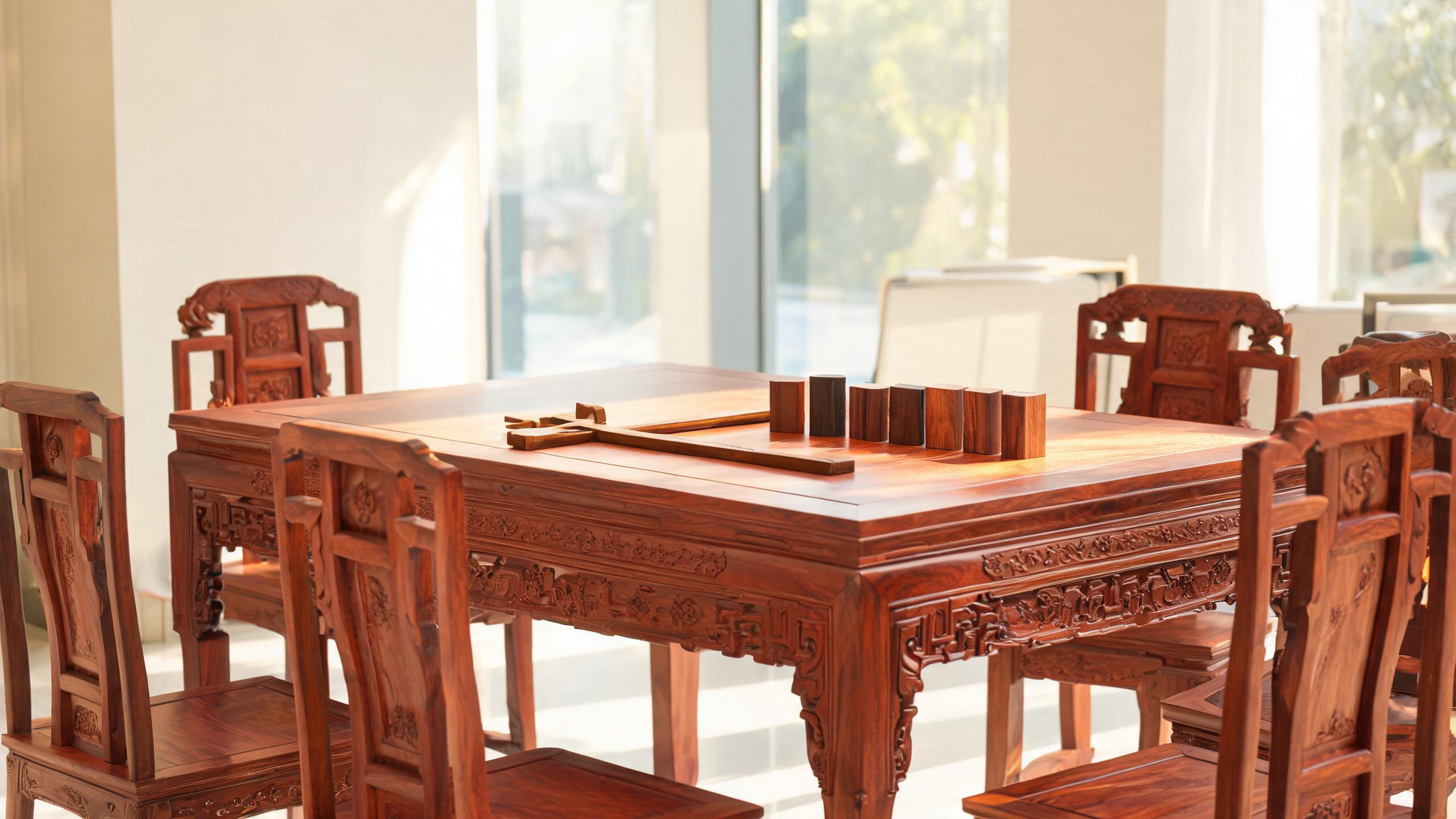
Magkano ang halaga ng solid wood furniture? Ipinaliwanag ng isang Chinese rosewood furniture manufacturer ang limang cost layers — timber, drying, joinery, carving at finishing — at kung paano dapat ihambing ng mga B2B buyer ang mga quotation.
Introduction: Why Pricing Is the First Question Every Furniture Importer Asks
Every B2B buyer who sources furniture from China eventually asks the same question: how much does solid wood furniture actually cost? It sounds like a simple question, but anyone who has requested quotations from five different rosewood furniture factories knows that the answers can vary dramatically — sometimes by a factor of three or more for what appears to be a similar dining table or sofa set. Understanding why those differences exist is the difference between a profitable import business and a warehouse full of unsellable stock.
This guide is written from the perspective of a manufacturer. We have been crafting classical rosewood furniture in Xianyou, Fujian Province — one of China's most important classical furniture production hubs — since 2008, operating a 12,000-square-meter factory and exporting to Europe, North America, Southeast Asia, and Australia. Over nearly two decades, we have answered thousands of pricing questions from wholesalers, hotel project buyers, interior designers, and retail chains. This article condenses that experience into a practical framework you can use to evaluate quotations, negotiate intelligently, and budget accurately for your next solid wood furniture order.
We will not pretend there is one universal price list. Solid wood furniture pricing depends on timber species, construction method, carving depth, finish, hardware, order quantity, and destination market compliance requirements. What we can do is show you exactly how each of those factors moves the price, what questions to ask a supplier before comparing quotes, and where buyers most often lose money by focusing on the wrong number.
What Actually Determines the Price of Solid Wood Furniture?
When a buyer asks how much a solid wood dining table costs, the honest answer is: it depends on five cost layers, and each layer can be estimated before you ever receive a quotation.
1. Raw Timber Cost: The Foundation of Every Quote
Timber is typically the single largest cost component in solid wood furniture, often representing 30 to 50 percent of the ex-works price. But "rosewood" is not one material. In the classical Chinese furniture tradition, and in the export market, several distinct species are used, and their prices differ enormously.
Siamese rosewood (Pterocarpus macrocarpus), one of the most respected timbers for classical furniture, sits at the premium end. It is dense, takes a deep reddish-brown polish, and holds carved detail exceptionally well. Because genuine rosewood species are listed under CITES Appendix II, legal sourcing requires documented, licensed supply chains — and that compliance cost is real, but it protects your business from customs seizures and regulatory penalties in the EU, the US, and Australia.
At the other end of the spectrum, related hardwoods such as Machilus nanmu offer many of the working properties buyers want — stability, attractive grain, excellent machinability — at a substantially lower timber cost. Neither choice is "wrong." A hotel project that needs 200 consistent dining chairs may be better served by a stable, cost-efficient hardwood; a flagship villa project or a collector-oriented retail line may justify premium rosewood. The key is that your supplier discloses the species honestly, with documentation, and prices accordingly.
Timber cost is also affected by dimensions and yield. A thick, wide tabletop slab cut from the heart of a large log commands a premium over small components, because large clear sections are scarcer and yield more waste. When you compare quotes for a large dining table, ask what board widths were assumed. A quote based on narrow, laminated panels will always look cheaper than one based on wide single-piece tops — and the difference is visible in the finished product.
Timber grading adds another dimension. Within the same species, logs are graded by diameter, straightness, color consistency, and defect count. Furniture made from first-grade heartwood timber costs more per cubic meter than furniture made from second-grade material with sapwood inclusions or minor defects — and no photograph in a catalog will show you the difference. This is why serious buyers ask for timber grade to be written into the quotation, and why we state it on every quote we issue.
2. Drying and Material Preparation: The Invisible Cost That Prevents Disasters
Here is a cost layer that cheap quotations quietly omit: proper timber drying. Solid wood furniture that ships to Europe, North America, or Australia crosses into dramatically different humidity environments. Wood that was not dried to match its destination climate will crack, warp, or open at the joints within months of installation — and every one of those pieces comes back to you as a warranty claim or a lost customer.
Professional manufacturers kiln-dry timber in humidity-controlled chambers over extended cycles. In our own production, timber goes through a 36-day humidity-controlled drying process, and components are released to the carving and assembly lines only when moisture content is below 14 percent, matched to destination-market conditions. That process ties up capital, energy, and warehouse space for more than a month before a single cut is made. It is a genuine cost — and it is the reason a properly dried quote can never compete with a factory that ships air-dried or under-dried wood.
When you receive an unusually low quotation, this is one of the first places to look. Ask the supplier directly: what is the drying cycle, what moisture content do you guarantee, and how do you verify it before assembly? A factory that answers confidently with specific numbers is pricing honestly. A factory that answers vaguely is transferring the cost of failure to you.
It is worth understanding why moisture content targets differ by destination. Wood is hygroscopic: it exchanges moisture with the surrounding air until it reaches equilibrium with local humidity. A piece dried for coastal Southeast Asia will sit at a higher equilibrium moisture content than a piece destined for a heated North American home in winter. If the drying target does not match the destination, the wood will adjust after arrival — shrinking in dry climates, swelling in humid ones. Proper manufacturers dry to the destination, not to a single universal number, and that customization is part of what you are paying for.
3. Construction Method: Mortise and Tenon Versus Shortcuts
Classical Chinese furniture is defined by mortise-and-tenon joinery — interlocking wooden joints that have held chairs, tables, and cabinets together for centuries without a single metal nail. This construction method is labor-intensive. Every joint must be cut precisely, fitted by hand, and checked for tightness. It is slower than screwing and gluing, and it requires craftsmen with real training.
The alternative — metal fasteners, corner brackets, and heavy glue reliance — is faster and cheaper, and for some product categories it is acceptable. But for classical rosewood furniture, and for any product that will experience the humidity swings of an international shipment, mortise-and-tenon construction is not just an aesthetic choice. Wood moves with the seasons; metal fasteners do not. A glued-and-screwed joint fights that movement and eventually fails. A well-cut mortise and tenon accommodates it. This is why we build every piece with traditional joinery and no metal nails, and why our quotations reflect the real labor that requires.
When comparing prices, ask how the frames are joined. If one quote is 20 percent lower and the answer involves "reinforced corners," you have found your price difference — and your future warranty problem.
There are dozens of distinct mortise-and-tenon joint types in the classical tradition — through tenons, blind tenons, dovetail-shaped shoulder joints, mitered frame joints — each suited to a specific structural role. A chair leg that takes lateral stress needs a different joint than a table apron or a cabinet door frame. Factories that genuinely master this craft price their joinery accordingly, and the furniture they produce survives decades of use and repeated international relocation. This is also why classical furniture made with proper joinery holds resale value: the structure does not degrade the way glued assemblies do.
4. Carving and Surface Craftsmanship
Carving is where classical furniture pricing spreads widest. A clean, minimally carved Ming-style piece emphasizes line and grain and requires far fewer carving hours. A Qing-style piece with deep relief carving — dragons, peonies, landscape scenes — across a full sofa set can represent hundreds of additional artisan hours.
Buyers should also understand the difference between hand carving and machine carving. CNC equipment can produce consistent, shallow decorative patterns efficiently, and for mid-market products it is a legitimate method. But machine carving cannot execute the deep undercutting, variable depth, and crisp edges that define high-end classical work. Our own guide to identifying authentic hand-carved furniture covers the tell-tale signs in detail; from a pricing perspective, simply know that deep hand carving can multiply the labor content of a piece, and quotes that ignore this are either assuming machine work or planning to cut corners.
Carving cost also scales with pattern complexity in a non-linear way. Doubling the area of a shallow border pattern might add 30 percent to carving labor; adding a single deep-relief medallion to a tabletop can add more than that, because deep relief requires removing large volumes of material while preserving fragile undercuts — work that only experienced carvers can do without breaking the piece. When you brief a supplier on carving, reference actual production photos rather than descriptions, and ask for a carving-hours estimate per piece. That number tells you more about the final price than any discount percentage.
5. Finishing: Beeswax and Traditional Lacquer
The finish is the final cost layer, and it matters more than most buyers realize. Traditional beeswax finishing enhances the natural grain and allows the wood to breathe and develop patina over time. Traditional lacquer finishing, applied in multiple coats with curing between layers, provides deeper protection and a richer surface — and it is significantly more labor-intensive.
Finishing also carries a compliance dimension. Buyers shipping to the EU and the US increasingly ask about the chemical profile of coatings. Finishes selected to align with EU REACH expectations and US CARB-related formaldehyde expectations for wood products are part of a responsible export program. A quotation that includes compliant finishing materials and documented processes will be higher than one that does not — and that difference is worth paying.
Finish choice also interacts with climate. Beeswax finishes perform beautifully in stable indoor environments and are easy for end customers to maintain — re-waxing is a simple annual task. Lacquer finishes offer more protection against spills and humidity swings, which matters for hotel dining tables and high-traffic hospitality settings. Neither is universally better; the right answer depends on where the furniture will live. A supplier who asks about your end-use environment before recommending a finish is a supplier who understands the product, and their quote will reflect a deliberate choice rather than a default.
How Much Does a Solid Wood Dining Table Cost, Then?
With the five cost layers established, we can give a structured answer to the most-searched version of the pricing question. We deliberately avoid publishing a fixed price list, because honest manufacturers cannot: timber markets move, exchange rates shift, and every project has different specifications. But we can describe how price scales with specification, which is what a professional buyer actually needs.
For a solid wood dining table, price scales primarily with four variables: timber species, top construction (single wide boards versus laminated panels), size and seating capacity, and carving intensity. A straightforward six-seater table in a stable hardwood with a clean Ming-style profile and a beeswax finish sits at the accessible end of the range. Move to premium rosewood, a wide single-slab top, deeper carving on the aprons and legs, and a multi-coat lacquer finish, and the price rises step by step — each step traceable to a specific cost layer, not to arbitrary markup.
The same logic applies across product categories. A rosewood sofa set's price is driven by frame timber volume, upholstery specification, and carving coverage. A bedroom set adds case-goods construction — drawer runners, panel doors, interior finishing — where joinery quality shows up in daily use. Whole-house custom projects combine all of these, which is why they are always quoted per project rather than per piece.
Our practical advice: instead of asking suppliers "what is your price," send a specification — species, dimensions, carving reference images, finish, destination port — and ask for a breakdown. A factory confident in its costing will happily show timber, labor, finishing, and packaging as separate lines. That breakdown is also your best negotiation tool, because it shows you exactly which specification changes save money without compromising the product.
Consider a concrete comparison. Two buyers each request a quote for a "1.8-meter rosewood dining table with six chairs." Buyer A receives a low quote built on: laminated narrower panels for the top, second-grade timber, a shortened drying cycle, machine-carved shallow borders, and a single-coat finish. Buyer B receives a higher quote built on: wide heartwood boards, first-grade timber, a full 36-day drying cycle to sub-14-percent moisture, hand-carved aprons, and a multi-coat compliant finish. Both tables are legitimately described as "solid rosewood dining tables with six chairs." Only one of them will look and perform the same in year five as it did on delivery day. The price difference is not markup — it is the five cost layers, priced honestly.
Why Do Quotes for "the Same" Furniture Vary So Much Between Suppliers?
This is the question behind the question. Buyers who collect three quotations for one dining table routinely see spreads of 30, 50, even 100 percent. Here is where that money actually goes — or doesn't go.
Timber Substitution
The most common source of price gaps is undisclosed material substitution. "Rosewood-look" hardwoods, stained lower-grade timber, and partial solid construction (solid frames with veneered panels) can all look convincing in photographs. Only documentation — species declarations, CITES-related permits where applicable, and pre-shipment inspection — separates honest pricing from bait pricing. We address this directly: every quotation we issue states the exact timber species, and buyers are welcome to verify material before shipment.
Drying Shortcuts
As covered above, skipping or shortening the drying cycle saves a factory weeks of time and working capital. It also transfers crack-and-warp risk entirely to the buyer. If one quote is dramatically lower, ask for the drying protocol in writing.
Joinery and Assembly Shortcuts
Screws and glue are faster than hand-cut mortise and tenon. On a photograph, at a distance, the difference is invisible. In year three of a hotel contract, it is very visible.
Finishing and Compliance Gaps
Non-compliant or minimal finishing is cheaper today and expensive later — both in product performance and in regulatory exposure for EU and US imports.
After-Sales Absence
A low quote from a supplier with no export track record carries hidden risk: no spare parts strategy, no replacement component production, no documentation for customs. Established exporters price a small margin for standing behind the shipment. That margin is insurance, and it is worth having.
How Destination Markets Change the Price Equation
The same dining table can carry three different landed-cost profiles depending on where it is going, and experienced importers model this before comparing factory quotes.
Europe
European buyers operate under the EU Timber Regulation framework, which requires documented legal sourcing of timber products. Finishing expectations are shaped by REACH chemical compliance. European consumers also tend to favor lighter, Ming-influenced silhouettes over heavily carved Qing styles, which affects both carving cost and shipping volume. Packaging must survive long inland distribution after port arrival, so crate quality matters more than buyers expect.
North America
US importers must navigate Lacey Act declarations for wood products and CARB-related formaldehyde expectations for composite and finished goods. The market rewards larger scale — dining sets for open-plan homes, oversized beds, sectionals — which increases timber volume per unit. Freight is dominated by full-container loads, so container utilization engineering (how many sets nest into a 40-foot container) directly changes your per-set landed cost.
Southeast Asia and Australia
Southeast Asian markets are geographically close, which shortens lead times and lowers freight, but high ambient humidity demands rigorous moisture-content control and finishes that resist swelling. Australia combines strict biosecurity inspection of timber packaging with a strong hospitality and residential renovation market; ISPM-15 compliance is non-negotiable, and documentation quality directly affects clearance speed.
When you brief a supplier, always state the destination market. A quotation that ignores destination-specific compliance is not comparable to one that includes it.
The B2B Buyer's Pricing Checklist: What to Ask Before You Compare Quotes
Use this checklist to normalize quotations from different suppliers so you are comparing like with like:
- Exact timber species and documentation: Which species, from what supply chain, with what CITES or legality documentation for my destination market?
- Drying protocol: How many days, what chamber conditions, and what guaranteed moisture content at assembly?
- Joinery specification: Mortise-and-tenon throughout, or fasteners in which locations?
- Carving method and depth: Hand carving, machine carving, or combined — with reference photos of actual production, not catalog renders.
- Finish system: Beeswax, lacquer, or other; number of coats; compliance with EU REACH and US CARB-related expectations.
- Packaging standard: ISPM-15 compliant export packaging, with corner protection and crate construction suitable for sea freight.
- Lead time by stage: Drying, carving, finishing, packing — so you know where schedule risk sits.
- Quantity breaks: Pricing at your target volume and at 20 to 30 percent above it, so you can plan growth.
- Custom and OEM/ODM terms: Design file handling, sample policy, and tooling implications for customized orders.
A supplier who answers all nine questions without hesitation has done this before, and their quote — even if not the lowest — is the one worth serious consideration.
Custom, OEM, and ODM: How Customization Affects Price
Many of our B2B buyers come to us precisely because standard catalog products do not fit their market. Customization changes pricing in predictable ways, and understanding those ways helps you budget realistically.
Dimensional customization — resizing a dining table for a market that prefers counter-height dining, or scaling a sofa set for compact apartments — is usually the least expensive form of customization, because the construction method and tooling are unchanged. Design customization — new carving patterns, modified silhouettes, brand-specific details — requires design and sample work, and is best evaluated through a staged process: drawing approval, sample production, then volume pricing. Full ODM development — a complete product line developed to your brief — is a project, not an order, and is priced accordingly.
Our OEM and ODM program supports all three levels, including free layout planning drawings for hotel and villa projects, and typical production lead times of 45 to 60 days for confirmed orders. The pricing principle is simple: customization costs are front-loaded (design, sampling) and then amortize across volume. Buyers planning a multi-year program should negotiate sample costs against the first production order rather than treating them as sunk expenses.
One more customization factor deserves attention: material commitment. Custom designs lock in a specific timber species and grade for the life of the program. If timber markets move during a multi-year program, pricing follows. Buyers running long programs should ask suppliers how material price movements are handled — fixed pricing for a defined period, indexed pricing, or forward purchasing. We discuss material planning openly with program buyers precisely because surprises benefit no one.
Project Sourcing: Hotels, Villas, and Whole-House Programs
For hospitality and residential project buyers, pricing works differently from catalog wholesale. A 60-key boutique hotel ordering dining chairs, tables, and case goods is not buying products; it is buying consistency, schedule reliability, and installation-ready delivery.
Three cost factors dominate project pricing. First, consistency engineering: every chair must match every other chair in tone and dimension, which requires selecting timber batches together and finishing in coordinated runs. Second, schedule integration: production must align with the project's construction timeline, which is why our 45-to-60-day lead time commitment and staged production planning matter — furniture arriving before the site is ready costs the buyer storage, and arriving late costs the project schedule. Third, site logistics: ISPM-15 crated, floor-by-floor packaging and labeling reduce installation labor, and that planning is priced into professional project quotes.
Project buyers should also budget for a small percentage of spare components — extra chair legs, touch-up finishing kits, replacement panels — produced in the same timber batch. This is inexpensive at production time and nearly impossible to match later.
A practical walkthrough: a 40-key boutique hotel needs 80 dining chairs, 20 tables, and 15 case-good pieces. A professional quotation for this project will include batch timber selection for color consistency across all 80 chairs, a coordinated finishing run, staged production aligned to the hotel's fit-out schedule, floor-labeled crating by room, and a spare-parts package. None of these line items appear in a catalog price — and all of them determine whether the project installs smoothly or becomes a series of expensive surprises.
Hidden Costs Buyers Forget to Budget
Beyond the ex-works price, a complete landed-cost budget includes several items that first-time importers routinely underestimate:
- Sea freight and volume weight: Solid wood furniture is bulky; crate dimensions matter as much as product price. Ask suppliers to quote crate dimensions per item so your forwarder can calculate accurately.
- Destination duties and compliance: EU timber regulations and the US Lacey Act require documented legal timber sourcing. Working with a supplier who provides complete documentation avoids delays and penalties — our overview of EU and US compliance for redwood furniture imports covers this in depth.
- Insurance: Marine insurance on furniture shipments is modest relative to cargo value and should never be skipped.
- Inspection: Third-party or factory-conducted pre-shipment inspection with photo documentation is cheap protection on any first order with a new supplier.
- Local delivery and installation: White-glove installation for carved furniture protects both the product and your brand.
When you build these into your model from the start, supplier quotations become comparable, and the "cheapest" quote often stops looking cheapest.
Negotiating Price Without Destroying Value
Negotiation in this category is not about squeezing the same specification to a lower number — that path ends in hidden substitutions. It is about trading specification intelligently. The most effective levers, in our experience:
- Adjust carving scope, not construction. Reducing carving depth or coverage saves real labor hours without touching the structural integrity that mortise-and-tenon joinery provides. Cutting joinery quality to save money is never a good trade.
- Consolidate SKUs. Ordering six dining chair models at 40 pieces each costs more per chair than ordering two models at 120 pieces each, because finishing runs and jig setups amortize across volume.
- Plan around timber cycles. Timber prices move seasonally. Buyers who can place orders when raw material markets are favorable — rather than reacting at peak season — capture savings that no amount of haggling can match.
- Commit to programs, not one-off orders. A buyer who commits to quarterly containers gets better pricing than one who buys a single trial container every eighteen months, because the factory can plan timber purchasing and drying capacity around the program.
Notice what is absent from this list: demanding a 30 percent discount on an already detailed quotation. When a supplier accepts that demand, the money comes out of your product somewhere — usually in the drying room.
How We Quote: Transparency as Policy
Because pricing questions are where trust is won or lost, our quotation process is deliberately transparent. Every quotation states the exact timber species and grade, the drying and moisture-content specification, the joinery method, the carving scope, the finish system, the packaging standard, and the lead time. Buyers receive production photos at key stages — timber selection, carving, assembly, finishing, and packing — so there are no surprises at container opening.
We also encourage buyers to start with samples or a trial container. A sample order lets you verify material, construction, and finish against the quotation before committing volume, and we structure sample pricing to be credited against subsequent production orders. This is how long-term sourcing relationships are built: on verified reality, not on catalog promises.
Frequently Asked Questions from B2B Buyers
What is the minimum order quantity for custom rosewood furniture?
MOQ depends on the product and customization level. Catalog items can often be ordered in small mixed-container quantities; fully custom designs are evaluated per project. Contact us with your specification for a concrete answer.
How long does a custom order take?
Confirmed custom orders typically run 45 to 60 days in production, plus sea freight. Timber drying happens before production, so it does not extend the stated lead time — but it is the reason realistic lead times cannot be compressed to weeks.
Can you match an existing piece or another factory's design?
Yes, within the bounds of intellectual property law. Send photos and dimensions; we will assess feasibility, propose the appropriate timber and construction, and quote accordingly.
How do you ensure the wood will not crack in my climate?
Through the 36-day humidity-controlled drying process and a sub-14-percent moisture content target matched to destination conditions, combined with mortise-and-tenon construction that accommodates natural wood movement.
What documentation do you provide for EU and US imports?
Complete commercial and packing documentation, timber species declarations, and applicable legality documentation supporting EU Timber Regulation and US Lacey Act requirements, plus ISPM-15 compliant packaging.
Do you support hotel and villa projects with layout planning?
Yes. We provide free layout planning drawings for hospitality and residential projects, alongside OEM/ODM customization and staged production scheduling.
Is more expensive rosewood furniture always better quality?
No — price should track specification. A well-built hardwood piece with proper drying and joinery can outperform a poorly built premium-timber piece. Judge the five cost layers, not the species name alone.
How should I budget for maintenance after delivery?
Solid wood furniture finished with beeswax benefits from periodic re-waxing in dry climates, and all solid wood performs best in stable indoor humidity. We provide care guidance with every shipment so your end customers protect the investment.
Can I get a price list for your catalog?
We provide indicative pricing ranges by product category on request, but firm quotations always follow a specification — species, dimensions, finish, quantity, and destination. This protects both sides from comparing numbers that describe different products.
What payment and trade terms do you work with?
We work with standard international trade terms and structured payment schedules tied to production milestones. Details are confirmed per order; buyers with established programs can discuss terms that match their cash-flow planning.
Conclusion: Price Is a Question of Specification, Not Luck
How much does solid wood furniture cost? Exactly as much as the specification you choose — no more, and ideally no less. The buyers who succeed in this category are not the ones who find the lowest number; they are the ones who understand the five cost layers — timber, drying, joinery, carving, and finishing — and who buy each layer deliberately.
If you are planning an import program, a hotel project, or a custom furniture line, send us your specification. We will return a transparent, line-item quotation backed by nearly two decades of classical rosewood furniture manufacturing in Xianyou, Fujian — and by the drying rooms, carving workshops, and export documentation that make the price real.