
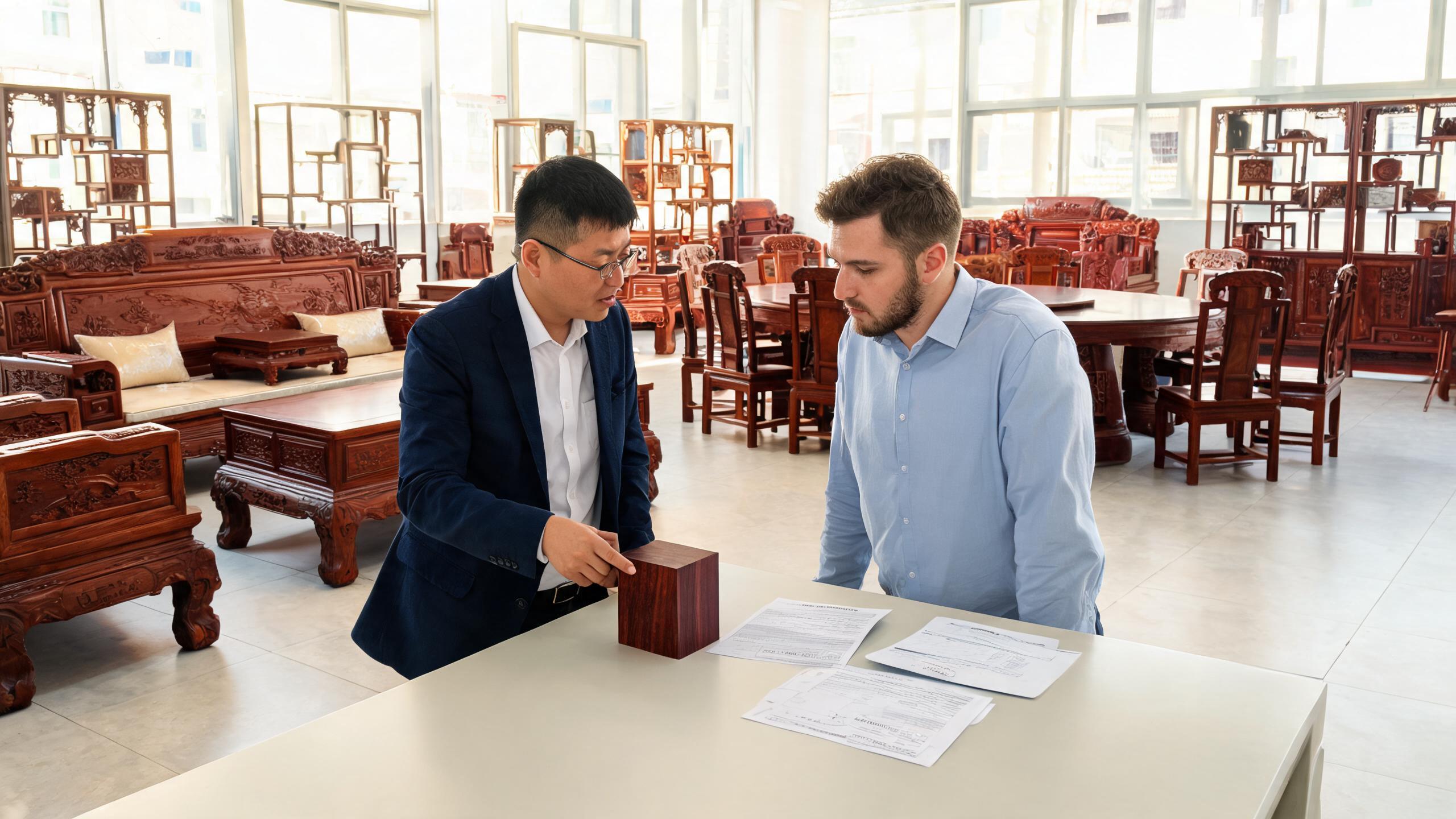
Isang praktikal na B2B guide kung saan bibili ng solid wood furniture mula sa China: ihambing ang mga factory, trade company, market at platform, i-verify ang mga supplier, at mag-import nang may kumpiyansa.
Where Should a B2B Buyer Start When Searching for Solid Wood Furniture from China?
Every year, thousands of importers, wholesalers, hospitality procurement managers, and furniture retailers type some version of the same question into a search engine: where to buy solid wood furniture. The question sounds simple, but the answer is layered. China remains the world's largest furniture manufacturing and exporting country, and within that vast industrial ecosystem, solid wood furniture occupies a distinctive position. Unlike flat-pack panel furniture, solid wood furniture — and especially classical rosewood furniture — demands specialized timber knowledge, joinery craftsmanship, kiln-drying capacity, and finishing expertise. That means the question of where to buy is not just about finding a low price. It is about finding a source that can deliver authentic material, consistent quality, export-ready packaging, and repeatable production across multiple orders.
This guide is written for B2B buyers: importers building a catalog, distributors supplying retail chains, contractors furnishing hotels and residential projects, and entrepreneurs launching a solid wood furniture brand. It walks through the real sourcing channels available today, explains how to distinguish a genuine manufacturer from a middleman, details a verification process you can run before committing any deposit, and maps the full procurement journey from first inquiry to container loading. The goal is practical: by the end of this article, you should be able to answer the question "where to buy solid wood furniture" with a specific, verifiable shortlist of suppliers and a clear evaluation framework.
What Does "Solid Wood Furniture" Actually Mean in the China Market?
Before comparing channels, buyers need a precise vocabulary. In international trade, "solid wood furniture" refers to furniture whose primary structural components — frames, legs, panels, tabletops — are made from natural timber rather than plywood, MDF, particleboard, or veneer over engineered cores. In the Chinese market, the category splits into two broad families that behave very differently in trade.
The Two Families: Hardwood Furniture and Rosewood Furniture
The first family is general hardwood furniture: oak, ash, walnut, elm, teak, and similar temperate or tropical species. These woods are widely available, machine-friendly, and typically finished with modern lacquers or oils. Production is highly industrialized, lead times are short, and price competition is intense.
The second family is rosewood furniture, known in China as hongmu furniture. This category follows the Chinese national standard GB/T 18107, which defines the species that qualify as hongmu, including Padauk, Siamese rosewood (Dalbergia cochinchinensis), Burmese rosewood, and several other Dalbergia and Pterocarpus species. Classical rosewood furniture is built with mortise and tenon joinery — a traditional Chinese technique that interlocks components without nails or screws — and is frequently hand-carved. Because these timbers are dense, slow-growing, and regulated under CITES for many Dalbergia species, rosewood furniture carries higher material costs, longer production cycles, and stricter documentation requirements than general hardwood furniture.
Why does this distinction matter for the question of where to buy? Because the best channel depends on which family you are sourcing. For commodity hardwood furniture, wholesale markets and online platforms can work well. For classical rosewood furniture, the credible sources narrow considerably to specialized manufacturing clusters — and verifying genuine material and craftsmanship becomes the central task.
Why Buyers Confuse Rosewood with "Rose-Colored" Wood
A common terminology trap: English-speaking buyers sometimes assume "rosewood" refers to rose-scented or rose-colored timber. In the furniture trade, rosewood refers to the dense, dark-grained tropical hardwoods listed above. Reputable Chinese manufacturers will state the exact botanical species, the standard it complies with, and the origin of the timber. If a supplier cannot name the species or dodges the question, that is an early warning sign regardless of which channel you found them through.
Where to Buy Solid Wood Furniture: The Five Main Channels Compared
When buyers ask where to buy solid wood furniture from China, they are really choosing among five channels. Each has distinct economics, risk profiles, and suitability for different order sizes and product categories.
Channel 1: Buying Direct from a Manufacturer
Direct factory sourcing means contracting with the company that actually cuts, joins, carves, finishes, and packs the furniture. For solid wood and rosewood furniture, this is generally the strongest channel for mid-to-large B2B orders because it offers the best price-to-quality ratio, direct control over specifications, and accountability when problems arise.
The advantages are concrete. First, pricing: without a trading company margin — typically 10 to 25 percent — the same specification costs less, or the same budget buys a higher grade of timber and carving. Second, technical communication: when you ask whether a dining table apron is tenoned or screwed, whether the moisture content is kiln-controlled, or whether the carving depth on a sofa set matches your sample, the person answering actually knows. Third, customization: factories can modify dimensions, adapt designs to target-market preferences, produce OEM and ODM orders, and adjust finishes for different climates. Fourth, traceability: a genuine manufacturer can show you its workshop, its kiln-drying facilities, its timber inventory, and its quality control process.
The trade-offs are real too. Factories usually have minimum order quantities, longer lead times for custom work, and less polished English communication than trading companies. Buyers must invest more effort in verification. But for anyone building a durable supply relationship in solid wood furniture, these are manageable costs.
Channel 2: Trading Companies and Export Agents
Trading companies buy from factories and resell to overseas buyers, handling communication, consolidation, and export paperwork. For buyers sourcing mixed containers — say, rosewood dining sets from one region and textiles from another — a good trading company adds genuine value through consolidation and project management.
However, for specialized categories like classical rosewood furniture, trading companies introduce risks: they may not understand the material deeply, they add margin without adding craftsmanship control, and when a quality dispute arises, responsibility gets diffused between the trader and the underlying factory. If you use this channel, insist on knowing the actual producing factory and retaining the right to communicate with it on technical matters.
Channel 3: Furniture Wholesale Markets and Clusters
China's furniture industry is organized in geographic clusters. Foshan in Guangdong province hosts enormous furniture wholesale malls serving global buyers. For classical rosewood furniture specifically, the historic clusters are in Guangdong (Zhongshan's Dayong town), Jiangsu (Suzhou, home of the Su-style tradition), Zhejiang (Dongyang, famous for carving), Fujian (Xianyou), and Yunnan. Visiting these clusters lets buyers see dozens of showrooms in a day, compare craftsmanship side by side, and negotiate in person.
The market channel suits buyers who can travel, who need small mixed quantities, and who have the expertise to judge quality themselves. Its weaknesses: quality varies wildly between adjacent showrooms, many market vendors are themselves resellers, and after-sales accountability across an ocean is weak. Buyers who purchase in markets without verifying the producing workshop often discover later that their "manufacturer" was a stall assembling pieces from several workshops.
Channel 4: Online B2B Platforms
Alibaba, Made-in-China, and Global Sources let buyers search "solid wood furniture" and reach hundreds of suppliers from a laptop. These platforms are excellent for discovery: scanning price ranges, reviewing product photography, reading reviews, and generating a first shortlist. They are weak as a final verification layer. Platform profiles can overstate factory status; a "manufacturer" badge does not always mean the company owns production lines. Use platforms to build the list, then verify each candidate through the methods described later in this article before sending any deposit.
Channel 5: International Trade Fairs
Fairs such as the Canton Fair in Guangzhou and the China International Furniture Fair in Shanghai concentrate qualified exporters in one venue. Meeting a supplier face to face, handling samples, and observing how their team answers technical questions compresses weeks of email vetting into an afternoon. The limitation is timing and cost: fairs run on fixed schedules, and the deepest rosewood specialists sometimes exhibit only at industry-specific events. Many successful buyers combine channels: discover at a fair or online, then visit the factory before the first container order.
Which Channel Fits Which Buyer?
A practical summary: if you are ordering full containers of a defined product line repeatedly, buy direct from a verified manufacturer. If you consolidate mixed goods and lack China presence, a transparent trading company can help. If you need one-off pieces and can inspect in person, markets work. Use platforms and fairs as discovery layers, not as the final trust decision. For classical rosewood furniture in particular, the direct-from-factory route with on-site or third-party verification is the industry standard for serious B2B programs.
Factory Direct or Trading Company: How to Tell Which One You Are Talking To
Many suppliers describe themselves as manufacturers whether or not they own production. Since the price, quality control, and customization depth all depend on this fact, verification is worth the effort. Here are the checks experienced buyers use.
Check the Business License and Scope
Ask for the company's business license. Chinese business licenses list the registered business scope. A genuine manufacturer's scope includes manufacturing terms for furniture; a pure trading company's scope reads as wholesale, retail, and import-export. The license also shows registered capital and the legal entity name, which should match the name on the bank account you eventually pay. Mismatches between the quoted company name and the receiving bank account are one of the most common fraud vectors in China sourcing, so this check protects more than your ego.
Verify Production Capability, Not Just Showrooms
Any supplier can rent a showroom. The distinguishing evidence is production: request a live video walk-through of the workshop, not a produced marketing video. Ask the host to show specific stations — timber storage, kiln-drying chambers, carving benches, assembly, finishing, and the packing area — and to pan across the floor on the same call. A real factory can do this within a day or two of notice. For rosewood furniture specifically, kiln-drying capacity is a critical tell: drying dense rosewood to a stable moisture content requires proper kilns, and a company without them is assembling or reselling, not manufacturing.
Interrogate the Technical Details
Ask questions only a maker answers fluently: What species and grade of timber is used for the frame versus the panels? What is the target moisture content after kiln drying, and how is it measured? Which joints on a given sofa set are mortise and tenon, and which components are reinforced? What finish system is applied, and how many coats? A trading company will promise to "check with the factory"; a manufacturer answers from direct knowledge, often with photos from the floor.
Compare Quotation Structure
Manufacturer quotes typically break down by specification: timber species, dimensions, carving depth, finish, packing method, and loading quantity per container. Vague lump-sum quotes with no specification detail usually indicate a reseller adding margin on top of an unknown source. Also compare the quoted FOB price against the product category's realistic range; a quote dramatically below every competitor for genuine rosewood is not a bargain, it is a material substitution risk.
How to Verify a Solid Wood Furniture Supplier Before You Commit
Once your shortlist exists, run a structured verification. The following sequence has protected many buyers from the classic failure modes: fake material, unstable moisture content, sloppy joinery, and vanished deposits.
Step 1: Document Verification
Collect and check: business license, export license or export agent arrangement, and — for rosewood — CITES-related documentation where the species requires it. Many Dalbergia species are CITES-listed, and legitimate exporters of rosewood furniture maintain the permits and re-export documentation that customs authorities in the EU, North America, and Australia may request. A supplier who dismisses documentation questions is signaling either ignorance or risk.
Step 2: Sample Evaluation
Order a sample or visit a showroom where you can physically inspect the construction. On solid wood furniture, check: joints should be tight with no visible gaps; drawers should slide smoothly on wooden runners; carvings should show clean depth transitions; surfaces should feel uniformly finished with no rough spots under the rails or inside cabinets. For rosewood pieces, examine the grain and color consistency, and weigh the piece — genuine dense rosewood is notably heavy. Ask for the moisture content reading of the sample; reputable makers measure it and will share the number, typically targeting a range appropriate to the destination climate.
Step 3: Third-Party or On-Site Inspection
For orders beyond a trial container, either visit the factory yourself or hire a third-party inspection service to conduct pre-shipment and, ideally, during-production inspections. Inspectors verify specifications against the approved sample, check moisture content, photograph the packing process, and confirm loading quantities. The cost is trivial relative to a container of furniture, and the leverage it gives you in quality disputes is decisive.
Step 4: Reference and Track Record Checks
Ask which markets the supplier currently exports to and request anonymized evidence: packing photos from previous shipments, export documentation samples with sensitive data redacted, or client references in your region. Cross-check the company's digital footprint — a real exporter usually has years of consistent online presence, exhibition participation, and content that reflects genuine production activity.
Step 5: Payment Terms That Match Verified Trust
Standard terms are 30 percent deposit and 70 percent balance against copy of bill of lading. Avoid suppliers demanding full prepayment before production, and be cautious with any request to pay a personal account. As trust accumulates over successful orders, terms can evolve; in the beginning, the payment structure is your main financial protection.
The Procurement Process from Inquiry to Container: A Step-by-Step Map
Understanding the full cycle helps buyers plan cash flow and calendars. Here is what a typical solid wood furniture order looks like when handled by a professional manufacturer.
Inquiry and Specification Alignment
Send your product list with dimensions, timber species, finish preferences, target market, and expected quantities. A capable supplier responds with a specification-anchored quotation, container loading calculations, and lead time estimates — not just a price list. This stage reveals communication quality, which predicts the entire relationship.
Sampling and Approval
For custom or modified designs, a pre-production sample or sample section (for large pieces, sometimes a component such as a carved panel or a table corner) is produced and approved. Photograph and measure the approved sample; it becomes the contractual quality benchmark.
Production and Milestone Updates
Production of classical rosewood furniture involves timber selection and cutting, kiln drying, rough shaping, joinery, carving, assembly, sanding, finishing, and curing. Depending on order size and carving complexity, this takes weeks to a few months. Professional factories provide milestone updates — photos at key stages — which also feed your inspection planning.
Pre-Shipment Inspection
Before balance payment, inspect: verify quantities, specifications, finish quality, moisture readings, and packing. Check that cartons include corner protection, that furniture is wrapped and foam-buffered, and that pieces are disassembled where appropriate to reduce shipping damage risk. Only after a passed inspection should the balance be released.
Booking, Loading, and Documentation
The supplier or your forwarder books the vessel. At loading, confirm container condition, count cartons, and photograph the stuffing process. The document set — commercial invoice, packing list, bill of lading, and where applicable fumigation certificates, CITES permits, and certificates of origin — should be reviewed for accuracy before the originals are couriered, because customs clearance delays usually trace back to document errors.
What Does Solid Wood Furniture from China Really Cost?
Price questions dominate the "where to buy" conversation, so buyers deserve a realistic framework rather than a number that changes monthly with timber markets.
The Cost Drivers in Solid Wood Furniture
Four factors dominate cost. First, timber: raw material is typically the largest cost component, and rosewood species prices vary enormously by species, grade, and origin, and have trended upward as supply tightens under regulation. Second, labor intensity: hand-carved classical furniture can involve hundreds of carving hours per set, which is why carving depth and detail move prices significantly. Third, construction: full mortise and tenon construction costs more than screwed and glued shortcuts, and it is the mark of furniture built to last generations. Fourth, finish and drying: proper kiln drying and multi-coat finishing add cost but prevent the two most common complaints — cracking and finish failure — in destination climates.
Why the Cheapest Quote Is Usually the Most Expensive
Experienced importers learn that in solid wood furniture, abnormally low quotes signal one of three substitutions: engineered wood hidden inside visible solid components, a cheaper species sold under a premium name, or skipped processes (inadequate drying, thinner finish, machine-only carving sold as hand-carved). Each of these surfaces after the goods reach your warehouse, when the cost of rectification — claims, replacements, reputational damage with your own customers — dwarfs the initial saving. The rational approach is to compare quotes at identical specifications and treat outliers with suspicion in both directions.
Is Solid Wood Furniture Worth It for a B2B Catalog?
Buyers also ask whether solid wood furniture is worth the premium over panel alternatives. For the B2B buyer, the answer depends on positioning. Solid wood — and rosewood in particular — commands retail price points, longevity, and a story (craftsmanship, heritage, natural material) that engineered furniture cannot match. In hospitality and premium residential projects, solid wood furniture differentiates the offering and withstands commercial use. For discount volume retail, panel furniture remains the correct tool. Matching the material to the market segment, rather than chasing the lowest unit cost, is what separates profitable import programs from margin traps.
Quality Benchmarks: What to Check in Samples and Production
Quality in solid wood furniture is verifiable, not mystical. These are the checkpoints professional buyers and inspectors use.
Moisture Content and Stability
Wood moves with humidity. Timber that is not properly dried will crack, warp, or open at the joints after arriving in a drier or more humid destination climate. Ask for the kiln-drying process description and the target moisture content range for your market, and request meter readings on the sample and during inspection. This single parameter prevents the majority of long-distance solid wood complaints.
Joinery Integrity
On classical furniture, examine the joinery: mortise and tenon connections should be snug, with grain-matched pegs where the design calls for them. Test stability by applying gentle lateral pressure on assembled pieces. Wobbly frames or visible glue squeeze-out indicate rushed assembly.
Carving Quality
For carved pieces, compare depth, sharpness of detail, and consistency across repeating motifs. Hand carving shows slight natural variation and crisp undercutting; machine carving repeats identically and shows rounded, shallow profiles. Neither is inherently wrong — but you should receive what you pay for, and the difference is inspectable.
Finish and Surface
Run a hand across every surface, including undersides and interiors. Look for even sheen, no dust inclusions, no thin spots, and consistent color. On traditional lacquer finishes, check for curing completeness; tacky surfaces indicate rushed production.
Packing Standards
Export damage usually happens in transit, not production. Confirm the packing specification: corner protectors, foam or pearl-cotton wrapping, sturdy five-layer cartons, and — for glass or fragile components — crate packing. A factory that shows you its packing line during a video call is a factory that has invested in this stage.
Customization and OEM/ODM: Working with a Manufacturer on Your Own Designs
One of the strongest reasons to buy solid wood furniture direct from a manufacturer is customization. Established rosewood factories routinely handle OEM production (building to your drawings or samples under your brand) and ODM development (adapting their existing designs to your market's dimensions, styles, and price points).
Practical customization levers include: dimension adjustments for Western room scales — classical Chinese pieces are sometimes resized for North American or European homes; style blending, such as simplified Ming-style silhouettes for contemporary interiors; upholstery and cushion fabric selection to match target-market tastes; finish color tuning; and hardware or functional additions like soft-close drawers where the design allows. When briefing a factory, provide dimensioned drawings, reference photos, timber species, finish targets, and the destination climate. A capable manufacturer responds with feasibility notes, cost implications, and a sampling plan — the quality of that response is itself a supplier selection signal.
Logistics, Compliance, and Documentation for Solid Wood Furniture Exports
Solid wood furniture is heavy, valuable, and — for rosewood — regulated. Buyers should understand the export-side requirements before comparing quotes.
Regulatory Documentation
Wood packaging and solid wood products generally require ISPM-15 fumigation or heat-treatment compliance for the packing materials. Rosewood furniture made from CITES-listed Dalbergia species requires CITES export permits from China and, depending on destination, import permits or re-export documentation. The EU's Timber Regulation framework and the US Lacey Act place due-diligence obligations on importers regarding legal timber sourcing. Working with a manufacturer that maintains complete, accurate species documentation is not optional paperwork — it is the foundation of lawful importation, and it is a core differentiator between professional rosewood exporters and casual resellers.
Shipping Modes and Cost Structure
Full container loads (typically 40-foot high-cube for furniture) offer the best per-piece freight economics. Less-than-container loads work for trial orders but raise per-unit freight substantially. Furniture is usually shipped FOB from a Chinese port such as Shenzhen, Guangzhou, Ningbo, or Shanghai; buyers with less experience may prefer CIF terms where the supplier arranges main-carriage freight. Transit times range from roughly two to five weeks to major destinations depending on route. Insurance is inexpensive relative to cargo value and should never be skipped on furniture shipments.
Common Mistakes B2B Buyers Make When Buying Solid Wood Furniture from China
Learning from others' expensive errors is cheaper than making your own. These are the recurring mistakes in solid wood furniture sourcing.
- Selecting on price alone. The cheapest quote in a rosewood RFQ round is almost always hiding a material or process substitution. Compare specifications first, prices second.
- Skipping sample approval. Production without an approved, photographed, measured sample removes your only objective quality benchmark.
- Ignoring moisture content. Beautiful furniture that cracks in a heated European winter or humid Southeast Asian monsoon generates claims that erase the margin.
- Paying before inspection. Balance payment should always follow a passed pre-shipment inspection, never precede it.
- Not verifying the legal entity. Paying an account whose name does not match the contracted company exposes the buyer to fraud with little recourse.
- Underestimating lead times. Hand-carved rosewood furniture takes time; compressing schedules forces shortcuts that show up in the goods.
- Treating compliance as the supplier's problem. Import permits, due diligence, and destination-market regulations are shared responsibilities; importers who ignore them face seized containers.
Frequently Asked Questions About Buying Solid Wood Furniture from China
Where is the best place to buy solid wood furniture in China?
For general hardwood furniture, the Foshan cluster in Guangdong offers the widest selection and infrastructure. For classical rosewood furniture, the specialized clusters — Zhongshan (Dayong) in Guangdong, Suzhou in Jiangsu, Dongyang in Zhejiang, Xianyou in Fujian, and parts of Yunnan — host the deepest craftsmanship. For most B2B buyers, however, the practical answer is a verified manufacturer in one of these clusters, contacted remotely and confirmed through video audits and inspections, rather than physical market shopping.
How can I tell if furniture is really solid wood and not veneer?
Check the edges and undersides: solid wood shows continuous grain wrapping over edges, while veneer shows a glued layer line. Weigh the piece — solid hardwood is heavy. Ask for the species name and a moisture meter reading. On carved rosewood pieces, the carving itself reveals solid timber. For container orders, a pre-shipment inspection verifies construction across the whole batch, not just the sample.
What is the minimum order quantity for solid wood furniture from Chinese factories?
It varies by factory and product. Many manufacturers accept mixed-container orders where a set of dining furniture, a bedroom set, and sofa sets share one container. Trial orders of a single container are the normal starting point for a new buyer relationship; factories set MOQs to make production runs efficient, not to exclude new customers.
How long does production take for rosewood furniture?
Standard designs from available stock typically take several weeks to about two months depending on carving complexity and finishing schedules. Fully custom designs add sampling time. Buyers should also calendar the pre-shipment inspection and vessel booking into the timeline rather than treating production end as ship date.
Do I need CITES permits to import rosewood furniture?
For furniture made from CITES-listed rosewood species, yes — the export permit comes from the Chinese side, and depending on your country, an import permit or prior documentation may be required. The EU, US, and Australia all apply timber legality controls. Choose suppliers who handle CITES documentation routinely and can show you sample permits with sensitive data redacted.
Is it better to buy from a factory or a trading company?
For specialized solid wood and rosewood furniture, direct from a verified manufacturer generally delivers better pricing, deeper technical control, and clearer accountability. Trading companies earn their margin on mixed-container consolidation and project management. The key is transparency: whichever channel you use, know who actually produces the furniture.
Conclusion: Turning "Where to Buy" into a Repeatable Sourcing System
The question "where to buy solid wood furniture" has a different answer for every buyer, but the method for finding that answer is universal. Define your product family precisely — general hardwood or classical rosewood. Match the channel to your order profile, weighting direct manufacturer relationships for repeat container programs. Verify before you trust: documents, video audits, samples, inspections, and payment structures that align incentives. Understand the cost drivers so you can judge quotes at equal specification. And treat compliance and logistics as design inputs, not afterthoughts.
Buyers who follow this discipline consistently report the same outcome: after one or two carefully managed orders, the sourcing question stops being "where to buy" and becomes "which of my two or three verified partners takes this order." That transition — from searching to partnering — is where the real margins and the real supply security in solid wood furniture live.
If you are evaluating solid wood or classical rosewood furniture suppliers for your market, start with a specification-driven inquiry: list the products, dimensions, timber species, and destination climate, and ask each candidate factory how they would manufacture, dry, finish, and pack it. The quality of the answers will tell you more than any product photo — and it will point you directly to the partners worth visiting.