
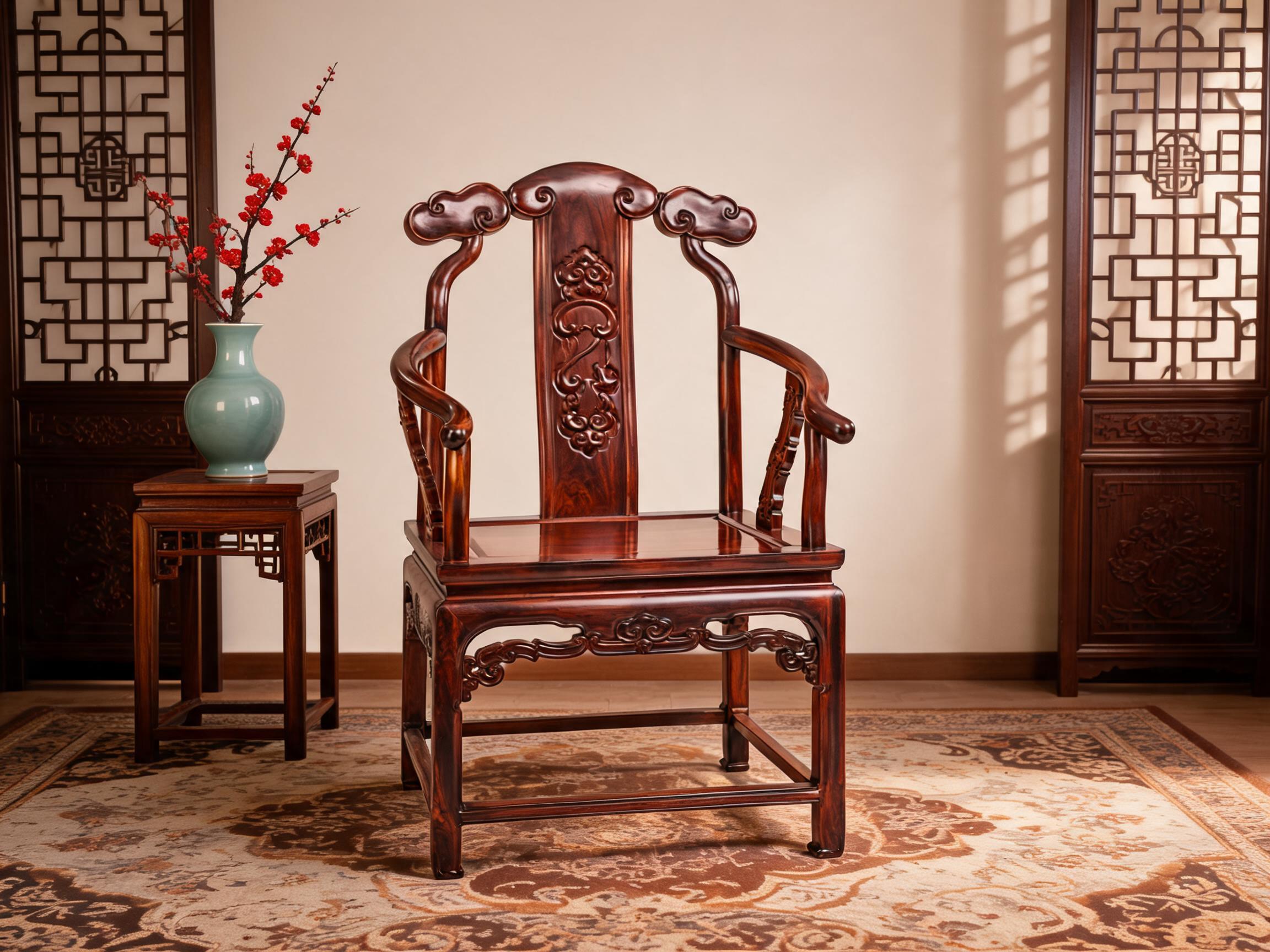
A practical B2B sourcing guide for procurement managers and interior designers looking to buy solid Siamese rosewood armchairs. Covers how to verify solid wood vs. veneer, what to check in a rosewood armchair factory, key specifications for hospitality projects, and common pitfalls to avoid.
BUYER GUIDE · HOSPITALITY & RESIDENTIAL
# Rosewood Armchair Buying Guide: How to Source Solid Siamese Rosewood Armchairs for Hotels, Resorts and Residential Projects If you are sourcing seating for a hotel lobby, a resort villa, or a high-end residential development, the rosewood armchair is probably already on your shortlist. Siamese rosewood—known in the trade as *Dalbergia cochinchinensis*—has a dense grain, a deep reddish-brown tone, and a natural resistance to wear that makes it a long-term asset in heavy-traffic interiors. But "rosewood" is a loose term in the export market. What arrives at your project site depends heavily on how you define **solid wood**, how you vet the **rosewood armchair manufacturer**, and what you put in the contract. This guide covers the practical checks that matter when buying in volume for hospitality or residential use.
Key takeaways for procurement teams:
## What "Solid Rosewood Armchair" Actually Means in Export
The single most common mismatch between buyer expectation and factory delivery is the definition of "solid."
In many Asian export factories, a chair described as "solid wood" may still use finger-jointed or laminated core wood for non-visible parts, with solid rosewood only on the frame and arms. That is not necessarily poor quality—it can improve structural stability—but it must be agreed upfront.
For a **solid rosewood armchair** in the strict sense, the buyer should specify:
- **Frame and legs:** solid Siamese rosewood, no MDF or plywood core
- **Backrest and armrests:** solid rosewood planks or curved solid sections (not veneer over substrate)
- **Seat panel:** can be solid wood or a high-density plywood base with upholstery—confirm which
- **Joinery:** mortise-and-tenon or dowel joints, not staples and glue alone
Ask the factory to state the solid-wood percentage per chair. A reputable **rosewood armchair manufacturer** will give you a figure such as "85–90% solid rosewood by weight" without hesitation. If the answer is vague, treat it as a red flag.
## Why Siamese Rosewood for Hotels and Resorts?
Siamese rosewood is not the cheapest hardwood available, so the choice needs to justify itself on project terms.
- **Density and hardness:** Siamese rosewood has a Janka hardness typically in the range of 1,000–1,200 lbf, which handles the abuse of luggage wheels, dropped keys, and daily guest traffic better than many softwoods.
- **Dimensional stability:** It resists warping in humid climates—relevant for resort projects in tropical zones.
- **Aesthetic consistency:** The grain is relatively uniform, with dark streaks that age gracefully. Unlike some woods that yellow or gray over time, rosewood deepens in tone.
- **Maintenance profile:** With a proper lacquer or oil finish, it needs only periodic polishing. Housekeeping teams do not need special training.
For residential projects, the same properties mean the **chinese rosewood armchair** style—often featuring carved backrests and curved arms—becomes a statement piece that holds resale value.
## Key Specifications to Put in Your RFQ
When you send an inquiry to a **rosewood armchair factory**, include these parameters so the quote is comparable across suppliers:
- Confirm "solid Siamese rosewood" in writing—specify the botanical name and the minimum solid-wood percentage per piece.
- Ask the factory for moisture-content readings, joinery method, and finish specifications before you place a deposit.
- Plan for lead times of 30–60 days for standard designs; custom hotel quantities often require more.
- Request a pre-shipment inspection report and, where applicable, CITES-related documentation from the supplier.
| Specification | What to Request | Why It Matters |
|---|---|---|
| Wood species | Dalbergia cochinchinensis (Siamese rosewood), origin stated | Prevents substitution with cheaper dalbergia or non-rosewood species |
| Moisture content | 8–12% at time of packing | Prevents cracking and warping after export to dry or cold climates |
| Joinery | Mortise-and-tenon or dowel joints on all load-bearing connections | Determines structural lifespan under daily use |
| Finish | PU lacquer, NC lacquer, or hard-wax oil; number of coats | Affects scratch resistance and maintenance frequency |
| Upholstery (if any) | Fabric grade, foam density (e.g., 35–40 kg/m³), fire-retardant standard | Hospitality projects often require local fire codes |
| Packing | Foam + carton, or wooden crate for sea freight | Prevents transit damage on long ocean routes |
| Load capacity | Static load test, e.g., 150 kg | Validates suitability for public spaces |
A factory that cannot explain its moisture content and joinery process in concrete numbers is a factory that has not solved those problems yet. Move on.## Solid vs. Veneer: How to Check at the Factory or Before Shipment If you are sourcing remotely, you can still verify construction quality through a pre-shipment inspection. Here is what the inspector (or you, if visiting) should check: - **Weight:** A solid rosewood armchair is heavy. A typical solid-frame chair with upholstered seat weighs 12–18 kg depending on size. If the chair feels light, it is likely veneer or hollow-core. - **End grain visibility:** On the underside of the seat rail or the bottom of the legs, solid wood shows continuous grain and end grain. Veneer shows a thin surface layer over a lighter substrate. - **Knock test:** Solid wood produces a dull, dense thud. Hollow or plywood sections produce a sharper, higher-pitched sound. - **Joinery check:** Look at the corners where the arm meets the back post. Mortise-and-tenon joints show a clean line; glued butt joints or staples are visible from the underside. ## Lead Times, MOQs, and Logistics For a **rosewood armchair factory** producing in volume, typical parameters are: - **MOQ:** 50–100 pieces for standard designs; lower for a single container mixed with other items. - **Lead time:** 30–45 days for standard models, 45–60 days for custom sizes or finishes. - **Sample policy:** Most factories charge for a sample (refundable against a bulk order). Budget for this—it is the cheapest insurance you will buy. For hotel projects, order a pre-production sample and have your interior designer sign off on it. This locks the finish color, the foam density, and the fabric before mass production begins. ## Compliance and Documentation Siamese rosewood is a CITES Appendix II species. This means international trade requires permits in many jurisdictions. A responsible exporter will handle the export permit; the importer is typically responsible for import-side documentation. Confirm with the factory: - Whether they can provide the CITES export permit - Whether the wood is legally harvested with chain-of-custody documentation - Whether the finish and adhesives meet the destination country's chemical regulations (e.g., REACH for EU, CARB for California) If a factory is evasive on CITES, do not proceed. The risk of customs seizure and project delay far outweighs any price advantage. ## Common Mistakes When Sourcing Rosewood Armchairs **1. Chasing the lowest FOB price.** Solid rosewood is a premium material. If the price is 30% below the market average, the factory is either using a different wood, cutting corners on drying, or reducing the solid-wood percentage. None of these end well for your project. **2. Assuming "rosewood" means one thing.** There are dozens of species marketed as rosewood. Specify *Dalbergia cochinchinensis* or "Siamese rosewood" in the contract, and state the origin (Thailand, Cambodia, Laos, or Vietnam). If the factory says "we use the same thing, just different name," get it in writing. **3. Skipping the pre-production sample.** For a hotel order of 200 chairs, a 1% finish mismatch across batches becomes a visible problem in the lobby. One sample locks the standard. **4. Not planning for seasonal humidity.** If your project site is in a dry climate (e.g., the Middle East) and the wood is shipped at 14% moisture, expect cracking within the first year. Specify the moisture content target for your destination climate. ## FAQ: Quick Answers for Procurement **Q: How long does a solid rosewood armchair last in a hotel lobby?** With proper finish and periodic maintenance, 10–15 years of daily commercial use is realistic. Residential use extends this significantly. **Q: Can I mix rosewood armchairs with other furniture styles?** Yes. The dark, warm tone pairs well with neutral upholstery and lighter woods. Many designers use rosewood pieces as accent furniture rather than full sets. **Q: What is the typical price range?** Ex-factory pricing varies significantly with size, carving complexity, and finish. Request quotes from multiple factories with identical specifications to compare. Expect to pay a premium over rubberwood or birch frames. **Q: Do I need to visit the factory?** For first orders, yes—or hire a third-party inspection company. For repeat orders with a proven supplier, a pre-shipment inspection report is usually sufficient. ## Final Checklist Before You Place the Order
Before signing the contract, confirm in writing:
Sourcing a solid Siamese rosewood armchair for a hotel, resort, or residential project is a matter of discipline, not luck. Define the wood precisely, vet the factory on process rather than promises, and lock every specification in the contract. Do that, and the chairs will serve your guests or residents for a decade or more.
For detailed specifications, MOQs, and current lead times on our rosewood armchair range, contact our export team directly. We work with hospitality and residential projects worldwide and can provide samples, inspection reports, and CITES documentation upon request.- Botanical name of the wood (Dalbergia cochinchinensis) and origin
- Solid-wood percentage per chair and which parts are solid vs. engineered
- Moisture content at packing (8–12%)
- Joinery method (mortise-and-tenon or dowel)
- Finish type and number of coats
- Packing standard for sea freight
- CITES export permit availability
- Lead time and MOQ
- Pre-shipment inspection terms