
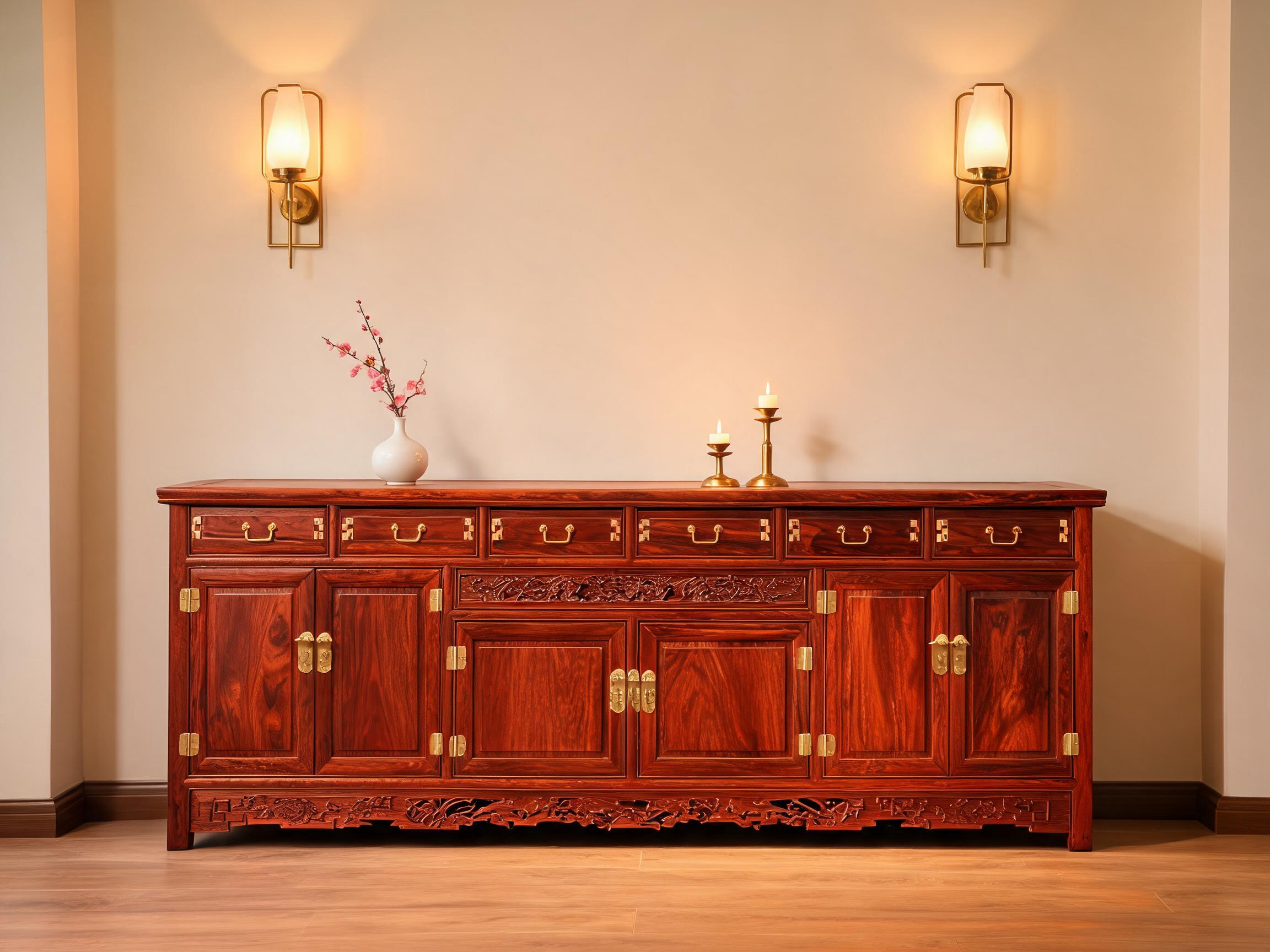
A practical B2B sourcing guide for importing Chinese rosewood sideboards and buffets. Covers material selection, dovetail drawer construction, hand-carving quality checks, pricing factors, MOQ and lead time expectations, and how to evaluate suppliers for dining room and hospitality projects.
BUYER GUIDE · DINING & HOSPITALITY
# Rosewood Sideboard & Buffet B2B Sourcing Guide: How to Import Classical Chinese Carved Sideboards with Dovetail Drawers You are sourcing rosewood sideboards for a hotel lobby, a restaurant group, or a high-end residential project. You have seen images of classical Chinese carved sideboards with dovetail drawers, and you like the look. But you are not sure what separates a piece that will last twenty years from one that will fail in three. This guide covers the practical side of importing: what to check in the wood, how to verify dovetail drawer construction, how to assess hand-carving quality, what affects pricing, and what to ask a supplier before placing an order.
Key takeaways for buyers:
## Why Buyers Choose Chinese Rosewood Sideboards
A rosewood sideboard serves two functions in a dining room or hospitality setting. First, it provides storage: table linens, serving pieces, cutlery, and barware. Second, it anchors the room visually. A hand-carved Chinese rosewood buffet with dovetail drawers brings a level of craftsmanship that flat-pack furniture cannot match.
For B2B buyers — hotel purchasing managers, interior design firms, restaurant groups, and furniture importers — the appeal is also economic. Chinese workshops with established carving traditions can produce a solid wood sideboard at a price point that European or American custom shops cannot match, even after shipping and duties.
But the category has pitfalls. "Rosewood" is used loosely. Carving quality varies from museum-grade to crude. Drawer construction can be genuine dovetail or a cosmetic fake. This guide helps you ask the right questions.
## Step 1: Understand What "Rosewood" Actually Means
The term "rosewood" covers multiple species with different properties, prices, and legal status. When a supplier quotes you a "rosewood sideboard," you need to know exactly which wood they mean.
- Rosewood is a broad commercial category — confirm the exact botanical species and origin before quoting.
- Dovetail drawers are a construction standard, not a luxury extra. Verify joint count and fit, not just the label.
- Hand-carving quality varies enormously. Ask for photos of the carving process and close-ups of the back.
- Moisture content (8–12%) is the single most important factor for export stability. Always request the reading.
- For hospitality projects, confirm fire-retardant finishes and edge protection before committing to a design.
| Common Name | Botanical Species | Typical Characteristics | Relative Cost |
|---|---|---|---|
| Huanghuali (Yellow Rosewood) | Dalbergia odorifera | Golden-brown, fine grain, fragrant; rare and expensive | Highest |
| Hongmu (Rosewood, broad category) | Dalbergia spp. (various) | Reddish-brown to purple-brown; the standard "rosewood" in Chinese furniture | High |
| Pterocarpus (Padauk / Narra) | Pterocarpus spp. | Often marketed as "rosewood" in export trade; orange-red to brown | Medium |
| Rubberwood / Hevea | Hevea brasiliensis | Pale, light; sometimes stained to imitate rosewood — not true rosewood | Low |
Red flag: If the supplier cannot show you a close-up photo of the drawer corner, treat the "dovetail" claim with caution. A genuine workshop will have photos of the joinery stage readily available.
## Step 3: Assess Hand-Carved Quality
A hand carved sideboard is the centerpiece of the room. The carving quality determines whether it looks refined or amateurish. Here is how to evaluate it without being an expert.
### What to check in photos and samples
- **Depth and undercutting:** Good carving has depth. Flat, shallow relief with no undercutting suggests machine routing or rushed work.
- **Symmetry:** For paired motifs (dragons, phoenixes, floral scrolls), check whether the left and right sides mirror each other. Asymmetry in a supposedly symmetrical design is a sign of poor execution.
- **Tool marks:** Look for clean, crisp edges. Rough, torn grain at the edges of carved areas indicates dull tools or rushed work.
- **Background texture:** The background field behind the carved motif should be smooth and even. A rough, uneven background is a common shortcut.
- **Back and sides:** Check whether the carving continues around the sides or only on the front. For hospitality use, you may want carving on all visible faces.
### Carving styles to know
- **Relief carving (浮雕):** The motif is raised from a flat background. The most common style for sideboard fronts.
- **Openwork / pierced carving (透雕):** The background is cut away entirely. More expensive, more fragile, and more visually striking.
- **Line carving (线雕):** Incised lines only. Subtle, often used for borders and accents.
For a dining room or hospitality piece, relief carving on the front panels with line carving on the borders is a balanced, practical choice.
## Step 4: Check Solid Wood Construction Beyond the Carving
A solid wood sideboard is only as good as its joinery. Carving is the visible art; the frame is the invisible engineering.
### Key joinery points to verify
- **Mortise-and-tenon joints:** Traditional Chinese furniture uses mortise-and-tenon, not screws or nails. Check that the main frame joints are mortise-and-tenon. This is the single most important structural feature.
- **Corner braces:** Look for corner blocks or braces inside the case. These add rigidity and prevent racking (the frame going out of square).
- **Back panel:** Is the back panel solid wood, plywood, or MDF? A solid wood back is more expensive but more stable and more in keeping with a premium piece.
- **Wood movement:** Solid wood expands and contracts with humidity. Check that panels are allowed to move — for example, floating panels in grooves rather than glued solid.
### Moisture content — the export-critical number
Wood that is not properly dried will crack, warp, or develop mold during ocean shipping. The standard for export furniture is 8–12% moisture content.
**Ask the supplier:** "What is the moisture content of the wood at the time of packing?" A reputable workshop will have a moisture meter reading and will know the answer immediately. If they hesitate, that is a warning sign.
## Step 5: Understand Pricing Factors
Rosewood sideboard prices vary widely. Here is what drives the cost.
| Factor | Impact on Price | Notes |
|---|---|---|
| Wood species | High | True Dalbergia rosewood is far more expensive than Pterocarpus or stained rubberwood |
| Wood grade | High | Clear, straight-grain lumber costs more than pieces with knots or color variation |
| Carving density | High | Full-front carved panels cost significantly more than carved borders only |
| Carving method | Medium | Hand carving is slower and more expensive than CNC routing with hand finishing |
| Drawer construction | Medium | Real dovetail solid-wood drawers cost more than glued or stapled boxes |
| Finish quality | Medium | Multiple coats of hand-rubbed lacquer or oil finish add labor cost |
| Size and material volume | High | Larger pieces use more lumber; a 180 cm sideboard costs more than a 120 cm one |
A rosewood sideboard is a long-term asset. The extra hour spent verifying the wood species, the drawer joinery, and the carving depth before ordering will save you from a shipment that does not meet your project's standard.## Start Your Sourcing Conversation If you are planning a dining room or hospitality project and need a classical Chinese carved rosewood sideboard with dovetail drawers, we can help. Send us your project details — target dimensions, number of pieces, preferred carving style, and your delivery timeline — and we will respond with product specifications, lead times, and pricing for your review. Request Product Details --- *This guide is for informational purposes. Wood species availability, pricing, and export regulations vary by region and change over time. Always verify current legal requirements and supplier capabilities before placing an order.*