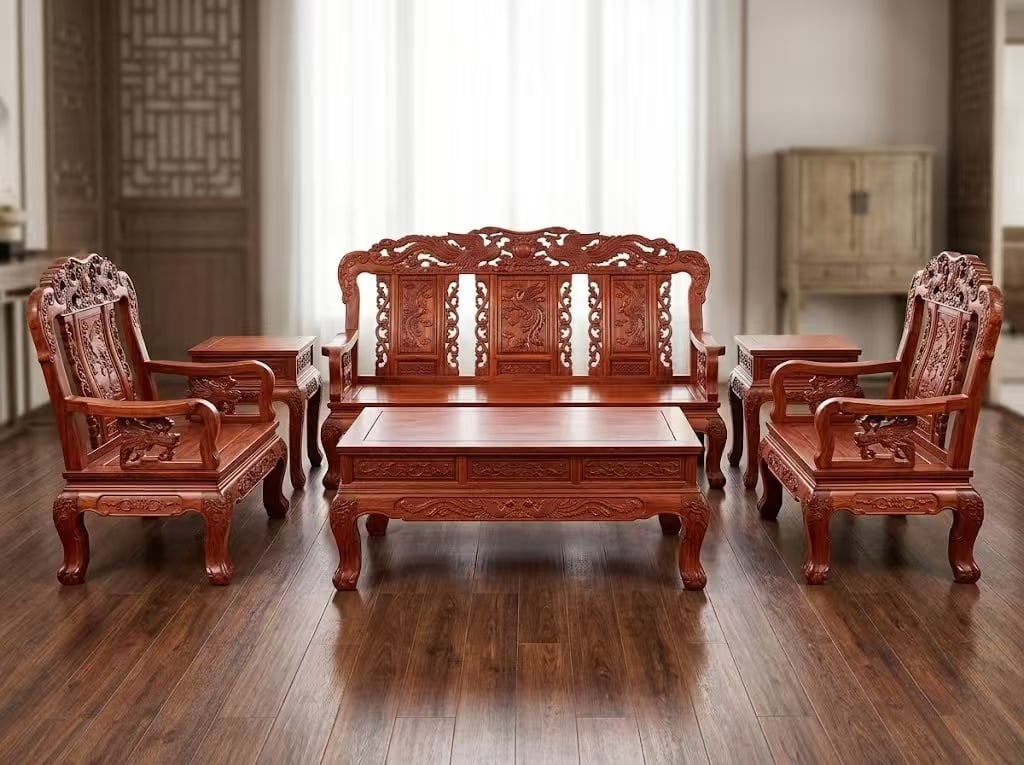
A practical guide for importers evaluating redwood sofa set suppliers. Covers the six things that determine whether a shipment clears customs, arrives intact, and meets your market's biosecurity and timber-traceability rules: export certifications (FSC, CITES, phytosanitary), ISPM-15 packaging standards, Incoterms selection, container loading math, destination-market customs requirements, and how an export-focused supplier differs from a domestic wholesaler. Includes real figures from Yunxiao Rosewood Furniture, a 12,000 sqm factory in Xianyou, Fujian.
BUYER GUIDE · TIMBER TRADE & LOGISTICS
# Redwood Sofa Sets Exporter: What Global Buyers Need to Know About Export Qualifications and Shipping
Buying redwood sofa sets from China is not the same as buying from a domestic wholesaler. The difference shows up at the border. A shipment can be held, fined, or returned for one missing document — a CITES permit without the right species name, a wooden crate without an ISPM-15 stamp, or a commercial invoice without the correct HS code.
This guide walks through the six things global importers must verify before placing an order with a redwood sofa sets exporter: export qualifications, packaging standards, Incoterms, container loading, destination customs rules, and how an export-oriented supplier is structured differently from a domestic factory.
Key takeaways:
• Verify four documents before ordering: FSC chain-of-custody, CITES Appendix II permit, wood drying certificate, and phytosanitary certificate (EU-bound).
• ISPM-15 heat-treated crates are mandatory for ocean freight — no exceptions for wooden packaging.
• FOB Xiamen is the default term; DDP shifts customs risk to the seller at a higher price.
• A 20-foot container fits approximately 4 sofa sets; order 3+ sets to justify FCL over LCL.
• Australia and the US have the strictest entry rules: AQIS biosecurity checks and Lacey Act declarations respectively.
## 1. Essential Export Qualifications for Redwood Furniture Exporters
Not all "redwood" is the same. The term covers many species, and the paperwork depends on exactly which tree the timber came from. For Siamese Rosewood (
Dalbergia cochinchinensis), which is commonly used in high-end redwood furniture, the requirements are strict.
**FSC Chain-of-Custody Certificate**
The Forest Stewardship Council chain-of-custody (CoC) certificate traces timber from the certified forest through every processing stage to the finished product. It proves the wood was legally harvested. For a redwood sofa sets exporter, this certificate must cover the specific production line that makes your furniture — not just the company name. Ask for the certificate number and verify it on the FSC database.
**CITES Appendix II Permit**
Dalbergia cochinchinensis is listed under CITES Appendix II. This means international trade is allowed but controlled. The exporter must obtain a CITES export permit from the Chinese authorities before shipping. The permit specifies the species, the quantity, and the shipment details. Without it, customs in both China and the destination country will reject the cargo. This is non-negotiable for Siamese Rosewood.
**Commercial Invoice with HS Code 9403.60**
The correct HS code for wooden furniture is 9403.60 (wooden furniture, other than office, kitchen, or bedroom). Using the wrong code triggers customs delays and potential fines. The commercial invoice must also state the wood species, the quantity, and the unit value accurately.
**Wood Drying Certificate**
Redwood must be dried to a specific moisture content before export — typically 8–12% for furniture. A drying certificate records the kiln schedule and final moisture readings. This is not just a quality issue; it is a phytosanitary issue. Undried wood can harbor pests and fungi.
**Phytosanitary Certificate (EU Member States)**
For shipments to the European Union, a phytosanitary certificate is required. This certifies that the wood has been inspected and is free from quarantine pests. The certificate is issued by the Chinese plant quarantine authority after inspection.
| Document | Required For | Issued By | Notes |
|---|
| FSC CoC | All markets (traceability) | FSC-accredited body | Verify number on FSC database |
| CITES Appendix II | All markets (Dalbergia spp.) | Chinese CITES authority | Species must match invoice |
| Commercial invoice | All markets | Exporter | HS code 9403.60 |
| Wood drying certificate | All markets | Factory / kiln operator | 8–12% moisture content |
| Phytosanitary certificate | EU, some other markets | Chinese plant quarantine | Confirm with buyer's customs broker |
## 2. Export Packaging Standards: What Survives Ocean Freight
A 6-piece redwood sofa set is heavy — roughly 180 kg combined gross weight across three crates. Ocean freight is punishing: humidity, salt air, stacking pressure, and forklift handling. Packaging is not an afterthought; it is a customs requirement and a damage-prevention system.
**ISPM-15 Heat-Treated Wooden Crates**
Any wooden packaging material (WPM) used in international trade must comply with ISPM-15. This means the wood is heat-treated to a core temperature of 56°C for 30 minutes, then stamped with the IPPC mark. The mark includes the country code, the treatment facility code, and the treatment applied (HT). Unmarked wooden crates are rejected at destination and may be destroyed at the importer's cost.
**Acid-Free Tissue Paper Wrapping**
Redwood has natural oils that can react with acidic materials. Acid-free tissue paper is used as the first layer of protection directly on the furniture surface. It prevents staining and moisture transfer.
**Corrugated Cardboard + EPS Foam Corner Blocks**
The tissue-wrapped furniture is then covered with corrugated cardboard for scratch protection. Expanded polystyrene (EPS) foam corner blocks absorb impact at the most vulnerable points — the corners and edges of sofas and armrests.
**1-Metre Drop Test on All Six Faces**
A proper export package is tested by dropping it from a height of 1 metre on each of its six faces. This simulates rough handling during loading and unloading. Ask your redwood sofa sets exporter whether their packaging passes this test. The test result should be documented.
**Moisture Barriers for Ocean Freight**
A polyethylene moisture barrier is placed inside the crate before sealing. This prevents condensation from damaging the furniture during the voyage, especially on routes crossing the equator where temperature and humidity swings are severe.
## 3. Trade Terms: FOB, CIF, and DDP Compared
The Incoterm you choose determines who bears the cost and risk at each stage of the shipment. There is no "best" term — only the right one for your situation.
| Term | Seller Obligations | Buyer Obligations | Best For |
|---|
| FOB Xiamen | Deliver goods on board vessel at port of loading | Main carriage, insurance, destination clearance | Buyers with own freight forwarder |
| CIF | FOB + insurance + freight to destination port | Destination clearance, inland delivery | Buyers wanting a single delivered price |
| DDP | Everything, including customs clearance and delivery to buyer's warehouse | Only unloading at final destination | Buyers new to importing, or small orders |
**FOB Xiamen (Default)** — The exporter delivers the goods on board the vessel at Xiamen port. The buyer arranges the main carriage, insurance, and destination customs clearance. This is the most common term for experienced importers who have their own freight forwarder.
**CIF (Cost, Insurance, Freight)** — The exporter pays for insurance and freight to the destination port. The buyer handles destination clearance and inland delivery. CIF gives a single delivered-to-port price, which simplifies budgeting.
**DDP (Delivered Duty Paid)** — The exporter handles everything: export clearance, main carriage, insurance, destination customs clearance, duty payment, and delivery to the buyer's warehouse. This is the highest-cost option but carries the least buyer risk. It is ideal for first-time importers or for markets where the buyer has no local customs broker.
## 4. Ocean Freight and Container Loading Math
Container loading determines your freight cost per set. Here is the practical math:
- **20-foot container**: fits approximately 4 sofa sets.
- **LCL (Less than Container Load)**: suitable for single-set orders. You pay for the space your crates occupy, plus consolidation and deconsolidation fees.
- **FCL (Full Container Load)**: recommended for 3+ sets. The cost per set drops significantly because you pay for the whole container, not per cubic metre.
A typical 6-piece redwood sofa set is packed in three crates. The combined gross weight is approximately 180 kg. For a 4-set container, that is roughly 720 kg of furniture — well within the 20-foot container's payload capacity, which means volume, not weight, is the limiting factor.
**Loading tip**: Ask the exporter for the exact crate dimensions and the container loading plan before booking freight. This avoids surprises at the port and lets you compare LCL vs FCL costs accurately.
## 5. Target Market Customs Requirements
Different markets have different rules. Here is what to prepare for in three major regions.
**Australia — AQIS Biosecurity Requirements**
The Australian Quarantine and Inspection Service (AQIS) enforces strict biosecurity rules. ISPM-15 compliance for wooden packaging is mandatory. The IPPC stamp must be clearly visible on every crate. Additionally, Australia requires a phytosanitary certificate for the timber itself, and the species must be declared. Failure to comply results in treatment, re-export, or destruction at the importer's cost.
**North America — Lacey Act and CARB**
The US Lacey Act requires importers to declare the scientific name of the timber species on the customs entry. For
Dalbergia cochinchinensis, this means the CITES permit and the Lacey Act declaration must match exactly. Additionally, if the furniture has any finished surfaces, the finishes must comply with CARB (California Air Resources Board) standards for formaldehyde emissions. Verify that your redwood sofa sets exporter uses CARB-compliant finishes.
**Southeast Asia — ASEAN Origin Certificate**
For shipments to ASEAN member states, an ASEAN origin certificate can qualify the goods for preferential tariff rates under the ASEAN-China Free Trade Area. This certificate must be issued by the Chinese Chamber of Commerce and submitted with the shipping documents. The savings can be significant, so it is worth asking your exporter whether they can arrange it.
## 6. Exporter vs. Domestic Wholesaler: The Structural Difference
The most common mistake buyers make is treating a domestic wholesaler as an export supplier. The two are not interchangeable. Here is what an export-ready redwood sofa sets exporter provides:
**Export Documentation Team**
A dedicated team prepares the full document set: CITES permits, FSC certificate, commercial invoice with HS code 9403.60, drying certificate, phytosanitary certificate, and the bill of lading. These documents must be consistent with each other — a single mismatch in species name or quantity causes customs delays.
**Export-Specific Packaging Engineering**
Domestic packaging is designed for short truck trips, not ocean voyages. Export packaging is engineered for humidity, stacking, and rough handling — ISPM-15 crates, moisture barriers, drop-test certification. The exporter has a packaging engineer who designs the crate layout for each order.
**Customs Clearance Support**
An exporter has established relationships with Chinese customs brokers and knows the current inspection requirements for CITES-listed timber. They handle the export clearance and provide the buyer's customs broker with the documents they need on the destination side.
**Remote Installation Guidance**
Redwood sofa sets, especially large configurations like 10-seat hotel lobby sets, may require assembly. An export-focused supplier provides remote installation guidance — diagrams, video calls, and written instructions — because they know the buyer cannot simply call a local technician.
**After-Sales Warranty**
Export suppliers back their products with a written warranty covering structural defects and finish issues. The warranty terms are defined in the contract, and the supplier honors them through a claims process that works across borders.
## Case Reference: Yunxiao Rosewood Furniture
Yunxiao Rosewood Furniture is a redwood sofa sets exporter operating from a 12,000 sqm factory in Xianyou, Fujian — the heart of China's redwood furniture manufacturing cluster. Founded in 2008, the factory uses traditional mortise-and-tenon joinery with bamboo dowels, meaning no metal fasteners are used in the frames. The wood undergoes a 36-day drying process, followed by an 8-coat raw lacquer finish.
Their product line includes 6 sofa set configurations, from 3-piece compact residential sets to 10-seat hotel lobby reception sets. All sets ship with FSC and CITES documentation, ISPM-15 crates, and are classified under HS code 9403.60. They support OEM/ODM projects with a 15-day design approval cycle.
## FAQ
**Q: Can I order a single sofa set for testing?**
A: Yes. Single-set orders ship via LCL consolidation. The freight cost per set is higher than FCL, but it is the standard way to evaluate quality before committing to a container.
**Q: How long does the CITES permit take to obtain?**
A: The timeline varies by the Chinese CITES authority's current workload. A competent exporter starts the application as soon as the order is confirmed. Ask your supplier for their current lead time.
**Q: What happens if my shipment is held at customs?**
A: The first step is to identify which document is missing or mismatched. An export-ready supplier will provide replacement documents quickly and coordinate with your customs broker. This is why the document consistency check matters — it prevents the problem before it starts.
**Q: Do I need to visit the factory before ordering?**
A: Not mandatory, but recommended for large orders. If you cannot visit, ask for a video walkthrough of the production line and the packaging process, and request references from buyers in your region.
## Next Steps for Buyers
Before placing an order, request the following from any redwood sofa sets exporter:
1. FSC chain-of-custody certificate (verify the number)
2. Sample CITES permit for a recent shipment
3. Packaging specification sheet with ISPM-15 stamp details
4. Wood drying certificate with moisture content readings
5. Container loading plan for your order size
6. Incoterm quote for FOB Xiamen, CIF, and DDP
These six documents tell you more about a supplier than any brochure. If the exporter provides them without hesitation, you have a professional partner. If they hesitate, keep looking.
For inquiries about redwood sofa set configurations, export documentation, or container loading plans, contact the export team directly with your target market and order quantity.