
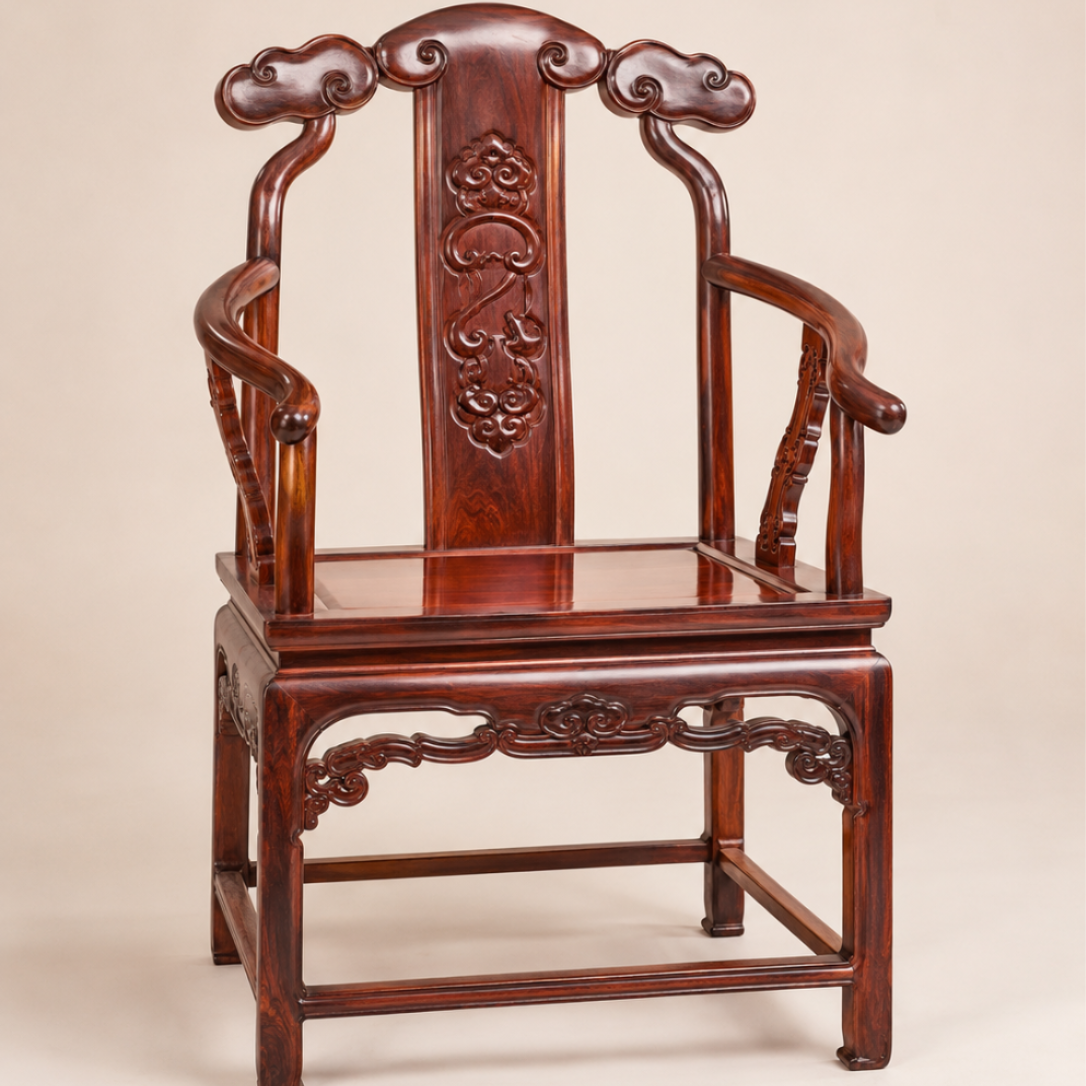
A practical procurement guide for importers and wholesalers sourcing rosewood dining chairs from China. Covers material identification, carved rosewood chair styles, standard sizing, quality inspection checkpoints, OEM customization workflows, and key questions to ask suppliers before placing an order.
BUYER GUIDE · B2B PROCUREMENT
If you are sourcing rosewood dining chairs from China, you are not buying a commodity. You are buying a product category where material origin, carving depth, joinery method, and finish quality determine whether your container arrives with a sellable premium line or a costly returns problem.
This guide is written for importers, wholesalers, interior design firms, and hospitality buyers who need practical criteria—not adjectives—to evaluate suppliers, specify the right carved rosewood chair style, and manage an OEM customization project without surprises.
- Rosewood is a broad trade term—verify the exact species and legal documentation before you negotiate price.
- Carving density and joinery type are the two biggest cost drivers in Chinese rosewood chairs; specify them in writing, not in words.
- Standard dining chair seat height is 45–48 cm; confirm your target market's ergonomic norms before finalizing the spec.
- OEM customization requires a clear technical pack: drawings, finish samples, and a signed quality standard.
- Ask for moisture content readings and kiln-drying records—this is the #1 hidden quality variable in solid wood furniture.
1. What "Rosewood" Actually Means in a B2B Context
The term rosewood dining chairs covers multiple species with very different price points, grain patterns, and legal status. In the Chinese furniture export trade, you will commonly encounter three groups:
| Trade Name | Typical Species | Characteristics | Relative Cost |
|---|---|---|---|
| Hongmu / Dalbergia | Dalbergia spp. (e.g., D. odorifera) | Dense, dark reddish-brown, pronounced grain; CITES-regulated | High |
| Rosewood / Padauk | Pterocarpus spp. | Lighter red-orange tone, coarser grain, lower density | Medium |
| Rubberwood / "Rosewood finish" | Hevea brasiliensis | Pale wood stained to mimic rosewood; not a true rosewood | Low |
Why this matters for you: If your supplier quotes a price that looks too good for solid rosewood, you are likely being quoted rubberwood or a mixed-wood product with a rosewood finish. There is nothing wrong with that product—but you must know what you are selling to your customers. Mislabeling wood species is a compliance risk in the EU (timber regulation) and the US (Lacey Act).
Action item: Request the botanical name (genus and species) on your proforma invoice and packing list. If the supplier hesitates, treat that as a red flag.
2. The Main Styles of Chinese Rosewood Chairs
When buyers search for Chinese rosewood chairs, they usually mean one of two design lineages: Ming-style (minimal, clean lines) or Qing-style (ornate, heavy carving). Within those, the carved rosewood chair category splits into several recognizable forms.
2.1 Ming-Style (明式)
Characterized by simple geometric lines, minimal ornament, and exposed joinery. The wood grain is the decoration. These chairs appeal to buyers targeting modern or Scandinavian-blend interiors. Carving, if present, is limited to small motifs like a stylized cloud or a dragon medallion on the back splat.
2.2 Qing-Style (清式)
Heavier, more imposing, and heavily carved. Qing-style rosewood chairs often feature full-panel back splats with deep relief carving—dragons, phoenixes, floral scrolls, or landscape scenes. These are statement pieces for traditional restaurants, luxury hotel lobbies, and high-end residential projects.
2.3 The Official's Chair (太师椅)
A Qing-style classic with a high back, protruding top rail, and often a footrest. The carving is typically concentrated on the top rail and the center splat. This is one of the most requested forms for hospitality projects that want a distinctly Chinese visual identity.
2.4 The Horseshoe Chair (圈椅)
Ming-style icon with a continuous curved armrest that flows into the front legs. The round-back form is ergonomic and visually light. Carving is usually minimal. Very popular for mixed-use spaces where you need a Chinese accent without overwhelming the room.
2.5 The Folding Stool (交杌)
A smaller, portable form. Less common in dining sets but occasionally requested for accent seating or ceremony spaces.
Buyer tip: Do not assume your supplier's catalog covers all styles. Ask specifically which forms they have produced in the last 12 months. A factory that mainly makes Qing-style carved rosewood chair lines may quote you a poor Ming-style replica, and vice versa.
3. Standard Sizing: What to Specify
Dining chair dimensions are not standardized across Chinese factories. You must specify them in your RFQ. The following ranges are typical for adult-use rosewood dining chairs in the export market:
| Dimension | Typical Range (cm) | Notes |
|---|---|---|
| Seat height | 45–48 | Must match your table height. Standard dining table is 74–76 cm. |
| Seat width | 45–52 | Wider for armchairs; narrower for side chairs. |
| Seat depth | 42–48 | Shallower for upright dining posture. |
| Overall height | 90–105 | Qing-style official's chairs can exceed 110 cm. |
| Overall width | 50–60 | Armchairs are wider; check doorway clearance. |
Ergonomics check: If your target market is Northern Europe or North America, consider a seat height at the higher end (47–48 cm) and a deeper seat (46–48 cm). If you are sourcing for East Asian markets, the lower end is more common. Confirm this with your end customer before tooling up an OEM run.
4. Carving Quality: What to Inspect
Carving is where the perceived value of a carved rosewood chair is made or broken. As a buyer, you cannot rely on photos alone. You need a written quality standard and a pre-shipment inspection checklist.
4.1 Depth and Relief
Ask for the carving depth in millimeters. Deep relief (8–15 mm) is more labor-intensive and more expensive. Shallow surface carving (2–4 mm) is faster and cheaper. Specify which you want per panel.
4.2 Symmetry
On a pair of chairs, the left and right sides should be mirror images. On a set of six or eight, all back splats should match. Inspect for asymmetry in the eyes of carved dragons or the curl of floral scrolls—this is the most common defect in mid-tier production.
4.3 Sanding Quality
Carved recesses must be sanded smooth, not just the flat surfaces. Run your hand (or a cotton glove) over the carved areas. Rough spots indicate rushed production and will be a customer complaint point later.
4.4 Finish Coverage
Verify that the lacquer or oil finish penetrates the carved recesses. Uneven finish in deep carving is common and visible under showroom lighting.
- Wood species matches the botanical name on the packing list.
- Moisture content between 8–12% (use a pin-type moisture meter).
- All mortise-and-tenon joints are tight; no gaps at joint lines.
- Chair sits level on a flat surface (no wobble).
- Carving is symmetrical on paired chairs.
- Finish is even, no drips, no bare spots in recesses.
- No cracks, checks, or sapwood on visible surfaces.
5. Joinery: Mortise-and-Tenon vs. Screws
Traditional Chinese rosewood chairs use mortise-and-tenon joinery—no nails, no screws. This is a structural and aesthetic standard. However, not all factories use it consistently, especially on lower-priced lines.
How to check: Ask your supplier directly: "Are the side rails joined to the legs with a through-tenon or a stub tenon? Are there any metal fasteners in the frame?" A reputable factory will answer without hesitation. If the answer is vague, request a cutaway sample or a production video.
Why it matters: Mortise-and-tenon joints handle the racking stress of daily dining use far better than screws. A chair that fails at the joint is a safety liability, not just a quality issue.
6. OEM Customization: How to Brief a Factory
OEM customization on rosewood dining chairs typically covers four areas: dimensions, carving pattern, finish color, and branding. Each requires different documentation.
6.1 Dimensions
Provide a technical drawing with all critical dimensions in millimeters. If you don't have a drawing, ask the factory for their standard spec sheet and mark your changes. Do not rely on verbal instructions.
6.2 Carving Pattern
Send clear reference images from multiple angles. If you want a modified version of an existing factory pattern, ask for a CAD or a hand-sketch approval before production. Carving is the most expensive part to rework.
6.3 Finish Color
Wood finish colors are notoriously difficult to match across batches. Ask for a physical finish sample (a small wooden block, not a photo) on the actual wood species you will use. Approve that sample in writing, and request that the factory retains a duplicate for production matching.
6.4 Branding
Options include a brass nameplate, a laser-engraved logo on the underside of the seat frame, or a branded cloth tag sewn to the seat cushion. Laser engraving is the most durable and cost-effective for solid wood. Confirm the logo file format (AI or vector PDF) with the factory.
6.5 MOQ and Lead Time
OEM runs on carved chairs typically require a higher minimum order quantity than stock items because the carving pattern must be set up. Confirm the MOQ per design and the lead time for the first batch. Ask for the lead time broken down: carving setup, frame production, finishing, and packing.
7. Cost Drivers: Where Your Money Goes
Understanding what drives the price of rosewood chairs helps you negotiate fairly and avoid being quoted a "bargain" that is actually a different product.
| Cost Driver | Impact Level | Buyer Action |
|---|---|---|
| Wood species (true rosewood vs. stained hardwood) | High | Specify botanical name in the contract. |
| Carving density and depth | High | Specify depth in mm and approve a sample. |
| Joinery method (mortise-tenon vs. screws) | Medium | Require mortise-tenon in writing. |
| Finish type (lacquer vs. oil vs. PU) | Medium | Choose based on your market's humidity and use case. |
| Packaging (foam + carton vs. wooden crate) | Medium | Confirm packaging for ocean freight; carved chairs need extra corner protection. |
| MOQ and order size | Medium | Consolidate designs to reach a better price tier. |
8. Compliance and Documentation
Solid wood furniture exports from China require attention to phytosanitary and timber legality documentation. For rosewood dining chairs specifically, the CITES status of the wood species is the critical compliance point.
- CITES: If the wood is a listed Dalbergia species, you need CITES permits for export and import. Confirm with your supplier that they can provide these.
- Phytosanitary Certificate: Required for solid wood products in many markets. Confirm whether your supplier includes this in the price.
- Fumigation: Wooden crates and pallets must be ISPM-15 compliant. Confirm the packaging standard before shipment.
- Declaration of wood species: Required for EU (EUTR) and US (Lacey Act) importers. Request this document at the quotation stage, not after the order is placed.
Practical advice: Ask your supplier for a copy of a recent export packing list and the associated customs declaration. This shows you how they classify the product and whether they routinely handle CITES-listed species. If they cannot produce a recent example, escalate the question to your compliance team.
9. FAQ: Common Buyer Questions
Q1: Can I order a single sample chair before committing to a container?
Most factories accept sample orders, but expect to pay the full cost of the chair plus freight. The sample cost is usually deducted from the first bulk order. Confirm the sample policy in writing, including whether the sample is refundable against the bulk order.
Q2: What is the typical MOQ for OEM carved rosewood chairs?
MOQ varies by factory and design complexity. For a new carving pattern, expect a minimum of 50–100 pieces per design. For existing factory patterns, MOQ may be lower. Always confirm in writing.
Q3: How do I verify the wood is actually rosewood and not stained rubberwood?
Request a small uncut sample block from the same batch. Check the end grain and weight. True rosewood is dense and heavy; rubberwood is lighter and has a different pore structure. If in doubt, pay for a third-party wood identification test (e.g., by a lab using anatomical analysis). This is a small cost relative to the value of a container.
Q4: What is the typical production lead time?
For stock designs, 25–40 days is common. For OEM with new carving, add 15–30 days for pattern setup and sample approval. Confirm the lead time in the contract and include a penalty clause for late delivery if that is your practice.
Q5: Do you provide after-sales support for damaged items?
Clarify the defective rate tolerance (usually 2–3% for furniture) and the remedy—replacement, credit, or spare parts. Get this in writing before you pay the deposit.
10. Final Checklist Before You Place an Order
Use this list as your pre-order gate. If any item is missing, pause the negotiation until it is resolved.
- Botanical name of wood species confirmed in writing.
- CITES / phytosanitary / fumigation documentation responsibility assigned.
- Technical drawing or spec sheet signed by both parties.
- Finish sample approved on the actual wood species.
- Carving depth and pattern approved (physical sample or high-res photos from multiple angles).
- MOQ, unit price (FOB or CIF), and payment terms in a signed PI.
- Lead time and penalty clause in writing.
- Pre-shipment inspection (PSI) arranged with a third-party agency or your own QC.
- Packaging standard confirmed for ocean freight.
Next Step: Talk to a Supplier with Real Production Experience
Sourcing rosewood dining chairs is a relationship business. The right supplier is one who answers the questions above with specifics, not with assurances. Send your RFQ with a clear spec sheet, your target price range, and your quality expectations. The quality of the answers you receive will tell you more than any catalog photo.
If you are planning a project and need help defining your technical pack or evaluating a quotation, contact us with your drawings and target market details. We will respond with a practical assessment based on our production capabilities—not a generic sales pitch.