
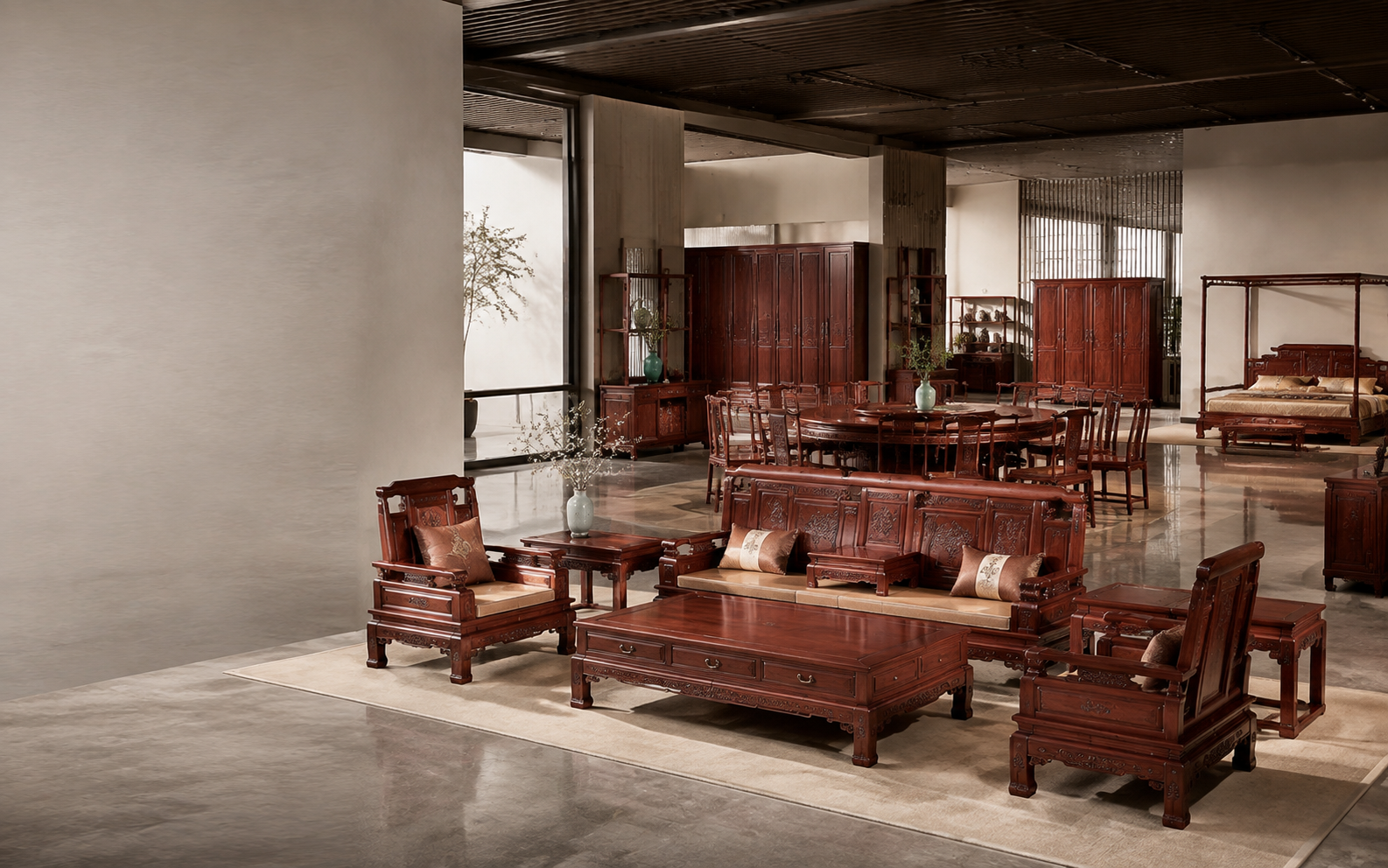
A practical procurement guide for hoteliers, interior designers, and villa developers sourcing classical solid rosewood furniture. Covers wood species selection, quality inspection criteria, custom manufacturing workflows, supplier evaluation checklists, shipping and compliance considerations, and common pitfalls — written for B2B buyers who need to order at project scale, not retail.
BUYER GUIDE · HOTEL & VILLA FF&E
Why Rosewood, and Why Procurement Is Different at Project Scale
Rosewood has been the default choice for high-end hospitality interiors for decades — not because of fashion, but because of physics. Dense grain, natural oil content, dimensional stability, and a deep, warm color that improves with age make it suitable for lobby reception desks, dining tables, bedroom suites, and villa living-room cabinetry. When you specify rosewood hotel furniture, you are not buying a product; you are buying a material that will be sanded, carved, finished, and installed as part of a larger interior scheme.
The procurement challenge is scale. A 120-key hotel might require 120 bedside cabinets, 60 dining tables, 40 lounge chairs, and a custom lobby desk — all in matching wood, consistent color, and identical joinery. A villa project might need only 10 suites, but each piece is larger, more detailed, and often fully custom. The supplier who can deliver one beautiful sample is common. The supplier who can deliver 500 matching pieces on a schedule is rare. This guide focuses on the latter.
- Specify the wood species and origin in your RFQ — "rosewood" alone is not a spec.
- Inspect moisture content, joinery, and finish thickness before production, not after.
- Custom rosewood furniture requires a technical drawing approval step — budget time for it.
- Ask for a pre-production sample and a sealed master sample before mass production.
- Confirm export documentation and CITES status with your supplier early.
Step 1: Define the Wood Species Precisely
"Rosewood" is a trade term covering multiple species with different density, color, and price. In the Chinese furniture manufacturing context, the most common options for hotel and villa projects are:
| Common Name | Typical Density | Color / Grain | Typical Use |
|---|---|---|---|
| Burmese rosewood (Pterocarpus macrocarpus) | 0.80–0.86 g/cm³ | Medium reddish-brown, darker streaks | Dining tables, bedroom suites, lobby pieces |
| Siamese rosewood (Dalbergia cochinchinensis) | 0.85–1.0 g/cm³ | Deep red to purple-brown, fine grain | High-end carved furniture, accent pieces |
| East Indian rosewood (Dalbergia latifolia) | 0.75–0.85 g/cm³ | Golden brown to dark purple, pronounced figure | Classical European-style furniture |
| Huanghuali / other Dalbergia species | Varies | Yellow-brown to deep red | Collector-grade, museum-quality pieces |
Each species has different workability, finishing behavior, and cost. For rosewood villa furniture, where pieces are often larger and more visible, the grain match across a suite matters as much as the species itself. Ask your supplier which species they stock consistently — a factory that regularly works with one species will give you better color matching than one that switches based on order size.
Step 2: Quality Inspection Criteria — What to Check Before You Order
Solid rosewood furniture fails in predictable ways. Here is what to inspect, in order of importance:
2.1 Moisture Content
Rosewood should be kiln-dried to 8–12% moisture content for most climates. If the wood is shipped green or under-dried, it will crack, warp, or split after installation — especially in air-conditioned hotel environments. Ask for the moisture meter reading on your pre-production sample. A reputable hotel furniture supplier will have this on record.
2.2 Joinery
Classical solid rosewood furniture should use traditional mortise-and-tenon joinery, not nails or staples. Check the corners of drawers, table aprons, and chair frames. The joint should be tight, with no visible gaps. For pieces that will be disassembled and reassembled on site (common for hotel FF&E), confirm that the joinery is designed for repeated assembly.
2.3 Finish Thickness and Type
The finish protects the wood from moisture, heat, and alcohol — all of which appear in hotel rooms. A typical specification is 3–5 coats of polyurethane or lacquer, with a final hand-rubbed wax or oil layer. Ask for the finish specification in writing. If the supplier cannot tell you the number of coats, treat it as a red flag.
2.4 Color Matching
Rosewood naturally varies in color between boards. For hotel projects, the supplier should either select boards for color consistency or apply a toner to unify the shade. Confirm the acceptable color variation range before production. A good rule: the color difference between two pieces in the same room should not be visible under normal lighting.
2.5 Hardware and Moving Parts
Drawer slides, hinges, and door closures should be specified by the buyer or approved by the buyer before production. For hospitality use, soft-close mechanisms and heavy-duty slides are strongly recommended — guest abuse is real, and replacement costs are high.
Step 3: The Custom Manufacturing Workflow
Most custom rosewood furniture for hotels and villas follows the same production sequence. Understanding it helps you plan your timeline and avoid surprises:
- Technical drawing approval — The factory produces detailed shop drawings from your design or reference images. You approve dimensions, joinery details, and hardware positions. This step takes 5–15 days depending on complexity.
- Pre-production sample — One piece is built to the approved drawing. This is your quality benchmark. You check wood color, finish, joinery, and dimensions against the drawing.
- Master sample sealing — The approved sample is sealed and kept by both parties. Mass production must match this sample, not the drawing.
- Mass production — Typically 30–60 days for a mid-sized order (50–200 pieces), depending on the factory's current load and the complexity of the carving.
- Inspection and packing — You or a third-party inspector checks the finished goods. Export packing for rosewood furniture usually involves foam protection, corner guards, and seaworthy cartons or wooden crates.
- Shipping — FOB, CIF, or DDP terms agreed in advance. Sea freight is standard for large orders; air freight is only viable for samples or small villa packages.
Step 4: Supplier Evaluation Checklist
Not every factory that claims to make rosewood furniture for hotels can actually deliver at project scale. Use this checklist when evaluating suppliers:
- Production capacity — How many pieces per month? What is their current order load? A factory at 90% capacity will delay your project.
- Species inventory — Do they stock the rosewood species you want, or do they buy per order? Stocked species mean better color consistency and shorter lead times.
- In-house drying capability — Do they have their own kiln drying, or do they buy pre-dried lumber? In-house drying gives them more control over moisture content.
- Carving and finishing skills — Ask for photos of completed hotel or villa projects. Look at the detail on carved edges, curved aprons, and inlay work.
- Export experience — Have they shipped to your country before? Do they know the packing requirements, fumigation rules, and documentation needed?
- Communication — Do they respond to technical questions with specifics, or with vague assurances? This predicts the entire project experience.
Step 5: Compliance, Documentation, and Shipping Risks
Rosewood species are regulated under CITES (Convention on International Trade in Endangered Species). Some Dalbergia species are listed, and export/import permits may be required. This is not something to discover at the port. Your supplier should provide:
- Species declaration — The botanical name, not just "rosewood."
- CITES permit — If applicable to the species and countries involved.
- Phytosanitary certificate — Required for most wood products entering the EU, US, and Australia.
- Commercial invoice and packing list — With accurate weights, dimensions, and HS codes.
Shipping rosewood villa furniture also requires attention to packing. Solid wood is heavy — a large dining table top can weigh 80–120 kg. The crate must be engineered for the weight, with proper blocking to prevent movement during transit. Ask your supplier for their standard export packing specification and photos of previous shipments.
Step 6: Common Pitfalls and How to Avoid Them
Pitfall 1: Specifying "Rosewood" Without a Species
You receive a quote for a different species than you expected, or the factory substitutes a cheaper wood. Solution: put the botanical name in your RFQ and on the purchase order.
Pitfall 2: Skipping the Pre-Production Sample
The finished pieces arrive with a different finish color than your reference image. Solution: always approve a physical sample before mass production.
Pitfall 3: Ignoring Moisture Content
Furniture cracks in the dry, air-conditioned environment of a hotel lobby. Solution: specify 8–12% moisture content and ask for the reading on the sample.
Pitfall 4: Underestimating Lead Time
Custom carving and finishing take time. A 200-piece order with heavy carving can take 60–90 days in production alone. Solution: add 2–3 weeks of buffer to the factory's quoted lead time when planning your project schedule.
Pitfall 5: Not Confirming Export Documentation
The shipment is held at customs due to missing CITES paperwork. Solution: confirm documentation requirements with the supplier before placing the order, and again before shipment.
Frequently Asked Questions
Q1: What is the minimum order quantity (MOQ) for custom rosewood furniture?
MOQ varies by factory. Some accept orders as small as 10–20 pieces for villa projects; others focus on hotel orders of 100+ pieces. Ask directly and be prepared to pay a premium for small batches, since rosewood is expensive and cutting waste is higher for small orders.
Q2: Can the factory work from my designer's drawings?
Yes, most experienced factories can work from architectural or interior design drawings. They will convert your drawings into shop drawings for approval. Complex designs may require a design consultation before quoting.
Q3: How do I ensure color consistency across a large order?
Ask the factory to select boards for color uniformity before cutting, and require a sealed master sample. For very large orders, you can also request a "color break" — a small set of approved color chips that the production team uses to match each batch.
Q4: What is the typical lead time for a hotel-scale order?
For a 100–200 piece order with moderate carving, expect 45–75 days from drawing approval to shipment. Add 2–4 weeks for sea freight to your destination. Custom designs with heavy carving or inlay work will take longer.
Q5: Can rosewood furniture be made with a mix of solid wood and veneer?
Yes, and this is common in hospitality. Solid rosewood is used for structural parts and visible edges; rosewood veneer over a stable substrate (like plywood or MDF) is used for large flat surfaces like table tops and cabinet doors. This reduces cost and weight while maintaining the appearance. Specify clearly in your RFQ which parts must be solid and which can be veneered.
Final Recommendations for Buyers
Procuring rosewood hotel furniture or rosewood villa furniture at scale is a structured process, not a single purchase. The buyers who get good results do three things consistently:
- They specify precisely. Species, moisture content, finish, joinery, hardware, and acceptable color variation are all written into the RFQ.
- They inspect early. The pre-production sample is treated as a contractual milestone, not a courtesy.
- They plan for the long tail. Lead time, shipping, customs, and installation are budgeted into the project timeline from day one.
If you are sourcing for a hotel or villa project and need a supplier who can handle custom rosewood furniture at scale, we recommend preparing a detailed RFQ with the criteria above and sending it to multiple factories for comparison. The factory that asks you the most specific questions during the quotation stage is usually the one that will deliver the most predictable result.
Need help preparing your RFQ or evaluating a supplier? Contact us with your project details — we can advise on specifications, timelines, and what to check before you commit.