
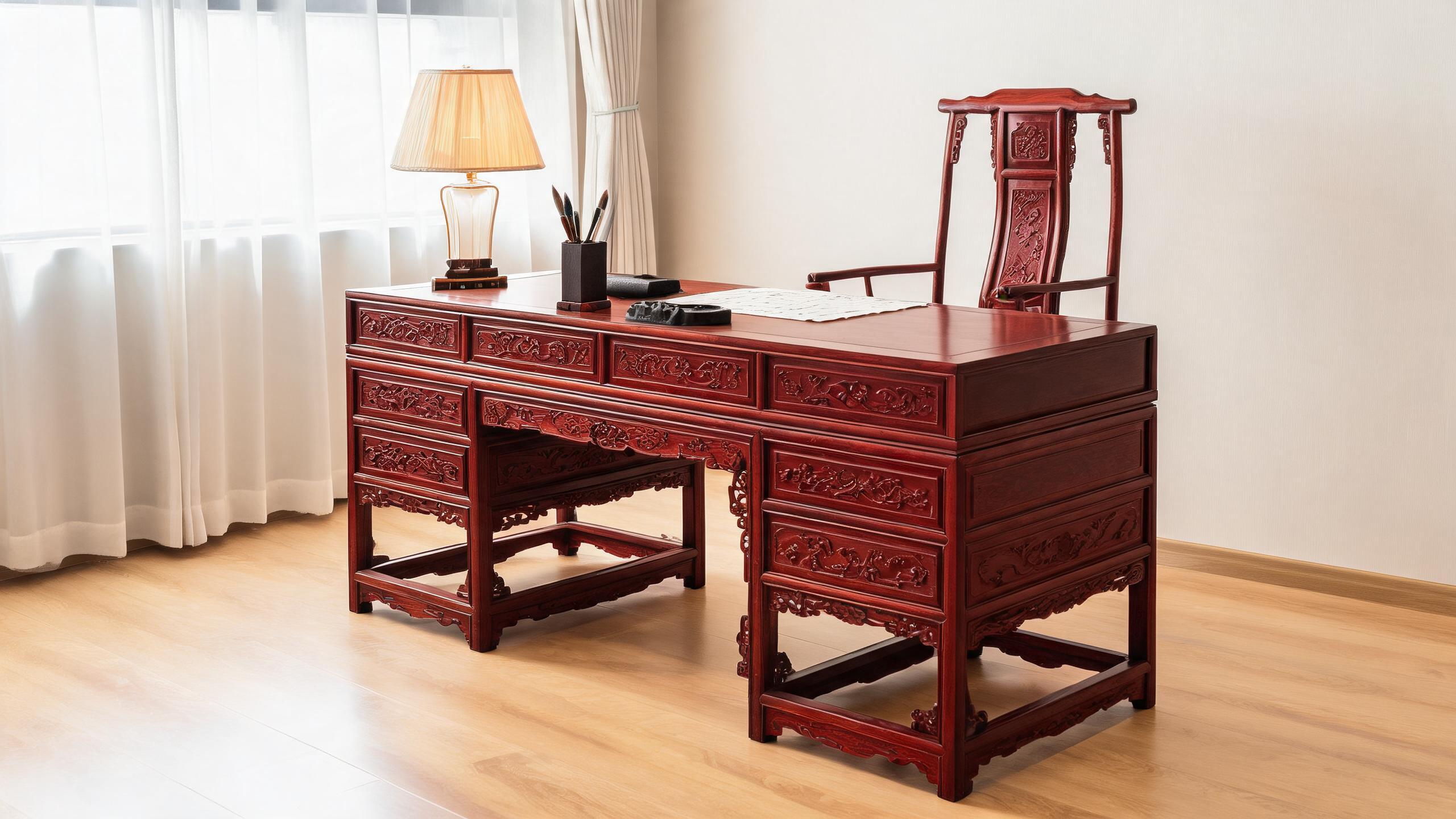
A practical procurement guide for hotels, executive offices, and home studies sourcing classical carved rosewood desks. Covers wood grading, joinery, finish types, size planning, and supplier evaluation criteria — written for buyers who need to specify, compare, and order with confidence.
BUYER GUIDE · CLASSICAL CARVED ROSEWOOD DESKS
# Rosewood Office & Study Desk: A B2B Buyer's Guide to Classical Carved Rosewood Desks If you are sourcing rosewood desks for a hotel executive suite, a law firm's partner office, or a high-end residential study, you are not buying furniture. You are buying a statement piece that has to survive shipping, installation, daily use, and the critical eye of an interior designer — all while meeting a delivery deadline. This guide covers what procurement teams actually need to specify: wood origin and grading, construction methods that affect longevity, finish options, size planning for real rooms, and how to evaluate a supplier before placing an order.
Key takeaways for buyers:
## Why Rosewood for Executive Desks and Study Tables
Rosewood (primarily Dalbergia species) has been the preferred timber for classical Chinese and colonial-style furniture for centuries. Its dense grain, natural oil content, and deep reddish-brown color with dark streaks make it visually distinct from walnut or oak.
For B2B buyers, three properties matter most:
- **Density and weight.** Rosewood is heavy. A full-size executive desk can weigh 80–150 kg depending on carving density. This is a positive for stability but a logistics factor you must plan for.
- **Natural oil content.** The wood resists moisture and insects better than many domestic hardwoods, which is why it suits humid climates in Southeast Asia and coastal regions.
- **Workability for carving.** Unlike brittle woods, rosewood holds fine detail without chipping, making it ideal for classical motifs — dragons, clouds, floral scrolls, and geometric lattice patterns.
That said, "rosewood" is a broad category. You need to specify which species you are buying.
## Rosewood Species: What to Specify
Not all rosewood is the same. For international trade, the most common types you will encounter are:
- Specify solid wood vs. veneer in writing — it changes price and durability more than any other factor.
- Carved rosewood desks need a minimum top thickness of 25–30 mm to avoid warping; verify before ordering.
- Ask for joinery photos (dovetail, mortise-and-tenon) — not just finished product shots — to assess construction quality.
- Confirm finish type (lacquer, PU, or wax) based on your climate and usage intensity; it affects maintenance schedules.
- Always request a pre-shipment inspection report or video for carved pieces; hidden cracks are the most common defect.
| Common Name | Botanical Name | Color / Grain | Typical Use | Price Indicator |
|---|---|---|---|---|
| Huanghuali (Scented Rosewood) | Dalbergia odorifera | Golden-brown, subtle grain | High-end classical furniture, collectible pieces | Highest |
| Burmese Rosewood | Dalbergia oliveri | Deep red to purple-brown, dark stripes | Executive desks, carved panels | High |
| Siamese Rosewood | Dalbergia cochinchinensis | Reddish-brown, darker heartwood | Premium furniture, cabinetry | High |
| East Indian Rosewood | Dalbergia latifolia | Purple-brown with black streaks | General fine furniture, veneers | Medium-High |
| Finish Type | Appearance | Durability | Maintenance | Best For |
|---|---|---|---|---|
| Traditional lacquer (raw lacquer) | Deep, glossy, translucent | High, but sensitive to alcohol and heat | Periodic re-polishing | Heritage hotels, classical interiors |
| Polyurethane (PU) matte/satin | Modern, low-sheen | Very high, resistant to scratches and liquids | Low | Executive offices, daily use |
| Wax finish | Natural, matte, wood feels warm | Low to medium; needs re-waxing every 6–12 months | High | Low-traffic studies, display pieces |
Red flags to avoid:
## FAQ: Common Questions from B2B Buyers
**Q: What is the minimum order quantity (MOQ) for carved rosewood desks?**
A: MOQ varies by supplier. Some accept single-piece orders for high-value items; others require 5–10 pieces for a production run. Confirm this early, as it affects your sample strategy.
**Q: Can I get a sample before placing a bulk order?**
A: For carved desks, a full-size sample is expensive to ship. Many suppliers offer a smaller carved sample panel or a scaled-down version. Alternatively, request a video walkaround of a finished piece with close-ups of carving and joinery.
**Q: How do I handle customs clearance for CITES-listed rosewood?**
A: Your supplier must provide the export CITES permit. Your freight forwarder will handle the import-side documentation. Confirm both parties are experienced with CITES shipments before you commit.
**Q: What is the typical lead time?**
A: For a standard carved rosewood desk, plan for 30–60 days after order confirmation. Custom designs with heavy carving can take 60–90 days. Always add 2–3 weeks buffer for shipping and customs.
**Q: How do I maintain a carved rosewood desk in a hotel or office environment?**
A: Use coasters for drinks, clean with a dry or slightly damp soft cloth, and avoid silicone-based polishes. For PU-finished desks, no regular polishing is needed. For lacquer or wax finishes, schedule a professional re-polish every 12–24 months depending on traffic.
## Next Steps: What to Prepare Before You Inquire
To get accurate quotes and avoid back-and-forth, prepare the following before contacting suppliers:
- Room dimensions and a floor plan sketch.
- Number of pieces and target delivery date.
- Preferred wood species (or ask for options with pricing).
- Solid wood vs. veneer preference.
- Finish type (lacquer, PU, or wax).
- Whether you need matching pieces (sideboard, bookshelf).
- Your shipping destination port and whether you need door-to-door delivery.
The more specific your inquiry, the faster you will get a usable quotation — and the fewer surprises you will have at the packing stage.
---
**Ready to source carved rosewood desks for your project?** Contact us with your specifications — room dimensions, quantity, and preferred finish — and we will respond with a detailed quotation, production timeline, and CITES documentation plan.- Supplier cannot name the exact Dalbergia species.
- No CITES documentation offered or "we will handle it later."
- Price significantly below market for solid rosewood — it is likely veneer, mixed wood, or stained hardwood.
- No production photos available; only generic catalog images.