
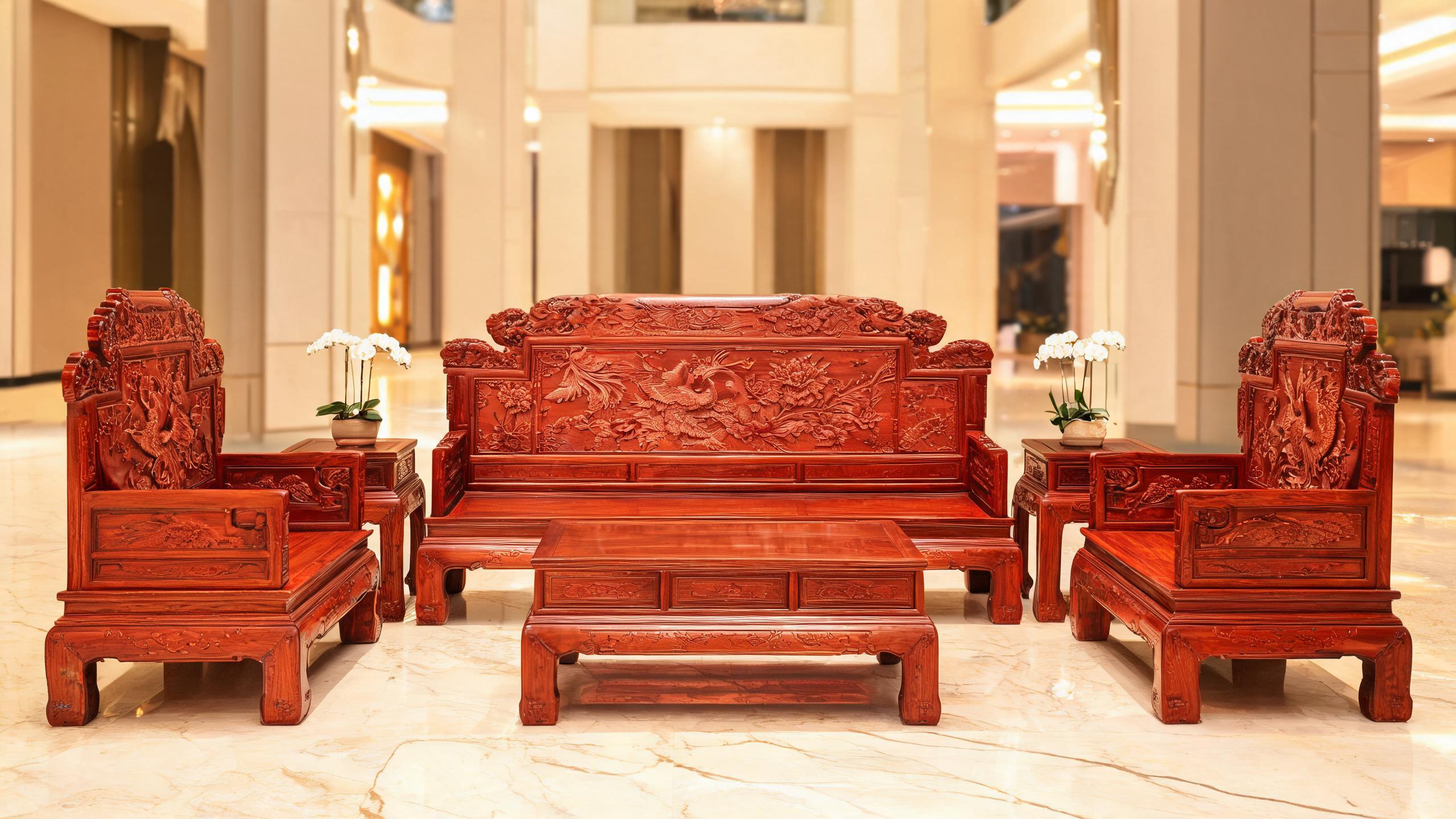
A practical guide for hospitality procurement professionals on sourcing carved rosewood reception sofa sets. Covers material selection, craftsmanship evaluation, quality control, logistics, and supplier assessment for hotel lobby and lounge furniture.
HOSPITALITY PROCUREMENT GUIDE
Rosewood Sofa Set for Hotels & Hospitality: How to Source Carved Reception Sofa Sets
Hotel lobbies are the first and last impression a guest has of your property. The reception area furniture — particularly the seating — carries more visual weight than almost any other furnishing in the building. A carved rosewood sofa set in a hotel lobby signals permanence, craftsmanship, and a design language that cannot be replicated with mass-produced upholstery.
But sourcing a rosewood sofa set for hotel use is not the same as buying residential furniture. You are specifying for high-traffic, 24/7 environments, with procurement cycles measured in months, and quality expectations that must survive guest use, housekeeping chemicals, and international shipping. This guide walks through the practical decisions: material verification, carving quality, structural integrity, compliance, and how to evaluate a hotel furniture export supplier before you commit.
- Verify rosewood species and legality documentation before discussing price — CITES compliance is non-negotiable for international shipping.
- Carving density and wood moisture content are the two most reliable indicators of a carved reception sofa set's longevity.
- Request a pre-production sample and third-party inspection; never rely on photos alone for hotel-grade furniture.
- Confirm the supplier's export experience with hospitality projects, not just residential furniture.
- Plan for lead times of 30–60 days minimum for carved solid wood pieces, plus sea freight.
Why Rosewood for Hotel Lobby Furniture?
Rosewood (genus Dalbergia) has been the material of choice for high-end hospitality furniture for decades. The reasons are practical, not just aesthetic:
- Density and hardness: Rosewood is one of the densest commercial hardwoods. It resists dents, scratches, and surface wear far better than oak, teak, or mahogany. In a lobby where luggage, shoes, and cleaning equipment constantly contact the furniture, this matters.
- Dimensional stability: Good-quality rosewood, when properly kiln-dried, moves less with humidity changes than many other hardwoods. This reduces the risk of joints loosening or panels cracking in climate-controlled hotel environments.
- Natural finish: The wood's deep brown-to-purple hues and natural oil content allow for a rich finish without heavy staining. This is a design advantage — the grain does the decorative work.
- Carving behavior: Rosewood's fine, uniform grain allows for intricate carving without the wood tearing or splintering. This is why carved reception sofa sets are almost always specified in rosewood rather than softer woods.
Species, Legality, and CITES: The First Filter
Before you fall in love with a design, you must confirm what species of rosewood the supplier is using. This is not a minor detail — it affects cost, legality, and your ability to import the goods.
Most commercial rosewood species are listed under CITES (Convention on International Trade in Endangered Species) Appendix II. This means international trade is permitted but regulated. You, as the importer, will need the supplier to provide the correct export permits. Without them, customs will seize the shipment.
| Species | Common Trade Name | CITES Status | Typical Use in Hospitality |
|---|---|---|---|
| Dalbergia latifolia | Indian Rosewood / East Indian Rosewood | Appendix II | High-end carved furniture, reception desks |
| Dalbergia sissoo | Sheesham / North Indian Rosewood | Not listed (but verify source) | Carved sofa frames, dining chairs, lobby seating |
| Dalbergia cochinchinensis | Siamese Rosewood / Thai Rosewood | Appendix I (restricted) | Rarely available for commercial export |
| Dalbergia oliveri | Burmese Rosewood | Appendix II | Premium joinery, carving |
For most hotel furniture export projects, Indian rosewood (Dalbergia latifolia) or sheesham (Dalbergia sissoo) are the realistic options. Sheesham is more affordable and widely available, while Indian rosewood offers deeper color and finer grain. Ask your supplier for the botanical name and the CITES permit copy before you request a quotation. If they cannot provide this, move on.
Carving Quality: What to Inspect on a Carved Reception Sofa Set
Not all carving is equal. The difference between a carved reception sofa set that looks premium for a decade and one that looks cheap within a year is visible in specific details. Here is what to check:
1. Depth and Under-cutting
Good carving has depth. Look at the relief — the background should be cut away significantly, not just surface-etched. Deep under-cutting (where the carved element is partially separated from the background) creates shadow lines that make the pattern read clearly from across the lobby. Shallow carving flattens out visually and collects dust in ways that are hard to clean.
2. Symmetry and Pattern Matching
On a sofa set, the left arm and right arm should be mirror images. The center panel of the backrest should be balanced. Check that the carving on the front rail and the back panel follow the same motif without awkward breaks. Sloppy pattern matching is the fastest way to spot a low-cost factory.
3. Sanding and Finish in Recesses
Run your finger inside the carved recesses. If the wood feels rough or you can see tool marks, the piece was not properly sanded before finishing. This is not just cosmetic — rough recesses will catch dust and are nearly impossible to clean in a hotel setting. A quality supplier sands carved areas by hand, in stages, before applying sealer.
4. Joint Construction
Carved solid wood furniture is heavy. The joints must be engineered for that weight. Look for:
- Mortise-and-tenon or doweled joints at all load-bearing connections (arm-to-back, seat rail-to-leg). Avoid pieces assembled with screws and glue alone.
- Corner blocks in the seat frame, screwed and glued, to prevent racking.
- Loose or wobbly arms when you apply lateral pressure — a common defect in cheap imports.
Moisture Content and Wood Stability
This is the single most important technical specification for a rosewood sofa set in a hotel. Wood moves with humidity. If the wood is not properly kiln-dried to the correct moisture content (MC) for your destination climate, the furniture will crack, warp, or split within the first year.
For most international destinations, the target is 8–12% moisture content. For very dry climates (e.g., Middle East, Arizona), aim for 6–9%. For tropical humid climates (Southeast Asia, Florida), 10–14% is acceptable.
Ask the supplier for their kiln-drying specifications and, if possible, request a moisture meter reading on the sample piece. A reputable hotel furniture export supplier will have this data and will not hesitate to share it.
"All solid rosewood components shall be kiln-dried to 8–10% moisture content, with a maximum variance of ±2% across the piece. Supplier to provide moisture meter readings on pre-production sample and on each production batch."
Upholstery and Cushioning for Hospitality Use
The carved frame is the star, but the upholstery is what guests touch. For hotel lobbies, specify commercial-grade materials, not residential:
- Foam density: Minimum 30 kg/m³ (high-resilience foam). For high-traffic lobbies, consider 35–40 kg/m³ or a foam-wrapped-polyester construction. Cheap foam will sag within months.
- Fabric: Choose a fabric with a high Martindale rub count (minimum 30,000 rubs for hospitality; 50,000+ for heavy public areas). If the design uses leather, specify top-grain or full-grain, not bonded leather.
- Removable covers: For hotel maintenance, request zippered, removable cushion covers. This allows cleaning and replacement without re-upholstering the entire piece.
- Fire retardancy: Confirm the foam and fabric meet the fire safety standards of your destination country (e.g., CAL 117, BS 5852, EN 1021). This is often a legal requirement for public spaces.
Evaluating a Hotel Furniture Export Supplier
You are not just buying a product; you are entering a supply chain relationship. Here is a practical checklist for assessing a supplier of rosewood sofa sets for hotel lobbies:
| Evaluation Area | What to Ask / Verify | Red Flags |
|---|---|---|
| Export experience | Ask for a list of hospitality projects shipped internationally. Request references or photos of completed hotel installations. | Only shows residential furniture; cannot name any hotel clients. |
| Documentation | CITES permits, fumigation certificate, packing list, commercial invoice, bill of lading. | Hesitates to provide CITES documentation upfront. |
| Production capacity | Ask for current monthly output in pieces and lead time for your order volume. | Vague on timelines; promises "fast delivery" without specifics. |
| Quality control | Do they have in-house QC? Do they offer third-party inspection (SGS, BV) before shipment? | No QC process; refuses third-party inspection. |
| Customization | Can they modify dimensions, carving patterns, or upholstery to your drawings? | Only sells catalog designs; no design/engineering support. |
| Sample policy | Do they offer a pre-production sample? What is the cost and lead time? | Refuses samples; expects you to order full container on photos alone. |
Cost Considerations and Realistic Budgeting
Pricing for a carved rosewood sofa set varies significantly based on species, carving complexity, size, and finish. While we do not publish list prices (they depend on your specifications and volume), here is what drives cost:
- Wood species: Indian rosewood costs more than sheesham. The difference can be 20–40% on material alone.
- Carving density: A heavily carved back panel with deep under-cutting takes an experienced carver several days. Labor is the largest cost component in carved furniture.
- Size and configuration: A 3-seater sofa with two armchairs will cost more per piece than a matching pair of occasional chairs due to material volume and structural requirements.
- Finish: Hand-rubbed lacquer or polyurethane finishes cost more than spray-applied sealer but offer better durability.
- Upholstery grade: Commercial-grade fabric and high-density foam add 10–15% to the piece cost versus residential-grade materials.
For budgeting purposes, expect a quality carved rosewood sofa set (3-seater + 2 armchairs) to be a significant line item in your FF&E budget. If a quote seems too good to be true relative to other suppliers, it usually is — often because of thinner wood, shallower carving, or lower-grade upholstery.
Logistics: Packing, Shipping, and Installation
Carved rosewood furniture is heavy and fragile. Proper packing is not optional. Specify the following in your purchase contract:
- Packing: Each piece wrapped in protective foam, then in a wooden crate or sturdy carton with internal bracing. For sea freight, use fumigated wooden crates (ISPM-15 compliant) to avoid customs delays.
- Container loading: Confirm the supplier knows how to load mixed furniture into a 40HQ container without damage. Ask for loading photos or a loading plan.
- Insurance: Always insure the shipment for the full CIF value. Wood furniture can be damaged by moisture or rough handling in transit.
- Assembly: Some pieces ship knocked-down (KD) to save freight costs. Confirm whether the supplier provides assembly instructions and whether your local contractor can handle assembly. For carved pieces, we generally recommend fully assembled (flat-pack is not suitable for carved solid wood).
Common Mistakes When Sourcing Rosewood Sofa Sets
Based on recurring issues in hospitality procurement, here are the most common errors to avoid:
- Skipping the pre-production sample. A photo is not a quality standard. Always approve a physical sample before mass production.
- Ignoring the destination climate. A piece dried for humid Vietnam will crack in dry Dubai. Specify MC for your climate.
- Assuming "rosewood" means one thing. Verify the botanical species and CITES status. The word "rosewood" alone has no legal or quality meaning.
- Under-specifying upholstery. Residential-grade fabric will not survive a hotel lobby. Write commercial-grade specifications into the contract.
- Not planning for lead time. Carved solid wood furniture takes time. Add 2–4 weeks of buffer to the supplier's quoted lead time for QC and shipping delays.
Frequently Asked Questions
Q: What is the difference between sheesham and Indian rosewood for hotel furniture?
Sheesham (Dalbergia sissoo) is more affordable, has a pronounced grain, and is slightly less dense. Indian rosewood (Dalbergia latifolia) has a deeper, more uniform color, finer grain, and higher density, making it the preferred choice for intricate carving. For a high-end lobby statement piece, Indian rosewood is the better investment. For larger quantities where budget matters, sheesham is a practical alternative.
Q: Can I order a custom carved design for my hotel?
Yes. Most reputable suppliers of carved reception sofa sets offer customization. You can provide your own drawings, or work with the supplier's design team to adapt an existing pattern. Custom carving will add to the lead time and cost, so plan accordingly. Confirm the supplier's policy on design ownership and whether they will sign an exclusivity agreement for your design.
Q: How do I verify the quality of carving before placing a large order?
Request a pre-production sample of one piece (or a section of a piece) before mass production. Inspect the sample personally or use a third-party inspection service. Check the points listed in the "Carving Quality" section above. If the sample meets your standards, it becomes your quality benchmark for the entire order.
Q: What documentation should the supplier provide for customs clearance?
At minimum: commercial invoice, packing list, bill of lading, CITES export permit (for listed rosewood species), fumigation certificate, and certificate of origin if required by your country's trade agreements. Ask for these documents to be prepared and sent ahead of the shipment to avoid customs delays.
Q: What is the typical lead time for a carved rosewood sofa set order?
For a standard design, allow 30–45 days for production. For custom designs with significant carving, 60–90 days is realistic. Add 20–40 days for sea freight depending on your destination port. Always confirm the supplier's current production schedule before committing to a timeline.
Next Steps for Your Project
Sourcing a rosewood sofa set for your hotel lobby is a significant procurement decision. The material is exceptional, the craftsmanship is visible, and the result — when done correctly — elevates the entire guest experience. The key is to apply the same rigor to this purchase as you would to any major FF&E investment: verify the material, inspect the craftsmanship, specify the technical details, and choose a supplier with proven export experience.
If you are evaluating suppliers for a carved reception sofa set or a full lobby furnishing package, we welcome the opportunity to discuss your project. We can provide specifications, samples, and a detailed quotation based on your design requirements and destination market. Contact our export team with your drawings or dimensions, and we will respond with a project-specific proposal.