
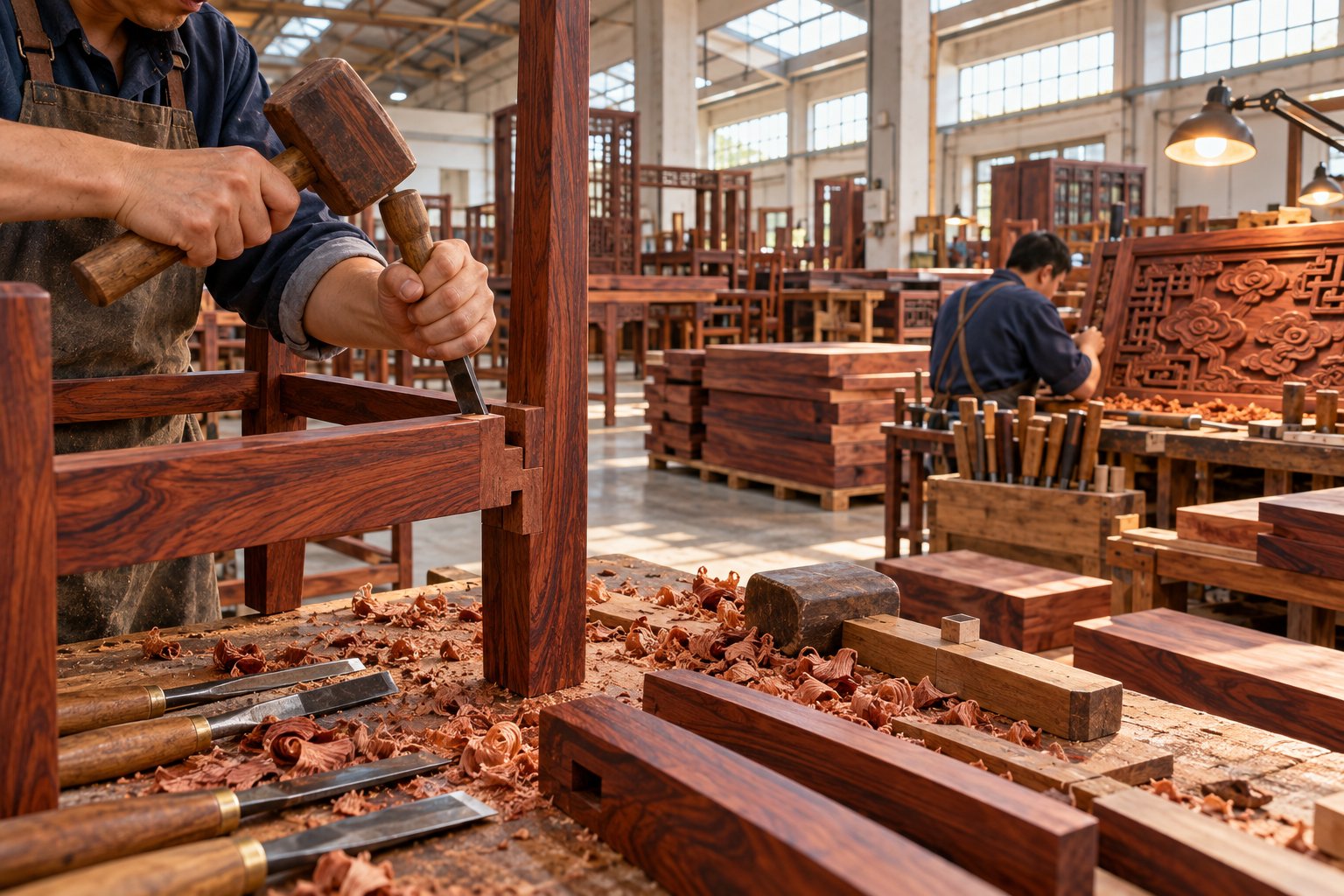
A buyer-side audit checklist for verifying a china furniture manufacturer before your first container order: licenses and export qualifications, FSC and CITES documentation, 36-day constant-humidity drying evidence, mortise-and-tenon and hand-carving line inspection, AQL pre-shipment inspection, ISPM-15 export packing, trial orders and destination-specific compliance notes.
Ordering a full container of solid rosewood furniture from a china furniture manufacturer for the first time is one of the biggest commitments an importer, wholesaler, hospitality purchasing manager or design-build firm can make. A single 40-foot container of carved classical furniture can represent tens of thousands of dollars, a six-figure retail value, and months of reputational risk if anything goes wrong. Unlike electronics or apparel, solid wood furniture is judged with the eyes and the hands: grain, joinery, finish, weight, smell, and the way a drawer closes. That is exactly why a structured furniture factory audit before your first container order is not a formality — it is the single most effective risk-control step in the entire sourcing journey.
This guide is written from the factory side. We have manufactured and exported classical solid rosewood furniture sets from Xianyou County, Fujian — the recognized hometown of traditional hardwood craft — since 2008, and over the years we have hosted hundreds of first-time buyers, third-party inspectors and sourcing agents on our 12,000㎡ workshop floor. We know what a serious buyer checks, what a careless buyer misses, and where honest misunderstandings happen on both sides. In the sections below you will find the same checklist we would hand to our own customer: how to verify business licenses and export qualifications, how to read FSC CITES documentation, what evidence to demand for timber drying and moisture content, how to inspect mortise-and-tenon joinery and hand-carving lines, how an AQL pre-shipment inspection should be structured, what ISPM-15 export packing must include, and how to design a trial order that protects your cash flow.
Why a Rosewood Furniture Factory Audit Matters Before Your First Container
Every experienced importer has a story that begins with "we skipped the audit." A buyer who had never visited the workshop approved a container based on one beautiful sample, and the production run arrived with mismatched grain panels and drawers that swelled shut in a humid coastal climate. Another buyer relied entirely on a trading company's photos and discovered that the "factory" was an assembly shed subcontracting carving to four different villages, with no consistent moisture control and no single party accountable for defects. These failures are expensive not because solid wood furniture is fragile by nature, but because the buyer never verified the process that produces it.
A rosewood furniture factory audit matters for three concrete reasons. First, classical furniture quality is determined long before assembly — by timber selection, drying and joinery tolerances that cannot be corrected after finishing. Second, hardwood furniture sits at the intersection of strict international rules: CITES permits for rosewood species, FSC chain-of-custody expectations in Europe and North America, EU REACH and US CARB standards for coatings, and ISPM-15 rules for wood packaging. A factory that cannot show its own compliance trail will eventually transfer that risk to you at the border. Third, your first container sets the template for every repeat order. If QC standards, packing methods and documentation formats are established correctly from container one, every subsequent order becomes cheaper and faster to manage.
A proper audit also recalibrates expectations on both sides. When buyers walk our drying yard in Xianyou and see boards staged for 36-day constant-humidity conditioning, they stop asking why lead time is 45–60 working days instead of 30. When we walk buyers through our carving stations and show how a single armrest can take roughly 40 carving hours, they understand why hand-carved court-style sets carry a different price than machine-relief imitations. The audit is where trust is built with evidence instead of adjectives.
Start with the Paper Trail: Business License, Export Qualification and China Furniture Supplier Verification
Before you book a flight, complete a desk-level china furniture supplier verification. The documents you request in the first email tell you as much about a supplier as the workshop itself will. Ask for, and check, the following:
1. Business license and registered scope
Request the current business license (营业执照) and check the registered business scope covers manufacturing and export of furniture — not just "trade." Verify the registered entity name matches the name on the quotation, proforma invoice and bank account. Mismatched names are one of the most common warning signs in Chinese sourcing: you may be buying from a middleman while believing you are dealing with the manufacturer. A licensed entity registered for at least several years of continuous operation — ours has manufactured in Xianyou since 2008 — is statistically safer than a company registered last quarter, though age alone never replaces a site visit.
2. Export qualification and customs registration
Confirm the supplier is a registered exporter with customs declaration capability, or clearly discloses which export agent it uses. Ask how previous rosewood shipments were declared, and request (under NDA if needed) a redacted copy of a recent bill of lading or customs declaration showing the real HS codes used for wooden furniture. A factory experienced in hardwood exports will know that rosewood species may require CITES export permits and will describe that process fluently rather than vaguely.
3. Factory ownership versus trading structure
Ask directly: do you own the workshops, drying kilns and finishing lines, and which processes are subcontracted? Honest answers build trust. Many credible factories legitimately outsource rough carving peaks or metal hardware, but a supplier who cannot tell you where each production stage physically happens cannot guarantee process control — and process control is what you are actually auditing.
4. Third-party verification records
Check whether the company has been audited by any third party: SGS, Bureau Veritas, Intertek, TÜV, or platform verification services. Ask for the report date and scope, not just a certificate badge. Also search the company in China's National Enterprise Credit Information system for legal cases or abnormal-operation records. A furniture sourcing agent can run this desktop check for you, but agents add a margin and a communication layer; a capable buyer's office can usually complete verification in a day.
Finally, verify contact-channel consistency. The salesperson who quotes you should be reachable on a registered company channel, and the proforma invoice should carry the company chop. These sound like small details, but in dispute scenarios they are the difference between a recoverable claim and an unrecoverable loss.
Timber Legality: How to Check FSC and CITES Documentation
Nothing ends a European or North American retail relationship faster than a timber-legality problem. Since rosewood species used in classical Chinese furniture — such as Siamese rosewood (Dalbergia cochinchinensis) — are listed in CITES Appendix II, your audit must confirm the factory can produce species-specific export documentation per shipment, not just talk about it.
FSC chain-of-custody
If your market or your retail clients expect certified material, ask for the factory's FSC chain-of-custody (CoC) certificate, check the certificate number against the FSC public database, and confirm the certificate scope covers furniture manufacturing — not merely trading. Then ask to see how CoC works in daily production: how certified timber batches are separated from non-certified stock, how volume credits are tracked, and how FSC claims appear on invoices and shipping documents. A factory with a live CoC system will show you batch records; a factory that bought a certificate will show you a laminated photocopy. We maintain FSC chain-of-custody and include the claim on export documentation for each qualifying shipment, because EU and North American buyers increasingly demand it contractually.
CITES export permits for rosewood
For CITES-listed species, every commercial export requires permits issued by the Chinese CITES management authority, plus any import-side permits your country requires. During the audit, ask the factory to walk you through their last three rosewood shipments: when permits were applied for, how long issuance took, which species and scientific names appear on the permit, and how the permit matches the commercial invoice and packing list. If the factory processes CITES applications in-house through its own export team — as ours does — lead-time planning becomes predictable. If the factory has never handled a CITES shipment and promises to "figure it out," treat the promise as a red flag regardless of how attractive the price is.
EU and US timber regulations
European buyers operate under the EU Timber Regulation framework requiring documented due diligence, and US buyers under the Lacey Act, which requires species-level declarations for many furniture product lines. Ask the factory what scientific names and country-of-harvest information it can supply on its timber documentation. A compliant supplier keeps this data at the timber-purchase level, not the finished-goods level. For a deeper walk-through of this topic, our article on FSC-certified timber compliance when importing rosewood furniture from China covers the documentation flow in detail.
The point of this section is simple: FSC CITES documentation is not paperwork the factory produces after production; it is a production-input system you must audit at the source. Ten minutes in the document room tells you more about a supplier's real compliance maturity than ten pages of marketing PDFs.
Drying and Moisture Content: The Evidence Behind Every Quality Claim
If joinery is the skeleton of classical furniture, moisture control is its heartbeat. Solid hardwood moves as it gains and loses moisture; a chair assembled at 16% moisture content and shipped to a heated North American home at 35% relative humidity will crack, warp and loosen within a season. This is why drying evidence is the most technically demanding part of a furniture quality inspection during a factory audit — and the part most first-time buyers skip.
What to ask about the drying process
Ask three questions and demand to see the corresponding evidence on-site. First: what is the drying protocol? A serious classical furniture factory conditions timber in stages — air drying after initial sawing, then kiln or constant-humidity conditioning before machining, and sometimes a second conditioning pass matched to the destination climate. Our own protocol exposes each product to 36-day constant humidity drying before finishing, with timber conditioned into roughly an 8–12% moisture range (up to about 14% for some components) matched to indoor humidity conditions, plus secondary conditioning for extreme destination climates. Second: how is moisture measured? Ask to see calibrated pin-type or resistance moisture meters in daily use and the logs operators actually keep. Third: is conditioning matched to the destination? A factory exporting to both the Gulf and Northern Europe should be able to explain how target moisture differs between them — if it cannot, it is not really controlling moisture, it is just drying wood.
What to verify on the workshop floor
Walk the drying area unannounced if possible. Count the depth of stacked, conditioned boards; look for end-sealing on timber; check whether kiln and conditioning-room records are handwritten in real time or printed freshly for visitors. Then do the practical test: ask an operator to measure moisture on three random finished components in front of you and compare readings against the target range in the purchase contract. Reputable factories welcome this test — it costs nothing and takes five minutes — because their numbers hold up.
Why this matters commercially
Moisture control explains most of the price difference between export-grade and domestic-grade furniture. It also explains lead time: honest 45–60 working day production windows for container orders exist partly because proper conditioning cannot be compressed without transferring cracking risk to the destination market. If a supplier promises kiln-ready timber in half the time at the same price, you are not being offered a bargain; you are being offered someone else's warranty problem. For a deeper technical background, see our article on why kiln drying and moisture control matter in rosewood furniture.
Walking the Joinery and Hand-Carving Lines
Classical Chinese furniture is defined by mortise-and-tenon construction: joints cut from the wood itself, locked with wooden (often bamboo) dowels, without metal nails or screws in the primary structure. Metal fasteners in solid hardwood restrict natural movement and concentrate stress, which is why nail-free joinery survives seasonal humidity swings that destroy glued-and-screwed furniture. During your factory walk-through, the joinery line tells you whether a supplier's claims are craftsmanship or marketing.
What good joinery production looks like
Watch for these specifics. Tenons should be cut with controlled tolerances — snug enough that assembly requires a wooden mallet, loose enough to allow glue and seasonal movement. Ask to see a joint mid-assembly: shoulders should close without gaps, and the dowel holes should be cleanly bored. Check whether seat rails and load-bearing members are appropriately thick for the piece — heavy sofa and dining frames, such as our nine-seat imperial dragon sofa with 38 mm seat rails, need substantially heavier members than a light side chair. Look for a finishing-carpentry station where assembled frames are scraped and sanded before finishing; factories that skip this stage produce furniture that feels rough under lacquer no matter how good the timber is.
Hand carving versus machine carving
Most export workshops use a hybrid: CNC roughing for repeatable relief patterns, hand chasing for detail, and fully hand-carved work on court-style signature pieces. None of this is wrong — what matters is that the supplier tells you which process your order uses and prices it honestly. At the carving stations, compare depth and undercuts on the samples: hand chasing produces varying depth, crisp undercuts and tool marks that catch light differently at every angle; pure machine relief has uniform shallow depth and soft edges. Ask how many carving hours a representative piece takes — a hand-carved court-dragon armrest can take tens of hours — and ask to see pieces at different stages so you can judge consistency across a set. Batch-matched grain and carving across all pieces of a set is a legitimate factory capability worth verifying with a real production record, not a stock photo.
Structure without metal nails: a claim you can test
"No metal nails" is easy to claim and easy to test. Ask the workshop to open or partially disassemble a joint sample (good factories keep cutaway teaching models) and inspect for hidden screws. Flip showroom pieces and look underneath: honest nail-free construction shows dowel plugs and cleanly finished tenon shoulders. During our own audits-as-buyer-experience tours, this single five-minute check separates true classical construction from veneered frames with hidden fasteners more reliably than any certificate.
For buyers who cannot travel, our virtual factory audit guide explains how to replicate these checks over live video — but treat virtual audits as a first filter, not a substitute for a physical visit before your first full container.
Finishing and Coatings: What EU REACH and US CARB Compliance Should Look Like
Finish quality determines how classical furniture survives shipping, sunlight and daily use — and finishing chemistry is where EU and US import rules bite. Traditional beeswax and raw-lacquer finishing remains the correct choice for classical rosewood, but modern export demands documented chemical compliance on top of tradition.
Ask the factory which finish system each product line uses and what the finish is tested against. Our export finishing meets EU REACH requirements and US CARB standards for formaldehyde-related emissions, and specific food-contact surfaces — such as dining table tops — can be finished with glossy lacquer compliant with FDA 21 CFR 175.300, with the test report referenced at inquiry stage. When you hear claims like this in an audit, ask for the chain: which coating supplier, which test reports, which batch dates, and how coatings are stored and applied (ventilation, mixing logs, film-thickness checks). A finishing line that cannot answer will eventually fail a destination-market spot test.
On the floor, inspect finish quality physically. Run your palm along inside corners — hand-rubbed multi-coat lacquer (our court-style sets use nine coats) feels smooth where cheaper spraying leaves orange-peel texture. Look at the underside of tables and the backs of cabinets: quality factories finish hidden surfaces too, because unfinished surfaces are where moisture enters. Check color consistency across set members; batch-matched grain and tone across an eight-piece living room set is achievable and should be demonstrated with actual batch photos from a prior container, not renderings.
Quality Control: Reading an AQL Pre-Shipment Inspection
An AQL pre-shipment inspection is the contractual safety net between you and the factory, and the audit should confirm the factory can support one — not resist it. AQL (Acceptable Quality Limit) sampling under standards like ANSI/ASQ Z1.4 or ISO 2859-1 defines how many units are inspected and how many defects trigger rejection. For furniture, buyers commonly use AQL 2.5 for major defects and 4.0 for minor defects, with critical defects (structural cracks, missing hardware, unsafe edges) set at zero tolerance.
What to confirm during the audit
First, confirm internal QC exists as a process, not a poster. Ask where in-line inspection happens: after joinery, after carving, after finishing, after packing. A factory that only inspects at the end will reliably ship problems it discovered too late to fix. Second, ask whether the factory has hosted third-party inspections (SGS, BV, QIMA and similar) and request a redacted past report; suppliers comfortable with third-party scrutiny are suppliers with nothing structural to hide. Third, agree the inspection standard in writing before production, including defect classification: what counts as a grain-matching defect, a carve-depth defect, a finish defect, a dimensional tolerance miss. Fourth, decide who pays for re-inspection if the first fails — standard practice is the factory, and a factory that argues about this clause is telling you something.
Building the inspection checklist
Your checklist should be product-specific. For a carved sofa set it includes joint tightness, carve consistency across matched pieces, finish film defects, cushion fit, hardware function and moisture readings; for dining sets it adds levelness, chair wobble tests and table-top flatness; for bedroom sets it adds drawer slide action, door alignment and hardware pull strength. Our related pre-shipment inspection checklist for importers provides a ready template you can adapt. During the audit, walk one recently produced order through the checklist with the QC lead and see whether their internal results would match what a third-party inspector would find. Agreement between internal and external inspection is the truest indicator of a mature rosewood furniture factory.
Export Packing: Verifying ISPM-15 Crates and Loading Plans
Furniture that survives the workshop can still be destroyed by the journey, so packing deserves its own audit hour. The core requirement is ISPM-15: the international standard requiring wood packaging material to be heat-treated and stamped to prevent pest transmission. Ask to see the factory's ISPM-15 treatment records and physically inspect crates for the official IPPC stamp — including the treatment code (HT for heat treatment) and the facility registration number. Crates without a legible stamp can be detained or destroyed at destination ports; this is a zero-negotiation item.
Beyond the stamp, evaluate packing engineering. Delicate relief-carved surfaces need custom crating with corner protection, moisture barriers and internal bracing — our export packing protocol uses heat-treated crates with EPS foam protection designed specifically for carved redwood furniture, with moisture barriers against ocean-freight humidity. Check how components are separated (foam interlayers, edge guards), whether drawers and doors are blocked from opening in transit, and how heavy components are distributed in the crate. Then review the container loading plan: proper loading distributes weight, braces tall cabinet pieces against the container wall, and leaves no heavy item resting on a carved tabletop. If the factory has photos or video of previous loading operations, ask to see them; the difference between a thoughtfully braced container and a thrown-together one is visible at a glance.
Finally, confirm insurance responsibility, marks and labels, and who supplies the packing list and photos for your customs broker. A factory that routinely exports to Europe, North America, Australia and Southeast Asia will have this workflow documented — ask for the documents from a recent shipment to your region.
Auditing Production Capacity, Scheduling and Communication
Documents and craftsmanship prove that a factory can build one beautiful order. Capacity, scheduling and communication prove it can build yours on time — and keep doing so across seasons. A first-time buyer often underweights this section because capacity problems are invisible until they become your problem: the container that ships three weeks late and misses your retail window, the peak-season order that gets quietly deprioritized behind a larger client, the salesperson who disappears during Chinese New Year. Build these checks into the audit itself.
Reading real capacity, not claimed capacity
Ask the factory to describe its production flow in numbers: how many carving stations, how many assembly benches, how many drying and conditioning rooms, how many containers per month are actually shipped. Then test the numbers against physical evidence. A workshop with twelve active carving stations and a board inventory staged across multiple conditioning cycles is visibly different from a workshop that assembles bought-in components. Ask what share of monthly output is repeat business for long-term partners — a healthy export factory typically runs on a backbone of repeat orders, and new customers are fitted into a scheduling system that already works. Also ask directly how your order would be slotted: which production month, which carving team, and what happens if the order ahead of yours slips. Factories that manage schedules well can answer without hesitation; factories that improvise will answer with reassurance instead of a plan.
Lead-time honesty and milestone visibility
Realistic lead time for a container of classical carved furniture is 45–60 working days after deposit, and a credible factory will explain the breakdown: timber conditioning, machining, carving (often the longest pole for court-style designs), assembly, finishing, curing, packing and booking. During the audit, agree on a milestone communication plan in writing — for example, photo checkpoints at timber preparation, carving completion, pre-finishing, packing and loading. Ask to see a milestone photo set from a real previous order. This is also the moment to discuss calendar risk: Chinese New Year closes most workshops for two to four weeks, and orders placed in the months before it compete for the same carving hours. A factory that raises these constraints itself is a factory that plans; one that promises everything is fine in December is a factory you will be chasing in February.
Communication quality as an auditable asset
Communication is not a soft factor; it is the system through which every specification, correction and approval travels. Assess it deliberately. Who exactly will manage your account — a dedicated export salesperson, or a rotating roster? Can they explain drying targets, AQL classifications and CITES timing in clear English, or only in polished brochure language? What tools do they use for order tracking, drawing approvals and photo reporting? Do they offer the supporting services that project buyers depend on — layout drawings for villa and hotel installations, remote installation guidance for local assembly teams, partial shipments for long-term partners? During the audit itself, note responsiveness: how long did it take to arrange unescorted access to the workshop floor, and did the people answering technical questions include production managers rather than only sales staff? A furniture supplier that gives you direct access to its QC lead and workshop manager is telling you, structurally, that it has nothing to route around.
Understanding the Cost Structure Behind a Rosewood Furniture Quotation
Audit meetings eventually reach pricing, and this is where many first-time buyers make their most expensive mistake: comparing quotations line by line without understanding what produces the number. Two quotations for "the same" nine-seat carved sofa set can legitimately differ by forty percent, because solid rosewood furniture pricing is the sum of processes with very different cost weights. Understanding the structure turns your audit into a negotiation about facts instead of a haggle about percentages.
Where the money actually goes
Start with timber. Species and grade dominate raw-material cost: legally sourced, export-grade Siamese rosewood with documented provenance costs multiples of lower-grade or undocumented stock, and a quotation that seems impossibly cheap usually starts here. Then drying and conditioning: 36 days of constant-humidity conditioning consumes energy, floor space and working capital, which is why compressed drying schedules show up as suspiciously low prices. Carving intensity is the next lever — a hand-chased court-dragon armrest at roughly 40 carving hours cannot be priced like a machine-relief panel. Joinery and finishing follow: nail-free mortise-and-tenon construction with thick seat rails uses more timber and more bench time than screwed frames, and a nine-coat hand-rubbed lacquer system consumes days of skilled labor per set. Finally, packing and documentation — ISPM-15 crating with foam protection, moisture barriers, FSC and CITES processing — are small percentages with outsized consequences when skipped.
Comparing quotations like an auditor
When you collect multiple quotations, normalize them before comparing. Confirm the species and grade are identical and documented the same way. Confirm the carve process (hand, machine, hybrid) and the actual carving hours per signature piece. Confirm the drying protocol and target moisture range in writing. Confirm finish coats and the compliance standards claimed. Confirm packing specification and who bears third-party inspection and re-inspection costs. Ask each supplier to state lead time after deposit with the same milestone structure. Once these variables are equalized, remaining price differences usually reflect scale, efficiency and margin — not quality risk. A quotation that cannot be normalized because the supplier will not specify its process has answered your question in the only way that matters.
Thinking in total cost, not unit price
Sophisticated buyers evaluate total landed cost: unit price plus freight, duties, inspection fees, and — the term most often ignored — expected defect and damage cost. A container from a factory with disciplined moisture control, nail-free construction and engineered packing arrives with a defect rate measured in fractions of a percent; a container from a compressed-process factory may arrive with cracked panels and swelled drawers that cost more to remediate than the unit-price saving ever returned. Add the administrative cost of claims, replacement freight and customer-service damage to your model, and the "expensive" factory is usually the cheap one. This is also why verification of the audit claims — moisture logs, inspection records, packing photos — is not bureaucracy; it is the evidence that lets you believe the defect-rate assumption your margin depends on.
Destination-Specific Notes: Europe, North America, Australia and Southeast Asia
The audit checklist above is universal, but the emphasis shifts with your destination market. Mature factories that already ship to your region will raise these points themselves; if they do not, raise them yourself and watch how fluently the export team responds.
Europe
European buyers face the strictest documentation environment. Retail chains increasingly require FSC chain-of-custody as a contractual condition, due-diligence files under the EU Timber Regulation framework, and REACH-compliant finishes with test documentation. Ask the factory how FSC claims are itemized on invoices, what scientific names appear on timber documentation, and whether it has shipped to EU ports under CITES permit for the specific rosewood species in your design. Humidity is also a factor: heated European interiors in winter sit at low relative humidity, which makes the drying and conditioning evidence in the section above directly relevant to warranty exposure.
North America
US buyers operate under the Lacey Act with species-level declarations for furniture product lines, CARB-related standards for composite and emission performance, and FDA food-contact expectations for dining surfaces in commercial settings. Ask how species declarations are compiled, whether dining-table tops can be finished with food-contact-compliant lacquer supported by test reports, and what packing standard the factory uses for long ocean transit to US ports. Canadian buyers should add bilingual marking questions and confirm the factory can align documents with CBSA requirements.
Australia
Australian importers should focus on biosecurity and packing: ISPM-15 compliance is enforced rigorously, and crates with bark remnants or undocumented treatment can be directed for treatment or re-export at the importer's cost. Ask whether the factory's crates are bark-free, heat-treated and stamped with the Australian requirements in mind, and how containers are cleaned before loading. Australia's climate range — from tropical Queensland to temperate Victoria — is also a reason to confirm that conditioning targets are matched to the actual delivery state, not just "Australia" as a whole.
Southeast Asia
Southeast Asian destinations reverse the moisture problem: high year-round humidity and monsoon-season transit mean the risk is swelling and mold rather than cracking. Ask how packing manages humidity — moisture barriers, desiccants, ventilation strategy — and whether components receive destination-matched conditioning before loading. Hotels and resorts in the region often order mixed containers across guest rooms, lobbies and dining areas, so also confirm the factory's experience with partial shipments and project-level packing lists that simplify on-site distribution.
After the Container Arrives: Installation, Claims and Building a Long-Term Supply Relationship
The audit relationship does not end when the container doors close. The weeks after arrival are when a supplier's service promises meet reality, and they are also the foundation for whether your first container becomes a fifth container. Cover this phase during the audit, while expectations can still be set calmly.
Installation and assembly support
Classical furniture assembled with mortise-and-tenon joinery travels disassembled or semi-assembled, and your local team will need clear guidance. Ask what installation support the factory provides: illustrated assembly instructions per product, video walk-throughs, and live remote guidance for complicated pieces such as canopy beds, four-poster suites and large carved cabinets. We provide remote installation guidance as a standing service because a correct first assembly protects both the furniture and the relationship; a factory that shrugs at installation questions is pushing skilled work onto your unprepared warehouse staff.
A fair, fast claims procedure
Agree the claims procedure in writing before production: what evidence is required (photos, videos, the inspection report reference), what response time the factory commits to, and how solutions are structured — replacement components in the next shipment, credit notes, or local repair cost sharing. Mature factories do not fear claims procedures; they fear ambiguity. Also ask for spare-part policy on hardware and small components, and how long the factory can reproduce finish and carve batches for future matching — a real capability for villa and hotel projects that phase over years.
From first container to framework partnership
Once the first container is delivered and accepted, convert the working documents into a standing framework: frozen specifications, agreed QC checklist, packing standard, lead-time commitments and a claims procedure. Long-term partners typically gain structural advantages worth negotiating deliberately — partial shipments that smooth inventory, reserved carving capacity ahead of peak retail seasons, OEM and ODM development for private-label programs, and free layout drawings for project business. If you plan a private-label or custom-size program, audit that capability specifically: prototype process, tooling ownership, and confidentiality terms. A supplier invested in your growth will treat these as partnership mechanics, not concessions.
A Practical One-Day On-Site Audit Checklist
For buyers visiting a factory in the Xianyou area or anywhere in China's classical furniture belt, here is the compressed version of everything above, sequenced for a single productive day:
| Time | Area | What to check |
|---|---|---|
| Morning, hour 1 | Office / document room | Business license, export records, FSC CoC scope, CITES permit files, coating test reports, ISPM-15 treatment records |
| Morning, hour 2 | Timber yard and drying rooms | Species segregation, batch records, moisture logs in real use, random meter readings on finished components |
| Morning, hour 3 | Machining and joinery | Tenon tolerances, dowel assembly, rail thickness on heavy frames, nail-free claim verification, mid-assembly joints |
| Afternoon, hour 1 | Carving stations | Hand vs machine process honesty, carve depth and undercuts, batch-matching records, carving-hour estimates for your design |
| Afternoon, hour 2 | Finishing and QC | Finish system and test reports, hidden-surface finishing, color consistency, in-line QC stations, AQL process maturity |
| Afternoon, hour 3 | Packing and loading area | ISPM-15 stamps on live crates, foam and moisture-barrier practice, bracing methods, previous loading photos |
| Wrap-up | Meeting room | Trial-order proposal, sample policy, lead-time plan (45–60 working days for containers), inspection terms, document commitments in writing |
Take your own photos with timestamps, record meter readings personally, and collect document copies with the company chop. Within a week you should have a written audit summary your management team — or your own clients — can review.
Frequently Asked Questions
Do I need to visit the factory in person before a first container order?
It is strongly recommended, and most experienced importers treat the first-container visit as non-negotiable. If travel is impossible, combine a live video audit with a third-party inspection company visit before production and again before shipment. The key is that at least one person you trust sees the actual production floor, moisture records and packing line before your money is committed to production.
Can a furniture sourcing agent run the audit for me?
Yes, and agents are useful for language, desktop verification and inspection coordination. Understand the trade-off: an agent adds cost and a communication layer, and the agent's incentives are not identical to yours. Many buyers use an agent for the first order and build direct relationships thereafter. Whichever route you choose, the audit checklist in this article still applies — verify licenses, FSC and CITES documentation, drying evidence, joinery, finishing compliance, AQL process and ISPM-15 packing.
What AQL level should I specify for solid rosewood furniture?
Common practice is AQL 2.5 for major defects and 4.0 for minor defects, with critical defects at zero tolerance. What matters more than the exact numbers is the defect classification: agree with the factory in writing what constitutes a major defect for carved surfaces, grain matching, joints, finish and hardware. A shared defect catalogue prevents most post-shipment disputes.
How much does a factory audit cost, and who pays?
Desk-level verification is essentially free apart from staff time. A one-day self-conducted visit costs flights, hotels and a translator if needed — typically a small four-figure sum in total. A third-party audit or inspection visit from an established firm usually costs a few hundred dollars per man-day. Buyers pay for their own audit visits and third-party inspections; factories absorb the host time. Re-inspection after a failed inspection is normally at the factory's cost, and most credible suppliers accept this without negotiation.
What is the difference between auditing a factory and inspecting a shipment?
An audit evaluates the system: licenses, documentation, drying process, joinery capability, finishing compliance, QC maturity and packing discipline — before your order is produced. An inspection evaluates a specific production batch against an agreed checklist, usually at the packing stage. You need both: the audit tells you whether the factory can be trusted to produce; the inspection verifies that this particular container met the standard. Skipping the audit makes every inspection a coin toss, because you have no evidence about the process behind the product.
How long does the whole process take from audit to container delivery?
Plan on four to eight weeks for audit, negotiation, samples or a trial order, and contract signing; then 45–60 working days of production after deposit for a container of classical furniture, plus CITES permit processing where the species requires it and ocean transit. Suppliers who quote dramatically shorter total timelines are compressing somewhere — ask exactly where, because it is usually drying or documentation.
Should I re-audit the factory before repeat orders?
Not necessarily, but re-verify selectively. A clean first container with a passing third-party inspection usually earns the factory a lighter repeat cycle: refreshed document checks annually, a periodic sample review, and continued pre-shipment inspections on a sampling basis. Trigger a fuller re-audit if ownership changes, if a new product category or species enters your program, or if any inspection result deteriorates. Trust in this industry is earned in containers, and it is maintained with records.
Conclusion: Audit the Process, Not the Brochure
A furniture factory audit before your first container order is not about distrusting a supplier; it is about building a shared, verifiable definition of quality before money moves. The factories worth your first container will welcome the checklist in this guide, answer document questions with records instead of adjectives, hand you a moisture meter, open a joinery sample, and put trial-order and inspection terms in writing. That is precisely how we prefer to work with new partners at our 12,000㎡ Xianyou workshop: 36-day constant-humidity drying behind every frame, nail-free mortise-and-tenon construction you can inspect joint by joint, EU REACH and US CARB compliant finishing, FSC chain-of-custody and per-shipment CITES export permits, ISPM-15 heat-treated export crates, and honest 45–60 working day lead times backed by milestone visibility.
If you are preparing a first container of classical solid rosewood furniture — sofa sets, dining sets, bedroom suites or a whole-house program for villas, hotels or retail floors — send us your product list, target market and timeline. We will share our audit documentation pack, arrange a workshop visit or live video walk-through, propose a trial-set path that protects your budget, and quote container programs such as our Ming Style round redwood dining table 8-seat set or rectangular 10-seat dining set with carved chairs. The best first container is the one both parties can stand behind for years — and that starts with an audit done right.