
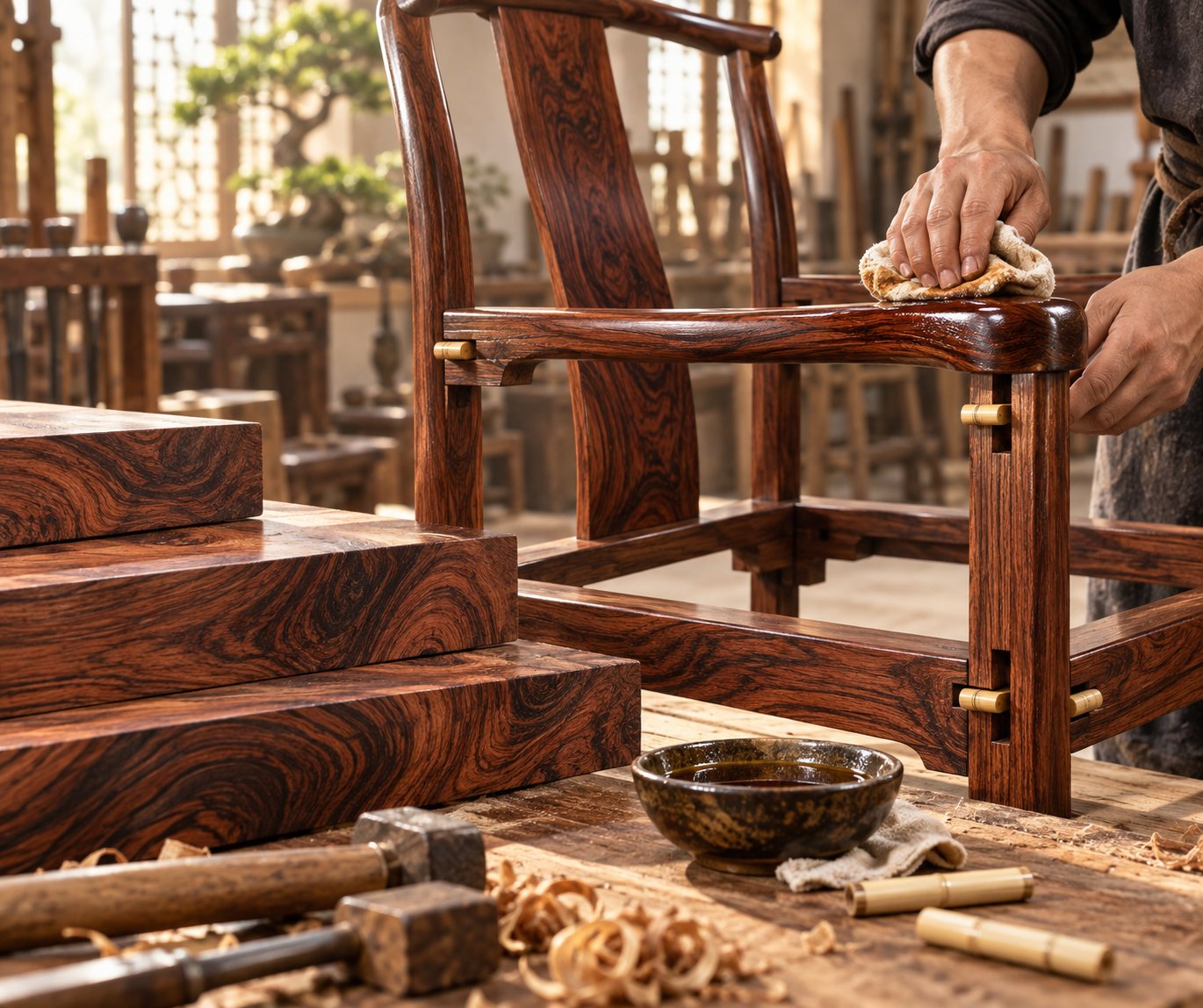
Un guide B2B complet sur les matériaux du mobilier en palissandre : palissandre du Siam (Dalbergia cochinchinensis), nanmu de Machilus, séchage en séchoir de 36 jours jusqu'à une teneur en humidité de 8 à 14 %, assemblages à tenons et mortaises avec chevilles en bambou, finition à la laque brute en neuf couches, conformité CITES/FSC et personnalisation OEM/ODM de Yunxiao.
Why Buyers Keep Asking What Rosewood Furniture Is Made Of
Every week, importers, hotel project buyers and furniture wholesalers ask our export team the same opening question: what is rosewood furniture made of? The question sounds simple, but behind it sits a chain of decisions that determines whether a container of furniture survives a humid monsoon climate, passes customs inspection in Australia, or satisfies a five-star hotel procurement specification in North America. Rosewood furniture materials are not a single ingredient. They are a combination of timber species selection, moisture content control, joinery engineering, surface finishing chemistry and compliance documentation. This article walks through each layer of that system as it is practiced inside a working Chinese rosewood furniture factory, so that a B2B buyer can evaluate any supplier — including us — with concrete criteria rather than marketing adjectives.
The term "rosewood" itself is part of the confusion. In international trade, rosewood generally refers to species in the Dalbergia genus, regulated under CITES Appendix II. In the Chinese classical furniture tradition, the category known as hongmu covers several dense, dark hardwoods, of which Siamese rosewood (Dalbergia cochinchinensis) is one of the most commercially important for export-grade reproduction and contemporary classical furniture. When a buyer asks what rosewood furniture is made of, the honest answer begins with the exact botanical name of the timber, because "rosewood" alone can describe timbers with very different density, oil content and price.
A Short History of Rosewood in Classical Chinese Furniture
Understanding what rosewood furniture is made of today is easier when you know why these species were chosen centuries ago. Ming and Qing dynasty cabinetmakers favored dense, fine-grained hardwoods because they could be worked to a glass-like finish without thick opaque lacquer, allowing the natural figure of the wood to carry the design. Hongmu and related species were imported into China through Southeast Asian trade routes for generations. The furniture that survived from those periods — altar tables, canopy beds, horseshoe-back armchairs — demonstrates why the material earned its reputation: dimensional stability across seasons, a natural luster that deepens with age, and enough hardness to hold crisp carved detail for a century or more.
Modern export rosewood furniture inherits that tradition but operates under very different constraints. CITES regulation now governs international movement of Dalbergia species, buyers demand documented compliance, and destination climates range from the tropical humidity of Singapore and Malaysia to the dry, heated interiors of North American homes. A factory that simply copies historical methods without modern kiln technology, moisture metering and finishing compliance will produce furniture that cracks, warps or fails inspection. So the modern answer to "what is rosewood furniture made of" is: traditional materials and joinery, engineered with contemporary wood science.
Siamese Rosewood: The Core Material
The primary structural timber in our export collections is Siamese rosewood, botanically Dalbergia cochinchinensis. It is a leguminous hardwood native to mainland Southeast Asia, prized for a deep reddish-brown heartwood that darkens attractively with age and exposure. Its density typically exceeds the water-mark that defines genuine rosewood-class timber, which is why it feels substantially heavier than mahogany or teak of the same volume. The grain is usually interlocked, producing the ribbon-like figure visible on quarter-sawn surfaces, and the wood contains natural oils that contribute to both its luster and its resistance to common furniture pests.
For buyers, three practical properties matter most. First, hardness: Siamese rosewood resists denting in high-traffic hospitality settings, which is why it appears in hotel lobbies and restaurant dining sets rather than only in display cabinets. Second, stability after proper seasoning: once dried to the correct moisture content and acclimatized, it holds joinery tight through seasonal humidity swings. Third, workability of detail: the wood carves cleanly, which is essential for the dragon, phoenix and floral motifs that define Chinese classical furniture. These are the reasons our Imperial Dragon 9-Seat Sofa and Four-Poster Bedroom Suite are built on this species.
CITES and FSC Compliance for Dalbergia cochinchinensis
Because Dalbergia cochinchinensis is listed on CITES Appendix II, every export shipment of rosewood furniture containing it must be supported by documentation proving legal, traceable harvest. In practice this means our raw material enters the factory with harvest and trade permits, is recorded batch by batch, and leaves with export documentation that matches the species declaration on the commercial invoice. Buyers in Australia, the United States, the European Union and Southeast Asia increasingly ask for this chain of paperwork before issuing a purchase order, and any supplier who cannot produce it represents a customs risk, not just a quality risk. Where projects require it, we also work with FSC-certified supply on request, and we state clearly on quotations which portions of an order are covered by which documentation. A buyer evaluating what rosewood furniture is made of should treat the timber's paper trail as part of the material itself.
Supporting Materials: Machilus Nanmu and Grade-A Hardwood Selection
Not every component of a rosewood furniture piece needs to be — or should be — the most expensive timber. Traditional Chinese cabinetmaking distinguishes between the show frame and the secondary structure. In our construction, large visible surfaces, carved elements and load-bearing frames use Siamese rosewood, while certain interior panels, drawer bottoms and concealed back panels use Machilus nanmu, a pale, fine, stable hardwood with a long history in Chinese furniture as a complementary material. Nanmu is lighter in color and weight, naturally insect-resistant, and dimensionally steady, which makes it well suited to parts the buyer rarely sees but which strongly affect long-term performance — a warped drawer bottom or a buckled back panel is a service complaint waiting to happen.
Every board, regardless of species, passes through a Grade-A selection process before it reaches the workshop floor. Graders reject boards with through-cracks, active insect damage, excessive sapwood on visible faces, or irregular grain that would compromise carved detail. The visible-face standard is stricter than the concealed-part standard, and the selection log records which board went into which component of which order. When a buyer asks us what rosewood furniture is made of, we can answer at the level of individual boards, not just species names. This traceability matters in dispute resolution and in matching replacement parts years after delivery.
Wood Drying: 36 Days to 8–14% Moisture Content
If timber selection determines what rosewood furniture is made of, drying determines whether it stays that way. Freshly harvested hardwood contains far more water than finished furniture can safely hold. If a factory builds with under-dried wood, the boards shrink after assembly, joints open, panels crack, and carved details split along the grain. This is the single most common cause of complaints about cheap "rosewood-look" furniture, and it is entirely preventable with disciplined kiln drying.
Our drying schedule runs approximately 36 days in humidity-controlled kilns, bringing the timber down to a target moisture content of 8–14%. The range is deliberate rather than vague: the lower end suits dry, heated or air-conditioned interiors such as those in North America and inland Australia, while the upper end suits the consistently humid climates of Southeast Asia. The kiln process is staged — initial gentle conditioning to relieve surface tension, gradual temperature increases, and final equalization so that the core of thick boards reaches equilibrium with the shell. Moisture is verified with meters at multiple depths and positions, not assumed from kiln charts.
Second-Stage Acclimatization for the Destination Climate
Drying to 8–14% is only half of the moisture story. Wood is hygroscopic: it continues to exchange moisture with the air around it. A dining table dried for a temperate climate and shipped directly to coastal Queensland or to an air-conditioned Singapore hotel will re-adjust, and if it adjusts after assembly, joints suffer. That is why we perform a second-stage acclimatization: components are held in a conditioning area set to the moisture level appropriate for the destination climate before final assembly and finishing. For a container destined for a humid Southeast Asian port, components equalize at the higher end of the range; for a dry North American interior, at the lower end. Buyers should ask any supplier not just "what is your moisture content" but "what is your moisture content for my destination" — the difference between those two answers is the difference between furniture that arrives stable and furniture that moves in its first season.
Mortise-and-Tenon Joinery and Bamboo Pins: No Metal, No Glue Dependence
The structural answer to what rosewood furniture is made of is not only the timber but the joinery. Classical Chinese furniture is assembled with mortise-and-tenon joints — precisely cut interlocking wooden connections that have proven themselves over centuries without screws or nails. In our workshop, joints are cut on a combination of CNC machinery for repeatability and hand fitting for final tolerance. Each joint type is chosen for the forces it must resist: through-tenons on table legs where racking loads are highest, dovetail-style joints on drawer fronts, mitered and keyed joints on frame corners where appearance demands a clean line.
Where additional reinforcement is needed, we use bamboo pins rather than metal fasteners. Bamboo's hardness and its slight natural moisture differential create a mechanical lock inside the pinned joint; unlike metal screws, bamboo pins will not corrode, will not loosen through thermal cycling of the surrounding wood, and will never stain the timber with rust bleed. This metal-free construction is not nostalgia — it is engineering. Metal fasteners in dense hardwood create stress concentrations and, in humid climates, corrosion products that discolor and weaken the joint over time. A buyer inspecting our furniture will find that a well-made joint separates only when its pins are driven out, exactly as a Qing dynasty cabinetmaker would have intended.
Adhesives play a limited, supporting role in modern construction — primarily in laminated core panels and veneer work where solid timber alone is not the right engineering answer — but the load-bearing skeleton of our frames remains glue-independent joinery. This is a meaningful distinction when comparing suppliers: furniture whose structure depends on glue alone will fail differently, and less predictably, than furniture whose structure is mechanical.
Surface Finishing: Nine Coats of Hand-Applied Raw Lacquer and Beeswax
What rosewood furniture is made of includes its surface, and the surface is where chemistry meets craft. Our signature finish is a traditional Chinese raw lacquer system, applied by hand in nine separate coats. Raw lacquer — the sap of the lacquer tree, refined and tinted — cures by enzymatic polymerization in controlled humidity, forming a hard, flexible film that is chemically distinct from modern polyurethane. Each coat is applied, allowed to cure, then burnished before the next, building depth and a luster that polyurethane cannot replicate: it reads as warmth from within the wood rather than a plastic film on top of it.
The final coats incorporate beeswax burnishing, which fills micro-pores and produces the tactile, silk-like surface associated with high-end classical furniture. Beyond aesthetics, the finish system serves the wood: it slows moisture exchange at the surface, reducing the amplitude of seasonal movement, while remaining flexible enough not to crack when the substrate moves slightly. Repairability is another practical advantage — a scratched raw-lacquer surface can be locally re-burnished and re-waxed by a technician, whereas a damaged polyurethane film usually requires full stripping.
Finishing Compliance: EU REACH, US CARB and FDA 21 CFR 175.300
For export buyers, the finishing system must also clear regulatory thresholds. Our finishing materials are selected to comply with EU REACH requirements on restricted substances, with US CARB formaldehyde emission standards for composite components where used, and with FDA 21 CFR 175.300 for indirect food contact surfaces — the relevant standard for dining table tops and serving surfaces. In plain terms: a restaurant can serve food directly on our finished dining surfaces, and a hotel can specify our casegoods in guest-contact areas without a compliance gap. Buyers should request the finishing compliance statement as part of the documentation package, exactly as they request CITES paperwork for the timber. What rosewood furniture is made of, in a compliance sense, is timber documentation plus finish documentation; a supplier who offers only the first half is exposing the buyer to the second half's risk.
From Log to Container: The Production Flow
Understanding what rosewood furniture is made of is easiest when you follow a piece through the factory. The sequence below reflects the actual flow for a typical export order:
- Timber intake and grading: imported logs and boards are documented, then graded; Grade-A boards are allocated to visible and structural components.
- Kiln drying: 36-day humidity-controlled schedule to 8–14% moisture content, verified by meter.
- Acclimatization: components conditioned to the destination climate's moisture band before assembly.
- Cutting and machining: CNC cutting of mortises, tenons and carved blanks, with hand finishing of critical tolerances.
- Carving: relief and openwork carving executed by hand for figurative detail, machine-assisted for repetitive geometric patterns.
- Dry-fit assembly: every piece is fully assembled without finish to verify joint fit, then disassembled.
- Sanding and surface preparation: progressive sanding to prepare the substrate for lacquer.
- Nine-coat lacquer application: hand-applied coats with curing and burnishing between each.
- Beeswax burnishing: final surface refinement.
- Final assembly and hardware: brass hardware where the design specifies it, installed after finishing.
- Quality inspection: joint integrity, moisture re-check, finish inspection under raking light, dimensional verification against the order sheet.
- Packing: corner protection, foam interleaving, and carton or crate packing configured for the shipping mode.
Each stage has a checkpoint and a record. When a buyer visits — and we encourage factory visits for serious project buyers — this is the sequence they walk through, and it is the sequence behind every photograph in our catalog.
Quality Control: What Gets Checked Before a Container Closes
A buyer's real question behind "what is rosewood furniture made of" is often "what am I actually getting in the container." Our pre-shipment inspection covers the categories below, and we provide the inspection record with the shipping documents:
- Moisture verification: meter readings on representative components, recorded against the destination-climate target.
- Joint integrity: every mortise-and-tenon connection checked for tightness; no visible gaps at assembled joints.
- Dimensional accuracy: critical dimensions verified against the approved drawings, typically within a few millimeters on large casegoods.
- Finish quality: surfaces inspected under raking light for runs, dust inclusion, thin coats or burnishing defects.
- Carving fidelity: carved details checked against the approved sample or drawing for completeness and depth.
- Hardware and function: drawers run smoothly, doors align, extension mechanisms cycle fully.
- Packing integrity: corner protection and interleaving verified against the packing plan for the container configuration.
Third-party inspection is welcome. Buyers who engage SGS, Bureau Veritas or their own QC representatives find our workshop accustomed to hosting inspections, and we treat the third-party report as part of the order record rather than as an adversarial event.
Packing and Container Logistics for Solid Hardwood Furniture
Heavy, dense furniture punishes careless packing. Our standard export packing uses multi-layer protection: foam corner blocks, stretch-wrap against surface abrasion, corrugated or honeycomb board shielding, and — for fragile carved elements and glass-topped pieces — custom crating. Container loading plans are drawn before loading day, because a poorly braced load shifts in transit and the damage shows up as cracked tenons at the destination, not as a freight claim. For mixed containers combining dining sets, bedroom suites and sofas, we sequence heavy casegoods on the floor and lighter upholstered pieces above, with load bars between tiers.
Buyers shipping to landlocked destinations or transshipping through multiple ports should tell us at quotation stage; the packing specification changes with the number of handling events. This is a small conversation that prevents a large category of damage claims, and it is part of what a complete answer to "what is rosewood furniture made of" looks like in practice — the material includes its journey.
Project Reference: Rosewood Furniture in Hotels and Restaurants
Hospitality is the most demanding environment for solid hardwood furniture: continuous use, commercial cleaning chemicals, luggage impact, and procurement specifications that require documentation. Our 8-Seat Bamboo Carved Dining Set, for example, was developed for restaurant and banquet use, with a reinforced apron structure to resist racking when chairs are pushed back hundreds of times a day, and a finish system rated for food contact per FDA 21 CFR 175.300. Hotel projects typically combine lobby statement pieces, restaurant dining sets and in-room casegoods, each with different wear profiles, and we configure finish and construction details accordingly.
Project buyers evaluating what rosewood furniture is made of should ask for references in their own segment. We can discuss completed hotel and restaurant programs, the specification decisions behind them, and the service history since delivery. A supplier who has never shipped into commercial hospitality will not know to ask the questions a hotel engineer will ask on site.
OEM and ODM Customization: Dimensions, Carving and Branding
A large share of our export volume is customized work. OEM and ODM services cover the full range from dimensional modification to complete new-model development:
- Dimensional customization: dining tables resized for specific banquet halls, beds adapted to non-standard mattress sizes, wardrobes engineered to fit specified room alcoves.
- Carving customization: motif selection and layout adapted to a brand's design language, from traditional dragon-and-phoenix programs to restrained geometric borders.
- Finish customization: lacquer tone matched to a project's interior palette, with sample panels approved before production.
- Hardware and upholstery: brass finish selection, fabric and leather specification for upholstered pieces such as the Imperial Dragon 9-Seat Sofa.
- Packaging and labeling: buyer-branded cartons, hangtags and instruction sheets for retail programs.
The customization process runs through engineering review, sample or prototype approval, and production release — the same sample-first discipline described in our earlier article on prototype development. Buyers should budget realistic time for the sample stage; a carved sample approved in week three saves a container of regret in week twelve. For the Four-Poster Bedroom Suite, for instance, canopy dimensions and carving depth are the two details most frequently customized, and both are far cheaper to change on a drawing than on finished timber.
Documentation Package: What a Complete Export Order Includes
When we ship, the documentation set typically includes the commercial invoice and packing list, CITES export documentation for Dalbergia species content, the finishing compliance statement covering REACH, CARB and FDA 21 CFR 175.300 as applicable, the pre-shipment inspection record with moisture readings, and care instructions in the destination language. Buyers integrating our products into retail or project programs can request specification sheets formatted for their procurement systems. We recommend collecting this list from any supplier before the deposit is paid; the quality of the paperwork is a reliable predictor of the quality of the furniture.
How to Compare Rosewood Furniture Quotes Like a Professional
Armed with an understanding of what rosewood furniture is made of, a buyer can compare quotations on substance rather than price alone. The comparison checklist we suggest:
- Species declaration: does the quote name Dalbergia cochinchinensis (or the actual species) with botanical names, or just "rosewood"?
- Moisture specification: is a target moisture content stated, and is it matched to the destination climate?
- Joinery description: does the supplier describe mortise-and-tenon construction, or avoid the subject?
- Finish system: how many coats, what chemistry, which compliance standards?
- Documentation: which certificates and permits are included in the price?
- Inspection rights: is third-party inspection explicitly welcomed?
- Sample policy: what does a pre-production sample cost and how long does it take?
- Warranty terms: what is covered, for how long, and what voids it?
Two quotes can differ by thirty percent and the cheaper one can still be the better value — or a trap. The difference almost always lives in the eight lines above, not in the price line.
Building a Long-Term Supplier Relationship
For importers and project buyers, the highest-leverage decision is not a single container but the supplier relationship around it. Long-term buyers get priority in production scheduling during peak season, faster sample turnaround because engineering already understands their standards, and honest early warnings when material markets shift. We maintain standing specifications for repeat buyers so that a re-order of the Imperial Dragon 9-Seat Sofa matches the original shipment without re-negotiating every detail. Buyers building a rosewood furniture program should evaluate suppliers on responsiveness and documentation discipline as much as on the first sample, because those are the traits that determine year-three performance.
Seasonal Planning for Rosewood Furniture Orders
Production capacity for solid hardwood furniture is seasonal. Chinese New Year compresses the first quarter; the pre-holiday export rush compresses the third. Buyers planning retail programs or hotel openings should place orders with lead times that respect these cycles — typically ordering three to four months ahead of the required ship date for standard models, and longer for custom carving programs. Moisture acclimatization also interacts with season: components conditioned during a humid summer need different handling than those finished in a dry winter, and our scheduling accounts for this. A buyer who asks "when should I order" is really asking "when will my furniture be at its most stable" — and the answer rewards early planning.
Digital Tools in the Modern Rosewood Furniture Purchase
The buying process itself has modernized. Video factory walk-throughs, live video calls during sample inspection, and shared project folders for drawings and approval records now supplement — not replace — physical factory visits. We support buyers who want to witness kiln loading or finishing application remotely, and we record short inspection videos for each order stage on request. For buyers in Australia, North America and Southeast Asia managing multiple suppliers, these tools compress decision cycles without sacrificing oversight. What rosewood furniture is made of can now be verified from a laptop as well as from a factory floor, and we encourage buyers to use both.
Common Misconceptions About Rosewood Furniture Materials
Several persistent misconceptions distort buying decisions, and each deserves a direct correction:
- "All rosewood is the same." Species within the hongmu category differ significantly in density, oil content and price. The botanical name is the only reliable identifier.
- "Heavier always means better." Density matters, but moisture content and joinery quality determine longevity more than raw weight.
- "Metal fasteners are stronger than wooden joints." In dense hardwoods, well-cut mortise-and-tenon joints with bamboo pins outperform screwed connections over decades, because they move with the wood instead of fighting it.
- "Thicker finish means better protection." A thick polyurethane film can crack when the substrate moves; a properly built raw-lacquer system flexes and remains repairable.
- "Kiln drying is optional for hardwood." It is the single most important industrial step between a log and a stable piece of furniture.
Buyers who internalize these corrections negotiate better specifications and avoid the most common failure modes in imported hardwood furniture.
After-Sales Service and Warranty Framework
Our warranty covers structural integrity of joinery and manufacturing defects in materials and workmanship under normal residential or commercial use, with terms specified on each quotation. Normal-use exclusions — standing water, direct heat sources, unauthorized refinishing — are stated plainly so that end users can be briefed correctly. Spare parts for hardware, replacement cushions for upholstered models, and touch-up finishing kits for lacquer surfaces are available for re-order. For hotel and restaurant programs, we can train the client's maintenance staff on lacquer care and joint inspection, because a five-minute quarterly check catches issues that become expensive if ignored for two years. After-sales capability is part of what rosewood furniture is made of in a commercial sense: the material promise extends past the container door.
Sustainable Sourcing and the Future of Rosewood Furniture
Sustainability in the rosewood trade is not a marketing layer; it is an operational requirement enforced by CITES and by buyer procurement policies. Our sourcing prioritizes documented, legal supply chains, and we support buyers who need FSC-certified material for specific programs. Beyond compliance, responsible factories invest in yield optimization — CNC nesting and careful cutting plans extract more furniture per log — and in finishing systems with lower emissions. Buyers writing ESG requirements into tenders should ask suppliers for specifics: which species, which permits, which certifications, what yield practices. Vague sustainability claims are worth nothing; documented ones are worth a place on a tender shortlist.
Regional Market Notes: Southeast Asia, Australia and North America
Different destination markets stress different properties of rosewood furniture, and a factory that exports to all three adjusts specifications accordingly. In Southeast Asia — Singapore, Malaysia, Indonesia — the challenge is sustained humidity: moisture targets sit at the upper end of the 8–14% band, ventilation-friendly construction matters, and mold prevention in packing is a real engineering topic. In Australia, the contrast between humid coastal cities and dry interiors means destination-specific acclimatization within a single country. In North America, dry heated interiors in winter pull moisture from wood aggressively, so the lower end of the moisture band and robust finish systems are essential. Buyers should tell us the installation city, not just the country; the specification difference is real.
Ten Questions to Ask Before Placing a Rosewood Furniture Order
To close the loop on what rosewood furniture is made of, here is the checklist we would use if we were the buyer:
- Which exact species, by botanical name, is used in the frame, the visible surfaces and the secondary components?
- What moisture content do you target, and how is it matched to my destination climate?
- How long is your kiln schedule, and how is moisture verified?
- Is the structure mortise-and-tenon with bamboo pins, or glued and screwed?
- What is the finishing system — how many coats, what chemistry, which compliance standards?
- Which CITES and FSC documentation is included, and who bears the cost?
- Can I commission a third-party inspection before shipment?
- What does a pre-production sample cost, and what is the sample lead time?
- What are the warranty terms, and what after-sales support exists in my market?
- Can you share references from buyers in my segment — hotels, restaurants, retail?
A supplier who answers all ten without hesitation has done the work this article describes. A supplier who answers two has answered enough.
Working with Designers and Architects on Rosewood Specifications
Interior designers and architects specifying rosewood furniture for projects need information in a different format than importers: finish samples against a material palette, CAD blocks for space planning, lead-time schedules aligned to construction programs, and specification language they can paste into tender documents. We provide finish sample panels, dimensioned drawings for standard and customized models, and written specifications covering species, moisture content, joinery and finish compliance. Early involvement pays: when we review a design intent before tender, we can flag which carved details drive cost and which dimensional changes avoid re-engineering, often saving the project weeks. What rosewood furniture is made of, for a designer, is also a set of documents that make the material specifiable.
Frequently Asked Questions
What exactly is rosewood furniture made of?
Our export rosewood furniture is built primarily from Siamese rosewood (Dalbergia cochinchinensis) for frames, visible surfaces and carved elements, with Machilus nanmu used for certain concealed panels and drawer bottoms. The structure uses mortise-and-tenon joinery reinforced with bamboo pins, and the surface carries nine hand-applied coats of raw lacquer finished with beeswax.
Is Siamese rosewood the same as the rosewood used in antique Chinese furniture?
Siamese rosewood belongs to the same Dalbergia genus and the Chinese hongmu tradition as many antique timbers, and it is the species most commonly used in high-quality modern classical furniture. Antique pieces may use different Dalbergia species; the botanical name, not the trade name, is what identifies the material.
Why does moisture content matter so much?
Wood expands and contracts with humidity. Timber dried to 8–14% moisture content and acclimatized to the destination climate moves minimally after assembly, keeping joints tight. Under-dried wood shrinks after construction, opening joints and cracking panels — the most common failure in cheap hardwood furniture.
What is the difference between raw lacquer and polyurethane?
Raw lacquer is a natural tree sap that cures into a hard, flexible, repairable film with depth and warmth; polyurethane is a synthetic film that is thicker and glossier but can crack with substrate movement and usually requires full stripping to repair. Our nine-coat raw lacquer system with beeswax burnishing follows the classical Chinese finishing tradition with modern compliance (EU REACH, US CARB, FDA 21 CFR 175.300).
Can I order custom sizes and carvings?
Yes. OEM and ODM customization covers dimensions, carving motifs, finish tones, hardware, upholstery and packaging. The process runs through engineering review and sample approval before production release.
What documentation comes with an export order?
Typically: commercial invoice and packing list, CITES export documentation for Dalbergia content, finishing compliance statements, pre-shipment inspection records with moisture readings, and care instructions in the destination language.
How long does a typical order take?
Standard models generally require several weeks of production after order confirmation, with custom carving programs longer. Seasonal capacity cycles around Chinese New Year and the pre-holiday export rush affect scheduling, so we recommend planning three to four months ahead of the required ship date.
Is rosewood furniture suitable for hotels and restaurants?
Yes, when it is built for it: reinforced aprons, food-contact-compliant finishes, and moisture content matched to the venue's climate. Our 8-Seat Bamboo Carved Dining Set and related hospitality pieces are specified for commercial use.
How should rosewood furniture be maintained?
Dust with a soft dry cloth, avoid standing water and direct heat, and refresh the beeswax surface periodically with a compatible wax. Scratches in raw lacquer can be locally re-burnished by a technician. Detailed care instructions ship with every order.
Is the timber legally and sustainably sourced?
Yes. Dalbergia cochinchinensis is CITES Appendix II listed, and our supply chain carries harvest and trade documentation that supports export permits. FSC-certified material is available for programs that require it.
Conclusion: The Material Is a System
So, what is rosewood furniture made of? Not one thing — a system. Legally documented Siamese rosewood and complementary nanmu, dried for 36 days to a destination-matched 8–14% moisture content, joined with mortise-and-tenon craft and bamboo pins, finished in nine hand-applied coats of compliant raw lacquer and beeswax, inspected at every stage, packed for the journey, and supported by documentation that clears customs and procurement audits alike. Every element in that system is verifiable, and a serious buyer should verify all of it. We welcome factory visits, third-party inspections and technical questions at any stage of the buying process — because a buyer who understands what rosewood furniture is made of is the buyer who will still be re-ordering a decade from now. Contact our export team to request samples, specifications or a quotation for your next program.