
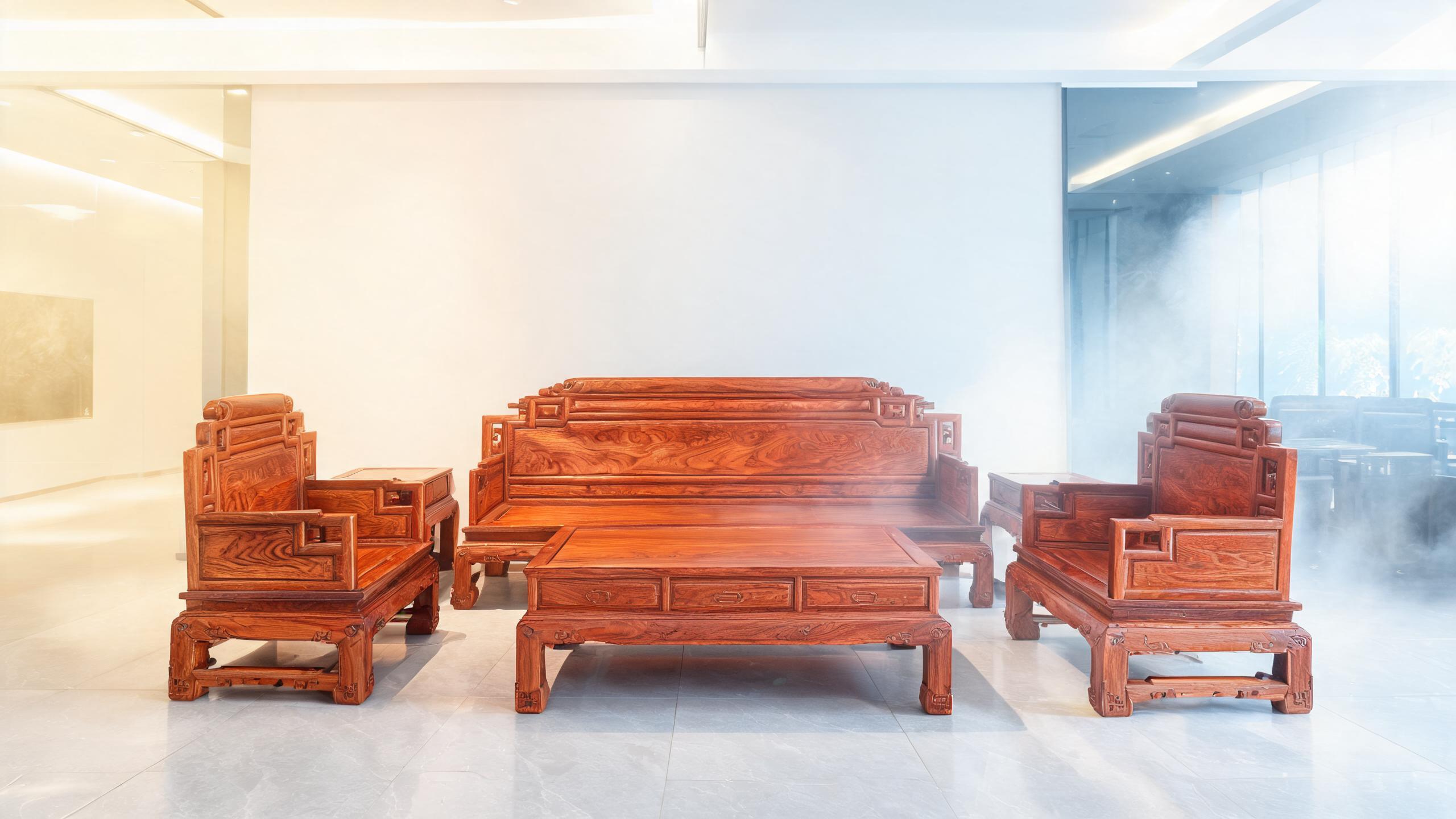
Un guide pratique d'approvisionnement B2B expliquant pourquoi les meubles en bois de rose massif se fissurent dans les climats étrangers et comment le séchage contrôlé en humidité de 36 jours, l'assemblage à tenon et mortaise, la finition en laque brute en neuf couches, l'emballage ISPM-15 et une acclimatation appropriée le préviennent.
Why Solid Rosewood Furniture Cracks in Overseas Climates — and How We Prevent It
If you import solid wood furniture from China, you have probably heard the same worry from your customers: "Will it crack after a year in my climate?" For rosewood furniture, the question is not paranoia. Solid rosewood is a living material long after it leaves the kiln. It keeps exchanging moisture with the air around it, and when that exchange happens too fast or too unevenly, the wood responds — sometimes with a hairline surface check, sometimes with a split across a panel. For a B2B buyer, a cracked sofa frame or a split dining tabletop is not a cosmetic issue; it is a warranty claim, a replacement shipment, and a dent in your brand.
This guide explains, from the perspective of a manufacturer that has produced classical rosewood furniture in Xianyou, Fujian since 2008, why rosewood furniture cracks in overseas climates, what actually prevents it, and exactly what you should verify before you place a container order. Everything described here reflects our own documented production practice: a 12,000-square-meter factory, a 36-day humidity-controlled drying cycle, moisture content held below 14 percent, traditional mortise-and-tenon joinery with bamboo pins, and nine-coat raw lacquer or beeswax finishing that complies with EU REACH and US CARB requirements. No invented case studies, no unverifiable claims — just the engineering of rosewood furniture cracking prevention as we practice it every day.
1. The Physics: Why Does Solid Wood Crack When It Travels Overseas?
Wood is hygroscopic. Even after the most careful kiln schedule, cell walls in timber continue to absorb and release water vapor until they reach equilibrium with the surrounding air. The moisture content at which a piece of wood stops exchanging moisture with its environment is called the equilibrium moisture content, or EMC. EMC is not a fixed number — it depends almost entirely on the climate.
In humid coastal Southeast Asia, indoor EMC can sit around 14 to 16 percent. In the dry winters of North America, heated interiors can pull EMC down to 5 or 6 percent. In arid inland Australia, outdoor EMC can drop below 8 percent. A rosewood dining table dried to 12 percent moisture content in Fujian and shipped to a heated Minnesota showroom will slowly lose moisture; a similar table shipped to Singapore in monsoon season will slowly gain it. Neither direction is inherently dangerous. What damages furniture is the speed and the gradient of the change.
When the outer layers of a board dry faster than the interior, the surface shrinks while the core does not. The surface is put into tension and, if the stress exceeds the wood's transverse strength, the fibers separate — a surface check, or in worse cases a crack that runs deep. The reverse happens when dry wood is suddenly exposed to high humidity: the shell swells around a dry core, producing compression failures called casehardening, which can later release as internal cracks when the board is resawn or stressed. Rapid swings — a container that sits in a hot port, a showroom with direct air conditioning blowing across a tabletop, a villa in a dry climate with underfloor heating — all amplify these gradients.
Three structural features of rosewood make this worse than in many other timbers. First, rosewood species such as Siamese rosewood (Pterocarpus macrocarpus, known in the trade as Burma padauk) are dense, with interlocked grain and high natural oil content. Density means more movement per percentage point of moisture change. Second, classical Chinese furniture uses wide, solid panels — a rosewood dining table top or a carved bed back rail is often a single broad board, not a veneered composite, so there is no engineered layer to restrain movement. Third, traditional construction relies on joinery rather than glue and screws, which is a strength in durability terms but means every joint is a place where two pieces of wood with different grain orientations meet and move at different rates.
Understanding this physics is the foundation of rosewood furniture cracking prevention. You cannot stop wood from moving. You can, however, control three things: the moisture content the wood starts with, the way the structure accommodates movement, and the rate at which the surface exchanges moisture with the air. Those three controls — drying, joinery, and finishing — plus two operational controls, packaging and acclimatization, are exactly what the rest of this article covers.
2. Why "Kiln Dried" Alone Is Not Enough: The 36-Day Humidity-Controlled Drying Cycle
Many supplier quotations say "kiln dried" as if it were a binary state. In reality, drying is a schedule, not a switch. Kiln dried rosewood furniture that has been rushed through a high-temperature cycle may show a low instantaneous moisture meter reading while still carrying severe internal drying stresses — casehardened shells, collapsed cells, honeycomb checks hidden inside the board. Such timber can pass a spot inspection at the factory and still crack months later in a buyer's showroom.
Our approach at Yunxiao is a 36-day humidity-controlled drying cycle for every batch of solid rosewood before it enters production. The schedule has three phases. In the conditioning phase, boards are stacked with stickers (spacers that let air circulate on every face) and brought gradually up to temperature in the kiln while humidity is held high, so the wood warms through before it starts to lose moisture. In the drying phase, kiln temperature and humidity are stepped down over weeks according to the species and thickness; thick carved stock for a rosewood sofa arm or a bed post moves far more slowly than thin drawer bottoms. In the equalizing and conditioning phase, the kiln is held at a humidity slightly above the target EMC so the shell re-absorbs a little moisture, relaxing the drying stresses locked into the outer fibers. Only after this conditioning do we measure moisture content across the stack — not at one point, but at multiple depths and positions — and release the batch only when readings are consistently below 14 percent.
Why 14 percent? Because it is a compromise calibrated to our target markets. Furniture destined for Southeast Asia and coastal Australia will equilibrate near 11 to 13 percent indoors; furniture for heated North American and European interiors will drift lower, toward 7 to 9 percent. Starting below 14 percent means the wood arrives close to — or slightly drier than — the EMC of most destination climates, so the moisture exchange after unpacking is gradual rather than violent. For buyers in exceptionally dry regions, we can extend conditioning to bring stock closer to 10 percent before finishing; this is one of the specification points we confirm during OEM and ODM project discussions.
There is a second, less obvious reason the drying schedule matters: air drying before kilning. Timber that is air dried in the yard for months before kilning develops far fewer drying defects than green timber thrown straight into a kiln. Our production planning builds this air-drying lead time into the 45 to 60 working day delivery window we quote for custom orders. When a supplier promises rosewood furniture in three weeks, the hidden question is always: where did the drying time go?
As a buyer, what can you actually verify? Ask for the moisture content reading protocol, not just a single number: how many measurement points per batch, at what depth, and what the release threshold is. A factory that dries properly will answer without hesitation. We provide batch moisture reports with every shipment, and we encourage third-party inspection at the pre-shipment stage precisely because a moisture meter reading is one of the easiest objective checks an inspector can perform.
3. Structure That Forgives Movement: Mortise-and-Tenon Joinery and Bamboo Pins
Even perfectly dried wood moves. The second pillar of rosewood furniture cracking prevention is a structure designed to accommodate that movement instead of fighting it. This is where classical Chinese joinery, refined over centuries, outperforms much modern construction.
Mortise-and-tenon joinery connects members by interlocking wooden projections (tenons) into matching cavities (mortises). Because the connection is wood-to-wood along the grain, it allows the joined members to expand and contract at slightly different rates without tearing themselves apart. A screw or a rigid glue line, by contrast, locks two pieces at a fixed distance; when seasonal movement builds up, something has to give — and what gives is usually the wood around the fastener, in the form of splits radiating from screw holes or delamination along glue lines.
Our construction uses dozens of classical mortise-and-tenon variants — through tenons, blind tenons, dovetail tenons, shoulder tenons — selected per joint according to the direction of load and the grain orientation of the members. Where a locking element is needed, we use bamboo pins rather than metal nails. Bamboo is itself a natural material that moves with humidity in a compatible way, and a bamboo pin grips by swelling into the drilled hole rather than by wedging apart the surrounding fibers the way a nail can. There are no metal fasteners in the structural frame of our furniture. This matters for two reasons beyond cracking: metal fasteners in dense rosewood can corrode and stain, and they create stress concentration points that become crack initiation sites under climate stress.
Panels are another structural decision. In classical construction, wide panels — a tabletop, a cabinet door, a bed rail carving panel — are set into frames inside a groove (the "floating panel" principle). The panel is never glued into the groove along its width; it is free to expand and contract seasonally within the frame. When you inspect a rosewood dining table, look at the underside: a properly built solid top will show the panel floating in its frame, sometimes with small wooden buttons or slip tenons holding it from beneath. A top that is glued flat onto a substrate with no allowance for movement is a future crack, no matter how good the drying was.
Grain orientation is the third structural variable. Where two members meet at a right angle — an apron into a leg, a rail into a post — the tenon is oriented so that seasonal movement in both members runs parallel to the joint rather than across it. This is craft knowledge that cannot be seen in a photograph; it is one of the strongest arguments for inspecting a sample or visiting the workshop before committing to a full container. Our workshop in Xianyou welcomes buyer visits, and for buyers who cannot travel, we document joinery details in the pre-production photo sets we send for OEM and ODM approvals.
4. The Surface as a Moisture Regulator: Nine-Coat Raw Lacquer and Beeswax Finishing
Drying controls the moisture content the wood starts with; joinery controls how the structure handles movement; finishing controls how fast the wood exchanges moisture with the room. A finish is not decoration — it is a semi-permeable membrane that slows vapor transmission in both directions, damping the humidity swings that cause surface checks.
Our standard export finish is a nine-coat raw lacquer process. Raw lacquer, the natural sap-based finish used on classical Chinese furniture for millennia, is applied in multiple thin coats, each one sanded and cured before the next. The result is a deep, satin surface that follows the grain rather than sitting on top of it like a plastic film. Because each coat is thin, the finish moves with the wood instead of cracking off it — an important property when the substrate expands and contracts seasonally. Thick polyurethane films, by contrast, can themselves check and peel when the wood beneath moves, and once a film cracks, moisture exchange through the break is faster than through bare wood.
For buyers who prefer a more natural hand feel, we offer a beeswax finish: the wood is sealed and then hand-rubbed with beeswax, which fills the pores and provides a moderate moisture barrier while leaving the grain fully visible. Beeswax finishes require slightly more maintenance in dry climates — a re-waxing every year or two — and we say so plainly to buyers during specification, because the right finish depends on the destination climate and the end-use environment. A hotel lobby in humid Singapore and a private villa in dry Colorado are different engineering problems.
Compliance is part of the finishing decision for export markets. Our lacquer and beeswax finishing materials are selected to comply with EU REACH requirements and with US CARB (California Air Resources Board) formaldehyde and emissions standards. For B2B buyers, this is not a detail: finishes that fail destination-market chemical compliance can block customs clearance or trigger retailer-level testing requirements. When you compare quotations between suppliers, ask specifically what the finish is made of and whether it is documented against REACH and CARB. A factory that finishes to export compliance will have this documentation ready; we provide it with order documents.
One more practical note on finishing and cracking: edges and end grain. End grain absorbs and releases moisture many times faster than face grain. In our production, end grain surfaces — table apron ends, tenon shoulders exposed at joints, the underside edges of tops — receive additional sealing coats precisely because they are the entry points for moisture. When you inspect samples, run your hand along the underside edges of a tabletop; a factory that thinks about cracking prevention seals these surfaces, and you can feel the difference.
5. Choosing the Timber: Species, Density, and What They Mean for Stability
Not all rosewood is the same, and the species you specify changes both the price and the climate behavior of the finished piece. Our catalog is built around three material families, each with a distinct stability profile.
Siamese rosewood (Pterocarpus macrocarpus, Burma padauk). This is the premium structural timber in our range: dense, oily, and richly colored, deepening from orange-red to deep burgundy over years of light exposure. Its high density and natural oil content give excellent dimensional stability once properly dried, and it holds crisp carved detail, which is why it is our default for carved rosewood sofa sets and classical beds. The same density that makes it stable also makes careful drying non-negotiable — thick sections of this species are the slowest to season, and rushing them is the single most common cause of cracking in cheap imitations.
Machilus nanmu (golden nanmu). A lighter, golden-toned hardwood prized for its fine, straight grain and subtle shimmer. It moves somewhat less dramatically than dense rosewoods because of its more uniform grain structure, making it a good choice for large panels — cabinet doors, wardrobe fronts, wide tabletop inlays — where a broad surface must stay flat. In mixed-material pieces we pair nanmu panels with rosewood frames, letting each timber do what it does best.
Grade-A solid hardwood. For buyers who need the classical look at a more accessible price point, we build selected lines in Grade-A solid hardwood, finished and joined to the same standards. It is still solid wood with the same movement physics, so the same drying, joinery, and finishing controls apply; what changes is the species' density and color, not the engineering.
The practical takeaway for a buyer is to ask two questions together: which species, and what moisture content was it dried to? A dense species dried carelessly is more crack-prone than a moderate species dried well. Species and drying schedule must be read as a pair, and both belong in your purchase specification.
6. Climate Quick Reference: What Your Destination Market Demands
The following table summarizes how the main destination climates for Chinese rosewood furniture differ, and what each demands from the drying and acclimatization chain. Use it as a discussion framework with your supplier, not as a substitute for local measurement.
- Tropical humid (Singapore, Malaysia, coastal Indonesia, southern Thailand): indoor EMC roughly 13 to 16 percent; the dominant risk is swelling and joint tightness rather than cracking, plus surface mold on unfinished wood. Furniture should start slightly drier than the local EMC, finishes must seal all surfaces, and ventilation in storage matters more than humidifiers.
- Seasonal humid subtropical (Hong Kong, Guangzhou-adjacent markets, Brisbane, Sydney): wide seasonal swings between wet summers and dry winters; the risk is repeated cycling rather than one extreme. Floating panels and movement-tolerant joinery carry most of the load here; acclimatization on arrival still matters.
- Temperate, heated winters (most of Europe, northern United States, southern Canada): indoor EMC in heated season can fall to 5 to 8 percent; this is the classic cracking climate. Drier-than-standard drying targets, sealed end grain, humidification guidance for end customers, and gradual unpacking are all important.
- Arid and Mediterranean (inland Australia, the American Southwest, much of the Middle East): low average EMC with intense sun loads near windows. Beyond drying targets, placement guidance — away from glass walls and direct afternoon sun — becomes part of the product documentation.
When you request a quotation, telling the supplier your destination city is more useful than telling them your country. A container bound for Vancouver and one bound for Phoenix should not be dried, finished, and documented identically, and a manufacturer that asks about your climate before quoting is a manufacturer that has thought about cracking prevention.
7. The Buyer's Pre-Shipment Verification Checklist for Rosewood Furniture Cracking Prevention
Everything above describes what the manufacturer does. This section converts it into a checklist you can use in negotiations, during sample evaluation, and at pre-shipment inspection. These are the points we ourselves would check if we were buying solid rosewood furniture from another factory.
- Moisture content documentation. Request batch moisture reports showing measurement points and readings, not a single average. Ask what the release threshold is (ours is below 14 percent, with lower targets available for dry-climate destinations) and whether readings are taken at multiple depths.
- Drying schedule disclosure. Ask how long the drying cycle is and whether timber is air dried before kilning. A 36-day humidity-controlled cycle with prior air drying is a meaningful, verifiable answer; "kiln dried" alone is not.
- Joinery inspection on samples. Examine joints on the sample piece: look for through-tenons where appropriate, check that panels float in frames, and confirm there are no visible screws or nails in structural members. Ask what percentage of joints are mortise-and-tenon versus glued.
- Finish specification and compliance. Get the finish written into the contract: nine-coat raw lacquer or beeswax, and written confirmation of EU REACH and US CARB compliance for destination markets.
- Batch wood grain matching. For sets — a rosewood sofa set, a dining suite, a bedroom group — confirm that components in one set are cut from the same log batch or matched for grain and color. This is an aesthetic point, but it also indicates disciplined batch control, which correlates with disciplined drying control.
- Packaging specification. Confirm export packaging includes moisture protection: foam corner protection, bubble wrap, and sealed cartons, with fumigation-free ISPM-15 compliant wooden crating for container shipments. Packaging is covered in detail in the next section, but it belongs on the checklist because a moisture-proof carton is your last line of defense against a monsoon-season port.
- Third-party inspection rights. Confirm in the contract that you may appoint a third-party inspector at pre-shipment, and that moisture content measurement is within the inspector's scope. We welcome this; a factory confident in its drying has nothing to hide.
- Acclimatization guidance. Ask the supplier for written acclimatization instructions for your market. What a buyer does in the first two weeks after unpacking matters as much as what the factory did in the previous three months.
None of these checks requires laboratory equipment. A pin-type moisture meter, a flashlight, and a checklist cover most of it. The point of the checklist is not distrust; it is that rosewood furniture cracking prevention is a chain of controls, and a professional buyer verifies each link.
8. After the Container: Shipping, Unpacking, and Acclimatization Without Cracks
A large share of cracking incidents attributed to "quality problems" actually originate in the last mile: how the furniture was packed, where the container sat, and how quickly the pieces were unwrapped and put into a dry, air-conditioned room. This section covers what happens after the furniture leaves our factory floor.
Packing. Every piece is wrapped in foam corner protection and bubble wrap, then packed in sealed export cartons. For container shipments, cartons are packed into ISPM-15 compliant wooden crates or on fumigation-free treated pallets, meeting the international phytosanitary standard for wood packaging material. ISPM-15 compliance matters beyond customs: properly treated and constructed crating also buffers the furniture against the humidity spikes of a sea crossing. Inside a sealed container crossing the Pacific or the Indian Ocean, relative humidity can swing dramatically between tropical loading ports and cooler open-water days; cartons and crating slow that exchange down to a rate the furniture can tolerate.
Transit and storage. We advise buyers to avoid leaving containers in direct sun at destination ports and to unpack within a reasonable window after arrival. A container baking in a tropical yard for three weeks is a humidity oven, and no amount of factory-side drying can protect furniture from that. If your logistics plan includes bonded warehousing, choose dry, ventilated storage.
Acclimatization. This is the step most often skipped. When furniture arrives in a climate very different from the factory's, it should be allowed to equilibrate gradually: unpack the cartons but leave the bubble wrap loosely in place for several days in the destination room, so the wood adjusts to local humidity through the packaging rather than through a sudden shock. Keep pieces away from direct air conditioning vents, radiators, fireplaces, and floor-to-ceiling windows with intense afternoon sun — all of which create localized micro-climates steeper than the room's average. For heated North American winters, maintaining indoor relative humidity between roughly 35 and 45 percent with a humidifier is the single most effective thing an end customer can do; this is guidance we include in the after-sales documentation we supply to our B2B partners for onward distribution.
Installation and assembly. For larger custom installations — whole-house furniture projects, hotel fit-outs — our team provides remote installation guidance, and components are numbered and pre-fitted at the factory so on-site assembly does not require forcing joints. A joint forced together in a dry room can split a tenon shoulder; a joint assembled correctly after acclimatization will seat itself. If your project includes on-site assembly by local contractors, include the acclimatization window in the project schedule rather than treating installation as the same-day final step of delivery.
Handled this way, the transition from a Fujian workshop to a showroom in Sydney, a villa in Los Angeles, or a hotel in Kuala Lumpur is a controlled process rather than a gamble. The physics never changes — wood will always respond to humidity — but every stage from the kiln to the living room can be engineered to keep that response slow and even.
9. Two Illustrative Scenarios: The Same Sofa, Two Different Outcomes
To make the chain of controls concrete, consider two hypothetical — and deliberately generic — sourcing scenarios. These are illustrative composites, not accounts of specific customers, but every control mentioned is one we either perform or document.
Scenario A: the shortcut order. A distributor needs a rosewood sofa set in four weeks for a seasonal promotion. A supplier agrees, skips extended conditioning, and ships timber dried to a nominal 15 percent with hidden casehardening. The set arrives in a dry-climate market in midwinter, is unpacked the same day into a heated showroom beside a glass wall, and within two months shows a split along a wide arm panel and radiating cracks around visible screws. Every link in the chain failed: no disclosed drying schedule, no floating panel, metal fasteners, no acclimatization window. The buyer's recourse is limited, because none of these controls was ever written into the contract.
Scenario B: the specified order. A project buyer sourcing for a boutique hotel specifies: Siamese rosewood, dried below 14 percent with batch moisture reports, mortise-and-tenon construction with bamboo pins, nine-coat raw lacquer documented for REACH compliance, ISPM-15 crating, and a written acclimatization protocol for the destination climate. Pre-shipment inspection includes moisture meter readings on sampled pieces. The furniture arrives, acclimatizes for ten days in the destination rooms before final placement, and settles into seasonal movement that the floating panels and joinery absorb invisibly. Five years on, the pieces have developed the deeper patina that makes classical rosewood furniture more valuable with age — and no warranty claims.
The difference between the two outcomes is not luck, and it is not only the factory. It is that the buyer in Scenario B turned cracking prevention into a specification, and verified it. That is the single most transferable lesson in this article.
10. Long-Term Care: How to Clean and Maintain Rosewood Furniture in Any Climate
Cracking prevention does not end at installation. Routine care determines whether a piece of solid rosewood furniture looks better every year — as well-maintained classical furniture does — or slowly accumulates surface damage. These care guidelines apply to both raw lacquer and beeswax finishes, and we supply them to our B2B buyers for inclusion in their own customer documentation.
How to clean rosewood furniture: dust with a soft, dry cotton cloth, following the grain. For fingerprints or light soiling, use a cloth very lightly dampened with clean water, wipe immediately with a dry cloth, and never let moisture sit on the surface. Avoid commercial silicone-based polishes and multi-surface sprays: silicones build up on lacquer and beeswax surfaces, dull the finish, and make future refinishing difficult. For beeswax-finished pieces, re-wax once or twice a year with a natural beeswax furniture wax, buffing with a soft cloth; this refreshes the moisture barrier that keeps wood furniture humidity swings gradual.
How to care for rosewood furniture seasonally: in dry seasons or heated interiors, keep the room's relative humidity in the 35 to 50 percent range where possible, and keep furniture away from heat sources. In humid seasons, ensure ventilation and wipe away any condensation promptly. Use coasters, placemats, and table pads under hot dishes; a steam mark is not a crack, but repeated heat stress on a finish degrades its moisture-regulating performance. Drawers and doors that feel slightly tight in humid months and loose in dry months are behaving normally — classical joinery is designed for this movement, and forcing a swollen drawer is how panels get damaged.
What normal movement looks like versus a defect: a hairline surface check at a panel edge in an exceptionally dry first winter, which closes again in humid months, is the wood doing what wood does; it is cosmetic and stabilizes as the piece equilibrates. A split through a structural member, a joint that has opened and stays open, or a crack that grows month over month is a defect and should be raised with your supplier under warranty terms. This distinction is worth writing into your own customer-facing documentation, because it prevents minor seasonal movement from becoming an escalated claim — and it is honest: solid wood furniture that never moves at all is usually not solid wood.
For B2B buyers, after-sales care documentation is also a sales asset. Retailers and project contractors who hand their customers a proper care guide see fewer warranty escalations and better reviews. We provide our care guidelines in editable form to our OEM and ODM partners for exactly this reason.
11. Frequently Asked Questions from Overseas B2B Buyers
Will solid rosewood furniture crack in a dry climate like the American Southwest or inland Australia?
All solid wood moves in dry climates, but cracking is preventable with the right controls: timber dried below 14 percent moisture content (lower targets available for very dry destinations), floating-panel construction with mortise-and-tenon joinery, a sealing finish on all surfaces including end grain, gradual acclimatization after delivery, and indoor humidity kept in a moderate range. Furniture that follows this chain of controls performs reliably in dry climates; furniture rushed through production and unpacked onto a heated floor does not, regardless of species.
Is kiln dried rosewood furniture guaranteed not to crack?
No honest manufacturer can guarantee that solid wood will never show movement — and a supplier who promises that should raise questions rather than confidence. What proper drying guarantees is that the wood starts close to its destination equilibrium, without hidden internal stresses. Combined with movement-tolerant joinery and a proper finish, this reduces cracking risk to a level appropriate for premium furniture. Ask for batch moisture reports and the drying schedule rather than guarantees.
How can I verify moisture content before accepting a shipment?
Appoint a third-party inspector for pre-shipment inspection and include moisture content measurement in their scope. A pin-type meter with readings taken at several points on representative pieces, compared against the contract threshold (below 14 percent in our standard specification), is a fast, objective check. We supply batch moisture reports with shipments and support buyer inspections as standard practice.
How long should furniture acclimatize after delivery?
For most destination climates, we recommend leaving pieces in their cartons, or unpacked with wrapping loosely retained, for five to ten days in the destination room before final placement and assembly. Larger solid panels and very dry or very humid destinations justify the longer end of that range. The goal is a gradual moisture exchange, not a fixed universal number — which is why we provide climate-specific guidance with each order.
Does humid climates cause mold on rosewood furniture?
Surface mold can appear on any organic material stored in still, humid air, but properly finished rosewood — sealed on all faces, including undersides and end grain — resists it well. The practical defenses are ventilation, avoiding storage directly against exterior walls in monsoon season, and wiping away condensation promptly. Mold on the surface is a maintenance issue; it is not the same as cracking, and it does not indicate structural failure.
Should I consider engineered or veneered alternatives to avoid cracking?
Engineered panels are dimensionally stable, which is why the furniture industry uses them — but they are not classical rosewood furniture. They cannot be carved in the traditional way, they do not develop the patina that makes solid rosewood more valuable over decades, and their thin veneer layer is itself vulnerable to peeling at edges in dry climates. For buyers who need the classical product category, the better answer is well-engineered solid wood, not a different material.
What is the difference between raw lacquer and beeswax finishes for export markets?
Raw lacquer, applied in nine coats in our process, gives a durable, satin, moisture-regulating surface that suits high-use pieces and hospitality projects. Beeswax gives a more natural, open-pore feel and is easier to refresh locally, but needs re-waxing every year or two, especially in dry climates. Both are finished with materials documented for EU REACH and US CARB compliance. The right choice depends on the destination climate and end use, and we advise on this during specification.
Do you offer OEM and ODM customization, and how does it affect lead time?
Yes. We are an OEM and ODM manufacturer of classical rosewood furniture — sofa sets, dining sets, bedroom sets, and whole-house custom projects — from our 12,000-square-meter factory in Xianyou, Fujian, established in 2008. Standard lead time for custom orders is 45 to 60 working days, which includes material selection, the 36-day humidity-controlled drying cycle where new stock is involved, carving, joinery, finishing, and packing. Custom specifications that change timber thickness or panel dimensions may extend drying time, and we flag this at quotation rather than discovering it mid-production.
What certifications and compliance documents come with an order?
Shipments include ISPM-15 compliant wood packaging documentation, finish compliance documentation for EU REACH and US CARB as applicable to the destination market, and batch moisture reports. Timber sourcing follows FSC-aligned responsible sourcing practices. If your market or retail channel requires additional documentation, raise it during specification and we will confirm what can be provided.
12. A Short Glossary for Buyers
- Equilibrium moisture content (EMC): the moisture level at which wood stops exchanging water vapor with the surrounding air; determined by temperature and humidity.
- Casehardening: internal drying stress in which the shell of a board is compressed around a drier core; releases as cracks when the board is cut or stressed.
- Surface check: a shallow separation of surface fibers caused by the shell drying faster than the core; often cosmetic and reversible.
- Floating panel: a wide panel set unglued into a frame groove so it can expand and contract seasonally without splitting.
- Mortise and tenon: a joint in which a projecting tenon locks into a matching mortise; the structural basis of classical Chinese furniture.
- ISPM-15: the international standard requiring wood packaging material to be treated against pests; a customs requirement in most destination markets.
- Acclimatization: the controlled, gradual adjustment of furniture to its destination climate after delivery.
13. Conclusion: Cracking Prevention Is a System, Not a Promise
Why does rosewood furniture crack in overseas climates? Because wood is hygroscopic, because climates differ, and because somewhere in the chain — drying, structure, finishing, packing, or acclimatization — a control was missing. Why does well-made rosewood furniture not crack? Because every one of those controls was present and verified.
For a B2B buyer, the practical takeaway is that rosewood furniture cracking prevention is verifiable. Moisture content reports, a disclosed drying schedule, mortise-and-tenon joinery with floating panels, compliant nine-coat raw lacquer or beeswax finishing, ISPM-15 packaging, and written acclimatization guidance are all things you can request, inspect, and write into contracts. A manufacturer confident in its process welcomes those requests.
At Yunxiao, this system is not a marketing layer on top of production — it is the production. Since 2008, our workshop in Xianyou, Fujian has built classical rosewood furniture the traditional way: properly dried timber below 14 percent moisture content, hand-cut mortise-and-tenon joinery with bamboo pins and no metal fasteners, nine-coat raw lacquer or beeswax finishes compliant with EU REACH and US CARB, and export packaging to ISPM-15 standard, delivered in 45 to 60 working days for custom OEM and ODM orders.
If you are sourcing solid rosewood furniture for your market — a rosewood sofa set for a retail program, a dining suite for a hospitality project, or a whole-house custom installation — send us your destination climate and project requirements. We will confirm the drying specification, finish system, and packaging plan appropriate to your market, and support third-party inspection at pre-shipment. Contact us through the inquiry form to request a quotation, samples, or our full buyer documentation pack.