
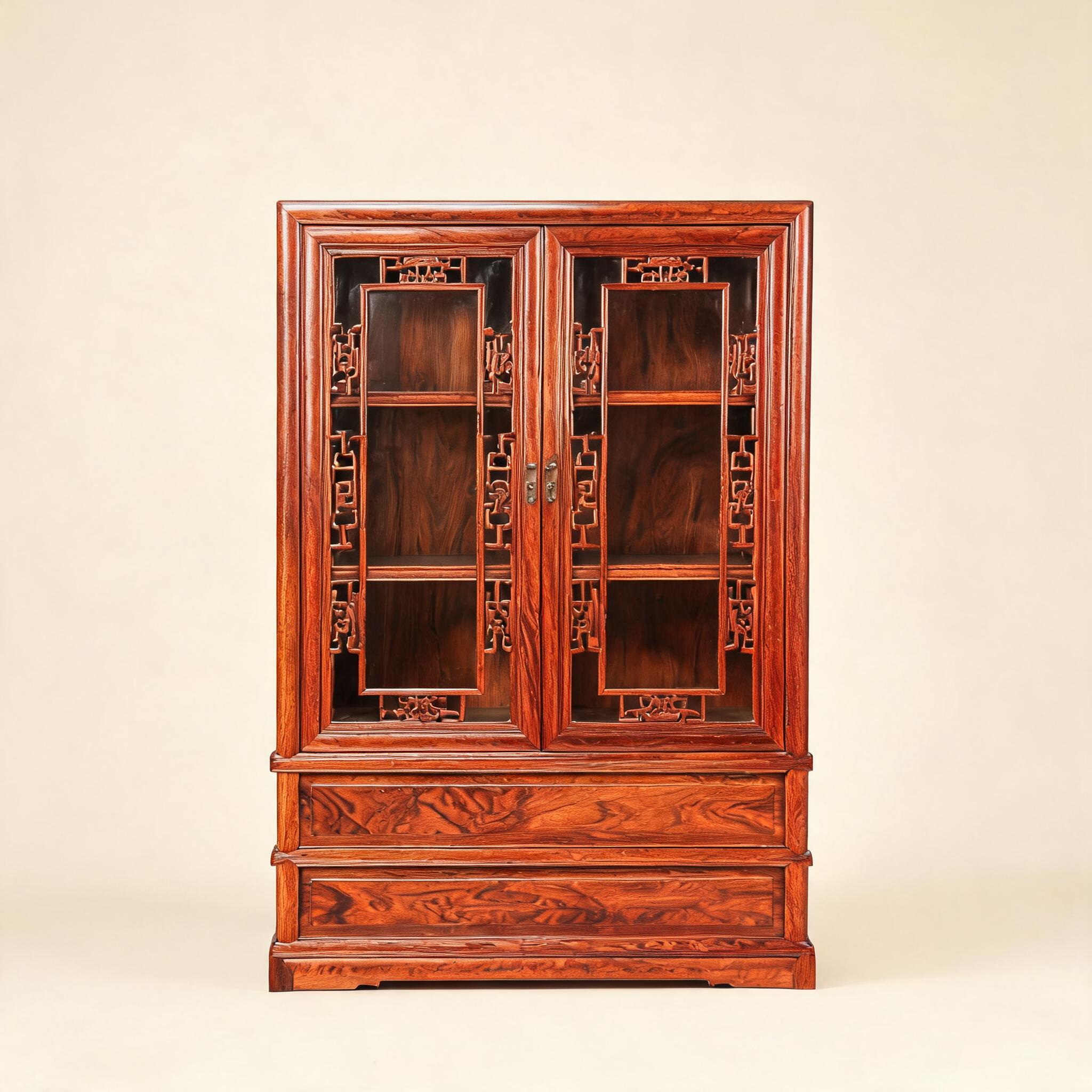
A practical B2B sourcing guide for importing classical Chinese solid rosewood bookcases and storage shelving. Covers timber grades, construction quality, finish types, application fit for hotels, libraries, offices and residential projects, plus supplier evaluation criteria and common pitfalls to avoid.
BUYER GUIDE · IMPORT & SOURCING
Rosewood Bookcase B2B Sourcing Guide: Importing Classical Chinese Solid Rosewood Bookcases & Storage Shelving
If you are sourcing rosewood bookcases or solid wood bookcases for a hotel lobby, a corporate library, an executive office, or a high-end residential development, the procurement process is different from buying standard office shelving. You are dealing with a natural material, traditional joinery methods, and a supply chain that spans timber sourcing, kiln drying, hand-finishing, and international freight. This guide covers what to check before you place an order, how to evaluate a Chinese supplier, and which specifications matter most for commercial and hospitality projects.
- Define the timber species precisely — "rosewood" covers multiple woods with very different price and stability profiles.
- Check joinery and construction: mortise-and-tenon vs. metal fasteners is the single biggest quality differentiator.
- Specify finish and moisture content for your climate zone to avoid cracking in transit and in service.
- For hotels and libraries, request fire-retardant treatment options and verify local compliance documentation.
- Always request a pre-shipment inspection and a moisture content report from an independent third party.
1. What "Rosewood" Actually Means in the Chinese Market
The term rosewood is used loosely in export catalogs. In the Chinese classical furniture trade, the most common species sold under this name include:
| Common Trade Name | Botanical / Chinese Name | Typical Characteristics | Relative Cost |
|---|---|---|---|
| Huanghuali (Yellow Huali) | Dalbergia odorifera | Golden-brown grain, fragrant, very dense; used in high-end Ming-style pieces | Highest |
| Hongmu / Burmese Rosewood | Dalbergia oliveri / Dalbergia bariensis | Reddish-brown, straight grain, good stability; common in export-grade classical furniture | High |
| Pterocarpus (Padauk / Narra) | Pterocarpus spp. | Orange-red to deep red, coarser grain; lower density than Dalbergia | Medium-High |
| African Rosewood / Bubinga | Guibourtia spp. | Red-brown with darker streaks; often substituted for Asian rosewood | Medium |
For B2B buyers, the critical question is not just "is it rosewood" but which species, from which origin, and with what CITES documentation. Many true Dalbergia species are listed under CITES Appendix II, which means you need export permits from China and import permits in your country. A reputable supplier will provide the species name on the commercial invoice and the necessary phytosanitary and CITES paperwork. If a supplier cannot name the exact species, treat that as a red flag.
2. Construction Quality: Joinery Is the Real Test
A chinese classical bookcase is not just a storage unit; it is a piece of engineering. Traditional Ming and Qing dynasty bookcases were built with mortise-and-tenon joints, no metal nails, and no glue dependence for structural integrity. Modern reproductions vary widely in how faithfully they follow this method.
When evaluating a rosewood bookshelf or bookcase for a commercial project, ask the supplier these specific questions:
- Are the frame joints mortise-and-tenon, or are they butt joints reinforced with screws and glue? Mortise-and-tenon is stronger and more durable, especially for tall bookcases that carry heavy loads.
- Is the back panel floating in a groove, or is it nailed on? Floating panels allow natural wood movement and prevent cracking.
- Are the shelves adjustable? For libraries and offices, adjustable shelving is a practical requirement. Fixed shelves limit flexibility.
- What is the shelf load rating? A solid rosewood shelf at 20mm thickness can typically support 40–60 kg if well-supported at both ends and along the back. Ask for a load test report if the bookcase will hold heavy reference books.
3. Solid Wood vs. Veneer: What Are You Actually Paying For?
The term solid wood bookcase is often used in marketing, but it can mean several things:
- Solid rosewood throughout — every visible and structural part is solid rosewood. This is the most expensive and the heaviest option. It is also the most durable and the most valuable for long-term investment.
- Solid rosewood frame with rosewood veneer panels — the frame and legs are solid, but large flat panels (sides, back, shelves) are engineered wood with a rosewood veneer. This is common in export furniture to reduce cost and weight while keeping the appearance.
- Rosewood veneer on MDF or plywood — the core is not rosewood. This is a lower-cost option that may be acceptable for residential projects but is generally not suitable for high-traffic commercial environments.
Ask the supplier for a bill of materials that specifies which components are solid and which are veneered. For a hotel lobby or a corporate library, we recommend at least a solid frame and solid shelves, with veneered panels acceptable only if the substrate is high-quality plywood (not MDF) and the veneer is at least 1.5mm thick.
4. Finish and Moisture Content: The Two Factors That Prevent Cracking
Rosewood is an oily, dense timber. It does not absorb water-based finishes well. The traditional Chinese finish is raw lacquer (shengqi) or wax, which allows the wood to breathe. Modern exporters often use polyurethane or nitrocellulose lacquer for a more durable, moisture-resistant surface.
For B2B buyers, the two most important technical specifications are:
| Specification | Recommended Range | Why It Matters |
|---|---|---|
| Moisture content at shipment | 8–12% (adjust for destination climate) | Wood that is too wet will crack as it dries; wood that is too dry will absorb humidity and swell |
| Finish type | PU lacquer or wax for commercial; raw lacquer for traditional | PU is more scratch-resistant; wax is more natural but requires more maintenance |
If you are shipping to a dry climate (e.g., Middle East, Australia, parts of the US), request a lower moisture content (8–9%) and a sealed finish on all surfaces, including the underside of shelves and the back panel. If shipping to a humid climate (Southeast Asia, coastal regions), request 10–12% and a breathable finish to allow moisture exchange.
Always ask for a moisture meter reading at the time of packing, and include a clause in your contract that allows rejection if the moisture content is outside the agreed range at the pre-shipment inspection.
5. Applications: Matching the Product to the Project
Different projects require different configurations. Here is how we segment the market:
Hotels & Hospitality
Hotel projects need rosewood bookcases that are durable, easy to clean, and visually consistent across multiple units. For guest rooms, a compact bookcase or a combined bookshelf-desk unit is common. For lobbies and executive suites, a large statement piece with glass doors (to protect books and display items from dust) is preferred. Key requirements: scratch-resistant finish, stable construction (guests will lean on it), and fire-retardant treatment if required by local codes.
Libraries & Institutions
Libraries need rosewood storage furniture that is modular, adjustable, and capable of high load-bearing. Traditional Chinese bookcases with lattice doors are aesthetically appropriate for rare book rooms and heritage collections. For general stacks, a more utilitarian design with solid shelves and metal or wood shelf supports is better. Load rating and ease of shelf adjustment are the top priorities.
Offices & Executive Spaces
Executive offices use a solid wood bookcase as a status piece. A Ming-style bookcase with open shelves or a Qing-style cabinet with doors works well. The finish should be matte or satin, not high-gloss, to avoid looking "commercial." Consider a custom size to fit the wall dimension exactly — most Chinese suppliers offer custom sizing at a modest premium.
Residential Projects
For high-end residential developments, buyers often want a rosewood bookshelf that serves as both storage and display. The key is to match the wood tone with the interior design. Rosewood ranges from golden-brown to deep reddish-brown; request finish samples and hold them against your interior material samples before finalizing the order.
6. Supplier Evaluation Checklist
When you shortlist Chinese suppliers for rosewood bookcases, use this checklist during the vetting process:
- Species documentation: Can they name the exact species and provide CITES and phytosanitary certificates?
- Production photos/videos: Do they show actual joinery, kiln drying, and finishing processes?
- MOQ and lead time: What is the minimum order quantity? A typical MOQ for custom solid wood furniture is 5–20 pieces. Lead time is usually 30–60 days after sample approval.
- Sample policy: Do they offer a pre-production sample? A sample of a small item (e.g., a stool or a small shelf) is often enough to judge joinery and finish quality.
- Inspection: Do they accept third-party inspection (SGS, Bureau Veritas, or a buyer-nominated inspector) before shipment?
- Warranty: What is the warranty on structural integrity? A one-year warranty on joinery and finish is standard; two years is better.
- Packing for export: Solid rosewood furniture is heavy. Standard export packing is a wooden crate with foam padding. Confirm that the packing is seaworthy and that the supplier has experience with long-distance ocean freight.
7. Common Pitfalls and How to Avoid Them
| Pitfall | Risk | How to Avoid |
|---|---|---|
| Vague species naming ("rosewood" without specifics) | You pay for Dalbergia but receive a cheaper substitute | Require the botanical name on the invoice and a small timber sample for independent testing |
| Insufficient kiln drying | Cracking and warping after arrival | Specify moisture content range; require a moisture meter report at inspection |
| Glue-and-screw construction | Joint failure under load; short lifespan | Request mortise-and-tenon construction; verify with production photos |
| Finish not suitable for climate | Finish blooms (whitening) or cracks in dry/humid conditions | Specify finish type and request a finish sample tested at your local conditions |
| CITES documentation missing | Shipment held at customs; potential fines | Confirm CITES permits are included in the price and timeline before signing |
8. Cost Expectations (Budgeting Guide)
Pricing for solid rosewood bookcases varies significantly by species, size, and construction complexity. As a general budgeting reference for B2B buyers (FOB China port, per piece):
| Product Type | Typical Size (W×H×D) | Indicative FOB Price Range (USD) |
|---|---|---|
| Small 3-shelf bookcase, solid Hongmu | 80 × 120 × 35 cm | $800 – $1,500 |
| Medium 5-shelf bookcase, solid Hongmu | 100 × 200 × 40 cm | $1,800 – $3,200 |
| Large classical cabinet with doors, solid Hongmu | 120 × 220 × 50 cm | $3,500 – $6,000 |
| Custom executive bookcase, Huanghuali or top-grade Hongmu | Custom | Quoted per project (typically $5,000+) |
These are indicative ranges only. Actual pricing depends on timber market conditions (which fluctuate with supply and CITES enforcement), the complexity of the carving and joinery, and the finish specification. For an accurate quote, provide the supplier with: target dimensions, number of shelves, door style (open, glass, lattice), finish type, and quantity.
9. Shipping and Logistics Considerations
Solid rosewood bookcases are heavy. A medium bookcase can weigh 80–150 kg. For a container load, plan on approximately 20–30 pieces per 20-foot container, depending on size and packing method. Key logistics points:
- Incoterms: For first-time buyers, FOB (Free On Board) is the most common starting point. For repeat buyers with established freight forwarders, EXW (Ex Works) or FCA may offer better pricing control.
- Packing: Require wooden crates with internal foam padding and corner protection. Ask for a packing list with photos before shipment.
- Insurance: Solid wood furniture is at risk of damage from moisture and impact during transit. Purchase marine cargo insurance that covers "all risks" or at least "with average."
- Destination customs: Verify the import duty rate for wooden furniture in your country. Some countries impose anti-dumping duties on certain wood furniture categories; check the HS code (typically 9403.30 for wooden office furniture, 9403.60 for other wooden furniture) and confirm the applicable rate.
10. Frequently Asked Questions (FAQ)
Q1: What is the difference between a rosewood bookcase and a rosewood bookshelf?
In the trade, "bookcase" (书柜) usually refers to a piece with doors or a closed back, while "bookshelf" (书架) is typically an open unit. Both fall under the same HS codes. Your choice depends on whether you need dust protection (bookcase) or open display (bookshelf).
Q2: Can I get a custom size for a specific wall or room?
Yes. Most Chinese manufacturers of classical furniture offer custom sizing. Provide the exact width, height, and depth, plus the number of shelves and any design details (e.g., carved panels, lattice doors). Custom sizes typically add 10–20% to the unit price and 2–3 weeks to the lead time.
Q3: How do I verify the wood is genuinely solid rosewood and not a veneer?
Request a small uncut sample of the timber (e.g., a 5×5 cm offcut) and have it tested by a local wood identification laboratory. Alternatively, use a simple density test — solid rosewood is heavy and sinks in water. Veneered panels are lighter and show a visible edge line where the veneer meets the substrate.
Q4: What is the typical MOQ for a B2B order?
For standard designs, MOQ is often 5–10 pieces. For fully custom designs, MOQ may be 10–20 pieces. Some suppliers accept a single sample piece at a higher unit price, which can be deducted from the bulk order. Confirm the MOQ and sample policy before you invest time in design discussions.
Q5: Do you provide fire-retardant treatment?
Fire-retardant treatment is available upon request for commercial projects. The treatment is applied to the finished surface and must be specified at the time of ordering. Verify that the treatment meets the fire safety standards applicable in your destination country (e.g., ASTM E84 in the US, EN 13501 in Europe).
Q6: What warranty do you offer on structural integrity?
Standard warranty terms vary by supplier. A one-year warranty on joinery and finish is common; some suppliers offer two years. The warranty covers defects in workmanship and materials, not damage from improper use, extreme humidity, or transit damage. Confirm the warranty terms in writing before placing the order.
Conclusion: Sourcing Rosewood Bookcases with Confidence
Importing classical Chinese solid rosewood bookcases is a viable and rewarding procurement strategy if you approach it with the right technical questions. The key is to move beyond "rosewood" as a marketing term and pin down the species, the joinery method, the finish, and the moisture content. For hotels, libraries, offices, and residential projects, a well-made rosewood bookcase is not just storage — it is a long-term asset that appreciates in value and defines the character of a space.
When you are ready to source, prepare a detailed specification sheet that includes dimensions, number of shelves, door style, finish type, moisture content range, and load requirements. Send this to 2–3 shortlisted suppliers and compare their responses on species documentation, joinery approach, and inspection willingness. The supplier who answers your technical questions directly and provides verifiable documentation is the one worth doing business with.
If you are planning a project and need guidance on specifications, custom designs, or pricing for rosewood bookcases and storage shelving, we welcome your inquiry. Provide us with your project details, target quantities, and destination country, and we will respond with a tailored quotation and production timeline.